Sunday, January 31, 2010

Daniel Deronda


Romola Garai as Gwendolyn Harleth in Daniel Deronda

My copy of Daniel Deronda accompanies me everywhere. At the coffeehouse: check. In line at the bank: check. Between unloading laundry baskets: check. You never know when you’ll find time to take a little laundry break and read Daniel Deronda. My old Penguin is no longer in use: it’s falling to dust, as I mentioned, and is now a curiosity held together with rubber bands. I still use it for the notes, however. I have a system whereby I read the Everyman text and then refer to the notes in the Penguin by Barbara Hardy. I have learned some fascinating facts from Barbara Hardy’s notes. For instance, Erckmann-Chatrian, an author read by the three artsy Meyrick sisters and their mother in DD, is the pseudonym of two collaborators who wrote pre-Zola working-class novels. Fascinating! I love Zola. And I can read Erckmann-Chatrian online.

Daniel Deronda is perhaps my favorite book. (Sometimes it's The Mill on the Floss: the favorite fluctuates.) My husband bet me I could read it in a weekend: he lost. But three hundred pages into it, I still love Gwendolyn Harleth, the overly-confident, beautiful, witty, snobbish heroine, who reminds me very much of Emma. Gwendolyn is skilled, but she could be more skilled. She wins a golden star at an archery contest, but the golden arrow goes to someone else. She is a pleasing singer but hasn’t practiced enough. She is a Diana, a chaste huntress (she rides to hounds, and when her male escort falls from his inadequate mount and strains his shoulder, she appallingly thinks it funny, because she views it in her mind as a kind of cartoon). She despises men, does not want to marry, and dreams of doing something great. But her mother loses her money, and Gwendolyn must give up her dreams.


I am also very fond of Daniel Deronda, the other major character in the novel. The nephew of a wealthy man, Daniel does not know his parentage, and is so altruistic that he sacrifices his own education to read for a good friend, a classics major who has developed an eye infection. More complicated and more intelligent than Gwendolyn, but less vital, and somewhat stern and withholding, he drops out of Cambridge to travel. I am very interested in his struggle to parse his identity, which ensues seriously after his meeting with Mirah, a depressed Jewish woman who has run away from her unscrupulous father and returned to England to try and find her mother. Mirah is a kind of female doppelganger of Daniel, if I remember correctly. And Daniel's search for Mirah’s mother catalyzes his search for his own parents.

A, S. Byatt, in the introduction to the Everyman edition (the novelist is apparently an Eliot scholar: she wrote the intro to my Penguin edition of The Mill on the Floss, too), points out that many have been dissatisfied with the dual-structure of DD. She tells us that F. R. Leavis believed the novel feel into two parts, a successful novel about Gwendolyn and the English aristocracy and an unsuccessful Jewish novel.

It's beautifully written: yes, I prefer the Gwendolyn parts, but also enjoy Daniel. I like the complications of the 19th-century novel devoted not only to character but to ideas. And Byatt clearly does, too. She writes:
"But I would add that Eliot's repeated insistence on the importance of the insignificant consciousness of her silly girl in the large and incomprehensible world she fails to master is part of the final flowering of the Bildungsroman, and a triumphant part."

Friday, January 29, 2010

Daniel Deronda and Mostly Mill on the Floss


Because of reading Daniel Deronda at the gym, I burned off far fewer calories than usual, pedaling slowly in a trance. My 900-page Penguin is disintegrating--the binding is so loose it’s more like a calendar with tear sheets than a book--but I’m preserving it in a rubber band so I can reread the intro and commentary. Although I like to make fun of others' notes in books, I have to laugh at myself: there is an aberrant chicken cacciatore recipe on the last page, which I scrawled there for reasons best known to my younger self. Couldn't I have borrowed a piece of paper?

I am simply breathless with admiration of The Mill on the Floss, which I finished today. What a remarkable coming-of-age story! Eliot flawlessly delineates passionate Maggie and plodding, unemotional Tom’s pastoral childhood on the banks of the river Floss, their change of circumstances when their father loses the mill, their accelerated maturation as Maggie gloomily begins to do plain sewing for money and gives up reading, and Philip goes to work as a flunky in his uncle’s business and hopes to rise (the real entrepreneur is his lower-class friend, Bob, who plans the cheap export business that makes Tom’s fortune).


There is a double-sexual plot involving Maggie: from childhood she half-pityingly loves the brilliant but crippled Philip Wakem, the son of the lawyer whom Mr. Tulliver blames for his losses; and she is very strongly sexually attracted to her cousin Lucy's annoying but physically beautiful boyfriend, Stephen. Both relationships are forbidden: her father and brother hate Philip, whom they associate with their financial disaster; and her love for Lucy prohibits the pursuit of Stephen. Sex is a problem for the complicated, philosophical Maggie, who gives up all relationships for the sake of family (especially for Tom). I absolutely believe in her morality with Stephen: who hasn’t had the experience of a friend’s boyfriend or husband coming on to them? But the strange scene on the river, where Maggie passively allows Stephen to carry her away in a boat overnight, then spurns him, thank God, though she goes home with her reputation ruined and is once again rejected by Tom, is a bit unrealistic. At the end her return to Tom in the flood seems an escape not just from problems but from sex somehow. Maggie is not allowed to have a sexual relationship. She can only love her brother. She dies for her sin of sexual desire (though Eliot surely wouldn't have considered it sin) and her wish for Tom's approval.

Jenny Uglow, however, in her interesting book, George Eliot (Virago), has a different interpretation of the much-criticized ending, which she considers “appropriate.

“Maggie achieves nothing, and even her drift down the river with Stephen is the result of refraining from choice. She carries nothing through to a conclusion, not even her own desires, and yet one feels that with a different kind of courage and honesty she could have admitted her passion for Stephen, confronted Lucy’s pain and outfaced St. Oggs. george Eliot makes us see, however, that this was not possible because Maggie is doubly trapped, by her own nature and by her position in society at that particular moment in history. She is thwarted at every turn--not only in the craving for education which is out of her feminine sphere, but also in her search for romance and marriage, the routes through which women traditionally should achieve fulfillment.”


I read this a little differently--I do think she chooses to go down the river with Philip, but then, when Philip slyly passes the last town, she is stuck with his decision to avoid danger by boarding a boat that won't reach harbor till the next day.

But I'm not really a critic: I'm an enthusiastic reader!

Wednesday, January 27, 2010

Busy


Above: A Card by Anne Taintor

I like to blog every day, but lately have nothing to report. It’s mainly: I read George Eliot. I read George Eliot. I read George Eliot. Do you really want to hear this? I mean, every day? Otherwise I've been contemplating housework (how can a clean house regress back to Ground Zero in one short month after Christmas?) and teaching the occasional class.

It’s days like this when I am astonished by the daily publication of two very good blogs, dovegreyreader and A Work in Progress. They NEVER miss a day, AND write well.

So, just so the blog won't languish, here's something a little different: a Q&A profile of myself, by the intrepid reporter, myself.

PROFESSION: Housewife rebelling against dirt, alternating a zealous attitude of “Out, damned spot!” with a let-me-finish-this-page, “Who-the-hell-cares-about-housework-anyway?” outlook.

CURRENTLY READING: George Eliot’s The Mill on the Floss, Nancy Hale’s The Prodigal Women, and Rosamunde Pilcher’s The Shell-Seekers.

WHICH OF THESE BOOKS DO YOU RECOMMEND? The Mill in the Floss, of course, but also the books aforementioned in the order listed. All three are good in different ways.

HOW DID YOU DISCOVER NANCY HALE? Through a short story in an anthology. Hale (1908-1988) was a descendant of Harriet Beecher Stowe. She went to art school, worked as an assistant editor for Vogue, was the first woman reporter at The New York times, and wrote regularly for The New Yorker. Her novel, The Prodigal Women (1942), was a best-seller.


WHAT IS THE BEST-DESIGNED BOOK YOU’RE READING AT THE MOMENT? The Mill on the Floss. It’s a Penguin. Penguin knows design.

WHAT IS THE WORST-DESIGNED BOOK YOU’RE READING AT THE MOMENT? Nancy Hale’s The Prodigal Women. This is a very cheap 1988 Plume paperback edition: Plume American Women Writers Series (a good series). I like the cover illustration by Kinuko Craft, but It’s 555 pages of small print (by now yellowed). This edition does have an introduction by Mary Lee Settle, though, which makes it worthwhile. And it has the advantage of being small enough to fit in a purse.

ARE YOU PLANNING ON READING ANYTHING INTERESTING IN THE NEAR FUTURE? I do plan to read some contemporary books I’ve had on the shelf for a while, among them Richard Powers’ new book. He’s one of my favorites: a very good American writer.

DO YOU HAVE ANYTHING ELSE TO SAY? No.

Saturday, January 23, 2010

George Eliot


Rain on ice.

It was an ideal day to stay home. Snuggled in my nightgown and "fleece" jacket, I read The Mill of the Floss all morning and part of the afternoon. I got off the couch to receive my latest package from Amazon, George Eliot’s Scenes from a Clerical Life and Selected Essays, Poems and Other Writings. Browsing through the latter, I already know that I'll read the essay, “Silly Novels by Lady Novelists,” first, and perhaps get some hints about popular 19th-century women novelists. Okay, silly, but sillier than now? The chick lit of the 19th century?

Eliot is my latest passion. The Mill on the Floss is a luminous tragicomedy, a page-turner, and a masterpiece. Really, I can hardly put it down. Book Second, “School Time,” is Eliot’s fascinating account of Tom’s classical education with the smug Rev. Walter Stelling, an unimaginative materialist and social-climber to whom Mr. Tulliver sends Tom because he wants him to become a professional, perhaps an engineer. Alas, this system of education does not suit outdoorsy Tom, who scarcely understands that Latin is a language or why he is to learn Euclid’s geometry. It is Maggie who perks up over the language during a visit, and Philip Wakem, a crippled pupil who arrives after Tom’s first term, who helps Tom to learn enough to justify the education. Absolutely absorbing, and very, very sad when Mr. Tulliver loses all his money to Philip’s father.


On another note, I’m two-thirds of the way through Somewhere off the Coast of Maine, Ann Hood’s first novel, one of the Bantam New Fiction paperbacks I picked up at a sale a couple of weeks ago. Part is set in the ‘60s, the story of three women who become friends at college, two of whom continue to be “hippies” after graduating and one of whom becomes an MBA. Part is set in 1985, the story of their rebellious children. This first novel is enjoyable, fast-paced, and short. The problem? After George Eliot, Hood’s prose is so plain it’s shocking; she is, however, an accomplished storyteller and this is enjoyable. I do recommend her later books.

Thursday, January 21, 2010

More Ice


My cold turned out to be a 24-hour virus, so I felt miraculously human and reprieved, but I spent the day at home anyway because I was unable to stand up outside. The ice storm continues: I tried to pretend it was only freezing rain, but it’s more and worse. It's supposed to continue tomorrow. I clung to the frozen shrubbery, skated sideways toward the sidewalk and tried to gain a foothold in the snow, then realized the snow was a sheet of ice and jumped towards the bushes again and pulled myself up the steps holding onto the ice-coated tentacles of branches. Even the threshold of our enclosed porch is icy.

A huge ice-encased branch crashed onto our roof. I heard something but thought it was a door banging. My husband came home and was extremely upset to find that the big tree next door had shaken off and tossed another branch onto our roof : this happens every couple of years and has been a great expense. He tried to haul it off with a rope--well, we could hardly use ladders--and naturally it didn’t work. We have to call the tree professionals tomorrow. It’s not going to be easy to find anybody since the whole city is a mess of fallen branches and trees. We have to be grateful that it didn’t go through the roof, no power lines are down, and we still have electricity. Parts of the city will be without power for days, and the western part of the state is a disaster area.

So we try to be laid-back.

I spent the day reading The Mill on the Floss, stunned by the clarity and beauty of Eliot's style. I like to have several books going on the side, but after Eliot I am now unable to read: (a) Ann Hood’s very charming novel, Somewhere off the Coast of Maine; (b) Rosamund Pilcher's popular family saga, The Shell-Seekers; and (c) Daddy-Long Legs (well, perhaps this isn’t a surprise, but I did enjoy this novel when I was eight).

I can, however, read Gail Godwin’s excellent new novel, Unfinished Desires, and Storm Jameson’s autobiography. I also read a little of a scholarly book about Virgil in case I find time to cram any literary criticism into our 30-minute segment on Virgil in my Latin class. (Doubtful.)

It’s a funny thing. When we moved back to the midwest, I thought the weather would be calmer. You know, bland. But it's been dramatic, one thing after another, floods, storms, tornadoes, blizzards, and ice.

Fewer power outages, though, which indicates the utility companies are better-run, because every time it thundered back in X, there was a power outage. There was lots of neighborly bitching on the stoop, sharing coffee from the old Melitta coffee maker, and yelling at every power truck that drove by: "When will you fix it?" It is truly depressing to sit in the dark at six and play 20 Questions, so I'm counting my blessings.

Wednesday, January 20, 2010

Virgil, An Icy Night, & George Eliot

Ice by Night (It's Safe to Say Night Photography Isn't My Forte):


I love the idea of stoicism and living by Aeneas’ words in adversity:

“forsan et haec olim meminisse iuvabit.”
(Perhaps someday it will be a joy even to remember this.”)

In reality I complain a lot. We had a blizzard in December. The whole city shut down. Still, I can deal with snow. It’s ice that dismays me. Try crawling up an icy hill to work. Yes, it can happen. I found myself clinging to fenders in driveways. It must have been quite a sight.

Today it’s just a little freezing rain. We’re tough. But the streets are slippery and dangerous, the driveway is a skating rink, our Yak Trax fell off our shoes, and some of our maple boughs sweep to the ground in an icy arc. (Please, please don’t fall on the neighbor’s garage.) There are power outages. Trees have fallen.

And I have a cold.

Two good things happened.

1. The mailman staggered up the drive at five-thirty (I was amazed he made it) with two copies of Virgil’s Aeneid in Latin. These are for my class: the students have their own copies of the Aeneid in translation, but I am providing the Latin text so these beginners can translate a few lines themselves (with much help). I have six texts from former teaching jobs: now I have enough for the class. They’re in surprisingly good condition. You never know when you buy that 80-cent copy whether it will be usable or covered with underlinings.

I’m back on the Latin chain gang. I have barely enough students for a class, but here we are again, a very nice group of people who admittedly drove me crazy last fall while I was figuring out how to meet the diverse needs of serious language students, charming people who wanted to improve their vocabulary, intelligent Catholics who want to translate the Latin Mass (it is beautiful), and some resolute souls who are new to language study.

It’s amazing how much they remember after two months off. I’m pleasantly surprised that they know their declensions and conjugations. We go slowly, but try to keep everybody on track. Some are so adept they could easily get teaching assistantships someday and the professors would be thankful to have them. I suspect, however, that if they applied for grad school, they’d be discriminated against because many are over 50.


2. It was a perfect day to read George Eliot. Her brilliant, flowing sentences, elegantly precise word choice, and moving insights are a joy, every paragraph as adeptly designed as a lively dance. Eliot describes Victorian childhood in such a way that it could be anywhere anytime. She perfectly captures precocious nine-year-old Maggie’s vulnerability and her hero worship of her older brother Tom, an ordinary boy who fishes, fights, whittles sticks, and, unlike his sister, hates reading. Ironically, ordinary Tom is the one who will get the education: even the father regrets that brilliant Maggie is the girl. i love the scenes of Maggie's passion for other people, her hammering on her "fetish" (an old doll) in the attic when she is upset, and her mood swings realistically dictated by Tom's approval or rejections. And I love the authorial comments.

Eliot understands relationships perfectly:

“We learn to restrain ourselves as we get older. We keep apart when we have quarrelled, express ourselves in well-bred phrases, and in this way preserve a dignified alienation, showing much firmness on one side, and swallowing much grief on the other. We no longer approximate in our behavior to the mere impulsiveness of the lower members of a highly civilized society. Maggie and Tom were still very much like young animals, and so she could rub her cheek against his, and kiss his ear in a random, sobbing way, there were tender fibres in the lad that had been used to answer to Maggie’s fondling: so that he behaved with a weakness quite inconsistent with his resolution to punish her as much as she deserved...”

Monday, January 18, 2010

The Year of Dickens, George Eliot & the Pop Fiction Front


Last year was the year of Dickens. It started with Drood, Dan Simmons’ novelistic re-creation of the last five years of Dickens’ life, as narrated by a jealous and vindictive Wilkie Collins. This blockbuster was over-long, but brilliant and exciting, and put me in the mood to read Dickens. I reread Bleak House, a masterpiece, and Little Dorrit, a pretty good but not great Dickens. I must admit that LD was exhausting. Little Dorrit as a character is one-dimensional and cloying, as opposed to the complex, humorous, and sensitive Esther Summerson of BH. Both do good, and I especially love Little Dorrit's relationship with Maggie, but Esther, also an amateur social worker, is deeper and more fully realized. There are many parallels between LD and BH that struck me because I read them so close together, but I was grateful to finish LD after five months. Sadly, I'm no longer a Dickens person. I love BH and Our Mutual Friend, but have no intention of reading any of the others for some time after my 2009 Dickens Marathon.

(N.B. By the way, does it strike anyone else that dovegreyreader is the Esther Summerson of bloggers? This is kind of a crazy thought, but doesn't she strike you as a Personality Who Is Also Kind? I haven't analyzed other bloggers in terms of Dickensian character. I don't know why this came to mind.)


This, I’ve decided, is the year of George Eliot. I found a nice Penguin of The Mill on the Floss at a book sale. Always fascinated by the strange things people mark in books, I can only be thankful this reader dropped her course or threw away her pen after three pages. On the first page, the reader underlined: “Just by the red-roofed town the tributary Ripple flows with a lively current into the floss.” Then she underlines, “And this is Dorlcote Mill.” On the next page, it’s “Now I can turn my eyes towards the mill again and watch the unresting wheel sending out its diamond jets of water.” Preparing for a paper on place in Eliot?

So I’m starting Eliot tonight, after a period of five or six years of reading other 19th-century authors, especially Trollope and Oliphant. I’m very excited about reading Eliot again. Middlemarch was the first long Victorian novel I read, after exhausting all the medium-length Thomas Hardys. It was so much better than Gone with the Wind, I thought enthusiastically. (I had spent a week reading GWTW as a high school student,) Well, a different period, of course, but in my system of cataloguing both counted as LONG books. I’ve read Middlemarch three times, the first time after it was recommended by an older literary friend who had a great influence on me. Eliot’s sentences are serious, clear, and gorgeously crafted. Her style is a rest after Dickens’ baroque rhetorical figures, impudent, stylized dialogue, and constant humor.

I can’t wait to read about Maggie and Tom.


ON THE POP LITERARY FICTION FRONT: Gail Godwin’s Unfinished Desires is beautifully written but also has all the ingredients of good pop. This addictive, fast-moving novel concentrates on the social intrigues and power politics of a Catholic girl’s school in North Carolina of the ‘50s, jumping back and forth in time and alternating viewpoints of nuns and students. (If you attended a Catholic school, you won’t want to miss this.) The premise is that Mother Ravenel, the former headmistress and an alumna of the school, has been commissioned in 2001 by alumnae to write its history. The novel is dominated by a ninth-grade class of Machiavellis who even managed as sadistic sixth graders to drive away a lay-teacher who’d thrived there for 20 years. The individuals are fascinating and this is the kind of book you can pick up and lose yourself in for a couple of hours at a time. Godwin is an energetic writer with a gift for delineating strong southern women. She is also very interested in the religious life, as her fans know.

Friday, January 15, 2010

The Literature of Emptiness


We’ve had more than a month of shoveling snow; are shivering even in multiple sweaters and fingerless gloves; and have curled up under a blanket watching Dr. Zhivago or listening to Susan Boyle for what seems forever.

And oh, yeah, there’s reading. This week I hit bottom with the Literature of Emptiness. I had planned to enjoy a stack of ‘80s Bantam New Fiction novels, beginning with Emily Listfield's Slightly Like Strangers, which has a stylized retro-chic cover photo of a miserable-looking couple sitting in a movie theater. This '80s Bantam series consisted of original novels published only in paperback. It was a “copycat” of Vintage Contemporary Originals, which published Jay McInerney’s Bright Lights, Big City, one of the quintessential ‘80s classics which may or may not have held up.

I’m tempted to call this author “Emily Listless.” Her style is absolutely flat and unemotional. The cool cover photo of clubbing-couple '80s-hair Barbie and Ken at the movies captures the tone.

In Slightly Like Strangers, Listfield’s protagonists, Amanda and Sam, are confused. Amanda is from New York and Sam is from Ohio, and those places represent the main differences between them. Amanda has seldom worked at a steady job, but now she is a partner in a boutique. Practical Sam is an editor at a trashy fashion newspaper he despises, but doesn’t have the courage to quit his job and write what he wants. Amanda, on the other hand, thinks his paper Backlog's shallow questions about what kind of underwear a choreographer wears when he dances are just fine. The two don't seem to have much in common.

Sam wants the stability of marriage; Amanda isn't sure. Once they're married, it’s as though they’re playing house. They go to a lot of clubs and have a lot of sex. She changes clothes a lot. Sam seems increasingly depressed. Sam stalks a woman with blue high heels. And...

Well, I don’t think I can go on. It’s really more or less a Dick and Jane book for the tragically hip and disaffected. The best I can say for it is that it doesn’t seem dated. This kind of shallowness is timeless.

Here’s a quote from a chapter about Sam's problems with a feature about hip bulimia:

“Sam hung up the phone and returned to the piece he had been editing, a bulimic’s guide to the best restaurant bathrooms in New York. Photographs of the facilities accompanied the copy and he spread them out on his desk next to the neatly typed paragraphs--he hadn’t touched them yet. Now he stared blankly at the captions for ten minutes before standing up and growling, ‘Where’s John?’”

Yup, it seems that Sam wanted photos not just of upscale restaurants. Diners would make the whole thing somehow more hip.

Enough of that. I'm done! I am so glad I never worked at a boutique or wrote about bathrooms. Will Sam and Amanda stay together? Do I care? I do, however, have two more Bantam New Fiction paperbacks from the sale, so stay tuned to the Literature of Emptiness (let's hope it's not that).

Wednesday, January 13, 2010

Alice Thomas Ellis


I discovered Alice Thomas Ellis in the '90s through the venue of film. When I rented the video of The Summerhouse, a film starring Jeanne Moreau, a woman ahead in line at Blockbuster gushed about the film and Ellis's trilogy. It was a short trip from the video store to the bookstore.

Recently I've discovered some of Ellis's other novels. The 27th Kingdom, shortlisted for The Booker Prize in 1982, is perhaps her most famous work. Ellis, who wrote like an angel, created characters with more than a bit of the devil about them, and the denizens of this superb comedy, set in the 1950s, are no exception. The likable heroine, Aunt Irene, is an elderly, artsy Ukrainian immigrant, settled comfortably in Chelsea. Although she is kind and a devout Catholic, Irene is surrounded by dishonest people. She buys antiques from the delightful but crooked O’Connors, a warm family who are not above scavenging and theft. She herself has evaded income tax. She suffers twinges of guilt about most of her relationships: she has overindulged her nephew, Kryil, a cruel, charming womanizer who lives with her and takes advantage of everybody; she dislikes her snobbish cleaning lady, Mrs. Mason, an impecunious major's wife; she inadvertently sets up a "hit" on the taxman; and she evicts her morbidly depressed lodger, Mr. Sirocco, when her sister, Berthe, the Mother Superior of an English convent, asks her to take in a saintly West Indian postulant, Valentine. Valentine has been temporarily banished from the convent because she offended Berthe by climbing a tree to pick a particularly succulent apple. This chaotic comedy, which mixes up good and evil, startles as it drifts to a shocking conclusion.

If you’re not familiar with Ellis's work, you’re in for a treat. Her background is also fascinating. Born in 1932, she grew up in Wales, attended Liverpool School of Art, and was a postulant at the Convent of Notre Dame du Namour in Liverpool. She married Colin Haycraft, the owner of Gerald Duckworth & Company, and became fiction editor. She was also a columnist for The Spectator (collected in four volumes of Home Life), a conservative Catholic who opposed church reform, and the author of fiction and non-fiction, including a recent book on food, Fish, Flesh, and Good Red Herring. She was the mother of five children. She died in 2005.

Saturday, January 09, 2010

Book Haul & Cover Art


There was another charity book sale. Not THE book sale--not the one with 300,000 volumes in a 4H barn, which I wrote about in the fall--but a small disorganized sale in a corner of the mall. I almost didn’t go, because i hate malls.

But I’m glad I did, because look at my haul. We had to sit on the floor and sort methodically through the boxes, some dumped in a large rectangular space in the middle of the rectangle of tables. People browsed not quite knowing what they were looking for. Was it all going to be Frank Yerby, Norah Lofts, and James Patterson, or were we going to find something unusual? The people working at the sale were nice but didn’t know the difference between hardcovers, trade paperbacks, and mass market paperbacks. “Are those hardbacks?” they asked us about the trade paperbacks. They were sweet, but not book people. In the end they charged us 50 cents per book.

So what did we find?

I came away with three Bantam New Fiction paperbacks from the ‘80s, a series of paperback originals published to compete with Vintage Original paperbacks. These attractive novels, known as “yuppiebacks,” were originally published in paperback, and written by the likes of Jay McInerney, Sara Voss, and Bret Easton Ellis. Ann Hood got her start with Bantam New Fiction. So did Glenn Savan, whose White Palace was eventually made into a movie. I’ve not read Emily Listfield or Richard Lees, but like the cover art. Pamela H. Patrick did the illustration for Ann Hood’s book, Christine Rodin for Slightly Like Strangers, and John Jinks for Parachute.

My husband came away with The Cave, his favorite Saramago.


And the other jumble, a mix of mysteries, one classic, a romance, and two middlebrow novels by Edna Ferber and H. E. Bates, will eventually be read in bed, or outdoors when our 15 inches of snow finally melts.


COVER ART: I've decided that cover art might be a good organizing principle for my winter reading. I’ve been searching my shelves for books with cover illustrations by Thomas Canty, who illustrated many science fiction and fantasy books. I bought some of these, embarrassingly, only because I liked his cover illustrations. The best one so far: I have begun reading Jonathan Carroll’s Bones of the Moon, a slim, strange novel about--well, I’m not sure what it's about. It’s impossible to describe his surreal, weird novels, peopled by exotic human beings, talking dogs, and camels. It is narrated by a beautiful, intelligent, imaginative woman, Cullen, who, after marrying a basketball player and having a daughter, begins to dream richly
of a world called Rondua, where she and her son, Pepsi--perhaps the fetus she aborted before meeting her husband?--go on a quest, directed and accompanied by talking animals. Cullen is disturbed by the dreams, but a psychiatrist tells her they are normal. Her life is getting stranger and the dreams scarier. The novel is beautifully written, serious, but not without humor.

Honestly, I intended to finish the book today--I was riveted by it this morning--but didn’t have time. I recommend Carroll’s books, but am too lazy to write about them. They’re not quite fantasies, not quite poetry. The closest I can come to a comparison is an indescribable book by David Lindsay, The Haunted Woman. Lindsay is best known for A Voyage to Arcturus, but The Haunted Woman is more in the bewildering weird tone of Carroll’s. Carroll is an American writer who has lived in Vienna forever, so I’m guessing some of his influences are European.

Anyway, there are record amounts of snow and it’s a good time to stay home and read books with good cover art, including the novels of Jonathan Carroll.

Thursday, January 07, 2010

What I'm Reading Now & What I Want


For Christmas I begged for John Thorndike’s memoir, The Last of His Mind: A Year in the Shadow of Alzheimer’s. Naturally it was under the tree. The subject of Alzheimer's doesn’t resonate with me, thank God - I asked for the book because I love Thorndike’s other books - but there is truly something for everybody here.

Thorndike leaves his farm, writing, and life in Athens, Ohio, to live with his 91-year-old father in Cape Cod when it becomes clear Joe can no longer live alone. This insightful memoir documents Joe's deterioration from Alzheimer's and Thorndike's own struggle to keep on an even keel. In addition to the daily record of painful observations of his father’s regression, depression, and confusion about simple tasks like dressing and going to the bathroom, Thorndike attempts--too late, as he says--to learn the story of Joe’s marriage to John’s mother, Virginia, a beautiful, successful doctor who committed suicide years after the divorce. Joe, an editor at Life and the founder of Horizon and American Heritage, was emotionally cold and withholding. Virginia left him for another man, who then deserted her.

Thorndike writes:

"I lie in my room, with the notes spread out on the bed, and wonder about it. Maybe she'd have wandered anyway--but maybe not, if my father had been more affectionate and playful. Instead, he kept his distance. He folded his arms, he sat upright on the couch or leaned faintly away from her, he never reached over and took a bit of food off her plate. At night he slept in his single bed. I never heard him tell my mohter how good she looked or smelled or felt."


Thorndike's musings about his upper-class, emotionally-deprived childhood are devastating. If you're like me, you know one, two, or, let's face it, several men who had this same relationship with their fathers. Thorndike is nice--almost too nice about it--but also tries to understand his anger, the misery over the deprivation of touch as an adolescent, and envy of his father's power.

Fortunately, he found refuge in the hippie culture of the '60s and leads a life that is the complete opposite of his father's ambitious choices. He writes, farms, builds houses, and raised a son, Janir, on his own. He compares his affectionate relationship with his adult son to that of himself and his father.

The writing is very clear, but muted--I hope he gets back to the novel he abandoned to care for his father--and this book will undoubtedly mean a great deal to anyone with an aging parent with Alzheimer's.

WHAT YOU WANT: What do you want for Christmas, now that Christmas is over? And why weren’t these books published BEFORE Christmas?

1. Gail Godwin’s new novel, Unfinished Desires. I’ve enjoyed most of this intelligent, lively Southern writer’s novels. In the ‘70s I fell in love with her novel, The Odd Woman, which I discovered after reading Gissing’s 19th-century classic, The Odd Women--well, I was bound to enjoy a novel about a midwestern college professor who likes 19th century novels, and it was recommended by a 19th-century lit professor. It broadened my horizons, as I read very little modern stuff back then, making exceptions only for Godwin, John Cheever, and Michael Moorcock.

2. Anne Tyler’s new novel, Noah's Compass. She’s a consistently good, solid, humorous writer: Iif you like one of her witty, whimsical novels, you’ll probably like them all. My favorite was Morgan’s Passing--something with puppeteers--but I also loved The Accidental Tourist. But she is not to everyone's taste: one of my professors called her "the most overrated writer in America."

A FEW GREEN LEAVES: Yes, Frisbee's new quarterly newsletter, A Few Green Leaves, is about to go to print. Be sure to subscribe. It's free. I only ask that you send stamps in return. For more information, click here.

Tuesday, January 05, 2010

Every Generation


My Generation

I'm absolutely fascinated by Storm Jameson's autobiography, Journey from the North, published in 1969. I keep marking quotes that speak to me across the years. Passionately grieving over the waste of World War I, she insists that her idealistic generation would have been most capable of carrying out social change, had not the men been killed.

After graduation from the University of Leeds, having moved to London before WWI, she and her Yorkshire friends confidently believed they would live as equals of graduates of elite schools.

"Our freedom intoxicated us; there was nothing we should not be able to attempt, no road not open to us, no barriers in the world that we children of farmers and seamen were going to walk about in as equals. Our certainty, our optimism, our illusions, are what mark our difference from every other generation which talked its tongues off its roots since. No generation has ever been so naturally idealistic. Nor, perhaps, so happy, since of all the illusions on which young men get drunk the illusion of a future, a road running toward infinity, breeds happiness more surely and quickly than even a successful love-affair."


Doesn't this sound like the Baby Boomers? Didn't we feel that the '60s and '70s were characterized by idealism and social change? That class would break down? But it is true that we didn't lose a generation of men. And as "grown-ups" some sold out. As I suspect Jameson's generation would have.

Jameson is writing about every generation, even though she despised the '60s.


Storm Jameson's Generation

Monday, January 04, 2010

Writers on Reading


Jane Smiley

We all love to read writers on writing. When do they write? Do they write by hand or prefer a computer? Do they sip coffee or Diet Coke as they write?

When it comes to writers on reading, we’re more ambivalent. Nonetheless, it's fascinating. Two of my favorite leftist writers, Storm Jameson and Jane Smiley, have very different perspectives - the former from the early-to-mid-twentieth century, the latter late 20th-to-early 21st century - but their relationships with books are equally intense.


Storm Jameson’s enthusiasm for reading is startling and spectacular. Jameson, the author of None Turn Back (the second of a trilogy), one of my favorite leftist novels, writes in her autobiography, Journey from the North, Volume I (PFD publishing), about her difficulties growing up: a moody mother, no social skills, and intense ambition set her apart from other girls. She was a precocious student, taking one Cambridge exam a year from the time she was 13. She writes vividly of her quickness and photographic memory.

“I read extraordinarily fast, taking in three or four lines at a glance - as I still do. I learned the whole of The Lady of the Lake, Marmion, Henry V, the first book of Paradise Lost, pages of Macaulay, of Biblical commentary... On the long walk to and from school, I kept a book open, reading and muttering. For that matter, I read everything that came under my eye, from perniciously bad novels - pernicious to anyone, poison to a future writer - to the Encyclopedia I stole paragraphs from for my essays.”


Yes, she’s brilliant, as is Smiley.

Smiley’s 13 Ways of Looking at the Novel received much attention and praise when it was published in 2005. It was a good book of its kind: she expatiated on the origins, psychology, morality, and art of the novel. At the end of the book she includes two-and-a-half-page critiques of 100 novels she read in preparation for the book. Smiley introduced me to a novel I’d never heard of (recently reissued): Jetta Carleton’s only novel, The Moonflower Vine, set on a farm in Missouri in the first half of the 20th century, the story of a patriarch's effect on his wife and daughters.

Smiley is always a clear and elegant writer. She writes succinctly, “A novel is an experience, but the experience takes place within the boundaries of writing, prose, length, narrative, and protagonist.”

I admit I skipped around the book and sometimes marveled yea, sometimes said I don’t care, but I was fascinated by the introduction and the short essays about books. Oddly, one of the things that stuck with me was a misconception. I thought she had said she read 40 pages an hour. What she actually said was:

“Most novels run 300 to 400 pages, or 100,000 to 175,000 words. If a competent reader can read 30 or 40 pages in an hour - that is, 12,000 to 20,000 words - then most novels take ten hours to read.”


In Chapter 13, “Reading a Hundred Novels,” she writes,

“My first idea was to read 275 novels, but I am a slow reader. It took me almost a month to read Anna Karenina and almost another month to read Moby-Dick, and I decided that anyway, there was not much more to be learned about the nature of the novel from 275 novels than there was from 100 novels (and after all, what with novels I read on the side for fun and for work, the final tally for three years of novel-reading would be closer to 130 than 100).”


It comes as a relief to know she might spend a month reading Anna K. She understates her expertise a bit so we don't know she's a genius - she's an authority, but not an alien. Unlike Jameson, who boasts about her speed, Smiley talks it down a bit - maybe because her book on novels is not an autobiography but an attempt to talk about novels to a layman in a personal way.

Saturday, January 02, 2010

Home Life Addiction


I’ve long been addicted to humor columns. The obsession started with my discovery of the dazzling Dorothy Parker, whose brief, witty essays, “In the Throes” - about being a writer and losing her pencil-- and "My Home Town”--which happens to be New York - are as wildly burlesque as her stories and poems. That led to Village Voice columnist Cynthia Heimel’s hilarious Sex Tips for Girls and Enough about You. Then somehow I went British and carried around copies of Monica Dickens’ One Pair of Hands and E. M. Delafield’s Diary of a Provincial Lady. And then I discovered Alice Thomas Ellis’s mesmerizing Home Life books, four collections of her engaging columns from The Spectator from the ‘80s.

A novelist, mother, editor, friend of writers and artists, and a conservative Catholic, Ellis wrote brilliant domestic comedy about state-of-emergency plumbing in Chelsea and personal hygiene in a cold house in Wales. In Home Life Two, she muses on the absurdity of bank cards and credit cards (money is faster); building on to her house; struggles with faulty dishwashers; and the ridiculous prevalence of love in the lyrics of pop music. She also wryly catalogues the eccentricities of her family: the laconic husband (referred to as Someone), four sons (who like bad pop music and leave dangerous, ominous-smelling camping equipment around) , “the daughter” (12 and incomprehensible), and a sensible live-in housekeeper/nanny/friend, Janet.

I was especially amused by her whimsical column about the telephone.

“I rather hate the telephone, especially the new sort which makes an awful kind of chirrup like a demented bird. I can never think what on earth it is when it suddenly starts cheeping, and it is maddening when you bother to answer it only to find that you have a lunatic on the other end who maintains a determined and--inevitably--rather threatening silence.”

We all used to complain about the phone. What a switch from today! when everybody walks around talking on tiny metallic phones as if they’re some kind of Hearing Aid--and as if it were a pleasurable novelty instead of a Big Brotherish nightmare. Yes, everybody wants to listen to your Musac ring tone. You have to listen to boring phone calls about nothing while you are at the gym or the grocery store. They usually go like: “I’m at the gym” or “I’m at the grocery store.” Then loud TV commercials insist at intervals that we need “free minutes.” The concept of "Free Minutes" is a curious one. "Free" wasn't always associated with the phone.

I had a curious experience at the gym the other day. Somebody had left a small metallic object on the treadmill. I didn’t know what it was. It had no cover and a very tiny screen. Was it a phone?

I stood outside the restroom, where the person without the "phone" had retired. And stood some more. Finally I knocked and yelled, “Did you leave your phone?”

But the embarrassing thing is I don’t know if it was a phone or not. Was it something like a PalmPilot or a Blackberry?

"I left it because I'm coming back."

Still, I kept guard over it till he returned.

By the way, Ellis was not against phones, which are convenient for transacting business and talking to loved ones.

Nor am I against them.

But Ellis does have a good anecdote about a party line. You must read it.

P.S. If you'd like to read more about Alice Thomas Ellis, subscribe to my free print newsletter, A Few Green Leaves. Using the U.S. mail (or Pony Express!) fits in with my retro-style. The mail may not be revolutionary, but it's a proven form of communication, and I thought it would be nice to proceed at a more leisurely pace. This isn't a joke: I'm really doing this in addition to the blog. Click here for more information.

Tuesday, December 29, 2009

The Best of the Decade


Making "Best of" lists is ridiculous when you love almost every book you read. Do you prefer Barbara Kingsolver's The Poisonwood Bible to Dorothy Canfield Fisher's The Brimming Cup? Julie Hecht's Happy Trails to You to Laurie Colwin's Happy All the Time? They're all great, but there's probably not room for all of them on the list.

And if you can't decide which books you loved most this year, imagine what it's like to catalogue the best of the decade. Earlier I listed an absurd number of my favorite books of 2000-2004. Now I've winnowed the whole decade down to a Top 30, and, guess what, my Top of the Charts is in reality more like a Top 200! Below are a mix of 30 classics and pop, old and new, listed by the year I read them.

2000:

Zadie Smith’s White Teeth

Romola by George Eliot

2001:

Empire Falls by Richard Russo

Positively 4th Street: The Lives and Times of Joan Baez, Bob Dylan, Mimi Baez Farina, and Richard Farina by David Hughes

2002:

In Sunlight, In a Beautiful Garden by Kathleen Cambor

A Whistling Woman by A. S. Byatt

2003:

None Shall Look Back by Caroline Gordon

The Empty Mirror: Experiences in a Japanese Zen Monastery by Janwillem Van de Wetering

2004:

Long for This World by Michael Byers

Monstrous Regiment by Terry Pratchett

The Best Awful by Carrie Fisher

Aloft by Chang-rae Lee

Don’t Tell Alfred by Nancy Mitford

2005

One Pair of Hands by Monica Dickens

The Newcomes by Thackeray

2006

Out of Sheer Rage: Wrestling with D. H. Lawrence by Goeff Dyer

The Trench by Abdulrahman Munif

2007

Hunk City by James Wilcox

The Towers of Trebizand by Rose Macaulay

2008

Honourable Estate by Vera Brittain


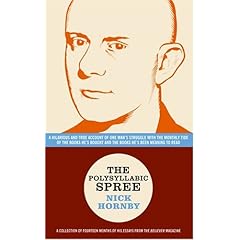
The Polysyllabic Spree by Nick Hornby

The Last World by Christoph Ransmayr

A Hazard of New Fortunes by William dean Howells

2009


The Children's Book by A. S. Byatt

Ovid's Heroides

The New Moon with the Old by Dodie Smith

An Avenue of Stone by Pamela Hansford Johnson

The Brimming Cup by Dorothy Canfield Fisher

They Walked like Men by Clifford Simak

Chronic City by Jonathan Lethem

See a longer Best of 2009 list here.

Sunday, December 27, 2009

The Plain Sense of Things


Have you ever read a book by a writer you wish you'd never heard of? A book a friend gave you because you’re a champion of regional fiction? A collection of short stories so flat and grim that even 221 pages feels too long?

Pamela Carter Joern’s The Plain Sense of Things makes little sense. This minimalist collection of linked short stories, set in western Nebraska, follows three generations of a family from 1930-1979. Wow, a quick trip, you may think. Maybe it’s like Kate Walbert’s beautifully-written intergenerational novel, A Short History of Women. But while Walbert has a gift for revealing her likable characters through vivid vignettes, Joern has a philosophy of ellipsis. Her prose is so pared-down that one continually expects supporting sentences that never appear. The characters are surfacely so hard and empty that I became squeamish. These downward-spiraling farmers and their wives don’t seem to feel much. They’re uneducated and crude (do you have to be educated to feel?). Sometimes they escape or are driven from the farm, but life is atrocious. Joern describes in a clipped, sometimes poetic, style the bitterness of ignorance and disappointment. A despairing widow, Mary, hits one of her teenage stepdaughters when she lags behind at housework. Later, Mary can’t get out of bed to attend another stepdaughter’s graduation. In Denver, two of the stepdaughters, one married and toting her child with her, pick up two men in a park. On the farm, a young boy masturbates while he watches his aunt nurse her baby. Jake, a failed farmer, takes second place in a singing contest, only to find that the radio station will not air the prize-winners’ performances after all.

Some of you will like this: it's not for me. Here is a typical paragraph.

“A year later, on a Sunday afternoon, Mary sits at her kitchen table snapping beans. Libby’s got Ruth outside dangling her feet in the horse tank, Edward’s checking on the cattle in the south pasture, and Helen is down for a nap. timmy and Nick walked to Pumpkin Creek with their fishing poles. Grace is hovering over the cook stove and worrying about whether her rice pudding will set up right. Mary has shown her a dozen times how to do it, but Grace doesn’t have the knack.”


I enjoy other minimalist writers: Ann Beattie, Bobbie Ann Mason, Raymond Carver, and Frederick Barthelme. But Joern’s economical descriptions of farm life don’t seem real to me. These characters are so beaten-down, and so undeveloped. Granted, part of it is set during the Depression. But the Depression seems like the highlight for some of these people.

I haven’t finished this book, though I will. My antidote for this super-depressing read is to read cozy Miss Read, a writer I've never enjoyed. Village School is about all I'm up for right now, though.

Saturday, December 26, 2009

Letters vs. E-mail: Sincerely, Yours Truly, and Best Wishes


Personal letters numbered among the joys of my life when I was growing up. Anything in the mail was a delight, even chain letters, though these were viewed with suspicion by parents and teachers. In third grade we learned the etiquette and format of letter-writing. Date and return address at the top, then the polite greeting, then the gossip, thank-yous, or condolences, and finally the choice of closing, Sincerely, Yours Truly, or Best Wishes. Then we acquired stationery and fountain pens. Then we got pen-pals. What could be more exciting than a letter from a pen-pal in Australia? A complete stranger, but who knew? Maybe we could be best friends someday. That was the sort of thing that happened in books.

I have cards and letters dating back to the ‘80s. A friend and I from grad school exchanged silly cards with letters enclosed until the late ‘90s. She and I continued to know each other so well that we visited back and forth across the country. We confided in our letters about boyfriend problems and work. She called me when she gave birth. She invited me to take a vacation with her and her child (though I couldn’t go because of work).

And, of course, I kept in touch with other friends through occasional chatty letters, but only those who loved writing kept in touch.

E-mail changed all that. Suddenly it was too much trouble for us to print out a letter, put it in an envelope, and lick a stamp. Everybody was on e-mail. Our short, badly-written missives went back and forth at the speed of dark. We didn’t know each other as well. I didn’t bother to revise my notes anymore, nor did anyone else. I knew everybody and nobody. I knew lots of complete strangers but I didn’t know my friends as well. It’s a quandary. How can we write so much and lose intimacy?

E-mail is a blessing and a curse. I have “met,” sometimes in person and sometimes only virtually, some charming, brilliant people who have similar interests. My e-mail friends are great, but my “real” friends are more like "e-friends" these days. It’s easier to exchange a few efficient e-mails than to correspond by "snail mail" Anyway, aren’t we older and colder now? Isn’t it a natural process that we don’t confide as much? Or has e-mail destroyed our innocence?

People in the traditional workplace learn to keep e-mails short. This is smart. I don’t know about you, but e-mail has sometimes screwed me over. Send a snotty e-mail about the vagaries of your boss--and, trust me, there’s always a “friend” out there willing to forward it. And perhaps this leads to a holding back in letter-writing too.

My sole remaining correspondent and I agree that people have become too lazy to write letters. We love our e-mail friends, but something is lost when people cease to consider letters an art. You don’t keep e-mail in a folder. Or at least I don’t. I probably get 50 e-mails a day.

Emily Post knew what she was talking about in 1922 when she wrote:

"The letter you write, whether you realize it or not, is always a mirror which reflects your appearance, taste and character. A “sloppy” letter with the writing all pouring into one corner of the page, badly worded, badly spelled, and with unmatched paper and envelope—even possibly a blot—proclaims the sort of person who would have unkempt hair, unclean linen and broken shoe laces; just as a neat, precise, evenly written note portrays a person of like characteristics.'


And that's the problem with e-mail. it catches me with my hair unkempt and my prose limp and graceless. Everything's a rough draft on the internet. (If Emily Post could see this blog, she'd have a fit.)

But I still have 30 years’ worth of cards and letters in a folder. And they mean something to me, if not to anyone else. It's evidence of another era. And who know where we're going with this one?

Friday, December 25, 2009

The Very Best of the Doors

I spent the day “rocking out” to the Doors. The Very Best of the Doors was one of the most coveted Christmas presents in our household: Other Family Members would not allow me to listen to it on my new Sony CD Walkman. “We want to hear it, too.” Even the animals seemed to like it. So we spent the day listening to “Break on Through (to the Other Side),” Light My Fire,” “The Crystal Ship,” “Waiting for the Sun,” and other brilliant old songs.

As Rolling Stone said,

"At its best, the Doors’ music — “Light My Fire,” “L.A. Woman” — has come to evoke a noirish view of ’60s California that contrasts sharply with the era’s prevailing folky, trippy style.”


One great thing about the counter-culture era: seasonal depression was never an issue. Christmas belonged to our parents’ culture and we simply didn’t take it very seriously. We’d go out for a walk, have a feast, exchange a few gifts (books),and see a movie. Oh--and we did like the Alistair Sims version of A Christmas Carol. That was as Christmasy as we got. Now we have more responsibility for the day and less fun. The religious aspect doesn't dominate the day, though of course that should be the focus. Instead, I get twice as many presents as I did a decade ago and why? Sure, they're mostly books, but the pressure is on to give more--and it should slow down over the years, one would think. But people just ignore me when I say we shouldn't exchange gifts anymore.

It used to be so simple!

As are these lyrics (back to the Doors):

Now, I'm gonna love you
Till the heavens stop the rain
I'm gonna love you
Till the stars fall from the sky for you and I

Jim was either trying to be cool, or did not know that the preposition “for” governs a direct object--”for you and me," "not for you and I."

Love ya anyway, Jim!

By the way, couldn't someone write a noirish mystery about the following: am I the only one who thinks some of those rock stars, Jim Morrison included, might have been murdered? Yes, it’s a crackpot theory, but how can so many of them have died so young? Other people took drugs, too, but stayed alive!

Okay, enough about that.

Thursday, December 24, 2009

Christmas Eve & Peace


Merry Christmas and Peace!

Some of you will have nice Christmases. Others will not. Some will have lovely dinners with your families; others will endure dysfunctional family dramas. Some will be solitary. Some will be stuck at home or relatives’ houses because of the weather. Some will stay in a posh hotel, but breakfast on Krispy Kremes from the convenience store, as we once did, because nothing else was open, and yet it was one of the best Christmases ever! But will we make it to the movies tomorrow in the snow?

Here’s what has happened to my ‘60s housewife stay-cheerful Christmas resolution: today I was suddenly unable to clear table surfaces! I simply lay on the couch and read like a vampire.

Here are some of the books on my table I couldn’t bring myself to clear off today. As you can see, I like lots of choices:

Breaking Dawn by Stephenie Meyer. The first book in the series, Twilight, is fantastic, but this one seemed a little hurried and awkward. I wouldn’t have finished it if my YA mentor hadn’t told me the end was worth it, but she was absolutely right. One has to know what happens to Bella.

Little Dorrit (I’ve read this book way too many times. I'm almost done, though.)

Simonetta Perkins by L. P. Hartley (a novella published by Hesperus Press)

Flambards Divided by K. M. Peyton. The last Flambards book.

The Guermantes Way (I’m reading it occasionally.)

The Sacred Book of the Werewolf by Victor Pelevin (a well-reviewed Russian novel, not a werewolf junk book!)

By the way, the dysfunctional family drama took place outside of our household. Still, it was sad, and listening to Susan Boyle made me cry (a sign that I was a bit upset, because she was singing Wild Horses, not the Dream song!). But the dropped ball is dropped, it's out of our control, and now we can relax and spend our actual Christmas day in peace.

So have a lot of happiness, and if you’re feeling too freaked-out, try to treat it as an ordinary day. It’s an excellent time to read, watch reruns of House, and listen to R.E.M. or your favorite rock.

Tuesday, December 22, 2009

Battery-Operated Christmas Trees, Indies & Part of Another List


As many of you know, I am half-facetiously playing the role of a '60s housewife this month. My struggle against Christmas depression and general seasonal affective disorder has comprised cleaning house and reading '60s novels by Rumer Godden, Pamela Frankau, K. M. Peyton, Elizabeth Goudge, and others. A constant clearing of table surfaces, all the lights in the house kept on all the time, and the purchase of a few Christmas decorations have kept those dark existential thoughts at bay. But I haven't quite been able to stay in the '60s, as there has been an earth-shattering advance in Christmas decorations, especially the TINY CHRISTMAS TREES from Target. If you pry open the base and insert batteries, TINY LIGHTS STRUNG AROUND THE TREES WILL LIGHT UP AND CHANGE COLORS. There were no directions, however, and it was like sovling a Rubik's cube to unravel the mystery. We had to pry off the base with a knife! It’s not like we’re engineers or anything (that’s a joke, because one of us is) but these things weren't on sale for nothing.

Meanwhile, I’m continuing to read and enjoy Barbara Kingsolver’s The Poisonwood Bible, her lively novelistic chronicle of a Baptist family in the Congo in 1959. While Nathan, the chauvinistic minister, smugly believes he is converting the "heathen," his wife, Orleanna, and their four daughters, Rachel, Leah, Adah, and Ruth May, more realistically and humanely interpret the culture through their daily interactions with people. As the Congo declares independence from Belgium in 1960 and other whites flee from the chaotic country, Nathan ignores the needs of his family, and of one very sick child, and insists on remaining without the Mission's salary. Narrated by the women of the family, mainly the daughters, the brilliant novel is tragicomic, moving, lyrical, and lightened by the children's malapropisms.

By the way, my husband mentioned that he read my blog (not a habit!) and understands that I want Kingsolver’s new book. So we’re going to walk up to the independent bookstore tomorrow. Usually this is not a good experience, because I have been followed suspiciously around the tiny space and generally treated like an intruder, but the other day when I was looking for a certain book for my spouse, the clerk was really nice and actually hunted down the title from some unpromising vague clues. Either she’s new, or I looked more normal in my snow-clomping clothes than my bicycling clothes (I don't think they care for the sweaty look). Anyway, now I feel I can support the store for the season.


AND NOW: Here’s a part of my Best of the Decade list (2000-2004). Just what you need: another list!

2000:

Zadie Smith’s White Teeth

Romola by George Eliot

2001:

Empire Falls by Richard Russo

Positively 4th Street: The Lives and Times of Joan Baez, Bob Dylan, Mimi Baez Farina, and Richard Farina by David Hughes

2002:

The Seven Sisters by Margaret Drabble

In Sunlight, In a Beautiful Garden by Kathleen Cambor

A Whistling Woman by A. S. Byatt

2003:

The Light Years by Elizabeth Jane Howard

None Shall Look Back by Caroline Gordon

The Empty Mirror: Experiences in a Japanese Zen Monastery by Janwillem Van de Wetering

2004:

Long for This World by Michael Byers

Monstrous Regiment by Terry Pratchett

The Best Awful by Carrie Fisher

Aloft by Chang-rae Lee

Don’t Tell Alfred by Nancy Mitford