Wednesday, April 29, 2009

Rogue Herries


I’m sitting on the couch, with that reader's absent-minded look of of being lost in another world. I haven’t gotten up for hours, because I’ve been transported to a house in 18th-century England outside of Cheswick (my book has a map), with Francis Herries, hero of Hugh Walpole’s magnificent historical novel, Rogue Herries.

Walpole’s 700-page magnum opus is exactly the thing to read on a damp gray day. i’m hooked on this tetralogy about the flamboyant Herries family, which follows the clan from the 18th to the 20th century. In the first volume, Rogue Herries, we meet Francis Herries, a strong, exuberant man in his 30s known for his lascivious humor, wild ways, and bad temper, who, having grown restless and disillusioned with city life, moves his family to Herries, a crumbling family house located among hills and moors in northern England. (Yes, it’s a get-back-to-the-land novel.) This bawdy, funny, dramatic novel emphasizes Francis’ commitment to the land and the damp, dark house which the rest of his family hates, but also relates the history of his son and youngest daughter. He earns the nickname “Rogue” when he sells his mistress at a fair (reminiscent of The Mayor of Casterbridge), but his placid wife adores him through adulteries and scandals; his staunch son David grows to manhood unwaveringly loyal, if not particularly intelligent, and with a knack for business; and his daughter Deborah, who is having a clandestine epistolary affair with a minister, fears him. (Only the middle daughter Mary, a treacherous, dull girl who moves to Cheswick to live with another branch of the family, dislikes him.)

Francis falls in love with a teenage gypsy, Mirabell Starr, and his adoration of her beauty and wild character make him determined to wait for her until she is is ready a decade later to move in with him. The marriage is one of convenience: she doesn’t love him and makes it clear. She has had a tragic past, and for years pines over a dead lover.

Walpole’s frequent allusions to Shakespeare, Richardson, Fielding, Hardy, and Bronte give you a hint of the tone. At one point, three women discuss the merits of Richardson and Fielding: the two sexy ones vote for Tom Jones. At another point, the tragic Mirabell becomes an itinerant actor in a Shakespearean company. Walpole’s style is so lively and his narrative by turns so playful and compelling that one races through this novel.

Here is an example of his lively description of a “good witch” in 1774 compared to a “bad witch” hunted and drowned earlier in the novel (the first of several paragraphs about her) :

Mrs. Henny was a southern woman who for ten years had been living a widow in Grange. She was a lady of all trades - nurse, midwife, cook, friend of all the world and, in the modern manner, a witch. One may see how different the modern manner (temp. 1774) is from the old, because whereas, years ago, Mrs. Wilson had been persecuted and drowned, Mrs. Henny was the most popular woman from Seathwaite to Portinscale.


This romp is very different from Mr. Perrin and Mr. Trail, the first Walpole I read, recently reissued by Capuchin Classics and reviewed here. Rogue Herries reminds me very slightly of one of those huge John Cowper Powys books. Walpole wrote much, and not always as well as here, according to critics, but I'm very much looking forward to the other Herries books (used Pocket Books editions abound on Amazon, or you can opt for new editions published by Frances Lincoln Limited ).

Sunday, April 26, 2009

A Meaningful Life


If you’ve been living in a cave, or depending on bookstores with a limited stock of reprint publishers, you may be unfamiliar with the NYBR series, which includes stunning titles like Rebecca West’s The Fountain Overflows, Sylvia Townsend Warner’s Lolly Willowes, Tatyana Tolstoya’s The Slynx, and Richard Hughes’ The Fox in The Attic. The latest addition to the series, L. J. Davis’s A Meaningful Life, is stellar: a comic masterpiece with disturbing elements, it follows the career of Boise-born Lowell Lake, an editor for a plumbing trade newspaper in New York, who wakes up one day at 30 with the epiphany that he’s wasting his life.

Who hasn’t had this revelation after a certain age? And what do you do to overcome it? In Lowell’s case, he buys a crumbling mansion which needs a total overhaul, in a dubiously gentrified Brooklyn neighborhood. His wife opposes this, and who could blame her after their tour of the filthy 22-room house, which has been a decrepit rooming house for quite a while? She announces that she'd prefer a trip to Aruba. Although they don't move to Brooklyn, Lowell satisfyingly spends his evenings at the house smashing partition walls and cleaning sludge from the basement, once the eccentric tenants are evicted.

He becomes obsessed with the life of the original owner, Collingwood, a rogue who was involved in many dubious business deals and lawsuits, and at one point fled to South America the day before the collapse of the Far Western Trading Association, leaving his partner to take the blame.

Since Lowell is a responsible, nice, law-abiding middle-class citizen, his fascination with Collingwood is a sign of his new determination to live wildly, whatever the cost. He's even disappointed that Collingwood was a heroic Civil War soldier. In his fantasies, he wants his Brooklyn counterpart to have led a totally disreputable life. And though Lowell is drunk all the time while working at the house, or swigging gin while watching Patty Duke reruns at home, it’s clear that he doesn’t know quite what he’s doing with a house in a mostly poor black neighborhood: the neighbors sit on the steps at all hours drinking and laughing, and the only people he can really relate to are the contractors he finally hires.

Each NYBR novel is introduced by a writer who champions it, and in this case Jonathan Lethem's enthusiastic essay about his personal friendship with Davis, having been the best friend of Davis's son while growing up in Brooklyn, can sell you on this book far better than I can. It makes you want to buy a house in Brooklyn. This 1971 novel is a smoothly written, quietly funny American classic.

You can read Lethem's introduction and the first chapter of A Meaningful Life here.

Thursday, April 23, 2009

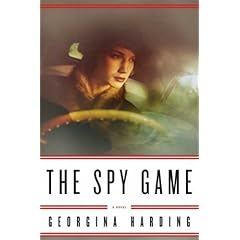
The Spy Game


Georgina Harding’s The Spy Game is a brilliant novel - one of the best contemporary novels I've read this year. As newspapers in economic slumps cut their book sections, it becomes more and more difficult to sift through the new books. Harding is an extremely entertaining and subtle writer - though this is not a spy novel, if that's what you're looking for.

The Spy Game is a luminous novel about identity, childhood, and history, centered on the imagination of two English children whose German immigrant mother dies in in 1961. The narrator, Anna, on the eve of a trip to investigate her mother’s history in the former East Germany, vividly recalls her childhood grief, when she, at eight, was in thrall to her older brother Peter’s conviction that their mother was a spy. Harding winds in and out of time and portrays Anna’s sensibility and inventiveness from a canny present and credulous past point of view. Peter’s irritating reactions are sympathetically presented by the adult Anna, who realizes that their mother’s German identity led to the bullying of Peter at school - the condemnation of Peter as a “Nazi” by his peers.

Harding’s extraordinarily clear style smoothly intermingles the complex children’s fantasy with real and imagined history: the Kroger spy case, written about in the newspaper two days before their mother’s death, is the catalyst for Peter’s theories that their mother is alive and may have gone back “behind the iron curtain.” Ambivalent about the spy hypothesis, never certain whether it is true or a game, Anna is frightened by Peter’s obsession. As he points out, there is no proof of their mother’s death: the children were not taken to the funeral.

Although she spends her days with her ordinary friend, Susan Lacy, and the rather dull Mrs. Lacey, Anna cannot escape remembrance of her own mother. The piano pieces she reluctantly learns from her German-Jewish music teacher begin to terrify her, as she mixes them in her mind with Miss Cahn’s reminiscences about childhood in Germany (which in some ways parallels that of her own mother’s). Anna eventually gives up playing because she refuses to think about the implications of Germany. But lMiss Cahn’s fate is intertwined with hers. Peter spies on her, ironically convinced that this lonely German refugee also may be a spy (because she is German and entertains German friends).

The piano teacher’s house was at the other end of the village on a street that led out towards the main road. It was a plain street squeezed up against the hillside, the houses all much the same, stone houses with narrow windows right on the pavement that you could see into, china ornaments arranged on the sill for you to see, empty armchairs in neat front rooms. Sarah Cahn’s was set back from the rest by just a few steps, so there was space for the plants that grew up the walls and hung close about the windows that time of year.


What Anna learns about her mother many years later in the former East Germany is not what she expects. But the pieces of the puzzle, which she realizes can be put together in many ways, help her assuage her grief.

Wednesday, April 22, 2009

How Green Was My Valley


A 1939 best-seller, Richard Llewellyn's How Green Was My Valley has never been out-of-print, and is adored by over 40 Amazon readers, many of whom laud it as a classic: if it is not a classic, it is truly a magnificent novel about life in a Welsh mining town at the turn of the century. Narrated by Huw Morgan, who looks back nostalgically at his childhood in the beautiful valley, this gem of a novel idealizes the Morgan family as a hard-working, joyful laughing, chorus-singing family of stubborn men and women, which splits over the radical sons' union politics and and Dada’s preference for management negotiation. When the brothers move out, it is the dauntless mother’s intercession which reunites them.

Seen through the eyes of a child, politics are interwoven with relationships and the the environment. Slag heaps spread and begin to spoil the beauty of the valley and poison the trout in the river by the slag. Although Huw’s father has recommended that the slag be hidden underground, the management ignores him. Wages drop and grim strikes sometimes lead to starvation and death, but the miners, crushed by greedy management, strike for their lives and end up with an inadequate minimum wage.

But Richard Llewellyn, known best for his lyrical style, humor, and his poetic, environmentally-forward-looking descriptions, writes beautifully:

When birds were nesting we often went out to find the nests and look in at the eggs, though we never took any, mind. My father would never allow me to collect them, and he would stop the other boys, too. I think because of that, our Valley was never quiet of birds. There is strange you will never notice birds till they are gone.


We love brave Huw, who is so curious about secret union meetings that he sneaks out at night. Crippled during a wintry night when he and his pregnant mother are caught in a blizzard, he is unable to walk for a few years: but it is worth it, because his leading his mother up the mountain to speak to the union on behalf of Dada (I defy you not to cry over this scene) saves Dada from death threats . Mother collapses on the way down and Huw must likewise save her by dragging her back to the bridge in the white-out, where his brothers can find them.

Huw’s observations of his older brothers and sisters, their successes, romances, and tragedies, are moving. (Tears have been shed over my Penguin: think how many tears have been shed over library books!) When their friend Marged’s father catches Huw’s brother, Owen, kissing her, he makes a laughable scene in front of the village and Owen, humiliated, refuses to marry her. Another brother, Gwilym, marries Marged. She goes mad. In one of the saddest scenes i’ve ever read, Marged mistakes Huw for Owen and threatens him. It’s very Wuthering Heights-y: she pines for Owen as Catherine does for Heathcliff. But her hallucination hurts her incredibly and leads to a tragedy.

There is so much more to this than plot. It is a real "page-turner," but also lovely and vivid.

Friday, April 17, 2009

A Tale of Two Families


Dodie Smith’s A Tale of Two Families is the fifth and rarest of her novels, and if I hadn’t set out to read her entire oeuvre, I would never have unearthed it. Perhaps the library didn’t stock it. I was familiar with three of her other titles: I Capture the Castle (everybody’s favorite girlhood book), The Town in Bloom, and It Ends with Revelations. But the two best, The New Moon with the Old, and A Tale of Two Families, never appeared on the shelf, or were stolen by mischievous girls in capes (our look back in the day--not that I stole, but I once lost a copy of Ozma of Oz, and refused, in some strange act of civil disobedience, to pay the fine. "I don't pay taxes: I don't owe the money," I announced dramatically. I lost my library card).

This beautifully-written short novel hinges on the decision of two middle-aged sisters, May and June, to move their families from London to the country to live in two neighboring houses, the Dower House and the cottage. Although the houses are beautiful, they are somewhat leery about the move, and with good reason: The sisters are married to two attractive brothers, George, a philandering, wealthy businessman, and Robert, a writer, and attractions flare up with the proximity of the two families.

When May and June’s mother, Fran, comes to visit, this tactful, experienced, seventy-something character unobtrusively becomes the most interesting character in the novel: she has a knack as an observer for solving problems and her wry, sensible interior dialogues about family life balance some of the crazier goings-on (particularly when her sister, Mildred, arrives: Mildred goes around dressed like Little Bo Peep and fantasizes about and meddles in other people’s sex lives). Fran also befriends Baggy, George and Robert’s father, who has switched from living with Robert’s family to George’s in the country.

There is a long, lovely, totally absorbing description of Fran’s shopping trip in the village, interspersed with amused remembrances of a song about a baby elephant learning to cross the street, and as the traffic is heavy, the song amuses her: she lugs a psychedelic shopping bag with her purchases, a suit and a green toy frog, and a scale which won’t fit in a bag, and has a minor accident that makes her aware of aging.

She stood on the kerb watching a steady stream of cars. (A woman standing beside her said resignedly, “Factory going-home time.’) She could see no pedestrian crossing. How did one get across? If there was a momentary break in the traffic on her side of the wide street, cars on the far side were sweeping past. She noted that hardy souls got as far as the middle of the street and then waited. She’d simply have to do the same...and very nerve-wracking she found it, standing there unauthorized by any island, expecting cars to crash into her behind. Really, this country High Street was more dangerous than Piccadilly Circus. At last! She could make it now if she was nippy. She started out - and instantly saw...a truck....She began to run, or rather, she intended to begin, what actually happened was that she found herself incapable of running. She simply could not run - it was like some nightmare in which one had leaden feet. Run, run!...Somehow, somehow, she staggered to safety only a couple of seconds before the truck swept past. And then, for no reason at all, her legs gave way and she sank to the pavement, dropping everything she was carrying. The clanging scales sounded like a car smash.


Fran is unscathed - but this is the first time she has confronted aging. Yet in many ways Fran seems younger than her daughters.

Everyone comes in pairs: May’s daughter, Corinna, a drama student in London, is in love with June’s son, Hugh, who works in the City, and May is appalled, beleiving they may marry and have abnormal children. But she needn’t worry much, because Hugh, it turns out, is sexually cold, and Corinna has to look elsewhere for sex.

If you like The Hundred and One Dalmatians, there is a sweet dalmatian in this novel! Dodie Smith raised dalmatians herself. There are several love scenes between dog lovers. But I won't spoil it...

Monday, April 13, 2009

Compton Mackenzie


I continue to enjoy Sinister Street, one of the greatest coming-of-age novels, and surely the most detailed narrative about turn-of-the-century education ever written (important for sociological as well as literary reasons). Does formal education or social environment form character? Mackenzie devotes pages and pages to each phase of the hero Michael's childhood and adolescence, weaving in the impact of education at each point. The Penguin Twentieth-Century Classics version contains Mackenzie’s fascinating foreword to the 1949 edition, in which he describes the Daily Mail's successful defense of the first volume of Sinister Street, published in 1913, against two libraries’ attempts to restrict circulation in "the banned book war." Edmund Gosse compared the novel to Proust’s Remembrance of Things Past, and Henry James told Mackenzie in a letter that he had “emancipated the novel.” Mackenzie thought Lascelles Abercrombie in the Manchester Guardian most fully understood Sinister Street : "We seem to be watching that strangest of all modes of evolution: the dissolution of one century’s character to make way for the character of another century.”

I’m still in the Oxford section of Sinister Street ("Dreaming Spires"), and I have to say it brings back some undergraduate memories: the quixotic Michael, having obstinately refused to compete for a scholarship so as to be under no obligations, treats Oxford as a gentleman’s club and does no academic work. it is, of course, a waste of his intellect. We see examples of Michael’s brilliance again and again, yet he refuses to write or express himself except casually, in conversation, though his friend Maurice begs him to write for their jointly-run newspaper; but Michael has some misguided belief that to work would be ungentlemanly. Waugh, of course, does something similar in Brideshead Revisited, though his characters are more outrageous and he is more barbed and humorous about their blatant snobbery and homosexuality. There is humor in Sinister Street - Mackenzie can show us how young and sometimes pompous Michael is - but there isn’t much sexuality. The "good eggs" (as opposed to the "bad men") are all heterosexual, yet we know nothing of their love lives, and Michael wants no sex while at Oxford - a change from his passion for Lily while at St. James in Part 2.

At Oxford Michael grows stuffy and conservative, wanting to live in the idyllic Platonic world without passionate involvement or intellectual commitment. Annoyed by the Catholic church’s new tolerance of Darwinism (the church was important to him during his rebellious period at public school), he prefers to enjoy leisurely lunches,intellectual discussions, readings and rereadings of Don Quixote (the only book that consistently seems to interest him), and rugby and cricket. He assures his former governess, who believes that he has become TOO staid and is in a rut, that he is happy:

“Once I wanted passionately to be like everybody else. I thought that was the goal of social happiness. Then I wanted to be violently different from everyone else. Now I seem to be getting near the right mean between the two. I’m enjoying Oxford enormously. I can’t tell you how happy I am here, how many people I like...I’m so positive that the best of Oxford is the best of England, and that the best of England is the the best of humanity...”


Now he can’t remain in this stasis. Something will shake him out of this. Eventually he does graduate, or at least leave Oxford.

Meanwhile, I am enjoying this and wondering why this brilliant book is out-of-print in the U.S..

Thursday, April 09, 2009

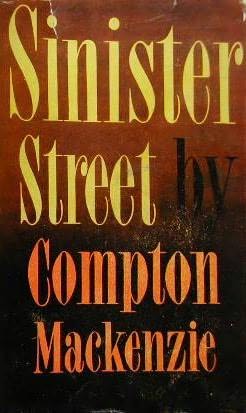
Sinister Street


Compton Mackenzie’s Sinister Street was stationed in the mud room for several years - there are bookcases everywhere - and was transferred lately to the dining room bookcase because it sounded just weird enough to add to the TBR. It was a free association thing: after Hugh Walpole, why not Compton Mackenzie, because the two wrote in the same period, knew each other, and when Mackenzie was praised by Henry James, Walpole became furiously jealous (as he was of almost every writer).

But this post is about Mackenzie.

Compton Mackenzie is now best known for Monarch of the Glen, a comedy many of us know from the TV series, but his 90 books were eclectic, ranging from the farcical to the serious: the bildungsroman Sinister Street is regarded by many as his masterpiece. So captivated am I by this brilliant novel, which documents the coming-of-age of Michael Fane, a serious, moody, changeable character whom we follow from his unhappy childhood, during which he pines for an absent mother (Part One, Prison House), through his prep-school and public-school days(Book Two, Classic Education), on to his Oxford days (Book Three, Dreaming Spires), and on to his life in Londo , that I’ve been declaiming impetuously, “THIS IS THE BEST BOOK I’VE EVER READ.”

Everybody’s pointing out that there’s room left in 800 pages for Mackenzie to disappoint, AND that I said the same thing about War and Peace. Well, there's no comparison, of course.

But not only does this novel have impetus and flow, it is also an intensely well-written, detailed narrative focusing on different systems of education and their effect on formation of an intelligent, independent character - Fane, entering adolescence, decides, after years of classical education, to change to the "modern" side, because he has lost interest in scholarship and now wants only to leave school. Many are the influences on Fane: the absent mother and mystery about his dead father; his creative governess;religion; poetry. More about this later.

Monday, April 06, 2009

Rereading The Brontes Went to Woolworths

Rachel Ferguson’s The Brontes Went to Woolworths is a rare gem of a novel with a flashy title: there was much commotion last summer as Bronte-mad readers struggled to acquire it after a mere

mention of the title in Carmen Callil’s essay on the founding of Virago books. Prices were inflated to $50-plus and desperate bloggers whimpered as they surfed book sites for an affordable copy. As in the stockmarket gone wild, somebody was on the phone checking used bookstores every five minutes. Somebody else got it for $20 at a hidden independent book site nobody ever heard of. The Virago-crazed were mailing it back and forth within their online book clubs. Some bibliophiles invest even in the worst economy - we have to assume that some of them only pretended they bought cheap and then generously shared their expensive copies.


Although this clever, charming novel seems slight on a first reading, a rereading - and
I can tell this will become an annual tradition - reveals it as a classic which can hold its own in modern literature. (You can read my original entry about it here.) Ferguson’s light, whimsical style meshes perfectly with the optimistic voice of the narrator, Deirdre Carne, who is vaguely reminiscent of Cassandra in I Capture the Castle. Deirdre’s enchanting sketches of the three Carne sisters’ conversations with and about imaginary friends - most of them celebs whom they read about in the papers - are interwoven with the governess Miss Martin’s daydreams and lonely letters to friends and relatives. Poor Miss Martin never knows whom they know and whom they pretend to know, and much damage is done both by the Carnes' flights of fancy in front of Miss Martin and by her plodding reactions. The Carnes are funny and sweet, but also snobbish about class, and though Deirdre is by far the kindest of them, she does not want to be "girls all together" with Miss Martin. And the confusion for Miss Martin increases when they become friends with the judge, "Toddy," already a regular character in their repertoire, whom Miss Martin thought an actual friend.

The first time I read this I admit I was appalled by the Carnes' occasional cruelty. British class distinctions will always be imponderable, and I can tell Ferguson thought the whole thing was screamingly hilarious It's not that one wants to be like Miss Martin, but I was sympathetic to her reactions to their cattiness about a real friend - they mimic the lower-middle-class accent of an actor friend who has kindly arranged a job for Katrine - and Miss Martin tells them coldly it's disloyal. Of course the problem is that this family performs in front of a stranger. She is left out: her place is in her room. And they are all natural actors.

Deirdre is truly kind - but the novel is about many things, and class does enter into it.

The Bloomsbury Group is reprinting this book next summer, so for those who didn't find it last year, there is hope.

Sunday, April 05, 2009

Hugh Walpole


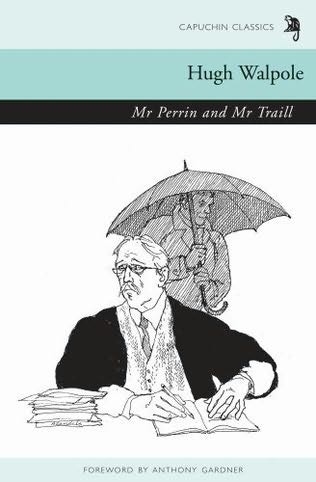
I was introduced to Hugh Walpole by Capuchin Classics, a reprint publisher whose eclectic catalogue is fascinating: among their offerings are Pamela Hansford Johnson’s An Error of Judgment and John Galsworthy’s The Dark Flower. First published in 1911, Hugh Walpole’s Mr. Perrin and Mr. Traill is a strangely modern novel about a conflict a between two teachers, Mr. Perrin, an uninspired math teacher in a dead-end job at a boys' school, and Mr. Traill, his nemesis, a young, popular, athletic Latin teacher who plays rugby and wins the affections of his students in his first term by his humor and sports savvy. Perrin is a truly frightening character - his hatred for the younger man drives him to all sorts of vindictive actions - and, to complicate the matter, the two also love the same woman (guess which one she picks?). This unsentimental novel’s inferno-like atmosphere blows up because incompatible teachers cannot escape each other in the 24/7 boarding school. This school novel is less polished than Pamela Hansford Johnson’s The Honours Board, which I recently read on a PHJ kick, and R. F. Delderfield’s famous school novel, To Serve Them All My Days, but all three explore similar territory, describing the rivalries that percolate in the insulated boarding school world. It's a great coincidence that they all turned out to be school novels (I was only familiar with Delderfield’s). But I very much enjoyed Mr. Perrin and Mr. Traill. I’m eager to read more Capuchin Classics.

I’m reading another Walpole novel, The Captives, which is available online at Gutenberg or manybooks.net. It’s a lugubrious novel, centering on the children of fundamentalists, young adults who struggle to escape emotional attachments to relatives who preach hellfire religion. Maggie, a 19-year-old minister's daughter and atheist, moves to London to live with her fundamentalist aunts after the death of her cold, cynical father. Determined to be independent, Maggie wants to escape her religious aunts' stifling household by finding work, but the stern, intimidating Aunt Anne and the ineffectual Aunt Elizabeth draw her into the world of a chapel whose brimstone-preaching, eloquent, charismatic minister, Mr. Warlock, impresses her (though she does not believe). His son, Martin Warlock, a rebellious agnostic, has returned from Europe and longs to escape his home. Maggie and Martin fall in love, though Martin’s love is a strange one: he persists in telling Maggie that she reminds him of a man and he doesn’t love her as he loves other women. “She wondered why it had hurt her when he had said he loved her as though she were a man, without any question of sex.” Oh, Maggie, run the other way! You know that this isn’t going to work out.

Anyway I’m halfway through this and am enjoying it. It’s a little different reading it on the computer. No, I don’t have a Kindle yet.

Thursday, April 02, 2009

H. G. Wells's The History of Mr. Polly

There are H. G. Wells lovers and H. G. Wells detractors. Some read The War of the Worlds again and again and argue endlessly over the effectiveness of the Tom Cruise movie. Then there are The Time Machine fans: that book has really been beyond me. But Wells also wrote realistic fiction with a socialist bent, and The History of Mr. Polly is for those who guiltily dislike the science fiction classics. if you're not an SF fan and want to understand Wells, you might want to venture into the realm of The History of Mr. Polly, a touching comedy of a working-class hero who, “exactly 37 and a half years old,” begins to feel suicidal, goaded by - and here’s Wells’s comic understanding of the real world - an enormous lunch. As he looks back over his life, we understand his hopes and dreams. (There are many sad events in Mr. Polly's life, but Wells's wry, comical 3rd person omnisicent point of view keeps it light.)

Mrs. Polly, upset by her husband's post-prandial grouchiness, muses:

The repast she had prepared for him did not seem to justify his ingratitude. There had been the cold pork from Sunday, and some nice cold potatoes, and Rashdall’s Mixed Pickles, of which he was inordinately fond. He had eaten three gherkins, two onions, and a small cauliflower head, and several capers with every appearance of appetite, and indeed with avidity; and then there had been cold suet pudding to follow, with treacle, and then a nice bit of cheese.

Mr. Polly, who started his career as a draper’s assistant, has been hampered by a slapdash education, but, in spite of this, has developed an endearing love of words; unfortunately, he can't spell or pronounce them as a result of the poverty of his education. Wells points out: “...the indigestions of mind and body that were to play so large a part in his subsequent career were only just beginning.” Mr Polly coins some charming malapropisms: "intrudacious," "meditatious," and "chivalresque."

As a young man, stimulated by the company of two fellow fellow apprentices, he happily acquires an informal liberal arts education. One of his friends, Parsons, an autodidact, reads widely, and introduces him to Shakespeare, Milton, and writers Mr. Polly calls “Bocashieu” and “Raboolosse.” Literature inspires self-respect: the working-class men become uppity and Mr. Polly by turns leaves and is dismissed from jobs. He is clever and witty, but his lack of education prevents his longed-for transcendence of class.

After his father dies, he opens his own shop, not really wanting to. And marries, not really wanting to. There is no job he wants: he's a dreamer.

And I’m afraid that’s as far as I’ve gotten.

But it’s a good, plain book, oddly modern, short and breezy, very class-conscious, and one can easily imagine waiting for the latest Wells and pouncing on it in a bookstore. I’m interested in reading some more of his realistic novels: Kipps, Tono-Bungay, Love and Mr. Lewisham, etc.

Sunday, March 29, 2009

Mrs. Macbeth Reads Mr. Skeffington


Call me Mrs. Macbeth. The basement is flooded. And all the fumes of popular cleansers couldn’t freshen the damp basement. Not the stinging whiff of Lysol, nor the chemical floral scent of Febreeze. We’ve swabbed the puddles and turned on the dehumidifier but the damp wafts upstairs and all the clothes now smell like basement.

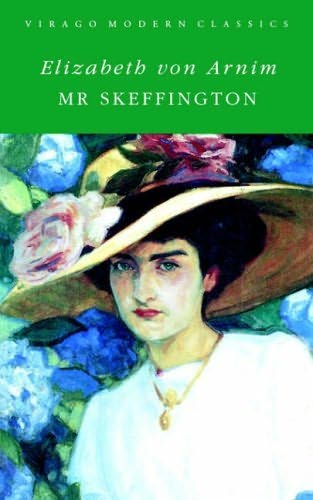
I've been too busy to read much this weekend, what with the washing mania and all, but I did read Elizabeth von Arnim’s short, pithy Mr. Skeffington. This charming novel is the lightest of comedies, the tale of a woman’s coming of age at 50. A different kind of coming of age: the charming Fanny Skeffington, a London beauty, has lost her looks after an illness and fears that her 50s will hold only horrors. Her awareness of aging coincides with frequent sightings of the ghost of her ex-husband, Job Skeffington, which drive her, unnerved, to seek advice from a "women's doctor" who hates women and abuses her for being single- and Fanny, thank God, walks out on him. She invents her own treatment, to visit men from her past for reassurance. Her ex-suitors include a sychophantic Oxford undergraduate; a misogynist priest; a rigid, narcissistic judge; and a wealthy, poetry-loving lord who, after Fanny dumped him, married a younger woman and started a family. Her adventures bring back different aspects of her self and past. Upset that she has lost her allure for men, she realizes that she has outgrown her need for these particular men's approval. She has had nothing but her beauty to rely on and understands that she has no inner resources. Von Arnim comments not only on beauty but on money and prejudice against Jews (Mr. Skeffington is a Jew): she isn't sappy and ends this with a twist. It's amusing, though not nearly as entertaining as Enchanted April or The Caravaners.

Wednesday, March 25, 2009

The Helena Trilogy

Pamela Hansford Johnson’s Helena trilogy, of which An Avenue of Stone is the brilliant centerpiece, is a masterly blend of Johnson’s confident voice and integration of psychological insights into well-drawn characters, precisely connected to time-frames and places - 1920s to late ‘40s in Bruges, London, and Paris.


To read the second novel first, An Avenue of Stone (1947), is both an advantage and a liability. Each novel is self-contained, so it is not necessary to read them in order. An Avenue of Stone is a tour de force, much more compelling than the other two, though it rather satirically portrays Helena, and one needs the first novel to understand her background. As Johnson says in the introduction to the 1972 edition of the first book, Too Dear for My Possessing, she was learning her craft when it was published in 1940, as opposed to the maturity of the second and the third novels, published in 1947 and 1948 respectively: “So, between books 1 and 2, I had seven years of learning to write: which is why I’ have decided not to revise Too Dear for My Possessing, but to leave it as it stands.”


Too Dear for My Possessing is a sprawling bildungsroman, following the fortunes of the narrator, Claud, a writer’s son, from age 13 to 30. Growing up in Bruges, he has an almost perfect childhood, tainted by occasional violent quarrels with his moody stepmother, Helena, a former chorus girl who bursts into spontaneous comic song or despairing tirades, depending on her quickly shifting moods. After Claud is sent to London to attend school, he adapts quickly to life with a kind, Dickensian uncle, but after his father’s death, he forms an obsessive Oedipal bond with Helena. At 15, he moves in with her and his half-sister, Charmian, and, at 17 gets a job as an insurance clerk. He is possessive and furious when Helena takes in a boarder.

It was because I felt myself a bread-winner that I so deeply resented Helena’s tenant.

“What the hell do we want with a lodger?” I demanded.

She stared belligerently at the space between my eyes. “He’s not a lodger, and I didn’t see why we should have that top back room doing nothing when we could make fifteen bob out of it.”

“But we’ve managed all right before! And now I’m earning we need money even less. Father would have had a fit. Have you been putting a card up?”

Her face was brick red. I noticed that she had dabbed fresh dye upon the widening parting of her hair. “No, I didn’t.”

“Well, then, how did you get him?”

“I met him.”

Claud becomes an art critic, has girlfriends, and marries a woman as a reaction to the news of a girlfriend's marriage. He is in love with a cabaret actress, Cecil Archer, who is obviously connected in his mind with Helena,r: he is too proud to follow her and settles for second-best. The Cecil sections are, to my mind, the dullest of the novel. But Claud is a fascinating character, and I enjoyed this very much.

I’m still reading A Summer to Decide. More on that later!

Sunday, March 22, 2009

An Avenue of Stone


We drove 200 miles to our favorite town of bookstores, hoping it had recovered from last year’s flood. The first thing we did was walk along the river. The river is usually the scene of readers, ducks, dogs playing frisbee, canoeists, runners, artists, strolling lovers, and workers rejuvenating themselves on their lunch breaks. Now much of the riverbank is fenced off, and we walked quite a way to find access. Cranes and bulldozers stand minatory among the sandbags, defacing the landscape with their crude reds and yellows. The flood destroyed several buildings, among them the Art Museum, and, since FEMA money can't be used to rebuild on a floodplain, we suppose they're working on a new levee. The river is very high, even with the bank, as you can see from the photo above.

The rising water also threatened the library last summer. Employees and volunteers saved rare books by passing them from hand to hand up the stairs. The library survived.

We sat down to admire the blue water and beautiful spring sunlight. I finished Pamela Hansford Johnson’s An Avenue of Stone; this unforgettable novel is a masterpiece, the second of a trilogy, which can stand alone. In this brilliant novel, set at the end of World War II, the narrator, Major Claud Pickering, an art historian and writer, describes the volatile relationships of his stepmother, Helena, amidst the deprivations of rationing and the disintegrating class boundaries of the postwar society.


The novel begins with Helena's ramblings about class.

“As a class,” Helena said, “we are doomed...”

Helena, a former chorus girl who married into the upper class and has established herself as a glittering hostess, loves to talk about the rebellion of the proles. As the novel begins, the sixty-something Helena is entertaining guests with outrageous complaints about the collapse of society, illustrated by exaggerated anecdotes about rude bus conductors and insolent shop girls. After her second husband, Lord Archer, dies, leaving the majority of his money to Helena’s daughter, Charmian, and, shockingly, to his former lovers, Helena can no longer live on the grand scale to which she is accustomed. She is persuaded to let her hunky chauffeur go and move into an apartment with Claud and Charmian. Helena, unused to living without admiration, becomes vulnerable to a kind of asexual love affair with Johnny Field, an irritatingly self-denigrating young man, whom Claud introduces into the household, assuring her that Johnny needs rest and “does nothing but read.”

At first she uses Johnny as a lackey to pass appetizers at parties and install linoleum at her cottage , but later she is fascinated by him and insists that she can't live without him. Claud and Charmian can't bear the situation and move out. Johnny the unlikely gigolo, is, surprisingly, a magnet to older women. One of Lord Archer’s former lovers, Mrs. Olney, a lamp shade maker, also tries to lure him to live with her.

Claud’s observations of this unlikely triangle are the center of the novel. But his wry observations keep him in the forefront, and it is for his voice that we read. This very slightly reminds me of Anthony Powell's novels.

Thursday, March 19, 2009

Fields of Prairie Grass


This afternoon I bicycled past a burning field. As the yellow-brown smoke thickened into a ghastly smog, I accelerated past the burning prairie grass, and though I’m not a smoke reader (there are people who calculate emissions for a living), I didn't want to breathe the obviously polluted air. Men in yellow coats and hard hats stood nonchalantly at the edges, not wearing safety masks, ready to put out the fire if it got out of hand.The parks department probably yawns over coffee: “Gotta do three fields today.” It’s the cycle of work for them. The prairie grass will be thick and wavy again in another couple of months. A renaissance.

Well away from the fire, I sat down with my thermos and book. A taped-together Penguin of Pamela Hansford Johnson’s An Avenue of Stone is not geographically correct after the burning of prairie grass. More appropriate farm books: Willa Cather’s O Pioneers; Bess Aldrich’s A Lantern in Her Hand; Jane Smiley’s A Thousand Acres; Martha Bergland’s A Farm under a Lake; Larry Woiwode's What I Think I Did; and, for light relief, Betty MacDonald's The Egg and I.

But one cannot live always in reality, and Pamela Hansford Johnson, a genius at depicting class differences in England, sweeps me far away. An Avenue of Stone promisingly begins:

“As a class,” Helena said, “we are doomed” - indicating consciousness of her absurdity only by a bright flash in my direction from her Tiberian eye.


More about this later.

By the way, nobody was surprised about the fire. "Oh yeah, I saw it." That laconic prairie matter-of-factness is even part of the cities here.

Tuesday, March 17, 2009

More Dodie Smith


I spent the lovely day basking in the warm sun in an old Road Runner t-shirt and holey sweats, sipping iced tea and reading Dodie Smith’s The New Moon with the Old. This 1963 pop masterpiece has somehow fallen below the critical radar, but this witty, elegant novel is even more engaging than the classic, I Capture the Castle. It begins with Jane Minton, a glamorous secretary-housekeeper, arriving at the beautiful Dome House to take a job. And though she is intimidated by the size of Dome House and ironically quizzes herself as to why she has taken a job she does not need, the portents are good.

She did not believe in omens but instantly knew that this was a good one: the afternoon sun, coming from behind the clouds, had turned the gray of the glass dome to a shimmer of gold. Seen from this hilltop where she had got out of her car to reconnoiter - and there could be no doubt that was Dome House- the effect was quite dazzling, and extremely cheering.

Only a moment before, her spirits had been low. The slate roof surrounding the dome was so large, the chimneys sprouting from the roof so numerous - and she had undertaken to do the housekeeping. That might prove to be a polite name for housework. One didn’t mind a reasonable amount; as a resident secretary one was usually roped in for it. But with a house that size...!

Now, in this sudden sunlight...

And she promptly falls in love with the Carrington family: Clare, the beautiful, unconventional, but rather harried older daughter who has been the housekeeper since her teens (she hilariously wants to be a king's mistress); Drew, a brilliant 19-year-old writing a historical novel set in Edwardian times; Merry, a 14-year-old aspiring actress who is prone to whimsical statements and can rattle off Chekhov, Sheridan, and Shakespeare: and Richard, a reticent composer who soon accepts her. The family watches TV every night with the two maids, who are treated charmingly as members of the family. But shortly thereafter Jane's absentee employer, Rupert Carrington, a London businessman, visits Dome House and confides that he must flee the country because he is about to be arrested for fraud. And all of them must suddenly get jobs...


Their jobs are fascinating: they reveal much about their psychology. In a way the Carringtons are like the Mortmains of I Capture the Castle: earning power nil (if you remember that scene). But they do embark on a variety of adventures and prove very creative.

I was so fascinated that when I absently spilled tea on it I frantically swabbed the cellophane cover, only to discover that thank God the book was pristine while only my t-shirt was ruined: the book smells of 1963 old library book, a vintage paper aroma that somebody should immediately bottle.

Interlibrary loan can be a godsend...

Sunday, March 15, 2009

The Death of the Heart & Friends and Relations


Elizabeth Bowen's The Death of the Heart is one of the best “diary” novels of the 20th century: this brilliant portrait of a girl's coming of age is drawn partly through a diary and letters, and partly through her guardian brother and his wife's witty, despairing conversations about her awkwardness.  The orphan Portia moves to London to live with her chilly half-brother, Thomas, and his arrogant, sophisticated wife, Anna. She is self-conscious in their glittering, too-perfectly decorated house. She records their drawing-room conversations and foibles in her journal. And Anna furtively reads it and complains even more about Portia's invasive watchfulness to two male writer friends than to Thomas.

Bowen's books were not read much during my student days. Viragos were just starting: we were more likely to know Antonia White or Elizabeth Taylor. A professor with a soft spot for me recommended The Death of the Heart during my miserable final year of grad school, when I became notorious for reading novels in my library study carrel between stints of long nail-biting study - I was a nervous wreck.

“Did you read Knox?”

“I can’t do anymore today.” (Swallowing a gummy worm.)

“Oh, then don’t. So you’re reading X? Have you read Elizabeth Bowen?”

In critical reassessments in the future, he thought that Bowen might be considered a better stylist than Virginia Woolf. I'm never sure what people mean when they say such things. The two are so different: Woolf and Bowen are at opposite ends of the spectrum - except that they record feminine experience. But Bowen has her own peculiar lyrical style. Her characters in her early novels sometimes seem wooden in comparison to her oddly shaped sentences - just a poetic word too many -, but it doesn't matter because the writing is so good. That is, if you’re a Bowen person.

Here's an example of her prose from the beginning of her 1932 novel, Friends and Relations:

The morning of the Tilney-Studdart wedding rain fell steadily from before daylight, veiling trees and garden and darkening the canvas of the marquee that should have caught the earliest sun in happy augury. The bride's relations frowned in sleep and were roused with a sense of doom by rain's inauspicious mutter on roofs and windowsills Clouds with their reinforcements came rolling over the Malvern hills. Till quite late, the rooms at Corunna Lodge were dusky as though the morning had been delayed.


It’s the phrases like “in happy augury,” "with a sense of doom," and "clouds with their reinforcements" that mark Bowen as a poet, but some of her beautiful adverbial phrases are excessive in the eyes of her detractors. She underlines and illustrates the augury for the marriage, which turns out to be mixed - the bride, Laurel, doesn't care about the weather, and only wants the wedding to Edward be over - but the sun comes out before the wedding. There are complications: Edward's mother, an eccentric divorcee, prefers Laurel’s sister, the more practical Janet, and is disappointed about her son's choice: she treats Janet as the daughter-in-law. And though Laurel marries Rodney, a wealthy man, the meetings between the sisters and their husbands are awkward, because Edward can't get over the fact that Rodney's uncle had a notorious affair with his mother, which ruined his childhood.

One of the main reasons to read early Elizabeth Bowen is to see how it develops into later-period brilliant Bowen. Friends and Relations is good, but one should start with The Death of the Heart.

Friday, March 13, 2009

The Babbling Book


In 1998 I was lounging in a bookstore, fervently praising John Thorndike's memoir, Another Way Home, when an eavesdropper swooped upon a copy, whisked it off to the cashier, and thanked me for the recommendation.


Smilng, he told the owner, “Hire that woman.”

1998 was a pretty good year for unpaid bookselling.  I'd been an accidental bookseller at The Owl for at least 10 years, since the buyer and I mutually sold each other on the strange novels of Rachel Ingalls and Robert Irwin.    I enjoyed hanging out at The Owl, reading bits and pieces of books I'd never heard of, and conducting ridiculous “first sentence tests” and “sincere or suck-up reviewer blurb tests.” I would daringly buy a book on the basis of a good first sentence, but not on a famous author’s blurb after discovering their frequent sell-outs. Customers overheard my ravings, as I overheard theirs . And sometimes we decided to buy each other's favorite books.

The owner of The Owl, a very cute little bookstore, offered me a job.

I thought the offer was ridiculous, because my already tiny salary as a greeting card writer would shrink to Lilliputian proportions if I accepted. “If you’d change your name to The Could I Make Any Less Money? Bookstore,” I said.

"What? Oh. Well, we'd give you a Christmas bonus."

I couldn’t honestly see that I’d be any good at running the cash register. This indie bookstore didn't have a computerized cash register, and I had serious money issues: like how much to tip in restaurants and at the hairdresser’s? Making change wasn’t something I’d done since sixth grade. But of course I was also supposed to chat to people.

“And that will be your strength.”

“Could you call yourself The Babbling Book?  The Accidental Bookseller?”

Bookstores don’t demand great social skills.

I didn’t take the job. I often wish I had. Not then, of course. The bookstore closed six months later, as so many independent bookstores have . But I would have liked to have been one of those arty bookstore saleswomen with jangly jewelry and glasses on a chain, and elegant dresses over tights and Mary Janes. It would have been fun except for the money. It would have been fun if the bookstore hadn't closed.

There are so few indie bookstores now. The Owl was a particularly good one.

But - and I could have told them this - owls were bad luck to the Romans.

N.B.  John Thorndike's Anna Delaney's Child is one of my favorite novels.  Save this novel!

Thursday, March 12, 2009

To Serve Them All My Days


I can't fall into old-fashioned historical novels the way I used to. I keep coming up for air. Yet I've entertained myself the last couple of nights with To Serve Them All My Days, which is great fun, a sheer escape into a gentle post-World War I landscape that probably didn't exist. (By the way, To Serve Them All My Days is still in print and also readily available at used bookstores.)

This is the only book by R. F. Delderfield I've read. I despised his blockbuster novels on the basis of the titles until I saw To Serve Them All My Days on "Masterpiece Theater," the classics-adaptation showcase to which I was addicted as a young anglophile (though I’ve lost touch since then). As I was a "militant" anglophile, not an imperialist, I scorned books with chauvinistic titles - and titles don't get much worse than Delderfield's - like God Is an Englishman and Theirs Was the Kingdom. But perhaps the titles were code to alert a certain niche of readers who were half-nostalgic for the interwar period. At any rate, they were very popular. And perhaps the frame of “Masterpiece Theater” allowed the rest of us to enjoy them.

To Serve Them All My Days is a behind-the-scenes school novel, and if you've taught at a private school it will ring true. It is realistic in its descriptions of staff squabbles, politics, and changing alliances, though its depiction of the boys' quirky mischief, loyalty, and occasional gallantry may seem simplistic . The hero, David Powlett-Jones, a Welsh coal miner's son and a veteran of World War I, metamorphoses into a genius teacher at a private school. We first meet David on the brink of his interview for the teaching job for which he has applied at the urging of a doctor, who believes the healthy setting and fresh air will restore David's shattered nerves. And Bamfylde, located on the beautiful moors, does heal him. The challenge of teaching history to boys of all ages stimulates his intelligence and sparks his inherent creativity: he links WWI history with the distant past in a way that engages the boys. There's also romance, tragedy, and second chances. Delderfield is an intelligent writer whose solid novel is scaffolded on fascinating characters, an understated style, and old-fashioned, chronological storytelling.

Pamela Hansford Johnson's The Honours Board is a much, much more interesting school novel; but I've enjoyed my Delderfield.

Monday, March 09, 2009

The Dodie Smith Canon


The lively writer Dodie Smith can be read again and again without pall, but only her classic novel, I Capture the Castle, and her children's book, The Hundred and One Dalmations, are in print. Therefore, I was thrilled to find The Town in Bloom, a 1965 novel, at a sale. it’s amazing when a rare book like this turns up . Some public libraries have a severe weeding policy - a banner at our library practically says, NO ‘60s POP FICTION AVAILABLE -and this book is, indeed, an ex-library book.

I’ve read I Capture the Castle eight or nine times, and once carried it as a talisman when I taught at a school that didn’t hire substitutes and had to proctor my classes during a bout of laryngitis. When students approached, I looked so glazed and threateningly germy that they took turns scrawling my notes on the board, fetched me cups of lukewarm tea, and allowed me to read my Smith comfort book. (Later I disinfected it and passed it around. I’m afraid I Capture the Castle may have been more popular than anything I assigned.) I have never met anyone who was less than charmed by Smith’s characters and blithe voice. The young, dreamy narrator, Cassandra, an aspiring writer, writes droll sketches in her diary of her family life in a dilapidated castle. “I write this sitting in the kitchen sink,” she begins.

The Town in Bloom is very stagy, so if you’re interested in the theater, you’ll enjoy it. It begins with a luncheon. LIke the author, the narrator, Mouse, is an amusing dilettante writer and a former aspiring actress; one minute she aches to finish writing a book, the next she decides she'd prefer to paint. Her wry viewpoint charms us from the beginning. When her eccentric friend Lilian, a former actress, invites three old theater friends to lunch by dramatically placing a personals ad in The Times, Lilian, Mouse, and Molly are the three who show up. But when Mouse glimpses an old woman on a park bench who might be the missing Zelle, she embarks on a taxi chase across London.

The novel is quite charming, though Mouse is not as interesting as Cassandra. The luncheon forms a frame for the book: Mouse's narration of an unforgettable period of their youth makes up the main story. At 18, the stagestruck Mouse moves to London. Although she cannot find a job as an actress - she is told again and again that she is a bad actress - she lives in a club for actresses and artists where she meets Lilian and Molly, who act in musical comedies. When Mouse lands a job at a prestigious theater as a secretary, she learns the business of the theater. Unfortunately, when she understudies for an understudy, she turns a drama into a comedy and infuriates the actors. She also falls for the famous actor/manager Rex Crossway.

Some scenes are extremely entertaining. The three meet Zelle on a rainy afternoon when they park their suitcases and handbags at a NO-VACANCY boarding house while they search for a cheap place to stay. Then they forget where the boarding house is (they can't even find the street). In desperation they finally dash out of the pouring rain into an unlocked empty house to use the telephone. While nervously drying off, they tour the house, and when Zelle finds them she is instantly amused, helps them find their boarding house in a taxi, and then treats them to dinner. (She pretends at first that she has a gun, but isn't afraid because she has eavesdropped on them and finds them hilarious.)

Some scenes are flat, but others show her dramatic flair (Smith was also a playwright). I Capture the Castle is the better novel, but I’m also enjoying this mildly. The cover flap, to which one should never pay attention, informed me: “The unusual little heroine’s freshness of outlook recalls that of Cassandra in ICTC, but Mouse is a more fully developed character with a deeper knowledge of life.” When I finish I’ll let you know. Smith fans might be disappointed; theater fans might like it.

Sunday, March 08, 2009

The Survival of the Fittest


I took time out from Drood (which has become increasingly terrifiying) to peruse another Pamela Hansford Johnson.

The Survival of the Fittest is a long, ambitious, sprawling novel which chronicles the relationships of a leftist group of friends from their youth in the 1930s through middle age in the 1960s. This is a remarkably earnest novel for Johnson, who doesn’t usually go in for epics. The Survival of the Fittest unknots the intertwined threads of leftist politics, history, love, and literature which link the group. The friends consists of a mixture of intelligent upwardly-mobile lower-middle-class workers and leftist aristocrats who, in the early days, denigrate or denounce their origins. Their coming of age in the wilds of the shadow of World War II marks them and sets them apart from subsequent generations. But in the time of crisis, literature unites the group: the unassuming, kind, stable Alison and the hard-drinking, mercurial Kit rise from anonymity to become successful, well-reviewed novelists; Clem is a well-known political journalist who analyzes the war; Bobby writes communist novels heavily edited by his publisher; and Jo publishes only one short story. All, both writers and non-writers, attempt to help the aspiring writer Jo, who cannot escape his childhood home because he and his sister Mildred, a teacher, must care for their domineering, crippled mother. And friendship means the most to him, since he does not form new familial bonds. This makes him the central figure of the group, as his home situation is static over the decades.