Showing posts sorted by relevance for query rumer godden. Sort by date Show all posts

Saturday, January 31, 2009

Rumer Godden

Finally, a beautiful Saturday! We turned off the heat, threw the porch door open, and basked in the sunlight, reading our library books. The sun feels so good! If we’d been braver, we would have sat outside in our Adirondack chairs, though there are still seven or eight crunchy inches of snow to deter us. (If we'd been younger, we would have done it.)

This timidly slanting light reveals memories of past reading in other gasping thaws. I remember with delight long ice-crunching walks to the library at the age of 12, gambling with my first adult library card on Rumer Godden's An Episode of Sparrows, Angela Carter's The Magic Toyshop, and Lloyd C.(?) Douglas's The Robe. It took a haphazard divining to come up with these three choices, but they were not as weird as you might think. I knew Rumer Godden from The Doll’s House, probably the only one of hers children’s books I'd read; I picked out The Magic Toyshop for the cover (and became hooked on Angela Carter almost before anyone else did); and The Robe because I’d been thrilled by the movie. Obviously my taste was all over the map, but I read all three indiscriminately, with equal enjoyment.
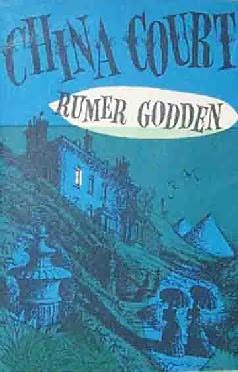
So...to go back in time, I've been reading some "real" library books, the old ones you find when you browse without preconceptions. I've rediscovered Rumer Godden's China Court, which was proudly displayed in the glass bookcases at my grandmother’s house. China Court was a Book- of-the-Month-Club book, as were most of my grandmother’s books. As a child I thought the novel had too many threads, portrayed too many generations, and was confusingly non-linear with parallel and intersecting back-and-forth-in time lines. Of course now I love it; it's exactly my kind of book. Five generations, the rise and fall of a Cornish house, the fourth generation abandoning the quarry and the obsolete china factory for more lucrative, less demanding careers. The novel begins with the death of Mrs. Quin, the third-generation dowager of the slightly dilapidated, once grand house, China Court.  Mrs. Quin, an unconventional woman who was originally rejected by Lady Patrick as an appropriate friend for her son, has, ironically, not only married into the family, but become the last matriarch and house historian.  Yet, through her wild garden, she has somehow renewed the house and even made the past more accessible.

One thing I love about Godden's style:  characters who are peripheral to the action, or even family members looking back at the past, comment, Greek-chorus-like, on events in the narrative.  We first learn about Mrs. Quin and life at China Court from her maids.

Godden writes:  "Neither Cecily nor Mrs. Abel whispered, nor did they speak of Mrs. Quin as if she were not there, but all the same, things were muted; there was no early firing of explosives from the quarry, which had stopped work when the news was heard and the men had been sent home as a mark of respect.  'But the news will be in the village before the men,' said Cecily.

"Of course, Dr. Taft's car would have been seen, then Mrs. Abel coming down, and Cecily knew the vicar would be here at any moment.  'No one goes in or out of China Court who isn't seen,' complained Cecily often, 'seen and talked about.'  The village was not kind: proudly inbred, it kept for strangers the spirit of its wrecker forebear, though where it respected it was staunch and for Mrs. Quin there would be genuine feeling.  'Mrs. Quin gone!'..."

Godden's best books deserve rereading:  most are out-of-print, at least in the U.S. We should lobby for  Persephone or Virago to "rediscover" them. T

Thursday, February 05, 2009

More Rumer Godden

This winter I’ve begun to read Rumer Godden again.

I rejected her many years ago, in my late teens, after I began to concentrate on the classics. Godden wasn’t good enought. Reading in bed after a day of work was too good to waste on pop fiction when I could be reading Dickens or Austen. (I’d Rather Be Reading Dickens: the T-shirt.)

I obviously hadn’t read Godden’s India novels.


Breakfast with the Nikolides and Kingfishers Catch Fire are both minor classics. Kingfishers is a little better than minor.

Kingfishers Catch Fire, an autobiographical novel based on Godden’s experiences as an impoverished mother of two children who moves to Kashmir to “live simply,” is a beautiful, moving, and symmetrically perfect gem, a poetic, sometimes comic narrative in which Godden contrasts the relative meanings of poverty to an English family and Indian villagers. Painted against a gorgeous landscape, described in colorful, piercing detail of sights and sounds, the novel delineates the misunderstandings and resentment catalyzed when the rebellious, hip mother intrudes on village life and transgresses social barriers without understanding the traditions and hierarchy dictated by pride and poverty.

In Breakfast with the Nikolides, the action revolves around the death of a dog.

When Louise Pool and two daughters return to India after eight years in France, Charles, still at odds with Louise, tries to get to know his children. He gives a dog to Emily. The dog comes down with rabies, and as Louise recognizes the symptoms, she hysterically demands that they put down the dog; she screams until she gets her way, though Charles and the young veterinarian, Dr. Das, are more conservative about the diagnosis.

The family is shattered by Louise’s actions. The children have been away at breakfast with the Nikolides. The dog’s death is a trauma, and Emily will not forgive the mother. The dog’s death also has ramifications for a widening circle, including Dr. Das, who has struggled into the middle class, and his friend, Anil, a Brahmin.

Of course it is Godden's elegant style that makes the books. But the elaborate structure underlying the style is worth studying, too.

I can remember how dismayed and dumbfounded I was when a teacher friend told me Rumer Godden was her favorite writer.

Now I respect her for standing up for this undervalued writer.

Sunday, November 29, 2009

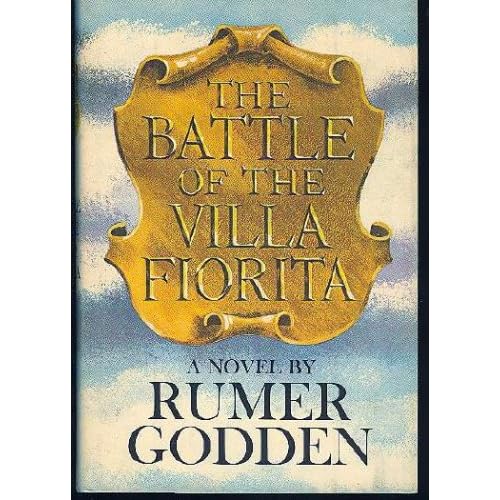
The Battle of the Villa Fiorita


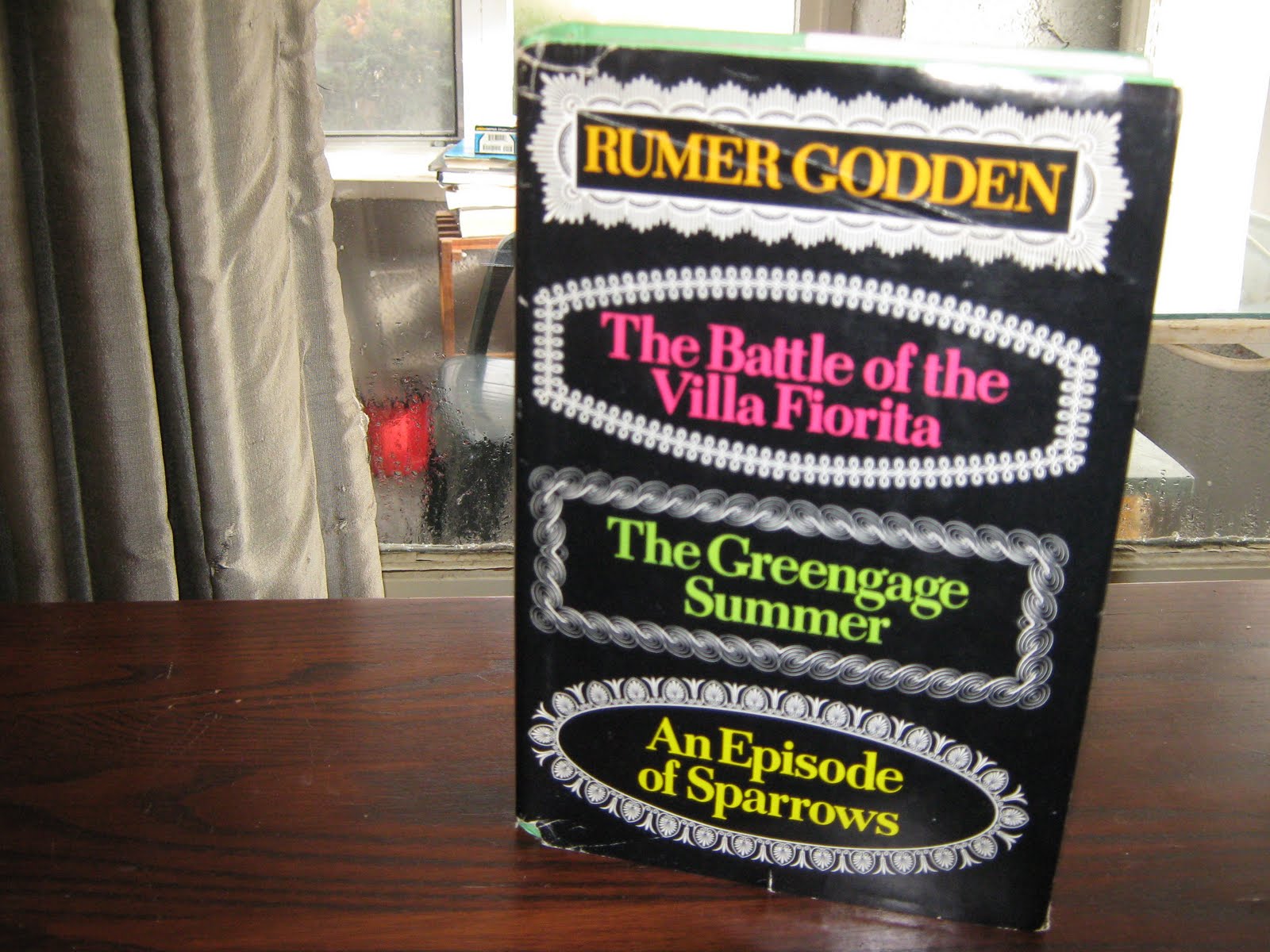
The Battle of the Villa Fiorita is one of three novels in the Rumer Godden omnibus I bought at the Fabulous Charity Sale for $1. It contains Godden's best novel, An Episode of Sparrows, a classic (marketed for children via NYBR, but originally published as an adult novel); The Greengage Summer, a perceptive study of an emotional trauma that hits a family of children living on their own in a French hotel while their mother is in a hospital; and the puzzling, uneven, but well-written novel, The Battle of the Villa Fiorita. The latter analyzes a battle between children and parents over a divorce. Do not look for a family story with a comfortable ending. Agonizing in parts, sad, moving, and occasionally comedic, written in Godden’s distinctive, poetic style, part narrative and part musing commentary, the novel unflinchingly examines the real horror that can be caused by children who don't understand adult relationships.

Godden writes lovely sentences, but she packs a fierce emotional wallop: she is not the mistress of the happy ending. Weirdly, this bitter, intelligent, realistic novel was dismissed as sentimental in Time magazine when it first came out in 1963. In a scathing attack, the reviewer wrote,

“There is evidence that the Book-of-the-Month Club could not exist with out Rumer Godden... This time Author Godden, 55, is addressing herself to the woman in early middle age who has had her children, has become bored with her husband and feels parched for romance.”


The reviewer apparently really disliked Godden. What does her being 55 have to do with it? The heroine, Fanny, is a complicated person - hardly looking for romance. And divorce is certainly not romantic: perhaps in '63, when divorce was less common, the reviewer didn't understand that.

The Battle of the Villa Fiorita is skillfully told, an interweaving of the points of view of the children and tthe adults. Caddie, the 11-year-old who plots with her brother, Hugh, to run away to Italy and break up their mother’s relationship with her lover, is very simple, naive, and direct. She is the ordinary child who values honesty and family tradition, and she desperately wants her mother back. Hugh is the sensitive, sickly, intelligent older brother who has been devastated by the loss of his mother but is too angry to show it. Godden has a gift for portraying children as they are, not from an idealized point of view. And we can see them turn into wily beasts, shattered by their mother’s leaving, willing to do anything, however unethical, to get her back.

But the most interesting part of the novel is told from the point of view of Fanny, a wife and mother who, after years of acting as a housekeeper-chauffeur-caretaker-wife-of-an-absentee-military husband, leaves her family, torn away by her first real sexual love for Rob, a film director. (By the way, Godden does not introduce this career for the sake of glamour, as Time magazine implies: Godden herself was acquainted with filmmakers of the ilk of Renoir, who filmed her beautiful novel, The River.) Fanny is lonely, left alone by her military husband who travels for his job, always the odd woman out at dinner parties (and she meets Rob at a dinner party). Fanny and Rob occupy a beautiful temporary nest in a borrowed Italian villa, but Fanny is also recovering from the loss of her children, won by her husband in a punitive custody battle. She sleeps all the time.

“Rob, Celestina, and Giulietta were united in worrying in case she was uncomfortable, cold, depressed. Here Fanny was first and for years she had always been last; the last to be served -’Because I did the serving’--the last to go to bed, unless Darrell were at home, but first to get up in the morning, she thought wryly. She was last on every list and automatically the one to give up everything, to stay behind, to go without. ‘Well, mothers are like that,’ she would have said. ‘Some mothers,’ said Rob.”


Although this is not Godden's best book, it is considerably better than much of what I read today! (Sorry, contemporary writers, but she was an original.) Considered middlebrow these days, she is still popular and her novels are available widely at used bookstores and stores online.

Wednesday, February 11, 2009

A Time to Dance, No Time to Weep

Last year I became a Virago addict: I read so many Viragos that I began to recognize the types of heroines: curious spinsters who question the status quo, mischievous curate’s wives, ambitious working women, courageous political activists, trapped women, and mothers who learn to "think outside the box." Much as I loved these books, I needed to branch out.   Gradually I began to remember the cherished women’s literature of my own childhood and youth.  So this is the winter of establishing my personal “Virago-Persephone” list, meaning that, though I’m not a publisher, these out-of-print books have merit and should be shared.  


It's been a Rumer Godden marathon around here.  On Monday I stayed up most of the night reading her compelling and beautiful memoir, A Time to Dance, No Time to Weep, which spans her first 38 years. Godden, raised partly in India, partly in England, had an idyllic childhood before being banished by well-meaning parents to a succession of horrifying English boarding schools.  "I still cannot fathom why, as it had been decided that Fa would go back to India alone and Mam would stay with us four in a rented house, we could not have been day girls which would have been more merciful; perhaps Fa and Mam had decided Jon was out of hand and, of course, where Jon went I went too."

At a convent boarding school, which obviously inspired her best-seller, Black Narcissus, a group of brutal, narrow-minded nuns resolved to crush Rumer and her older sister Jon's obstreperous spirits.  Rumer was branded a "liar" for telling exaggerated stories about India; and when Jon had malaria she was accused of "rubbing the thermometer on her blanket - a school trick we poor innocents had never heard of - and she was told to get up, dress and go back to her class at once."  Eventually they were yanked out of this school:  Mam realizing something was wrong when they ceased to write letters:  Jon refused to write because of the nuns' censorship.

Five years later, when Mam and her four daughters returned to India, Rumer and Jon were debutantes, and Rumer, who had never had a beau, was so flattered that she almost married at 18.  She regained her senses in time, broke the engagement, and returned to England to study dance education. (Fa said it would have been cheaper to keep her at home).  She ran a dancing school in Calcutta for several years and, between classes, wrote her first novel; then, during World War II, as a wife and mother of two children, having written her first "big" book, Black Narcissus, Godden retreated to Kashmir as “an abandoned wife” (her irresponsible, Mr. Micawber-type husband joins the army and takes up with another woman).  She renovated a bungalow, taught the children, gardened so they could live off their own vegetables, and with a sculptor neighbor traded their  children  back and forth:  it was the only way she could have uninterrupted work time.  Eventually a shocking episode with the servants cut short the idyll.  This fascinating memoir uncovers the roots of her more autobiographical novels, and in the cases of The Greengage Summer and Kingfishers Catch Fire, she quotes excerpts. A fascinating life is obviously needed

Godden captures the atmosphere of India with beauty and wit and lightly conveys the advantages of living in such a multicultural society. She also elucidates the joys and problems of a writer’s life. The book ends with her return to England. Her second memoir, A House with Four Rooms, describes her years in England.

Godden grew up inseparable from her older sister Jon, a talented writer whose bouts of mental illness impeded her stamina and prevented her achieving the same stature as Rumer.
I haven't read her, but I certainly would be interested.

Thursday, November 26, 2009

The Greengage Summer and the '60s


It’s a slow Thanksgiving, as it’s meant to be. There is no traffic on the street, a pumpkin pie was won at the Turkey Trot (not by me), the aroma of slowly roasting turkey permeates the house (baste every 15 minutes till the thermometer reads POULTRY) , and I am devoting the day to ‘60s literature.

The ‘60s literature puts me in the ‘60s holiday housewife spirit, which is my camouflage for the season. Actually I’m reading a 1963 omnibus of Rumer Godden’s novels, a book club edition bought at the Fabulous Charity Book Sale. Godden is one of my favorite writers - I especially love Kingfishers Catch Fire (reviewed here), her autobiographical masterpiece about a kind of pre-hippie widow who moves with her two children to an obscure village in India and almost gets killed because she doesn’t understand the culture.

Why does this make me feel like a ‘60s housewife?

Well, the pre-feminist ’60s is what my mother experienced. It was "before everything changed - before The Graduate,” as she recalls. She admired the Kennedys, read book club books, went to all the movies, used Green Stamps, made daily trips to the grocery store and the “locker” to get meat (our grandfather was a farmer), stayed home and took care of the children without complaint. The '60s was not for her primarily a period of social change, though she opposed the Vietnam war. Now that has not been my life, but I find it helpful to replicate the quiet atmosphere of Thanksgiving here. Nobody was depressed or suicidal over our holidays!

So there is a lot of reading going on - and there would have been a lot of smoking, too, if this had been that era. There is a little classical music in the background, but earlier we listened to Eric Clapton on “Bellbottom Blues” (1970, but close enough). And I finished The Greengage Summer - and am now blogging, a 21st-century activity, so I'm out of period.

The Greengage Summer is not Godden’s best novel, but it is a revelation: another autobiographical novel (I’ve read her autobiography), about a family of children who end up living alone at a hotel in France one summer while their mother is hospitalized for blood poisoning.

The story is divulged retrospectively through the perceptions of the narrator, Cecil, a 13-year-old girl who is beginning to understand the “grown-up” world as the action happens. Shadows waver and solidify and become human as Cecil analyzes her family’s fascination with Eliot, a kind, handsome Englishman who befriends them. Eliot comes and goes and is having a desultory affair with the owner of the hotel, the rather scatterbrained Zizi, but when Joss, Cecil’s beautiful older sister, recovers from a stomach illness and comes down from her room, Eliot is entranced and begins spending all his time with them.

The children love him, but Eliot’s girlfriend, Zizi, begins to humiliate Joss, upset by what is going on. And though Eliot and Joss don’t have an affair, Joss becomes competitive with Zizi in payback for the humilation. And as other men begin to pay attention to Joss, a tragedy unfolds.

The tone is fairly light - Cecil does not understand everything that happens as it happens - none of them understand what Eliot is up to. But the strange ambiguous ending does show him in a heroic, if rather warped, light.

I really enjoyed this. If you want to read more about Rumer Godden, go here.

Off to play Clue!

Sunday, December 20, 2009

Catch As Catch Can


What happens when you OD on reprints? Is it possible to read too many old books? (Take two aspirin and call me in the morning.)


Four reprint publishers, Virago, Persephone, Kessinger, and Elibron, featured prominently on my reading list last year. These dauntless small presses gamble on lost literary gems, otherwise unobtainable. Like what? you want to know. I was spellbound by the leftist fiction of Vera Brittain (Virago), diverted by the wit of Rachel Ferguson (Virago and Persephone), engaged by the fascinating, overlooked 19th-century novels of Margaret Oliphant (Elibron and Kessinger), and moved by the Willa Cather-influenced novel, Fidelity, by the Pulitzer-winning playwright Susan Glaspell (Persephone).

But this year not so much. The Phenomenal Four don't traffic in Pamela Hansford Johnson and Rumer Godden, writers I rediscovered in 2009. Two other good small presses, however, list at least one title by these authors in their catalogues: Capuchin Classics has Johnson's An Error of Judgment, and Loyola Press has reissued two of Godden’s nun books (In This House of Brede is especially good). As for collecting the rest of their books, it’s catch as catch can. It's a matter of chasing bargains day to day on the internet (like searching for the Holy Grail, or a unicorn).


Lately I’ve divagated strangely further away from my Phenomenal Four ideal into mid-to-late 20th century fiction. What does it mean? Have I gone modern? I’m finally reading Barbara Kingsolver’s 1998 blockbuster, The Poisonwood Bible, and loving it. It's as good as everyone said it was. (The voice of one of the characters is even reminiscent of Scout's in To Kill a Mockingbird.) And in the last month I’ve read Pamela Frankau, Elizabeth Goudge, Rumer Godden, Patricia W. Wrede, K. M. Peyton, John Thorndike, Jonathan Carroll, and Stephanie Meyer (the first Twilight book is excellent).

Better go back to Viragos and Persephones before the year ends, I thought. So I checked out from the library a Persephone, Princes in the Land, by Joanna Cannan. Unless there’s a revelation in the next 30 pages, it's been a waste of time.

Cannan seems strangely conservative in her values: Upper-class horsey redheaded Patricia meets awkward lower-middle-class grad student, Hugh, on a train. A charming meeting is characterized by spilling books out of a bookbag and poetry-reading. Hugh, apprehensive, not to say hostile, about class issues, visits her on the estate and is put at his ease by her broad-minded grandfather. Patricia's mother, Blanche, like some evil fairy at a wedding, predicts Paticia's life will be ruined by marrying out of her class and that she’ll end up in some narrow little house, stuck doing housework. Alas, her predictions actually come true: Patricia is the most fettered of housewives and mothers. Her husband grows stuffy and unappreciative and really does feel pleased that he has ended Patricia's horseback riding and quashed her spirit. Ouch. And her children don’t turn out the way she thought they would. Corrupted by the lower-middle-class?

There must be a twist at the end. This can't be about class. But I’m wondering. Patricia's mother, the unsympathetic character, is hardly a seer, is she? So what will happen? Something cheerful, I assume. The writing is awfully plain--and uninteresting to me.

I’m hoping for the best. But I also struck out with Sheila Kaye-Smith’s Joanna Godden (Virago) earlier.

On the other hand Kessinger and Elibron have kept me happy with Mrs. Oliphant, so maybe it was just a few bad titles from these other presses.

Or I’m transforming into a contemporary fiction promoter? I plan to read some new books this week--new this year, not just new to me!

Yikes!

Tuesday, December 08, 2009

A List for Those of Us Who Like Lists: Favorite Books of the Year


I love lists, but my favorite books of the year are seldom the newest books. I leave those to reviewers, connoisseurs of 21st century
literature, and pop culture enthusiasts who not only embrace the newest titles by Jonathan Lethem (Chronic City is my favorite new book of the year), A. S. Byatt (why didn’t her book win the Booker Prize?), and the Twilight books (which I liked), but also Hilary Mantel (can any American stand to read a 700-page historical novel about Cromwell?), Philip Roth’s latest self-indulgent imagining of sex between an octogenarian and a lesbian, and Dan Brown's best-seller.

I often read OLD books. OUT-OF-PRINT books. I love the classics, but seem to have read the complete Penguin list of classics, which duplicates the thousands of books in our home collection. So these days I read a lot of books by forgotten, frequently dead writers.

But I’ll try to make this list eclectic. Four living writers made it! N.B. The books are listed in no particular order, and I gave links to the first 10 "reviews" and then got tired of looking them up!

1. A Meaningful Life by L. J. Davies. I said here, "a comic masterpiece with disturbing elements, it follows the career of Boise-born Lowell Lake, an editor for a plumbing trade newspaper in New York, who wakes up one day at 30 with the epiphany that he’s wasting his life."

2. Kingfishers Catch Fire by Rumer Godden. I said here: "Godden delineates the misunderstandings and resentment catalyzed by a rebellious, hip mother who intrudes on village life in a remote area of India and transgresses social barriers without understanding the traditions and hierarchy dictated by pride and poverty."

3. The Death of the Heart by Elizabeth Bowen. I said here: "Bowen's brilliant portrait of the orphaned Portia's coming of age is drawn partly through a diary and partly through the witty, despairing conversations... of her brother and his wife."

4. Sinister Street by Compton Mackenzie. I said here: "a well-written, detailed narrative about the effect of different systems of British education...This is the best book I've ever read!" (It was probably the best book I read that day.)

5. A Tale of Two Families by Dodie Smith. I said here: "This beautifully-written short novel hinges on the decision of two middle-aged sisters, May and June, to move their families from London to the country to live in two neighboring houses, the Dower House and the cottage. Although the houses are beautiful, they are somewhat leery about the move, and with good reason: The sisters are married to two attractive brothers, George, a philandering, wealthy businessman, and Robert, a writer, and attractions flare up with the proximity of the two families."

6. Lies Will Take You Somewhere by Sheila Schwartz. A stunning, lyrical novel about a Jewish family, told from the point of view of a hip, discontented rabbi's wife and her confused husband. Written about here.

7. Youth and the Bright Medusa by Willa Cather. I said here: "A splendid collection of short stories about artists..."

8. Roast Beef, Medium by Edna Ferber. I said here: "...the tone of Edna Ferber’s delightful collection of short stories, Roast Beef, Medium: The Business Adventures of Emma McChesney (1913), puts me in mind of D. E. Stevenson's Mrs. Tim. It’s not that the heroine has much in common with Mrs. Tim - Emma McChesney is perhaps the only successful traveling saleswoman in literary history, a stellar employee of T. A. Buck’s Featherloom Petticoats. Her domestic situation is utterly different from Mrs. Tim's, too, as she is the divorced mother of a 17-year-old son. But her sense of humor, friendliness, and resilience are an American rendition of Mrs. Tim.'

9. An Avenue of Stone trilogy by Pamela Hansford Johnson (my favorite writer!). The complex, witty trilogy chronicles the relationship between the narrator, art historian Claud Pickering, and his histrionic stepmother, Helena, amidst the disintegrating class boundaries of postwar society. I gushed here (and elsewhere: bring this back into print! It is as good as Anthony Powell's Dance to the Music of Time.

Other books I've loved and reviewed this year but am too lazy to provide links for:

Nella Last’s War: The Second World War Diaries of Housewife, 49.

They Walked Like Men by Clifford A. Simak

The Brimming Cup by Dorothy Canfield Fisher

Harry Joscelyn by Margaret Oliphant

The White Witch by Elizabeth Goudge

The Children's Book by A. S. Byatt

Chronic City by Jonathan Lethem

Far North by Marcel Theroux

Tam Lin by Patricia Dean

This Rough Magic by Mary Stewart

The Shuttle by Frances Hodgson Burnett

Tuesday, December 22, 2009

Battery-Operated Christmas Trees, Indies & Part of Another List


As many of you know, I am half-facetiously playing the role of a '60s housewife this month. My struggle against Christmas depression and general seasonal affective disorder has comprised cleaning house and reading '60s novels by Rumer Godden, Pamela Frankau, K. M. Peyton, Elizabeth Goudge, and others. A constant clearing of table surfaces, all the lights in the house kept on all the time, and the purchase of a few Christmas decorations have kept those dark existential thoughts at bay. But I haven't quite been able to stay in the '60s, as there has been an earth-shattering advance in Christmas decorations, especially the TINY CHRISTMAS TREES from Target. If you pry open the base and insert batteries, TINY LIGHTS STRUNG AROUND THE TREES WILL LIGHT UP AND CHANGE COLORS. There were no directions, however, and it was like sovling a Rubik's cube to unravel the mystery. We had to pry off the base with a knife! It’s not like we’re engineers or anything (that’s a joke, because one of us is) but these things weren't on sale for nothing.

Meanwhile, I’m continuing to read and enjoy Barbara Kingsolver’s The Poisonwood Bible, her lively novelistic chronicle of a Baptist family in the Congo in 1959. While Nathan, the chauvinistic minister, smugly believes he is converting the "heathen," his wife, Orleanna, and their four daughters, Rachel, Leah, Adah, and Ruth May, more realistically and humanely interpret the culture through their daily interactions with people. As the Congo declares independence from Belgium in 1960 and other whites flee from the chaotic country, Nathan ignores the needs of his family, and of one very sick child, and insists on remaining without the Mission's salary. Narrated by the women of the family, mainly the daughters, the brilliant novel is tragicomic, moving, lyrical, and lightened by the children's malapropisms.

By the way, my husband mentioned that he read my blog (not a habit!) and understands that I want Kingsolver’s new book. So we’re going to walk up to the independent bookstore tomorrow. Usually this is not a good experience, because I have been followed suspiciously around the tiny space and generally treated like an intruder, but the other day when I was looking for a certain book for my spouse, the clerk was really nice and actually hunted down the title from some unpromising vague clues. Either she’s new, or I looked more normal in my snow-clomping clothes than my bicycling clothes (I don't think they care for the sweaty look). Anyway, now I feel I can support the store for the season.


AND NOW: Here’s a part of my Best of the Decade list (2000-2004). Just what you need: another list!

2000:

Zadie Smith’s White Teeth

Romola by George Eliot

2001:

Empire Falls by Richard Russo

Positively 4th Street: The Lives and Times of Joan Baez, Bob Dylan, Mimi Baez Farina, and Richard Farina by David Hughes

2002:

The Seven Sisters by Margaret Drabble

In Sunlight, In a Beautiful Garden by Kathleen Cambor

A Whistling Woman by A. S. Byatt

2003:

The Light Years by Elizabeth Jane Howard

None Shall Look Back by Caroline Gordon

The Empty Mirror: Experiences in a Japanese Zen Monastery by Janwillem Van de Wetering

2004:

Long for This World by Michael Byers

Monstrous Regiment by Terry Pratchett

The Best Awful by Carrie Fisher

Aloft by Chang-rae Lee

Don’t Tell Alfred by Nancy Mitford

Monday, December 07, 2009

Reading Pamela Frankau and Viewing The View


Pamela Frankau has her fans, yet people in real life seldom talk about her. It’s left to us cyber-characters (myself included) to proselytize about Frankau's novels. There was quite a lot of traffic when I blogged about her a few years ago (at a blog that I deleted). For those unfamiliar with her work, I would put her in the same class, more or less, as Rumer Godden and Pamela Hansford Johnson; perhaps a tad less polished than those two, but still very good and lots of fun to read. Anyway, three of her novels, The Willow Cabin, The Winged Horse, and A Wreath for the Enemy are back in print, thanks to Virago. So go out and buy them while you can! They’re considerably cheaper now than they will be when they go out of print. Remember the scandalous price of the out-of-print Virago of The Brontes Went to Woolworth’s before Bloomsbury reissued it.


Frankau fits well into my reading plan because (a) she wrote 30 books between 1927 and 1967 (lots to read if I can get hold of them), and (b) she is the chronicler of utterly original, unexpected characters: actors, faith healers, writers (playwrights, advertising copywriters, novelists), people who lose their money, frivolous, brilliant women who live according to their own moral codes, intense surgeons who give weird fatherly advice while they pick up lost girls at parties, psychics, etc.. But go with the Viragos first: they are among her most famous books.

I just finished a lesser work, Slaves of the Lamp, the second of a trilogy that centers on a theatrical family, Clothes of a King's Son. Sing for Your Supper, the first novel in the series, is excellent and I love her writing, but it seems that she simply fell in love with her characters (as Upton Sinclair does in the Lanny Budd books) and didn’t worry much about the structure of the second book.

THE VIEW: it was my plan to start watching The View, a show popular with women who work in the home, because it is a good thing to plug into pop culture from time to time (and I'm into the whole housewife thing till Jan. 1, as you know). Barbara Walters founded the show and it takes the form of a conversation among five women, Walters, Joy Behar (the liberal who also has another talk show), Whoopi Goldberg (the moderator, though away today performing in England), Elizabeth Hasslebeck (the ultra-conservative football player's wife and now fashion designer), and Sherri Shepherd (new to me) . Today they were discussing Tiger Woods. Honestly, could anything be such a snooze? So he had a fight with his wife and she "wrapped a golf club around his head," according to the gossip, though “no one knows what went on between those four walls,” as one of the View women said (sorry, I forgot which one, but it seemed very sensible).


Apparently Tiger Woods has offered his wife $80 million to stay with him for seven years.

Joy, the witty Democrat ("one of the few lefties on TV," as she says), cynically pointed out , “A lot of women stay and try to make their marriage work...and they do it for nothing.'

I agree and wanted to cheer.

Barbara Walters wants to know when Tiger finds the time to practice.

I just wish the subject matter were more interesting. They’re intelligent women and couldn’t they raise the level of TV by talking about more important subjects? Aren’t we all tired of hearing about celebrity men cheating? Why don't we just outlaw adultery and be done with it? And legalize smoking? (I think adultery is worse!)

Okay, I don't really think we should outlaw adultery. But I do really, really think we should legalize smoking. This crazed Puritanical prohibiliton of smoking/yet encouragement of prurient voyeurism about celb cheating is mystifying.

Thursday, March 11, 2010

J. B. Priestley and the Critics


I've always meant to read J. B. Priestley, despite the condescension of critics which has somehow floated into my consciousness. I mean, why should I pay attention to critics? Some admittedly have taste and incredible integrity, while others are book whores writing flattering gibberish or trashing the powerless, but I can't tell one from the other without first buying a hundred bad books. So these days I try to block them out, with the exception of a few tried-and-true bibliophiles like Michael Dirda of The Washington Post. If I don't, I end up with piles of stuff like Kit Whitfield's In the Waters, which is well-written but isn't my thing, and if I had had any sense I would have figured that out from the review. Caveat emptor! Silly goose! Caveat lector quoque!

An uncritical life would doubtless work out very well. Think of all the unfashionable Viragos, Persephones, Capuchin Classics, Pamela Hansford Johnson, and Rumer Godden I've discovered at random. Priestley is among them. He was very popular in his day, like Maugham, of whom he very much reminds me, and H. E. Bates, another underestimated writer. Perhaps you've heard of Priestley's best-seller, The Good Companions, which won the James Tait Memorial Prize in 1929, or Angel Pavement, another of his smash-hit famous novels. He wrote enough novels, essays, plays, and memoirs to challenge the flowing pens of Trollope and Mrs. Oliphant (though he wrote in another era, of course).

Now Priestley is out-of-print in the U.S. The other day on the porch I dug up an old copy of Lost Empires, a lively novel about a young artist's experiences in his uncle's magic act in music halls before World War I. This was made into a Masterpiece Theater production in the 1980s, I learned from the photo caption on the back. Colin Firth was in it!


In the "Prologue by J.B.P," Priestley spins a frame-construction yarn about going painting on holiday and visiting a watercolor artist, Richard Herncastle, whom he'd known years ago. Herncastle, who is now too old and shaky to paint, has been writing his memoirs about his theatrical youth, and gives them to Priestley for revision. In Chapter 1 we commence reading Herncastle's story, narrated in the first person. This is so fast-paced, so well written, and so much fun that I am galloping through it. I hate magic acts, so I had some reservations, but the novel focuses on the relationships between actors on the road and the work of the theater rather than the technical tricks of the magic trade (though some of that is fascinating, too).

Richard has been saved from a dull clerical life by his Uncle Nick's offer of a stage management job, which takes him on a rollicking ride through the provinces of England. The gloomy, champagne-swilling, star magician Nick travels with an ensemble of lackeys, including his slavish assistant and lover, Cissie, two carpenter/engineers, and a drunken dwarf. Richard loves the job, because he can paint during the day, though there are trying weekends of traveling from town to town on bumpy trains, hustling all the stage paraphernalia into the theater, and negotiations with the bands about music. Richard's interactions with the other actors who share the bill with Uncle Nick, dancers, jugglers, and comedians, hone his powers of observation.

I love the slightly whiny Cissy, who has to watch what she eats, at least in front of short-tempered Nick, because she has to vanish during the act by dropping from a box into a thin pedestal which no one believes she can fit into. Nick bitches whenever she puts on an ounce! Then there's Julie Blane, the excellent West End actress who has come down in the world because of drink. I'm up to a quite exciting chapter where a suffragette's husband hires Nick to plot the disappearance of his wife, wanted by the police, from a political meeting, so she isn't dragged off to prison for more force feeding.

This is so much fun to read. Very Maugham-ish. I don't know about you, but I can read Maugham almost indefinitely. I have a feeling I'm going down the same road with Priestley.