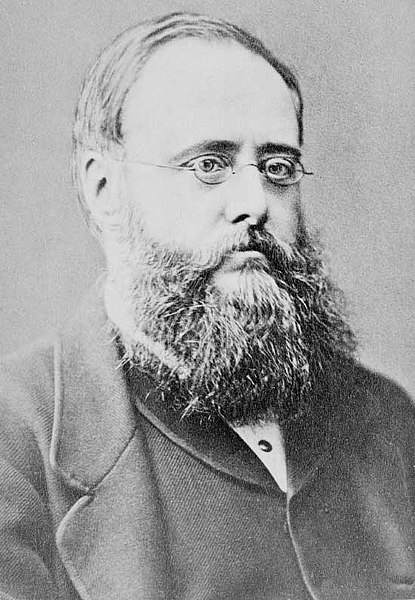
A friend, horrifed by Wilkie Collins's beard, said, "What a beard!" and suggested I do a piece on beards of literary men. So I've done a little investigation and posted photos of: (1) Wilkie Collins (top left); (2) Charles Dickens (below Collins); (3) Anthony Trollope (below) and (4) Henry James (below Trollope). Not all Victorian writers had beards as I learned after INTENSIVELY searching the internet (meaning 10 minutes). George Gissing and Edmund Gosse, for example, sported tasteful moustaches (which one hopes may have boosted sales despite their radicalism). There's something rather grotesque about two of the beards (who were their stylists?), though I like Dickens's. Which of these is your favorite beard? A, B, C, or D?
Monday, June 09, 2008
Beards in Literature
A friend, horrifed by Wilkie Collins's beard, said, "What a beard!" and suggested I do a piece on beards of literary men. So I've done a little investigation and posted photos of: (1) Wilkie Collins (top left); (2) Charles Dickens (below Collins); (3) Anthony Trollope (below) and (4) Henry James (below Trollope). Not all Victorian writers had beards as I learned after INTENSIVELY searching the internet (meaning 10 minutes). George Gissing and Edmund Gosse, for example, sported tasteful moustaches (which one hopes may have boosted sales despite their radicalism). There's something rather grotesque about two of the beards (who were their stylists?), though I like Dickens's. Which of these is your favorite beard? A, B, C, or D?
Sunday, June 08, 2008
Dames
It's a rainy day, so you rifle through your bookshelves.... Dames by Elizabeth North is randomly chosen, the kind of boarding school novel you might read as a girl (i.e., by Enid Blyton, a writer alluded to by North in the clash between the faculty's snobbery and the girls' tastes), except the characters are sophisticated and it chronologically jumps back and forth over a 25-year-year period. It's a bit like a subdued English version of Mary McCarthy's The Group, except it begins at a boarding school instead of a Seven Sisters college. At Dames School, the teachers dislike the group called the Ambers. These five girls scorn anyone “public-spirited, hearty and conscientious...” They nonchalantly mock their English teacher, pretend they’re menstruating in gym class, and skip chapel.
The rebellious Erica becomes a hip but worried mother of children who follow a guru in California. Mousie, the most overlooked member of the group, is at the center of the novel and becomes the least conventional. A woman in her 30s, Mousie has fallen in love with a married man and travels to Ethiopia to take over a mission connected with Dames.
The headmistress of Dames, Miss Bedford, is also unconventional. Disillusioned, she believes the school is outdated. She is defeated by the Ambers, the new kind of girl admitted by the school. Half of her doesn’t care about their skipping chapel; half of her realizes she must punish them, though the punishment will have no impact. An older Mousie, Miss Bedford is half in love with her late best friend’s widowed husband and meets him in Ethiopia when she spends her holiday at the Dames mission house.
So one single woman is in love with a married man; the other with a widower.
There is a coolness and cleverness to the subtle, witty style, which is so minimalist it stays in the background. There is an odd connection between the privileged Dames school and the patronage of the mission in Ethiopia. Sadly, this seems to be a forgotten book.
Friday, June 06, 2008
Wilkie Collins and Eliot Bliss
Wilkie Collins's Blind Love is a luxurious pleasure after hard work. It doesn’t take itself too seriously--it absorbs one's whole attention--and somehow it is believable while one reads. The intriguing characters include a harum-scarum young lord who romantically becomes a double agent in an assassins' group; Iris, a brilliant, faithful woman who saves him three times (once in men’s clothes); Hugh Mountjoy, a steady friend who fiercely loves Iris and negotiates her safety several times by bribing a confidence man to stay away; a con-man doctor; a former actress; and a half-mad maid.
Serialized in the Illustrated London News in 1889, Blind Love was completed by Walter Besant and posthumously published. , Collins on his deathbed left Besant copious notes on the development of the plot and even lines of dialouge. This neglected novel is worth looking up--but only do so after reading No Name, Armadale, The Moonstone, or some of his more famous works. The Dover paperback gives no background on Besant, just his short preface explaining the circumstances.
Now, back to Viragos. For every essay celebrating Virago’s 30th anniversary (the latest on Sunday June 4 by Justine Picardie), I have read at least five Viragos. Actually I read 8 last month. I can wholeheartedly recommend many: the witty Molly Keane (whose early books are published under the name M. J. Farrell), Nina Bawden’s Circles of Deceit (I’m a sucker for books about artists), Vera Brittain’s earnest Honourable Estate (which concentrates on the suffrage movement and socialism before and after WWI), and anything by Rose Macaulay (best known for Towers of Trepizand, but The World My Wildnerness and Told by an Idiod are also good and published by Virago).
I've most recently read Eliot Bliss's Saraband. What’s wrong with it? Why didn’t I like it? My enjoyment of this novel has been tepid at best. Saraband is the sometimes-poetic story of a dreamy Catholic girl, Louie, whose years at a Catholic boarding school never seem quite real to her (though she has one mischievous friend and mourns the pretty music teacher who leaves the nunnery ). Her idyllic home with her grandmother, Lulu, her mother, and uncles grounds her with an imagination that inspires some of the most vivid imagery and memories.
The first paragraph illustrates Louie's dreaminess: “All along the road from the river the frost made patterns on the ground, and how beautifully the air smelt...The sharp air hung over one’s head like the blade of a knife, she imagined it saying, ‘Behold, you shall be cold, you shall be cold...’ Winter had a most exciting smell, it made one think of people whom one knew and yet had never met, places where at some time or other one felt sure one must have lived and yet could not remember. The frost hung on the trees, it made them look as if they had gone white during the night from fear, it gave them a very queer stark look.”
Beautiful writing. this is great stuff, but why all the run-on sentences? As though she had turned stanzas of a poem into prose. Of course that's the point. Louie writes poetry and says she doesn't know how to write prose.
I also like this passage about leaving the business school where she learns stenography and typing.
“She was leaving the draughty, noisy place, the singing of the machines and the crowds on the stairs. Now they were all new people in the crowds, one hardly ever recognized a face anywhere. it was astonishing how quickly they changed. Very few people took the whole course. Most of them came to learn quickly, and they learnt quickly and went. And yet there were the same kind of people on the stairs. The same kind of conversation went on all around them....”
The pileup of adjectives and the unique phrase “singing” of the machines are brilliant. Then dreary short sentence follows short sentence. This particular Catholic feminist novel Isn’t in the same class as Antonia White’s Catholic novels. But Bliss does seem to be following in the footsteps of May Sinclair and Dorothy Richardson.
Dorothy Richardson, a friend of Bliss, may have influenced her style. Richardson, of course, is more innovative, but the more I write about Bliss the more I see this influence may be important.
Wednesday, June 04, 2008
Naked Lunch and Ice
I once listened to a record of William Burroughs reading from Naked Lunch. “I'm looking for a fix in Pleasantville, Iowa," he rasped. Much laughter all around. My eyes widened. Marijuana: okay. Heroin: no. I never forgot the time a friend on LSD forgot how to read and we took care of her until she was sane enough to return home. Insanity was only postponed: a few years later she ended up in a mental hospital. Did the LSD do it? And unfortunately those were the days when psychiatric treatment consisted of a regimen of drugs that resulted in personality change. She seemed so somehow slow and thickened when she came out. And so I have never read William Burroughs. Get real, I always think. But perhaps this is the year I overcome my prejudices and read these "drug" classics.

Some drug literature, however, fascinates me. Who can be consistent? [LEFT: detail of self-portrait of ANNA KAVAN] Anna Kavan, an English writer whose heroin addiction shaped her fiction, is known as a “cult” novelist (a phrase I recently applied it to Winifred Holtby’s socialist novels, just showing you can apply it to anything). Her most famous novel, ice, is sometimes considered science fiction, other times a surreal allegory. “Reality had always been something of an unknown quantity to me,” says the narrator of Ice. This allegorical world is on the brink of an icy nuclear war and the narrator is searching for a mysterious, fragile girl who has eluded both him and her husband (who thinks she is in need of psychiatric treatmen). It's fairly obvious that Kavan is the fragile girl (who charmed men but rejected them in favor of heroin). A few years ago I considered writing a paper on Kavan, but my notes led me nowhere. I should have concentrated on one book (Julia and the Bazooka, a book of short stories, is my favorite), but I wrote notes on all of them. Too much material for a single paper.
There is a biography of Kavan. And Rhys Davies, a Welsh writer and friend of Kavan, wrote a novel based on her life. He wrote that she once threw a chicken at him during a dinner party, but she also worked as an interior decorator and could be charming.
It would have to be inconvenient to be a friend of an addict. I mean how good a friend could they be? Chickens thrown at us at dinner? But I love Kavan’s writing: she is as good as (or better than) Jean Rhys, only completely unknown in this country.
Saturday, May 31, 2008
The Cult of Winifred Holtby
It's middlebrow novel time--beach reading, even if there is no beach--and the dusty novels of the '20s and '30s fit nicely into a totebag. After reading three of Winifred Holtby's absorbing if uneven and unsubtly political novels, I am suddenly a Holtby "cult" fan. SOUTH RIDING, ANDERBY WOLD, & THE CROWDED STREET speak across time and are emotionally and intellectually true. Her naturalistic portraits of women on farms, in villages, and cities are unglamourous but somehow touch one and often strike home: women have more choices now, but these books illustrate a period when not being selected to marry was shameful and spinsterhood was the "S" word. Women's and socialist politics, important to Holtby, have not, surprisingly, changed much.
Muriel, the unsympathetic protagonist of THE CROWDED STREET, was beginning to bore me when it became clear that this is Holtby's plan. Muriel's dullness and indecisiveness are caused by her very conventional, determined mother's indoctrination, which slowly withers Muriel's personality. After a meeting of a church society, "(Muriel) thought: 'What on earth shall I do when I get home? Read? All books are the same--about beautiful girls who get married or married women who fall in love with their husbands. In books things always happen to people. Why doesn't someone write a book about someone to whom nothing ever happens--like me?'"
Like a princess in a fairy tale, Muriel requires salvation, though that's not quite how it turns out. And perhaps the process is somewhat unrealistic. Never mind. Holtby completely carries us away.
This is not quite a classic--but almost. Library books of a lost world. And Persephone Books has just reissued this.
P.S. And talk about coincidence--there is an enthusaiastic REVIEW of this in the Sunday June 1 Spectator. The link is below:
http://www.spectator.co.uk/the-magazine/books/658421/not-the-marrying-type.thtml
Wednesday, May 21, 2008
Winifred Holtby
Another Virago in the house? All right. It's Winifred Holtby's SOUTH RIDING. I didn’t like this one so much as her best friend Vera Brittain's masterpiece, HONOURABLE ESTATE..
Holtby, the subject of Vera Brittain's memoir, TESTAMENT OF FRIENDSHIP, simply did not write as fluidly and well as Brittain. Holtby’s sprawling, intelligent, political, if somewhat turgid, novel, is compelling, yet awkward, the labored story of a town. SOUTH RIDING fascinatingly spirals out from actions of the city council of South Riding to highlight the characters of all classes from shack dwellers to headmistresses to construction workers on the dole to once wealthy farmers. Perhaps that is its appeal: Holtby cares so much about her characters and contrasts the innocence of socialists and do-gooders to the corruption of sleazy council members who hope to make real estate deals by preying on the poor. The traditional narrative is never preachy, and she gives all the characters their due. Published posthumously in 1936, the Winner of the James Tait Black Award, it doesn’t measure up to the best of ‘30s liberal writers like Storm jameson. Nevertheless, it is a very good traditional novel, logically constructed, if not exquisitely written.
In her preface Holtby wrote to her alderman mother: “What fascinated me was the discovery that apparently academic and impersonal resolutions passed in a city council were daily revolutionizing the lives of those men and women whom they affected. The complex tangle of motives prompting public decisions, the unforeseen consequences of their enactment on private lives appeared to me as part of the unseen pattern of the English landscape.”
Anyway...this one is readily available, though I’m not sure about Holtby’s others.
Tuesday, May 20, 2008
Revolutionary Road
Richard Yates (1926-1992), the author of Revolutionary Road, knows the hopeless emptiness of suburban life. He knows the commuters who hate their 9-5 jobs and the claustrophobic housewives whose pregnancies cut them off radically from past achievements and friends. Revolutionary Road, a cult classic, is passed on by word of mouth, or, according to Richard Ford in his introduction to the 2000 Vintage edition, taught by maverick professors who specialize in Kesey, Kerouac, and Paula Fox (the latter’s work is especially pertinent).
The protagonists, a couple named Frank and April Wheeler, never intended to live average lives. They enjoyed their slight rebelliousness in Greenwich Village until April became pregnant, the contingency on which their lives hinge. Frank talks her out of an abortion (which was a perilous and horrifying prospect, since she intended to perform it on herself with a syringe), but the pregnancy in fact ruins both their lives. April has no life outside the suburb; Frank, who prides himself on doing nothing at his job and not even knowing what it is, rebels at work, hilariously shuffling files from his in-box to his desk drawers to the secretary’s files and back to his own in-box, writing brochures and letters as seldom as possible. April, however, stuck at home, has lost confidence. She encourages him to quit his job and move to France, where she can support the family.
it is a, ironically, a madman who understands their philosophy. John, a schizophrenic mathematic, articulates their loathing of suburbia:
“You want to play house, you got to have a nice job. You want to play very NICE house, very SWEET house, then you got to have a job you don’t like. Great. This is the way ninety-eight-point-nine percent of the people work things out, so believe me buddy you’ve got nothing to apologize for. Anybody comes along and says “Whaddya do it for?’ you can be pretty sure he’s on a four-hour pass from the State funny farm...”
It takes a madman to speak the truth. And possibly a housewife (April has less to lose than Frank). But the reader also sympathizes with Frank’s point of view. He may be unlikable and arrogant, but is believable as a guy in a gray flannel suit who is tempted by success at a job he doesn’t respect.
Saturday, May 17, 2008
Honourable Estate
Readers of Virago Modern Classics have been hustling their green-backed paperbacks (and new chick-lit-lookialikes) out of their bookcases lately. You’ll see women in urban landscapes on the buses reading Elizabeth Taylor's A View of the Harbor, and sweaty women swigging water and munching power bars beside a dusty trail, reading Vera Brittain’s Honourable Estate (1936; Virago 2000).
The 30th anniversary of the founding of Virago is the occasion of gossipy reminiscences in blogs and the Guardian (including an article by founder Carmen Callil). Bloggers will ask what your favorite Virago is and are there any copies of The Brontes Went to Woolworth's for less than $34 (the answer is no). I've been reading some extraordinary Viragos myself. I LOVED the Tortoise and the Hare by Elizabeth Jenkins, which I learned about in Carmen Callil's article. And I mention Vera Brittain’s Honourable Estate because I was denied it so long by its obscure status, and because Brittain’s novels have been sneered at by critics and more often overlooked.
Carolyn Heilbrun, a literary critic who wrote the introduction to Brittain’s Testament of experience, declared: “Brittain was not a great novelist....She discovered her form to be the documentary.” Because of such dismissive statements, I assumed that Brittain’s autobiographies were her best work and never looked for the novels. I am stunned by this low estimation of her fiction. Honourable Estate is a swift-moving 587-page novel of ideas, from which I could barely tear myself away for work or for sleep.
In Honourable Estate, Brittain analyzes the impact of World War I on two generations of men and women. Janet, a pre-war suffragist, loathes housework and motherhood and escapes from her fanatical vicar husband to political meetings. In the next generation, Ruth, the feminist daughter of an indulgent manufacturer, graduates from Oxford, despite her family’s belief that marriage should be her “estate." A nurse during World War I, disillusioned by many losses, she believes that the war continues after the armistice as refugees pour into camps in Russia and Poland. All characters are psychologically damaged, but make a difference in society. The novel is not plot-oriented, but Brittain's ideas and the emotional political involvement of her characters are exquisitely expressed and explained in her fluid style.
Thursday, December 20, 2007
The Media
Media distortion is hardly a surprise. Jonathan Alter's editorial in the Dec. 24 issue of Newsweek claims, "In a carefully prepared sound bite at last week's Des Moines Register Democratic debate, Hillary Clinton thought she had found a line to jump-start her flagging campaign: 'Some believe you get change by demanding it. Some believe you get change by hoping for it. I believe you get it by working hard for change."
Some of the ACTUAL quotes were more vigorous--less dumbed-down. Edwards said (in response to another candidate) that it would be unrealistic to promise he could do everything in one year. Hillary responded to Edwards, "Well, I'm going to be busy." And she also mentioned "hard work."
Whether you prefer Edwards' realism, Obama's idealism, or Clinton's aggressiveness, their words were more intricate, snappier "sound-bytes" than Alter's quotations.
Alter analyzes Edwards style as "confrontational," Obama's as "conciliatory." and Clinton's as based on "perspiration." He didn't mention the other candidates. The voting records don't match their stump speeches--what a surprise--and he should have given us stats (they're out there). Essentially he says that Clinton should work on children's issues. "Her best bet is to reconnect with the real Hillary, the one who spoke out passionately for children." All of them must do more than that to get the nomination.
Most of the editorial reads as though it were written before the televised debate (in fact all except the first paragraph). And the quotes are tedious--inconsistent with Alter's style. Perhaps an intern took the notes.
And, if I may say so, his attitude towards Hillary Clinton is sexist. Get her back in the mommy-dom, is what he suggests
.
Thursday, December 13, 2007
Pre-election
I love Edward Gorey cards--but this year have a much more amusing card. It’s an Edwards card! On the cover is a photo of the family. Inside there's a message, which if you can read you're brilliant. The handwriting is terrible. It looks like: “Fur deliberately sacrifice...and, closs all...in cless times...”
Brilliant PR! And I'm not mocking. I put the card on my mantel.
Right now--I'd far rather stay home and do embroidery than go to any caucus or primary. I feel grumpy about it. I have to decide so soon. Why can't we have one big primary on the same day? Don't they do something like this in France?
I have to do my research at the Congressional Record, though I'd rather go by the PR.
So far I support Hillary Clinton to an extent it’s because she’s a woman, but I also believe she might win. She has worked with Republicans closely in the Senate and is very pragmatic and middle-of-the-road, which many progressives complain of. I still remember her health care reform committee as a First Lady during the ‘90s. Defeated, but a good effort. Frankly, I don’t think they can do a damned thing about health care--the drug companies are too strong. Of course, I don’t know who owns America... Hillary is tough: God knows she’s had experience. All those “scandals” during the Clinton administration.
I might change my mind. I do love Edwards's PR.
Thursday, March 22, 2007
Powell and Lethem
If you haven't read Jonathan Lethem's The Fortress of Solitude, you should. It's a classic (she says who doesn't get to decide these things), a brilliant novel, an often jeering riff or graffiti "tag" on Powell's A Dance to the Music of Time. The first allusion to A Dance to the Music of Time comes on p. 50:
"One day she thrilled, almost drunkenly to scratch with a ballpoint pen in the pages of Anthony Powell's Casanova's Chinese Restaurant_, breaking a taboo of seventy-eight years: she heard her father's voice then, a shred of memory, commanding her reverence for the leather-lined vault of his library. There might be nothing worse than defacing a book, but now she felt the urge to drop them, half read, from her deck into her overgrown garden. She would only need to turn her wrist, let her grip slip once more. She knew she'd quit, one way or another, drop the book or simply die, before finishing the twelve volumes of Powell's novel, his Dance to the Goddamn Music of Time. Powell had written too much, taken too much of her time already, and she punished him by scribbling in his book, a wavering row of lines, like some hieroglyphic tide."
This is so brilliant: I almost can't express how brilliant it is. Because in this gentrified Brooklyn neighborhood of the '70, hieroglyphics, graffiti, comic books, Star Wars, funk, and science fiction take the place of Powell's cycle (traditional literature), classical music, and Andy Warhol's art. Scrawling is somehow necessary: art is for everyone. There is no prep school or Oxford: it's public school, Stuyvesant, maybe City College. Lethem outlines class as: the upper-class woman who wants to gentrify the neighborhood, a woman who can't read Power after observing middle-class whites and blacks in the brownstones (artists, singer), middle-class blacks in the projects, Purerto Ricans, and Italians. Abraham, a single father and artist, has given up painting since moving to Brooklyn and has now documents his life painting on film and designing paperback covers. A black singer and divorced father has given up his lurcrative career to move to Brooklyn (he does drugs and watches football) but compromises by going back to work as a singer in a bad funk band (he's the only one who doesn't dress like a pimp). Dylan is the main observer, the artist's son who has to figure out how to be a reader, a writer of "tags," white, and not get beaten up every day by the blacks. (He's one of three whites in his public school.) The types are surprisingly similar to Powell's in many ways, sans prep school: Mingus is one of the most important characters, likable and able to move easily between black and white; Widmerpool is a fawning bootlicker, a boy named Arthur, a chess-playing nerd who fakes asthma attacks to escape violence and who has figured out how to latch onto Dylan and Mingus for protection.
It's fascinating: it's a scribble on the pages of Powell. It's "okay, Powell, this is you, privileged, in England, and this is us." Something like that.
It's the class distinctions that have always gotten on my nerves in Powell. They're much easier to understand in Lethem: there's more going back and forth.
Anyway, some of you might be interested in this book. I'm...FASCINATED. How could anyone be so brilliant?
Wednesday, February 21, 2007
The Bastard of Istanbul
Here is an entertaining quote from Elif Shafak's The Bastard of Istanbul, a novel about a Turkish family and an Armenian family and their intertwined pasts. Amanoush, the Armenian-American beauty with no friends, meditates on the subversive power of novel-reading and can't stop talking about books on dates. (Novels do seem to be disapproved of by people who read only history, science or biography--they're considered light-weight--and perhaps that's why so few novels get reviewed in The New York Times Book Review. And perhaps that's why Shafak includes a long chapter about Amanoush's reading ):
"Though books were potentially harmful, novels were all the more dangerous. The path of fiction could easily mislead you into the cosmos of stories where everything was fluid, quixotic, and as open to surprises as a moonless night in the desert. Before you knew it you could be so carried away that you could lose touch with reality--that stringent and solid truth from which no minority should ever veer too far from in order not to end up unguarded when the winds shifted and bad times arrived. It didn't help to be so naive to think things wouldn't get bad, as they always did. Imagination was a dangerously captivating magic for those compelled to be realistic in life, and words could be poisonous for those destined always to be silenced. If as a child of survivors you still wanted to read and ruminate, you should do so quietly, apprehensively, and introspectively, never turning youself into a vociferous reader. If you couldn't help harboring higher aspirations in life, you should at least harbor only simple desires, reduced in passion and ambition, as if you had been de-energized and now had only enough strength to be average. With a fate and family like this, Armanoush had to learn to downplay her talents and do her best not to glimmer too brightly...."
And later Amanoush tells her aunt:
"'You see, unlike in the movies, there is no THE END sign flashing at the end of books. When I've read a book, I don't feel like I've finished anything. So I start a new one.'"
Friday, February 16, 2007
American Masterpieces, Not Read in Loserville
Maureen Howard’s Novels of the Seasons are contemporary American masterpieces, little read. Think of Anthony Powell’s A Dance to the Music of Time as written by an American Virginia Woolf. Yet who reads them? Very few seem to have heard of her. There are so few Catholic writers I really like. She lacks the masochistic streak of Mary Gordon. She is no Flannery O'Connor, but writes about the sweep of geography, history, art, and perhaps the end of Catholicism in America. (The end of civilization? No, I'm joking.)
Howard fuses the stories of several Catholic families, immigrants, refugees, Catholic commune workers, priests, stockbrokers, farmers, artists, computer guys, professors, Audobon's wife, and even an autobiographical sketch of Howard. Personally, I find these novels more eloquent and less sentimental than Alice McDermott's Catholic novels. Why do critics love McDermott rather than Howard? Because the critics can understand McDermott? (I don't mean to put down McDermott, who is very good in her way.) Yet Howard’s pyrotechnics of language and prodigious leaps back and forth in time are much more gorgeous and layered. Give this woman a National Book Award or Pulitzer.
A Lover’s Almanac is perhaps the simplest novel in the cycle: Louise Moffat and Artie Freeman, a young couple without a history at the millennium, learn their personal histories and invent their own life-style, rebelling against parents and grandparents who concentrated on American rather than personal history. Louise and Artie see themselves as more sophisticated and ironic, but these Generation X-and-a-halfers have not lived through wars or sacrificed for family or country and only partially, through photographs and letters, come to understand their family relationships (yet self-centeredly and without much knowledge of their country’s history). The second and third novels give us their 20th century families' viewpoints, as well as Audobon and his wife’s. The refugee family from Austria in World War II is Catholic, not Jewish: fascinating in itself, since the Catholics who died in concentration camps are largely forgotten. The novels are told in sream of consciousness, straightforward narrative, illustrations, almanac pages, and histories of Franklin, Edison, and other Americans.
Perhaps religion is missing from Louise and Artie's lives.
These novels are showy and magnificent, the story of America. Too flamboyant? I don’t think so. The fourth novel--Autumn-- is yet to come.
Where are the Modern Library editions?
Thursday, February 08, 2007
Willa Cather, The Rolling Stones, and U2
Willa Cather’s fictional “lost lady” has something in common with The Rolling Stones and U2: all three bank with “shelters that pay handsomely.” Marion Forrester chooses to invest with Ivy Peters during “changing times” in the west, much to her old-fashoned friends' disapproval. And according to The New York Times (business, Section 3, p. 1, Feb. 4), the Stones and U-2 bank in the Netherlands. Bono and U-2 switched last year after Ireland did away with tax breaks for musicians, but the Stones have done it for 30 years.
Here’s why I like the Stones: they say “Hello, Detroit,” play, and collect their paycheck. They don’t suck up. They're businessmen. They don't pretend otherwise. After Captain Forrester’s death, Marion is a stony stone, stonier than the Stones. She doesn't care what anyone thinks. She needs money. It’s “Hello, Sweet Water” and then she’s out of there.
I'm prim about investments and tax shelters myself (not that I have any) but don't want taxes to support the war in Iraq. Give it to health care, etc. Marion, of course, was completely selfish. She had to get out of Nebraska. And that she did so by Ivy Peters's investments pulls her down in the readers' eyes.
A lot of people are criticizing U2 for banking in the Netherlands, trying to find hypocrisy in their actions. Bono has certainly done a lot of good for the world and I don't know where his taxes would have gone in Ireland.
Anyway, why was this in the New York Times? It's certainly "business lite."
If anyone wants to write about Cather’s women and banking...feel free.
Wednesday, January 31, 2007
A Lost Lady
One of the saddest American novels I've read is Willa Cather's A Lost Lady. No one in the twentieth century writes more tragically and exquisitely than Cather, though she’s often designated a regional writer and craftsman rather than a tragedian and artist. She influenced F. Scott Fitzgerald, a midwestern writer who did not write about the midwest, and surpasses him because she realistically documented life on the prairie after she moved east, unlike Fitzgerald, who preferred to write about New York and France. Yet she is often despised for her "sentimental" novels about the pioneer era and its decline. Her work is passionate more often than sentimental, but many critics cannot see that and dislike her nearly perfect, simple style, believing it is less significant than that of her successors, Fitzgerald and Hemingway.
A cup of tea and Cather’s descriptions of winter in A Lost Lady are grand: they make one feel the cold of the terrible Nebraskan winters. The structure of A Lost Lady is complex. We see Captain Forrester and his wife, Marion Forrester, through the eyes of Niel, a small-town boy who grows up to admire the Forresters. Niel's uncle, Judge Pommeroy, is one of their few social equals. Marion Forrester is a vivacious woman who flirts with men and boys, allows the boys to fish on her property, and feeds them fresh cookies. Her husband, one of the richest men in town, is 25 years older, but she seems devoted to him. Questions are raised about this as the novel continues, yet we understand her duality. As long as the Forresters can spend the winter in Denver with friends, Marion can endure life in Sweet Water, Nebraska. But after Captain Forrester gives away his money to protect the working-class men who have lost everything in a failed Denver bank, Marion begins to drink and no longer cares if people know about her affair with a man in Colorado. Her morals are worse than the Captain’s and her ideals non-existent: Niel and Judge Pommeroy are disappointed and shun her. After the captain's death, Marion allows Ivy Peters, a base, cruel lawyer, to control her investments and business affairs. She doesn’t care that he cheats Indians and the poor.
“Money is a very important thing,” she tells Niel. Later, she explains to him why she has given her business to the working-class, scornful Ivy Peters. “[Your uncle] wouldn’t attempt to sell [the house] for more than twelve. That’s why I had to put it into other hands. Times have changed, but he doesn’t realize it. Mr. Forrester himself told me it wouldn’t be worth that. Ivy says he can get me twenty thousand, or if not, he will take it off my hands as soon as his investments begin to bring in returns.
Hermione Lee writes a chapter on "Lost Ladies" in her amazing critical study, Willa Cather: Double Lives. She writes:"There is a crucial change, now, from the early pioneering novels. The foucs has shifted from the immigrants to the American 'aristocracy'; and from female heroism to femininity. These heroines are 'ladies,' socially adept, self-conscious, sophisticated, decorative. They have no children, they are separated from their family roots, they have no independent occupations, and they define themselves in terms of their relation to men. They are confined and thwarted, not expansive and self-fulfilling. Their energies are poured, not intos something impersonal and bigger than themselves--the shaping of the land, the making of an art--but into personal feelings and self-expression. They are much more elusive and less reliable than the pioneering women-heroes."
No one respects Marion Forrester after a time. Yet Niel retains an affection for her. He learns the end of her story: she has finally gotten away. So was she lost? Was she right to change her business in changing times? Niel has the old values. So do we. Yet we think she might have straightened out near the end, after leaving Sweet Water, which was a kind of death to her.
Sunday, January 28, 2007
Kristin Lavansdatter
An Amazon book club plog is discussing Kristin Lavransdatter, a book I loved so much the first time that I tried to teach myself Norwegian.
Because I needed a respite from genre fiction, I turned first to Gissing and Trollope. Now I’m rereading Kristin Lavransdatter, the remarkable, luminous twentieth century trilogy about Kristin’s girlhood, marriage, and religious life in medieval Norway.
Penguin has a new translation of KL, which is supposed to be very good. I have the 1929 Nobel Prize Edition, translated by Charles Archer, which was fine when I first read it and is still fine now. One cannot be plugged into an iPod and read this; perhaps the Penguin edition is easier. In the first 35 pages Kristin runs away from an elf-maiden and a monk asks her to contemplate becoming a nun.
“’We have no child but me,’ answered Kristin. ‘So ‘tis like that I must marry. And I trow mother has chests and lockers with my bridal gear standing ready even now.’
“’Aye, aye,’ said Brother Edwin, and stroked her forehead. ‘tis thus that folk deal with their children now. To God they give the daughters who are lame or purblind or ugly or blemished, or they let Him have back the children when they deem Him to have given them more than they need. And then they wonder that all who dwell in the cloisters are not holy men and maids--’”
Having read this once before, I understand that Kristin would have been better off as a nun than married to an alcoholic (if I remember correctly he is an alcoholic: I haven't gotten that far).
I don’t think Undset is read much these days, even though she won the Nobel Prize. Perhaps the Penguin translation will introduce Kristin to a new generation. There is also a movie available at Amazon.
You may wonder why I can't stick to my reading plans. 2007 was supposed to be the year of the genre book. But can anybody read nothing but SF/fantasy and mysteries? I’ve read about medieval falconers and hawkmistresses (I love _Hawkmistress!_), psychics, women with vampire boyfriends, and crimes solved by detectives in ancient Rome and Egypt. Then I said one should read nothing but Gissing.
Next week...what?
Tuesday, January 23, 2007
Gissing, Vampires (Ugh), and Trollope
I mentioned that you might as well read nothing but Gissing.
One could make Gissing one’s life work. I loved The Nether World, which is one of his best novels about class. There is no escape for most of his lower-class characters, but a few of the slum dwellers who sacrifice themselves to help others are educated, virtuous, and philanthropic. They don't exactly find their rewards, though. If you can’t find Gissing's books at the library (and I can’t), most of his novels are at Project Gutenberg so you can read them on your computer or PDA or Sony Reader.
At Amazon I discovered, with a lot of work, that Gissing’s books are in print. Typing in George Gissing wasn’t enough. I then had to click on George Gissing after clicking on a title to get all of his books to come up. Something has happened to the Amazon database since they “improved” it a few years ago. Jeff Bezos’s book database was the best in the world until it was improved. It's still good, but one has to be very creative. I had to think like an idiot to find a boxed set of Leonard Woolf's autobiographies (finally found it: God knows how).
Instead of reading more Gissing this weekend, I decided to read one of those science fiction mystery series about women with vampire boyfriends. Who on earh would want a vampire boyfriend? Good vampire boyfriends, but a little of that goes a long way. Like 100 pages. There aren’t enough hours to read about women with vampire boyfriends.
After 100 pages I threw down the vampire book in disgust. I needed a classic. Finally I picked up Ralph the Heir. Reading Trollope is like going back to an old boyfriend who writes sensibly about money, marriage, class, and politics. Ralph the Heir, a playboy, doesn't pay his bills for clothes and boots, relying on his great expectations of a legacy. Since his uncle shows no sign of dying, he may have to marry the breeches-maker's daughter, Polly. It's so entertaining. Some people read nothing but Trollope, and though he's not as good as Gissing, he's great in a different way.
Friday, January 19, 2007
George Gissing
Why read anything but George Gissing? One can’t read genre fiction all the time. If one isn’t reading a mystery or a science fiction novel, one might as well read Gissing. Not a likable writer. Too gloomy, too depressive. But one can’t put his books down. Unlike Dickens, he shows unrelenting poverty and the daily grubbing for money. New Grub Street is a masterpiece about writing junk for money. The Odd Women and In the Year of Jubilee portray women who must work for their living or starve. Marriage doesn’t prevent starvation. Men drink and are estranged from their wives, who struggle to raise children and sometimes also drink. These three novels are underrated like many notable realistic novels of the nineteenth century. Realism wasn’t quite the thing. Dickens was comic. Gissing has no sense of humor. The British weren’t happy about Zola, one of Gissing’s cherished writers. What novel did I read in which a Zola novel is taken away from a young woman? Something by Colette, perhaps My Mother's House. And Gissing reminds me so much of Zola.
Having spent the day in Gissing’s thrall, reading The Nether World, a novel about working-class London, I am pondering the editor Stephen Gill’s suggestion that the novel is based on Great Expectations. it seems so much more complicated. The characters include slum dwellers, orphans, alcoholics, factory workers, barmaids, actresses, and one wealthy old man who hopes to use his money to help the lower classes. No one can fight his or her way out of the Nether World. I am not reminded in any way of Dickens. There are no caricatures. Dickens could be dark, but not like this. Dickens was an entertainer. Gissing wants to educate.
Gissing began The Nether World after being called to see his estranged wife, who had died of alcoholism in a bare room. In his diary her wrote: “Henceforth I never cease to bear testimony against the accursed social order that brings about things of this kind.”
In the twenty-first century most American novels seem to be about the upper classes. Some American writers assume there is no class. One exception is Richard Powers’s The Echo Maker, largely set in Nebraska, about a working-class man who suffers from a rare neurological disease after a car accident. But Powers doesn’t quite capture the tone of working-class men in dialogue. The dialogue about sports and women could take place among any men. He can’t do class.
It’s very hard to do.
That’s why we might as well read Gissing.
Check out George Gissing Website
Thursday, January 18, 2007
Genre Fiction
Snobs hate genre fiction. It's never been clear to me why. The best mysteries and science fiction novels are seldom if ever included in the canon, though some are certainly classics.
For years I had to conceal a taste for mysteries because only Dorothy Sayers and P. D. James were acceptable in my circle. Oh, no, nobody read mysteries, until I met a plucky woman who told me she read nothing but mysteries and showed me a whole room devoted to them.
Then suddenly Agatha Christie was back in vogue with the new BBC Jane Marple series. Elizabeth George’s Inspector Lynley series was also helped along by the BBC.
Interestingly, mysteries are often adapted for TV, but never science fiction or fantasy novels.
Genre people are extreme fans. That makes me not quite a genre person. Some genre enthusiasts read nothing but police procedural mysteries, others nothing but cozies about English villages, the crimes often solved by old ladies, others nothing but P.I. novels, others hard science fiction, and still others fantasy.
Historical mysteries are often excellent. I recently discovered Lauren Haney’s first-rate Lieutenant Bak mysteries, set in ancient Egypt. Haney is a former technical writer, with a plain flawless style. She doesn’t attempt to win the reader too quickly but contrives her plots thoughtfully and analytically . She includes historical details about Queen Hatshepsut and police and the military in ancient Egypt. At first her protagonist seems to have little character, but Lieutenant Bak of the Egyptian Medway police is a quiet, tough, and tenacious character who speaks wittily when he speaks, and who interrogates everyone associated with a crime and keeps going when others have long given up.
In Haney’s A Curse of Silence , Lieutenant Bak investigates the murder of a popular local prince. The murder was committed in the house of an inspector who has been sent by Queen Hatshupset to evaluate the worth of army fortresses and storehouses from the city of Buhen to the southern frontier. The people of Buhen and the provinces are furious, believing the inspector’s men are responsible for the murder and that they will shut down fortresses and cause unemployment. Lieutenant Bak must solve the crime, advise the inspector, and also provide protection for the inspector and his party as they travel through the south.
Haney writes so well that I was a little disturbed to see the series seems to have stopped in 2003. I hope she’s still writing something.
Trixie Lore
Ellen Moody of Ellen and Jim Have a Blog, Too has often mentioned Bobbie Ann Mason’s study of Nancy Drew. Although I avidly read Nancy Drew as a girl, I preferred a rival series about the tomboyish Trixie Belden. Sixteen books in the series have been reissued by Random House and are worth a look by collectors and others. I reread several recently, considering writing a retrospective about the female role models of my youth, and though I found the Trixie Belden books uneven, they are enjoyable in a kitschy way. She is indeed a sympathetic heroine. Fourteen-year-old Trixie believes there's nothing she can't do. Although she simply has too many distractions to succeed in school, she is very bright: she spends her time sleuthing, horseback riding, raising money for UNICEF, elderly displaced women, the school art department, and other charities, and attending meetings of the club she belongs to.
Julie Campbell Tatham, the creator of Trixie Belden, conceived of the series as an alternative to Nancy Drew, which she thought badly written. She wanted Trixie to be a more realistic character than Nancy, so Trixie has faults, occasionally makes mistakes in her sleuthing, and often jumps to conclusions, though she always solves her crime in the end. The first novel was published under Tatham’s maiden name, Campbell, in 1948; after the sixth book she left to write Cherry Ames and a stewardess series (both created by another writer). Then Western Publishing Company, publisher of the Trixie Belden series, which had paid her a flat fee for her books, insisted that it owned the rights to continue the series with other writers. Tatham fought them in court and won royalties for the other books, which were written by several different ghostwriters under the name Kathyrn Kenny, In 1986, after the publishing company had been bought a couple of times, the series died. If I remember correctly, Mattel was the last owner of the company. They were probably too busy with Barbie to appreciate Trixie.
It’s fascinating to see how Trixie changes over time. So many writers were involved that no one is quite sure who wrote some of the books. Some have been identified, others not. My favorite ghostwriter wrote both The Mystery of Cobbett’s Island and The Mystery of Mead’s Mountain. This particular “Kathryn Kenny” is a better stylist than most. Trixie is considerably more worldly and mature in the 1980s than she was in the ‘50s and ‘60s, though even then she could knock guns out of gang members’ hands (The Mystery of Cobbett’s Island), solve a sheep theft case and survive one of the worst floods in Des Moines (The Happy Valley Mystery), and briefly pilot a plane (The Mystery of Mead’s Mountain).
Most of the plot is told in dialogue. The novels are a bit clumsy, but I thought them incredibly witty as a child and was mesmerized by Trixie and her best friend, Honey. My mother had to buy me these and the Nancy Drew books. She had an argument with the librarian, who did not pity my mother for having to buy me the two series. The librarian told her the books were too poorly written to be in a library. Well, that has changed over the years...
Subscribe to:
Posts (Atom)