Friday, October 24, 2008

D. E. Stevenson and Mrs. Tim


D. E. Stevenson wrote her Mrs. Tim Christie books, a quartet of interwar novels written in the form of witty diary entries , after a friend read her amusing diary and suggested she “pep it up” and publish it as a novel. The four resulting novels, Mrs. Tim Christie (originally Mrs. Tim of the Regiment), Mrs. Tim Carries On, Mrs. Tim Gets a Job, and Mrs. Tim Flies Home, resemble E. M. Delafield’s Provincial Lady series, though Stevenson's are less telegraphic (and Dodie Smith's I Capture the Castle is possibly influenced by both). The diary genre was popular in the ‘30s and ‘40s, and perhaps the short entries made the domestic comedy seem more appealing and realistic because they fit the staccato routines of daily life.

Mrs. Tim, though a British officer’s wife, is not in the least military: rather, she is a tactful, often secretly mirthful, popular figure among the soldiers and their wives: her husband, Tim, has a dry sense of humor, though, like all husbands, he is obtuse about fashion and wonders why she can't keep wearing the same dress; their Tom-Sawyer-like son is away at a prep school; and their rambunctious daughter asks embarrassing questions when the meddling colonel's wife drops in to tea.

The entries, subtly hilarious, consist of a vivid, first-person narrative (if only we could all write diaries like this!). For instance on April 12 in Mrs. Tim Christie (published in the 1930s):

“Sit down after dinner feeling very tired. Tim points out that I have done nothing all day to make me tired (which is true, in a way). He continues that I have no business to be tired. I have not got a crowd of half-boiled soldiers to plague my life out from morning to night. Am surprised at this statement (as Tim has been very keen on his territorilals up to now), but conclude that something must have occurred to upset him, and resign myslef to listen and sympathize instead of starting Sheila Kaye Smith’s latest novel, which I have just procured with vast trouble from the librfary.”

Compare this to an entry of Diary of a Provincial Lady Dec. 9 (published in 1931, a bit earlier than the Mrs. Tim books:

“Rose staying here two days before going on to London. Says All American houses are Always Warm, which annoys Robert. He says in return that All American houses are Grossly Overheated and Entirely Airless. Impossible not to feel taht this would carry more weight if Robert had ever been to America."

Stevenson and Delafield write gentle satires of family life, but I prefer D. E. Stevensons more expansive (and less snobbish) entries.

The Christie family adjusts to frequent moves, and much of the book is set in Scotland. Mrs. Tim and the Provincial Lady both have to cope with the servant problem, which few of us have had to contend with these days, but the British in novels have difficulties with governesses, cooks, etc. (And of course Monica Dickens, in One Pair of Hands, quits her cook job, because the employers are so unreasonable, so that's another way of looking at it) .

These are great winter books. Very addictive.

Sunday, October 19, 2008

Wuthering Heights


Wuthering Heights, which I last read in the hospital, is one of those novels I reread every few years. I am perusing it again this fall: it is my desert island book. At a slumber party long ago, while Sgt Pepper’s Lonely Hearts Club Band crooned on the stero, a friend declared that Wuthering Heights was the best book ever written. So, at 3 a.m. I read it. Charlotte is perhaps a better writer, but one reads Emily Bronte for her passionate weirdness and powerful poetic effects, for her genius at matching mood to landscape (moors and parks), for her Byronic hero, Heathcliff, an interloper at Wuthering Heights, and for the quasi-feral passion between Heathcliff and Catherine, the imaginative yet disappointingly practical daughter of Wuthering Heights who chooses money and security over love.

The most famous passage of all time might be (after Catherine Earnshaw has a dream about heaven):

“This is nothing,’, cried she: ‘I was only going to say that heaven did not seem to be my home; and I broke my heart with weeping to come back to earth, and the angels were so angry that they flung me out into the middle of the heath on the top of Wuthering Heights, where I woke sobbing for joy. That will do to explain my secret, as well as the other. I’ve no more business to marry Edgar Linton than I have to be in heaven; and if the wicked man in there had not brought Heathcliff so low, I shouldn’t have thought of it. It would degrade me to marry Heathcliff now; so he shall never know how I love him: and that, not because he’s so handsome, Nelly, but because he’s more myself than I am. Whatever our souls are made of, his and mine are the same; and Linton’s is as different as a moonbeam from lightning, or frost from fire.”

And heaven is not her home, by the way.

The frame story is less appealing, concerned with, yes, property rights and death . Heathcliff, who has become wealthy and acquired property, rents the Grange (the Lintons’ former home) to .Lockwood, the narrator. This voyeuristic tenant hears the story of two generations of Earnshaws, Heathcliffs, and Lintons from the housekeeper, Nelly, a fairly well-educated, faithful employee who has occasionally interfered horribly for what she considers the good of the interwoven families and has become exasperated by all of them. (She is a genius at explaining their complex network of relationships.) Mr. Lockwood can listen, and he can write, but Linton-like, he lives in the Linton house and cannot act. Or is it Nelly writing and telling the story? Emily is so perverse that we can’t know what she really meant.

Monday, October 13, 2008

East Lynne

Glutted by the history of Henry VIII, I have abandoned Ford Madox Ford’s historical novel,The Fifth Queen, a strange, stilted, literary pageant which revolves around Katherine Howard. (if it’s not the Boleyns, I have to consult Weir’s The Six Wives of Henry VIII.)

So I have returned to the Victorian age, and am very much enjoying Ellen Wood's East Lynne. Her work was introduced to me by The Virago Book of Ghost Stories, and thus I am now reading East Lynne, her most popular novel,


Considered a sensation novel, it emphasizes sexual jealousy among women and the resulting smoldering triangles, of which Archibald Carlyle, at the apex, seems amazingly oblivious. Lady Isabel, the main character, marries Archibald Carlyle only after the gorgeous Captain Levison rejects her; Barbara Hare, who had expected Archibald to marry her, is furous that the insipid, beautiful Iabel has usurped her place; and Isabel is also jealous of Barbara, who is consulting Archibald "on business" at every opportunity. Exhausted by childbirth and what sounds like post-partum depression, Isabel loses her sparkle and goes abroad to recover. Captain Levison appears on the scene, idly flirting with her, bent on the destruction of her marriage.

Isabel becomes far less insipid as the novel goes on, and when she needs to support herself, she demonstrates remarkable intelligence and self-reliance. But I don't want to give away the plot.

Wood writes plainly and well, and the story is so compelling that I was able to read half at one sitting.. There are flaws and awkward transitions, but it races along. She asks questions about adultery and women: Who supports women when the marriage fails? How can women support themselves unless they marry? What happens to adulteresses?

This novel is also being discussed at:

  • Trollope Discussion Group listserv
  • Monday, October 06, 2008

    Six Wives in the Vegetable World


    I have lately been ruled by the vegetable world: tomatoes, endless tomatoes, tomato sauce for dinner every night, simmering on the stove while I absently read the newspaper. Baked eggplants, doomed never to be eaten. (We have quite a few scooped eggplants in the refrigerator, but no tahini so we never make our dip. When asked what tahini is, I always vaguely say, "They sell it at the health food store." If I remember correctly, it's like peanut butter. So can I just use Skippy?) I'm also harvesting hot peppers so horrifyingly spicy one dares use only a sliver in cooking . It is one big vegetable world, in fact.

    So the other day, bored with the vegetable world, I visited a bookstore, and while browsing in the "If You Like This, You'll Like This" section, I discovered Alison Weir's beautifully written and thoroughly researched history, The Six Wives of Henry VIII.

    Between Alison Weir's scholarship and Philippa Gregory's historical novel,The Other Boleyn Girl (yes, I enjoy this racy interpretation of the facts), I am taking a crash course in Boleyns and rapidly filling in the gaps. The clarity and organization of Weir's work is especially impressive.. I can dip into it and learn quickly about the period. (I'm using it as a reference book.) She explains confidently (and not in the subjunctive) her various sources and different historians' interpretations. The basics are necessary to understand the elusive quality of Jane Boleyn and to appreciate Fox's ambitiious biog (which occasionly seemed hazy to me) .


    So I've moved beyond my first intro to Henry: "I'm 'Enery the Eighth I am...Enery the Eighth I am I am...I got married to the woman next door...she's been married seven times before...And everyone was a 'Enery..." Something like that.

    Thursday, October 02, 2008

    Jane Boleyn and the Subjunctive


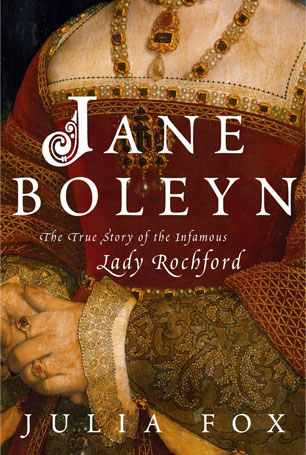
    I am deliciously settled into Julia Fox's delectable biography, Jane Boleyn: The True Story of the Infamous Lady Rochford. Have a glass of milk and curl up: it's a bit like reading a novel. i'm unfamiliar with contemporary biographies, and, honestly, this revisionist history reminds me a bit of Lytton Strachey's narratives. Jane was bad, bad, bad: a traitor and a gossip. So we've heard. But Julia Fox has written the case for Jane: she has researched every document or oblique reference to Jane, as is evident from the detailed notes and bibliography My only problem is that she is too quick to admit what she doesn't know . No one seems to have bothered much about Jane except Fox, and it seems that little has been documented. Nonetheless, she has read depositions, biographies, Henry's letters to Anne, wordings and proceedings of the marriage ceremony, manuscripts at the Nathional Archives: this research must have taken years.

    Fox frequently uses the subjunctive, however, and this makes me distrust her. There are quite a few "may haves" and "might haves" as Fox struggles to put together the puzzle. The biography would be (subjunctive again) more plausible if she used direct or indirect statements.

    Page 246: "We do not know the precise date of Jane's appointment as a lady of the privy chamber but once installed she was likely to come across several of her friends and acquaintances. Her mother's sister, Katherine, recentlyw widowed by the death of Sir Piers Edgecombe, would be there, and so would young Katherine Carey, Mary Stafford's daughter."

    There's also a lot of: "Jane may well have been included in one of those ceremonies."

    So my question is: how much do we really know about Jane Boleyn? Thus far, the convincing passages center on Anne, about whom so much more is known. Less subjunctive would help here. So perhaps the title should be: The Conflict of Anne and Jane, etc.

    I'll keep reading. I'm only halfway through.

    Friday, September 26, 2008

    A Good Indian Wife


    I stayed up till the wee hours reading Anne Cherian's novel, A Good Indian Wife, one of B&N's Discover books. Why is contemporary Indian literature so good? I started with Narayaon and moved on to Jhabvala, Ghosh, Bannerjee, and Manil Suri. These novels are all exquisitely written yet earthy and rich with subtle undertones . But Cherian is exceptional at conveying the culture of Inida, the radical differences between an Indian village and San Francisco. The story is absorbing but we also see the immigrant's view of the seeming coldness of America.

    We see and feel the action through two main characters: the stay-st-home Leila and the doctor Neel, who spends much time flying his own plane when he isn't with his American girlfriend.

    The main character, the sympathetic character, is Leila, a 30-year-old teacher of Shakespeare, who becomes a "victim" of an arranged marriage in India. Rejected again and again by suitors, she is thrilled when an Indian man from San Francisco returns to his village and agrees to marry her, through a kind of comedy of errors. (And which Shakespeare Cherian was referring to I'm not quite sure, but she and Leila know their Shakespeare thoroughly, so obviously there is a prototype).

    Since she has no dowry, she has no choice but to live at home and teach at a women's college,. The prospect of marriage relieves her, even though Neel doesn't come to see her after the initial marriage brokerage. she believes the wedding red sari makes her look fat, and the hennaed designs on hands and feet are not her usual fashion statement. This portrait of Indian life is fascinating: the trips to sari shop, the struggles with relatives (both Leila's and Neel's), the food preparation, and the traditions that are completely humiliating to Neel, the reluctant husband.

    Chernan alternates points of view--Leila's and Neel's--so we understand Leila's terror at Neel's stark apartment and worry that he isn't a doctor after all; and Neel's resentment of the marriage contrived by a pushy aunt and by his grandfather's assurance that he needs to see Neel married before he dies. Neel cannot believe he is in this situation. Neel lies about his work hours so he can frequently visit his blond American girlfriend, rather stereotypical but, yes, the manipulative bimbo who schemes to break up his marriage. We feel Leila's aching loneliness and isolation in an apartment house in San Friancisco where no people are on the streets and watch with fascination the development of the marriage. There is much more to this novel. Such good writing!

    Sunday, September 14, 2008

    The Last Victorian Proto-Feminist Heroine


    From Oct 23-26, at the L. M. Montgomery Research Center, scholars and Anne aficionados will convene to explore the cultural influence of Lucy Maud Montgomery's books. They will also celebrate the centenary of her first and most popular novel, Anne of Green Gables. And if you've never read Anne, this is a good year to begin, because there are innumerable articles about the centenary.

    The Anne of Green Gables books are not only girls' novels, but also "cult" books: readers, especially women like me, who have not read Anne in many years, will be amused and amazed to rediscover Anne's wit, charm, romantic imagination, and humorous adventures.

    Montgomery, who wrote 24 books between 1908 and 1939, was not an Anne: she was a complex, energetic woman, whose idealized Anne reflected her optimism, but who had a darker, anomalous adult self, which had to cope with depressions and the loss of a son. Unhappy at 30, she wrote in her diary : " Only lonely people write diaries." After involvements with two men, one of whom she was briefly engaged to, she eventually married a minister (as does Phil, a character in Anne of the Island, who, also ditches two men to marry a minster). After marriage, Montgomery indefatigably played the role of the minister's wife, cared for her husband during his frequent depressions, raised children, and wrote and wrote and wrote.

    Montgomery is undoubtedly the Louisa May Alcott of Canada. Anne, the heroine of an eight-novel series, is a more feminine, whimsical equivalent of tomboy Jo. Both are covertly feminist, though they certainly make no speeches about it, and both unfortunately become more boring after marriage: that marks the end of the best adventures of Anne and Jo, though Montgomery and Alcott desperately introduce charming new characters and sometimes tragic situations. Anne is less shy than Jo--she has the gift of gab--and is more socially adroit: she would never accidentally burn someone's hair with the curling tongs, because she would know how to use them. Hair, however, is an issue in both books: Anne has red hair, which is a trial to her, and Jo's one beauty is her hair, which she cuts off to support her father in the Civil War. Different as their personalities are, they both cope with poverty, are extremely strong-willed and competitive, get into scrapes, are high achievers in the workplace, and inhabit a moral but not stuffy atmosphere. Jo is awkward despite her brilliance, but the more sociable Anne brings sunshine to others by genuine curiosity and by coaxing cranky old women, bachelors, "old maids," and troublesome students into surrendering some of their power for the greater good.

    Are the Anne books as good as I remembered them? Yes, in fact , they are: lively, all-ages books. The first novel, Anne of Green Gables chronicles her childhood, when she arrives as an imaginative orphan on Prince Edwards Island, where her new guardians, Marilla and Matthew, are expecting a boy;; Anne of Avonlea describes her experiences as a teacher in a one-room-schoolhouse; Anne of the Island her university years; Anne of Windy Poplars, an epistolary novel, delineates her three years as principal of a high school; and Anne's House of Dreams is the story of her marriage. (I have yet to finish the rest of them,, and I certainly never read all of them in childhood. ) Anne is a role model but she is not a prude: she loves good clothes, organizes a civic improvement society in Avonlea, turns down a proposal from a man who sends his sister to propose by proxy (she is insulted but then she sees the humor), enjoys matchmaking and meddling (even advising elopement on one occasion), and befriends classmates and waifs, at Avonlea's school, a stand-offish schoolteacher, crankly neighbors in Avonlea who eventually become proud of her, college roomates who include an intellectual beauty who prefers to flirt and dither than show off her brains, darling widows who run a boarding house, a lighthouse keeper, and, of course, Mr. Right comes along, more or less in the guise of Jo's Lauriey (WHAT was Jo thinking when she turned him down?)

    There is even a scholarly Norton's edition of Anne of Green Gables, if you don't want to get caught reading Bantams. And you can buy the complete set of Anne books: I believe there are 8, though more if you cound the Chronicles of Avonlea and Further Chronicales of Avonlea.

    She also wrote many other series, including the autobiographical Emly books, with which I am less familiar.

    By the way, the Montgomery conference url is: http://www.lmmrc.ca/

    And here is an url to a radio podcast:

    http://www.onpointradio.org/shows/2008/08/anne-of-green-gables/

    Monday, September 08, 2008

    An Orderly Man

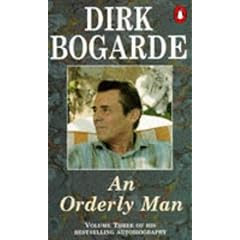
    I was walking through the library, idly gazing at biographies, when Dirk Bogarde's name jumped out at me. I had seen “Despair” (based on Nabokov's novel), when I was a teenager and lacked the concentration to appreciate it. But somehow I knew his name, knew he was a good actor, and wanted to read his memoir.


    In An Orderly Man, which is a sequel to two earlier memoirs, Snakes & Ladders and A Postillion Struck, he documents his life from his late '40s into his '50s. Tired of the hectic life of an actor, he buys a small run-down house in France (which is the frame and organizing concept of the memoir). The house needs extensive renovation. He hires an architect to redesign the house, which the architect explains has been neglected for 500 years. While Bogarde is away finishing a film (he retires only occasionally), the architect and contractors finish the house.

    His account of what happens next is humorus yet despairing. Everything that can go wrong did. The moving truck smashes half his possessions, the pond that he paddles around in turns out to be leaking sewage, and his topsoil was limestone and dust.

    But the lack of electricity is the worst thing.

    “It was August, the middle of the biggest French holiday. Not a hope of finding an electrician, let alone one who knew where the main cable might run. We continued unloading the vans as fast as possible, all thoughts of a refreshing bath banished, no light, and presumably no heat to cook.”

    Of course all that is soon taken care of, and he lives quietly for two years in the well- loved house, working in his garden and entertaining his family. He also begins to think of writing. Amazingly, almost as in 84, Charing Cross Road, he corresponds with a brilliant old woman ( who once lived in his english house, who helps him fill the gaps in his literary education, returns his letters with grammar corrections, and shares his life at a distance.

    The house in France gives him the quiet he needs to write.

    He goes back to work after two years because he needs money. He works on many commercial films, but he also writes about working with Visconti on “A Death in Venice” (he writes about the concentration demanded by his role, but he’s fabulously funny about his co-star, who has been buillied into acting by his grandmother and cares about nothing but motorcycles).

    Then he is very proud of his work on Liliana Caviani’s “The Night Porter,”which sounds agonizing: about an SS man and a non-Jewish woman in a concentrration camp who falls in love with him. Cavani, Bogarde, and his costar, Charlotte Rampling were sued for obscenity in Italy. They won their cases, but this is the kind of art film he tended to be involved with.

    Friday, September 05, 2008

    Hanff


    This morning I read Helene Hanff’s Q’s Legacy, which is a prequel-sequel to her best-seller 84, Charing Cross Road, and a chatty hybrid memoir which literally tumbled out of a china cupboard (where there are books, not china). It's difficult not to enjoy her first book, the popular 84, Charing Cross, which is a charming collection of letters between Hanff, a New York writer, and the employees of Marks and Co., an antiquarian London bookseller. (Amazon doesn't quite go in for this.) In Q’s Legacy, she describes the events that indirectly led to the writing of her best-seller: after weirdly failing a college scholarship exam by not knowing how to read maps (she was otherwise a stellar student), she discovered by chance the books of Sir Arthur Quiller Couch, which she used as a guide to studying literature. She also needed out-of-print books after reading Q: thus began the correspondence with Marks and Co. The Q-based literary background enabled her to win a playwriting contest, move to NY, work in the theater in many capacities, write magazine articles, and eventually meet the witty Asian editor and friend, Gene, who helped her find a publisher (Helene eventually helped Gene pass her U.S. citizenship test). Helene's friends included famous editors, actors, and fans who telephoned her at midnight. It's a very touching, funny book, vaguely reminiscent of Elaine Dundy's writing (Dundy was also a playwright).

    Friday, August 29, 2008

    Midnight's Children


    Blogging once a week is enough for me, I've decided. I've been incredibly listless lately and have deleted one entry after another (this one should be deleted, but I'll leave it here). Before I talk about Rushdie, I want to speak about how much I envy those who can blog every day, amusingly and well. Some bloggers are so witty and perspicacious that I've bought as many books from them (essentially) as I have from bookstores. After reading blogs like, say, dovegreyreaderscribbles, I often thrill to the siren of a good book. I love having a journal of my reading, but it IS easier to list books in a journal (any notebook will do, though I have a Moleskine, as do many of us online ). Scribbling: that’s the underground, pre-blog way to list books

    I'm more than halfway through Salman Rushdie's Midnight's Children,, as two of his books were given to me for my birthday and I've chosen to start with this one (winner, 1981, Booker Prize). I only wonder why it’s taken me so long to discover Rushdie This particular incident will perhaps sound silly, but a pompous bookstore owner DID try to prevent me from buying it in the '80s. Sitting behind the counter giving hostile looks to the customers, he said, “Midnight’s Children will mean nothing to you; it means something to me.”

    Well, okay. He allowed me to buy Marilynne Robinson’s Housekeeping. But I should have bought Midnight’s Children from a more stable bookseller: independent bookstores in those days had no competition and were occasionally owned by demented entrepreneurs. I miss the best one, but it's impossible to pretend they were all "cozy" or inspiring or whatever the myth is. I'm sure there are cantankerous booksellers everywhere: in B&N and Borders, too.

    Midnight’s Children is part fairy tale, part David Copperfield ("I was born in the city Bombay...once upon a time...”), the story of midnight-born children on August 15, 1947, the moment of India’s independence. Narrated by Saleem Sinai, a midnight child, the novel brilliantly interweaves the present with the past, depicting the partly-mythological adventures of a family, and on another level, an allegory of the post-Indian political happenings.

    Thursday, August 07, 2008

    The Caravaners


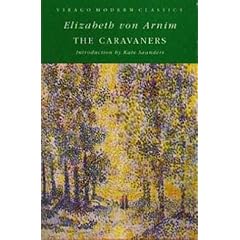
    Elizabeth von Arnim’s The Caravaners, a gentle, charming satire, is, indeed, the kind of novel I would have read in 1909, when doubtless I would have been a housemaid pretending to dust the drawing room. The Caravaners is vaguely based on von Arnim’s own experiences as a caravaner, which she embarked on after seeing an advertisement for vans and horses (very like another adverisement, the impulse behind the trip to Italy in Enchanted April). “Pray for fine weather, my child,” she wrote to her daughter. “For if it wet heaven knows what will become of us.” According to Kate Saunders, who wrote the introduction of the 1988 Virago edition, “it was the wettest August on record, and the caravaners spent most of their time shivering over the cauldron of rain-splashed porridge.”

    There is nothing worse than camping in the rain. Those of us who have done it know the misery. But Baron Otto von Ottringe, the narrow-minded narrator, does not put a good face on anything (and after all he has a caravan, not a tent). We see everything through the eyes of this smug, narrow-minded, anti-English Prussian, who has been persuaded to take a caravan trip in England with his young wife, Edelgarde (partially because it is cheap ). On the trip he hates every minute of it (just as he hates England): tramping beside the horse while it pulls the caravan (he had pictured sitting cosily inside), guiding it through narrrow gates (symbolic of his narrowness), rain all the time, begging food from farmers who won’t always sell to them, holding umbrellas over brew pots, sausages that never brown, washing up (which he shirks as women’s work).

    His wife, Edelgarde, on the other hand, blooms. She shortens her dresses and refuses to wait on him. She points out that he can do everything he asks her to do. He cannot understand this rebellion. She relaxes as a result of her liberal companionship: the politically liberal German woman who suggested the trip, her Anglicized German sister, Mrs. Menzies-Legh, who has lived in England for many years, Jellaby, a socialist, and a lord, with whom Otto won’t even talk until he finds out he is “Lord Sigismund’” Otto alienates everyone. He only sees the caravaners as a microcism of his own society, in terms of rank, which he cannot spot in this classless society among the caravaners.

    What a good book! Really a classic of its kinds. And it is set during August...

    Monday, August 04, 2008

    Mansfield Park


    I’m hanging out, sipping lemonade, reading Mansfield Park, a brilliant novel but somehow dull to me, especially after Persuasion. Fanny, the (anti-)heroine, is not unlike Anne in some respects, good, kind, competent, but timid, immature. prim, and without humor. A ward of the Bertram family, Fanny has never felt herself the equal of her female cousins, who intimidate her by referring to her as "stupid," etc.. She is generally overlooked except by Edmund, the second son, meant to be a clergyman.

    Fanny improves as time goes on, but her saintly temperament changes only as a result of jealousy. Mary Crawford, a lively young woman (with bad morals, of course), visits her sister at the parsonage, and Edmund delights in her vivacity. Mary and Henry Crawford, her brother, love to flirt, and within a few weeks Henry has broken the hearts of both Maria and Julia Bertram, and Mary has won Edmund’s heart (with more ambivalence about breaking it). The central scheme of the novel is a “racy” plan for amateur theatrics devised by Mr. Bertram, the hapless, licentious oldest brother (perhaps very like Henry). The play will bring the "lovers" together. Fanny from the start is scandalized, and Edmund, too, tries to discourage his swept-away siblings. But eventually Edmund’s admiration of Mary Crawford clouds his judgment: he cannot allow a stranger from the neighborhood to act as a lover with Mary. Fanny, who is in love with Edmund (who regards her as a younger sister), is very distressed not only by his acting, but by his acting with Mary.

    The return of Sir Thomas stops the play. Henry’s seduction of Maria and Julia also stops: he hastily leaves Mansfield.

    Is theater an evil? Because it allows amateurs to transcend emotional boundaries? Or is it ultimately hurtful because amateurs can't tell the difference between real and acted love?

    Mary Crawford stays behind and Fanny is constantly overwhelmed by her kindness (jealously),

    Not to give away more of the plot, I will instead quote from Vladimir Nabokov’s Lectures on Literature (given at Cornell):

    “Mansfield Park is a fairy tale, but then all novels are, in a sense, fairy tales. At first sight Jane Austen’s manner and matter may seem to be old-fashioned, stilted, unreal. But this is a delusion to which the bad reader succumbs. The good reader is aware that the quest for real life, real people and so forth is a meaningless process when speaking of books. In a book, the reality of a person, or object, or a circumstance depends exclusively on the world of that particular book. ...The charm of Mansfield Park can be fully enjoyed only when we adopt its conventions, its rules, its enchanting make-believe. Mansfield Park never existed, and its people never lived.”

    But in his next essay, on Bleak House, he begins.

    “Personally I dislike porcelain and the minor arts, but I have often forced myself to see some bit of precious translucent china through the eyes of an expert and have discovered a vicarious bliss in the process. Let us not forget that there are people who have devoted to Jane all their lives, their ivy-clad lives....”

    I hate it when they go on and on about Jane's miniatures, etc. Comparisons are odious: Austens' books cannot be compared with Dickens's; and I very much dislike this reference to "ivy-clad lives." Nabokov's chapter on Mansfield Park seems dispassionate, but that whole "women's angle" thing is out of place.

    Friday, August 01, 2008

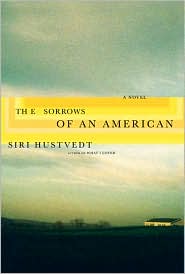
    The Sorrows of an American


    I've found a really good novel by Siri Hustvedt, The Sorrows of an American, about which I knew nothing. The narrator, Erik, is a psychiatrist and his sister, Inga, is a philosopher. After their father's death, they go back to Minnesota to clear out their father's papers. The papers trigger and change the narrator's memories, dreams, and responses. "I am lonely," he keeps muttering. He realizes he has been saying it for a long time.

    Everyone in his world is lonely, or alone. He is divorced, his sister is widowed with an only child, his tenant is an artist mother with an only child. Mr. T, a former psychiatric patient, shows up on his street, babbling poetry, in intense pain

    "Chip planters from the other side, channeling me, man, the great dead heads (not grateful, ungrateful), Goethe, Goering, God, Buddha, Bach, Bruno, Houdini, Himmler, Spinoza, St. Theresa. Rasputin. Elvis. Talkin' graves. Chosen from the other side. Nondimensional spaces, texts coming through, beating me hard up there. Mingus. Fear and trembling, trembling, and fear...."

    The patient needs his notebook. He has stopped taking his medicine, because it has made him obese. At the emergency room, the narrator explains that Mr. T needs his notebook. Mr. T is allowed to keep that, but in the psychiatric hospital they don't see him as special and the narrator is grieves over Mr. T's grief.

    Unlike Mr. T, the dangerous former boyfriend of Miranda, the artist-tenant, photographs her all over the city and breaks into Erik's house.

    Miranda does not find this odd. She, an artist, continually makes excuses for the behavior of another artist, a photographer.

    Hustvedt has this exactly right.

    Lots about dreams. A discussion at the dinner table about dreams, interpretation, remembering them, how writers use dreams. The novel sometimes reads like a series of eerie dream sequences.

    Thursday, July 31, 2008

    Persuasion

    What does it mean to be a Janeite? Does it mean I can go to the convention as a journalist and interview Janeites for an alternative paper? (The conference is sold out.)

    Austen fans have uniformly good taste and all seem to have a favorite novel. Some argue for PRIDE AND PREJUDICE; others for SENSE AND SENSIBILITY; still others for EMMA; others for MANSFIELD PARK. I cannot tell you how many writers have written about MANSFIELD PARK : A. S. Byatt and Ignes Sodre in IMAGINING CHARACTERS, Nabokov in one of his lectures. No one seems to like MANSFIELD PARK much, so one wonders why they bother.


    This was my year of PERSUASION. I read this as satire, though many read this as a conservative novel reinforcing class and rank.

    Anne Elliott, quiet except for her inner voice, is almost too demure at 27, and is unlikely to marry, having already turned down two proposals. Wentworth, the man she loved, was disapproved of by her family and by Lady Russell, her arbiter of taste; Charles, whom she didn’t love, settled for her sister, Mary. When Captain Wentworth shows up in her life again, he almost sadistically flaunts his preference for another woman. Yet the two are not unaware of each other. We experience Anne's agony personally; we hear Wentworth addressing Anne's weaknesses when he talks to his new love interest, Louisa, obviously still more than a little obsessed with Anne.

    There are so many triangles in PERSUASION, too many to chart. Anne, her brother-in-law, Charles, and Mary, her sister; Anne, Wentworth, and Louisa (Wentworth’s new love interest); Anne, Captain Benwick, and Louisa, etc.. Anne is much in demand for a demure and pale beauty.

    There are also parallels between PERSUASION and other books. Mrs. Smith and Miss Smith in PERSUASION and EMMA (there is even a Smith in MANSFIELD PARk); the trip to Lyme with day trips in other books; etc.

    Have heroes ever been so cranky? Captain Wentworth, Knightley, Darcy, etc.? Love can tame them.

    Anne does learn in the novel. She has compromised in the past, but learns more about asserting herself and flirtation. She is occasionally snobbish, but mostly inwardly mirthful over her father's and sisters' obsession with class (espcieially Mary's inappropriateness: of the sisters, she is the one we like the best). Anne has made mistakes, but is so likable, heroic (the only one not to panic when people get sick), though it doesn't always show on the outside: again, she hangs back, useful in the household, like a maiden aunt, never putting herself forward, a brilliant woman who can read Italian, appreciate music, who knows the social forms, but in the end knows the forms get in everyone's way.

    Tuesday, July 29, 2008

    Bachelor Girl Lit 101 (written during my "pop" period)


    There’s no urine test to prove it, but I AM addicted to an outmoded literary genre. In an age when the press reports an alleged man shortage and pop sociologists document post-30-aged women’s diminishing chances of marrying, I’m urging the revival of what I personally call ‘60s Bachelor Girl Lit (a predecessor of Chick Lit).

    In these mostly British novels, all of which were published during the ‘60s, the unmarried heroines get a lot of fun out of life. (Remember fun?) Adventurous, sexy, and refreshingly light-hearted, they generally settle in cities, run with arty crowds even when suck in humdrum jobs, and like men without necessarily wanting to get married.

    Why the ‘60s, you may ask. Well, quite simply: hard-working women of the latter-day ‘80s crave entertainment. After a long day’s slaving in the harsh, cruel world, light reading in the bathtub is the ultimate luxury. And the buoyant antics of ‘60s bachelor girls are infinitely more amusing than the alienation of housewives and mistresses described in ‘70s fiction, or the terminally cute befuddlement of post-feminist heroines of the ‘80s (can they get any quirkier?)

    A recent rereading of Bachelor Girl Lit evoked fond memories: the exhilarating struggle for self-determination; the solitary highs and lows of single life; the single outsider’s keen perceptions of the compromises and drawbacks of married life.

    Most important, however, these wry, funny novels buoy the spirits of single and married women alike.

    1. THE EDIBLE WOMAN by Margaret Atwood. Nice girl Marian is engaged to an equally nice young lawyer; her mini-skirted roommate, Ainsley, leads a wild life. When unexpected events trigger Marian’s rebellion, all hell breaks loose. An extremely funny book.

    2. CASSANDRA AT THE WEDDING by Dorothy Baker. Awarded a Houghton Mifflin Literary fellowship for her first novel, YOUNG MAN WITH A HORN, Baker wrote CASSANDRA AT THE WEDDING in 1962. The narrator, Cassandra, disturbed by her twin sister’s engagement, wreaks havoc before coming to terms with “the things that get in your way; the indignities you have to suffer before you’re free to do one simple, personal, necessary thing--like work.”

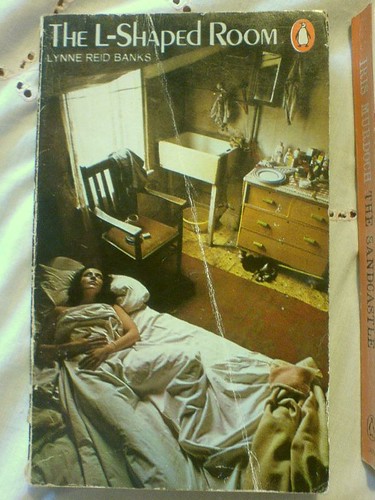
    3. THE L-SHAPED ROOM by Lynne Reid Banks. Pragmatic Jane Graham is respected at her public relations job. A slip-up--an unplanned pregnancy--forces her to examine her life. In a bug-infested L-shaped room, she befriends some unconventional Londoners and makes peace with her disapproving father. (Two sequels published in the ‘70s, THE BACKWARD SHADOW and TWO IS LONELY, relate Jane’s further adventures.)

    4. THE GREAT OCCASION (in THREE NOVELS) by Isabel Colegate. Attractive Angel listlessly attends a succession of wild parties while secretly pining for a charming homosexual friend; Charlotte falls in love with an artist sight-unseen on the basis of his paintings; and Selina, on whom our hopes are pinned after the others grow disillusioned, remarks, “I think it’s better to be in love with someone you don’t know...Then they themselves don’t play any part of it, loving or not loving you.”

    5. THE MILLSTONE by Margaret Drabble. Brainy Rosamund theoretically approves of the sexual revolution, but hasn’t yet experienced it personally. When she takes a break from her research to lose her virginity, she has the bad luck to get pregnant.

    6. A JEST OF GOD by Margaret Laurence. Time is slipping by for 34-year-old Rachel, whose invalid mother dominates her. During a brief, not always happy, love affair, she discovers the importance of taking risks.

    7. THE COUNTRY GIRLS TRILOGY AND EPILOGUE by Edna O’Brien. The first two novels in this recently reissued trilogy constitute a lyrical coming-of-age story. Caithleen and Baba, two bickering, mischievous friends, contrive their own expulsion from a convent school and move to Dublin to pursue fun and love. Obrien occasionally overwrites the wispy, romantic parts, but it’s all undoutedly true to women’s literary heritage.

    There should be ten here, but I’m missing a page.

    Sunday, July 27, 2008

    Elizabeth Taylor: Hide and Seek


    My social circle used to comprise people who read Elizabeth Taylor, Elizabeth Bowen, and Elizabeth von Armin. We would roam around at political parties, eating ghastly food and trying to think of something to discuss besides politics. When we discovered similar tastes in literature, we argued for our favorite Elizabeths: Elizabeth Taylor seemed to get the most votes, though her characters always seemed a little too ladylike to me. (How do they get so ladylike?) Elizabeth von Armin’s novels also have their fans, particularly for The Enchanted April. Elizabeth Bowen, with her elegant prose and sometimes dark point of view, appeals most to me, though she's the dark horse.

    Elizabeth Taylor’s A Game of Hide and Seek certainly has its merits (such as being a delight). Her deceptively simple style offsets a complicated narrative about young and middle-aged love. Harriet, the central character, believes she is not good at anything. At 18, she fails her exams and disappoints her mother, a former suffragist whose politics Harriet despises. Harriet falls in love with Vesey, the cynical nephew of her mother's best friend, and Vesey upsets the family (for instance, he takes Caroline's children out to eat meat, which they are not allowed), causing Caroline to make an excuse to send him home to his mother. Because he is only able to get attention by pseudo-sophisitcation, he is willing to hang around in his frivolous mother's boudoir and watch her apply beauty treatments while he cracks cynical jokes. He is eventally sent down from Oxford for the turmoil he causes and for his lackadisical attitude toward work.. Harriet's and Vesey's failure is a bond.

    When they meet in their 30s, Harriet ismuch more confident: she has married Charles, a successful businessman and is the mother of an intelligent child who loves Greek; Vesey is a bad actor who works in regional theater, and is still cynical, still charming when he wants to be. Vesey's disruption of the household irritates Charles, furious at the reappearnce Harriet's formerr lover (even if the love was not consummated). One can't help but think it's silly for Harriet and Vesey to become involved, but Harriet has a spark that has been smothered by Charles. On the other hand, Charles and Harriet are very well-suited in conservatism: Charles's has rejected his mother, a former actor, whose dramatic ways still irritate him , just as Harriet disliked her mother's politics.

    Charles reads Persuasion, his favorite book, and wonders what marriage is about.

    The novel isn’t perfect, however: some of the really interesing characters die, or become cardboard walk-ons: Harriet's mother dies; Caroline, Vesey’s vegetarian aunt dies, the two young children, with whom Harriet and Vesey play Hide and Seek, show up at their mother's funeral in dreary military uniform.

    Elizabeth Bowen (yes, my Elizabeth!) reviewed it, “Soberly speaking, however, it is not too much to say that A Game of Hide-and-Seek has something of the lucid delicacies of Persuasion, together with, at moments, more than a touch of the fiery-icy strangeness of Wuthering Heights.”

    Thursday, July 24, 2008

    One of Our Conquerors by George Meredith


    One of Our Conquerors is a very good, if not great, novel, but I closed it thinking, “This is enough Meredith for now.” Meredith writes witty, epigrammatic, baroque English: some will like it, others not. The main issue of the novel is divorce, and it is reminiscent of Edith Wharton's themes, also dealing with hypocrisy and the double standard for women.

    In the first chapter, Victor Radner, the Babbit-like businessman and central character, sullies his white waistcoat. Cleaning up the “absurd blots of smutty knuckles” and buying a new waistcoat is easier than defending the sullied reputation of his mistress of 20 years, Nataly, who, blackballed by bores, never finds her place in society. Their daughter, Nesta, who grows up in their bohemian musical circle (Nataly is a former singer), knows nothing of their unmarried relationship. Money can protect Nesta, if not Nataly. Victor blames his first wife, who still bears his name, Radner, for not giving him a divorce. He says she shouldn’t have married him in the first place: she was too old. Divorce is the issue, but so is Victor's hypocrisy and the hypocrisy of society. Two women’s lives have been ruined. Nataly, increasingly worn and sensitive, has almost ceased to love him.

    Victor does has a buoyant sense of humor, which makes him likable. He laughs about his waistcoat. “But I am taking it seriously,’ he said, and jerked a dead laugh, while fixing a button of his coat.”

    The dead laugh--this sadly is the tone of the whole novel. Every incident follows on Meredith's beautifully planned interwoven path.

    We see some of the chapters through Nataly’s and Nesta’s points of view. Meredith understands them very well. They love Victor, but he is too ostentatious for them. They want to live a quieter life.

    This is a very worthwhile, and the more I think about it, unconventional novel.

    Monday, July 21, 2008

    The Rector's Daughter


    Sometimes it seems that spinsters dominated the women’s literature of the 1920s and 1930s. Viragos particularly published women's classics about the lives of spinsters, while the "gentler" Persephones are often women’s “family” novels. (Not always, though.) Viragos have had a determined spinster slant since their beginning 30 years ago: In 1984 they published an original papterback by Sybil Oldfield, The Spinsters of this Parish, partially about F. M. Mayor.

    F. M. Mayor’s The Rector’s Daughter (1925) is a spinster lit masterpiece. The women characters are saddish and in part shaped by their environment: Mayor's vivid writing rather Gothically potrays Dedmayne, the damp and moldering village where Mary, chief spinster, has lived her whole life (one of Mary's favorite writers, Trollope, wouldn't have been caught dead in Dedmayne: he preferred less moldy hamlets, preferably peopled by aristocrats). Mary, rather exhaustingly intimidated by her father, has only occasionally left home.

    Mayor writes: “Dedmayne is an insignificant village in the Eastern counties...Dedmayne was on the way to nowhere; it was not troubled by motors or bicycles, except native bicycles. The grimy “Blue Boar” did not induce any one to stop for tea. Artists and weekend Londoners wanted something picturesque....”

    The village is not picturesque; neither is Mary. She prefers winter to any other season. She doesn't like the hyperbole of flowers. Rain and black trees suit her best. She has no outlet for her energy. After her mentally iill sister, Ruth, is released from an asylum, Mary cares for her until she dies of a stroke. Her father doesn't grieve. The servants love and coddle Mary.

    Mary is not a desperate character: after Ruth's death, she travels with an aunt and stays at a boarding school where the women conspire to help her change her appearance and hope she’ll catch a man. Mary doesn’t mind dowdy clothes and unfortunately the only man in the boarding house doesn’t consider proposing to her (though she doesn’t particularly like him and he has been rejected by all other female society there).

    Her friends begin to reappear in her life,. This is not a drab, hopeless book. Mayor is not too serious--she writes with humor of a woman whose life “went round in its accustomed round; Advent Sunday, Carols, the Christmas treat, Ash Wednesday, and a hope that people will come to Church this Lent (never realized);...summer treats; garden- and tennis-parties....”

    The novel is not without a love interest. But when Mary is invited to mix with the upper class, a small tragedy happens. Her relationships are unbalanced. Horse-and-hunt women with nicknames like "Jim-Jam" turn her world upside down. Kathy, a beautiful woman who doesn't notice Mary, particularly hurts her.

    There is much more to this than plot, of course. Mayor's direct narrative does not get lost in sentiment. This is a startling book, never softening Mary's difficulties, and the character, unlike Barbara Pym's single women, is penniless. That of course makes all the difference. Without money, how can these women live? Pym's women can work.

    Saturday, July 19, 2008

    Elizabeth Gaskell


    I read a little today: 100 pages or so of Wives and Daughters, which I’m reading for a book group (and as usual I’m behind.) This is one of those forgotten novels--forgotten by me anyway--which have been revived by feminist critics in recent years. (I myself first read it as a graduate student, after reading Gaskell's biography of Charlotte Bronte.) Wives and Daughters is a rich example of her work, almost contemporary in its understated style, and is generally regarded as her masterpiece, Gaskell's style is quiet but intense, not unlike her friend Bronte's style in Villette (another masterpiece). Each character and episode is delineated skillfully, especially the character of Molly Gibson, whose life is sketched childhood to womanhood. Molly, a doctor’s daughter, is quiet, yet emotional and spirited, strongly bound to her father, and imbued with a sense of rightt.. She makes friends mainly among older people, because ther are no young ones in the neighborhood. Her father's marriage to a (slutty) former governess breaks up Molly's home: old servants are dismissed; she prevents Molly from visiting an old friend merely for the sake of stopping her; and she cares only about fashion and a posh social life (she wants to make Molly drop her old friends). Gaskell contrasts Molly with her new stepsister, the beautiful Cynthia, who doesn't stick strictly to the truth herself, doesn't care about people admiring her beauty (they've always done that),and informs Molly repeatedly that she'll never "be good." Yet the two amuse each other greatly: Molly has never known anyone like this.

    By the way, we're reading Gaskell in this book group: http://groups.yahoo.com/group/trollope-l/

    In his 1866 review of Wives and Daughters , Henry James wrote: "The book is very long and of an interest so quiet that not a few readers will be sure to vote it dull....The reader will be tempted to lay down the book and ask himself of what possible concern to him are the clean frocks and the French lessons of little Molly Gibson. But if he will have patience awhile he will see.”

    Henry, I loved the details.

    Thursday, July 17, 2008

    Hiatus

    It’s very difficult to keep a daily reading journal, the kind of thing I used to ask my students to do in a “Writing about Literature” class. My students didn’t know what a reading journal was. Neither did I. But they'd scribble about Heart of Darkness or P. G. Wodehouse or whatever they were reading and I’d write about what I was reading and occasionally we’d read bits aloud. They’d groan when I read mine: “Not E.M.. Forster again.” But I was reading about E. M. Forster and, believe me, they learned about him

    I've been drinking a lot of iced tea lately. I mean a lot. It is very hot here and there's a constant struggle about whether to keep the air conditioner on. So I've been reading Angela Thirkell.

    She was the granddaughter of Burne-Jones, and made her living as a writer from the age of 30 on. Her novels are witty in a somewhat subdued goofy way (though this might offend class-conscious people: her people are snobs, but the humor makes them occupy their own little world: nothing like any world I know). Angela Thirkell's What Did It Mean? made me laugh so hard I forget about the humidity. No one reads her anymore except for members of the Angela Thirkell Society. Go to their web site and learn all about her books.

    George Meredith’s One of Our Conquerors is temporarily on hiatus: the yellow pages in the 1914 edition crumble in my hands. One of Our Conquerors is, however, available in some new paperbacks( published by (Kessinger or BiblioBazaar) and I have ordered a new copy. (This also might be available online, but I haven't looked.)

    In the meantime I’m beginning Hostages to Fortune by Elizabeth Cambridge. The Persephone web site say it’s being reprinted so I feel incredibly lucky to have a copy. The Saturday Review i in 1933 said it was not "a beach companion" but “a book to be read and relished in an armchair at home.” So those of us who don't go to the beach much won't feel intimidated.

    Tuesday, July 15, 2008

    One of Our Conquerors, Pomfrey Towers, and Time after Time

    What do you read in the heat? (A) mysteries, (B) classics, (C) non-fiction, (D) Other?

    Where do your read it? (A) on a chaise longue wearing earplugs to keep out the lawnmower noises, (B) sprawling in a comfortable chair with a fan overhead, (C) at the office between checking e-mail, (D) ) Other?

    As for myself:

    1. As promised, I have read a mystery, Time and Time Again, by B. M. Gill. Narrated by an upper-class accountant who has spent 18 months in prison for throwing a rock at a policeman during an anti-nuke demonstration, she cannot fit into conventional society (people keep telling her she had a cushy time in prison) and secretly hangs out with a shoplifter she met in prison.

    2. Angela Thirkell’s Pomfret Towers (Thirkell writes humor books, somewhere between A Provincial Lady and P. G. Wodehouse).

    3. George Meredith’s One of Our Conquerors, much superior to Beauchamp’s Career. The “revised” edition, published in 1914 by Constable & Company, is, unfortunately, a little crumbly with some uncut pages. (Those rip easily, regrettably). I highly recommend this book, if you can get a copy. It’s rather Edith Whartonish, reminding me very much of The Custom of the Country.


    The contingency of the novel lies in the relationship of Victor Radner to Nataly, a woman he has lived with for 20 years. His first wife, a much older woman, introduced him to Nataly when she was her companion. The first Mrs. Radner has never gotten over her grief over the elopement and has maliciously refused a divorce, Victor, a cheerful Babbilt who is satisifed with money l, is relatively unharmed by the gossip, but society is harder on women, as Nataly knows. And so they have moved from place to place, shunned as soon as society finds out their position.

    The Radners and their daughter, Nesta, attract friends through their music. There is a huge cast of diverse characters who attend the concerts at the Radners’ house: Meredith wittily contrasts teetotalers with oinophiles, etc. His has suitors: Radner hopes to marry her to a lord or some bigwig because he tells them she will have $10,000 a year settled on her.

    Victor builds an enormous house of which his wife and daughter are ashamed, and we learn as much about him through their dialogue and thouhts as we do through Victor's escapades (Meredith also does this in Beauchamp's Career).

    Sunday, July 13, 2008

    Political Novel


    George Meredith’s Beauchamp’s Career is an odd, confused jumble of a book. Some believe this is the best political novel of its kind, but I can’t pretend I like it as much as Phineas Finn. Beauchamp's Career is about not only politics but love, and how one affects the other--love and politics, money and marriage. Meredith's Beauchamp, inspired by the historical character, Frederick Maxse, a radical who ran for election in Southampton in 1868, becomes a radical candidate and canvasses from door to door among the poor, hoping to trigger a revolution. The first 80 pages, however, are devoted to the theme of love. Beauchamp is not a mercenary: he has a platonic affair with a young French girl, who is engaged to an older man. At one point Beauchamp obstinately tries to carry her away against her will on a yacht. This extremism is characteristic of Beauchamps in politics as well, and soon he is defined to us not just as a radical but as appallingly domineering in his relationships with women.

    Beauchamps decides to become a candidate because, after studying the radical pamphlets and speeches of his friend Dr. Shrapnel, he believes that he can equalize the fortunes of English society. Maxse, Meredith's model for Beachamps, wrote. ' ..I found that a number of Britons were slaves, slaves for artificial oppressive circumstances, for the maintenance of which the governing classes stood, in my eyes, responsible," and this pretty much sums up Beauchamp's campaign. Beauchamp's political career hinders his financial prospects with his aristocratic uncle, who not only cuts off money, but furiously sends a catty nephew to oppose Beachchamp in the election. Beauchamp's candidacy, in fact, threatens all society.

    Politics are important, but love and money are more so. “I must have money. I must have money,” he says, forever worrying about starting a radical journal. When Beauchamp’s uncle turns against him, he decides he must marry an heiress. Cecilia Halkett, brilliant and impressionable, would marry him, but her father, the Colonel, understands that Beauchamps wants her inheritance to start a radical journal. Cecelia, too, notices this, but it doesn’t seem offensive to her. She’s not a rebel: she, like Renee, is a “good girl,” who will do nothing without her father's approval. Jenny, the pragmatic niece of Shrapnel, is fatherless and skeptical about radicalism: she has no money, so she is not a candidate for wifedom. But all three women play as important parts: we see Beauchamp more clearly through their eyes.

    Margaret Harris writes in the intro to the 1988 Oxford World Classics: “Women are denied writes, and even needs. Cecilia suffers, grievously; but her position socially and economically is a privileged one, and she has the means partly to salve her hurt by putting to sea. By contrast, for Jenny Denham...male dominance is compounded by her material dependence. However, she has a resilience and self-sufficiency..."

    The book is fairly enjoyable, in a kind of messy way, but If you want to read Meredith, you’re far better off reading The Egoist or Diana of the Crossways.

    Thursday, July 10, 2008

    Haggard Summer


    I'm reading King Solomon’s Mines (1886), an adventure novel by H. Rider Haggard.

    Haggard, who lived in Africa for six years, wrote 34 adventure novels. His fans included Robert Louis Stevenson, Kipling and Orwell. The influence of Treasure Island on King Solomon’s Mines is unmistakable and Haggard genially admitted it: both novels center on a treasure map and describe adventurers who attempt to decode it. The characters in King Solomon’s Mines, however, are nobler and more idealistic. Allan Quatermain, KSM's 50-year-old ex-elephand-hunter narrator, Charles Good, and Sir Henry travel n search of ir Henry’s brother, who was last seen traveling in search of the legendary diamonds of King Solomon's Mines. Wwith the help of a map from a dying treasure hunter, the three travel across Afica. The geography--crossing the desert without water and climbing freezing mountains, in which the streams run south to north--is their primary enemy until they reach a Zulu city.

    Obviously there is more to follow.

    By the way, Haggard's masterpiece, SHE , has three sequels. If you want to read any of Haggard's books online,, they're free at various web sites.. But you can also buy the books in paper and print style....

    Tuesday, July 08, 2008

    Kind of a Summer Thing

    You really need to get out of the house in this heat and spend at least part of the day in air conditioning. Mad Housewife does this. First, she loads her almost-messenger bag with easy reading for coffeehouses. Then she takes off on her city bike. It squeaks. The tires rub. She can’t fix it. But she continues bravely.

    In the fabulous coffeehouse she orders a cold drink (mocha fabucchino or something) and chooses what to read, taking books out of her bookbag.

    Possibilities:


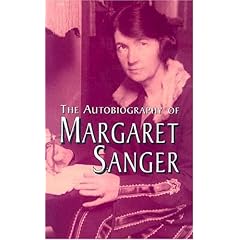
    1. The Autobiography of Margaret Sanger. She's been meaning to read this forever.


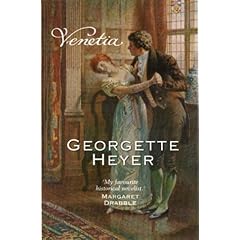
    2. Georgette Heyer’s Venetia. The witty repartee flies back and forth in these humorous romances between libertines and witty George Meredith heroines. Who hasn’t laughed over these?


    3. King Solomon’s Mines by H. Rider Haggard. Mad Housewife is a fan of She, one of the best adventure/romances of all time. Haggard, who lived in Africa for many years, said, “The thing must have heart; mere adventures are not enough. I can turn these out by the peck.” It’s a Dover. You can read it in public. Mine is a triple-pack, She, Allan Quatermain, and King Solomon’s Mines.

    4. Any mystery. It doesn't matter. Agatha Christie, John D. MacDonald, Arthur Conan Doyle...

    Meanwhile, you notice that everybody at the coffeehouse is on laptops doing mysterious things. Perhaps they’re writers; perhaps they’re students; perhaps they’re mad housewives reading King Solomon’s Mines online. It’s kind of a summer thing.

    Monday, July 07, 2008

    Luck

    As you may have noticed, I read mainly older novels. I spent many years happily reading Philip Roth, Ann Beattie, Antonya Nelson, and the late Ray Carver. But lately I have had bad luck with contemporary fiction, such bad luck that I've considered turning to biogaphies, and have one biography on my coffee table as I write this, about Evelyn Nesbit, though I have no idea who she was .

    My cross-off list: I didn’t care for Peter Carey’s latest; Jim Crace’s futuristic trashed world was too horrifying and real (he can create a world); and Ethan Canin’s book simply floored me. How could I hate so innocuous a novel? See my post: http://frisbeewind.blogspot.com/2008/07/just-in-time-for-4th-of-july.html


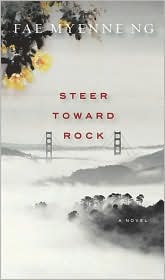
    Fae Mayenne Ng’s STEER TOWARD ROCK is pretty good, though. Ng, a Chinese American born in San Francisco and a finalist for the PEN/Faulkner award in 1994, does not write much but what she writes is perfect.. STEER TOWARD ROCK,, her second novel, delicately integrates voice, identity, and place, making that integration almost the subject, and certainly the foundation of the novel. Her characters, like beautiful Origami figures, are shaped by her poetic prose and confident swirl of voices.

    The main character is Jack Sveto, a butcher who “was sold to a (Chinese-American) woman who couldn’t have babies. The village was so small, its name was a number.”

    And that is part of the sadness of this narrative: the numbers instead of names, the use of false names for illegal aliens. The characters are Chinese illegal aliens (like Jack), immigrants, and Chinese-Americans raised in San Francisco's Chinatown. Stories become confused. Stories and lies become truth. There is also a complicated Chinese belief about holding back part to the story. Even the younger generation is confused about identity.

    Jack falls in love with a woman who won’t love him back. He gets her pregnant; she runs away. She is a Chinese-American with her real nane, She cannot imagine Jack's life.

    “I first saw Joice Qwan at King Duck’s Noodle House. Mankok and I were running a hand truck of butchered pigs to the Four Seas and as we passed, there she was, sitting at my favorite windows, so I couldn’t see her face well. I was drawn to the way she held her bowl, a thumb on the top rim and four fingers underneath, so that the heavy restaurant bowl seemed cradled in her hand. “

    Jocie is wild: a woman of the ‘60s. Jack is forced by Gold Sveto, his “fake father” (who extracts payment from Jack periodically) to bring over a pseudo-wife from China in Jack's name, so Gold can replace his infertile wife. IIronically, Ilin is infertile, too. But she has her own life, and learns to be a butcher.

    Fertility and infertility are recurring themes in this novel. Jack’s daughter also struggles with story and backstory and family and choices.

    There are a few problems with changing narrators. Ilin suddenly takes over a chapter. Who the hell?...one thinks. But voice is only one issue here, and we're soon swept away by the writing.

    Sunday, July 06, 2008

    Poor Caroline

    While brooding on the question of what to read next, I turned to Winifred Holtby, my favorite inter-war novelist, whose name lives on here mainly because of Vera Brittain’s sutobiography TESTAMENT OF FRIENDSHIIP. Holtby is one of the greatest satirists of the '20s and '30s--a brilliant feminist who lectured on pacifism, worked for the League of Nations, and still found time to write novels.

    POOR CAROLINE is Holtby’s best book. It was also her first best-selling novel. In Geoge Davidson’s introduction to the Virago edition he mentions that in 1931 POOR CAROLINE was “hailed as the wittiest novel of the season.”

    This is spinster lit at its best. (If you read enough Virago and Persephone classics, you’ll recognize the elements.) Caroline, an evangelical, imaginative spinster, has ,at 72, been abandoned by her relatives. She lives in poverty, but refuses to acknowledge the sadness of her plain rented room, nor does she let poverty impede her activites. She has founded the Christian Cinema Company, an institution devoted to the making of Christian, anti-Hollywood film. At her insistence she has assembled (maybe captured is a better word) an incongruous board of directors: a penniless, indolent aristicrat, a Jewish antique enthusiast who needs a connection to get his son into Eton, an inventor who works with "talkie" films, and a con-man who pretends to write screenplays. Caroline ignores the politics. She expects not only to clean up the cinema for Christians, but to make millions. One has to laugh at her big dreams and imagination, but at the same time it is sad, and sometimes very irritating. She goes off the deep end when making plans, gets starry-eyed over a curate, chats to journalists in such a hysterical manner that they ignore her. And, worst, she doesn’t properly appreciate Eleanor, the feminist, scientifc, loyal niece from South Africa who, by contributing money to the bankrupt film company, helps Caroline retain her fantasies.

    Caroline's relatives in the chorus at the beginning laugh after the funeral at Caroline . “But, my dears, the Will. Do you know, she left 500 pounds each to Betty and me, and eight thousand to her dear friend and kinswoman, Eleanor de la Roux, and twenty thousand--yes, twoenty-thousand, to the Rev. Roger Mortimer...Just think of it--she must have been a little bit potty, wasn’t she, Mums, dying in an imfirmary at seventy-two and making a will like that leaving thousands of pounds, that she hadn’t got, to people she hardly knew?"

    Well, that's Caroline. And, although she is absurd, one can't help disliking her relatives for not helping her. And one can see that Holtby compares Caroline and Eleanor--two generations with different opportunities for women.

    Friday, July 04, 2008

    David Copperfield


    On bicycle breaks, I’m still fishing out DAVID COPPERFIELD from my panniers, slowly making progress, loving the characters and comedic genius, wondering why I'm so slow (300 pages to go). Only Dickens in the nineteenth century could write Shakespearean comedy. The language of the first-person narration is outrageously good (David's sketches of the bizarre characters he meets are hyperbolic, but also affectionate).

    The cast of characters include: Peggotty, the devoted servant who throws her apron over her head when she laughs; Mr. Peggotty , Ham Peggotty, Little Em'ly, and the gloomy Mrs. Gummidge, who live in a boat on the beach in Yarmouth; Mr. Murdstone, David’s cruel stepfather, who, in Peggotty's view, drives David's mother to her death; wily Uriah Heep, who schemes to take over his patron's law office; Aunt Betsey Trotwood, David’s guardian, who hates donkeys and rushes several times a day to drive them off her property; and Mr. and Mrs. Micawber, a genteel if ridiculous couple who are always in debt.

    Here's an example of Dickens' Micawber's witty advice to David when he boards with them: "Annual income twenty pounds, annual expenditure nineteen nineteen six, result happiness. Annual income twenty pounds, annual expenditure twenty pounds ought and six, result misery."

    One can read Dickens all year round, and perhaps that's why I'm savoring it. BLEAK HOUSE is almost everyone's favorite: Harold Bloom wrote about it in GREAT BOOKS, and Nabokov wrote about it in NABOKOV'S ENGLISH LECTURES. There's something shivery about the description of the fog and Chancery Court; something humorous and touching all at once about Esther Summerson's 1st perseon narrative (her background is Jane Eyre plus feminine David Copperfield).

    The character Desmond on LOST, the T.V. show, has read all of Dickens except one, which he carries in a plastic bag (I'm not sure what he's saving, though someone told me it was OUR MUTUAL FRIEND).

    I haven't read PICKWICK PAPERS.

    Here's an excerpt from Nick Hornby on DAVID COPPERFIELD (from THE POLYSYLLABIC SPREE, a great book):

    "For the first time since I've been writing this column, the completion of a book has left me feeling bereft: I miss them all. Let's face it: You're usually just happy as hell to have chalked another one up on the board, but this last month I've been living in this hyperreal world, full of memorable, brilliantly eccentric people, and laughs (I hope you know how funny Dickens is), and proper bendy stories you want to follow."

    Thursday, July 03, 2008

    Just in Time for the 4th of July

    Ethan Canin’s AMERICA AMERICA is, well, a beach book. Why not be honest about it? Ron Charles in the Wash Post compared it to ALL THE KING’S MEN so I rushed out and bought it. Was that neccessary? No. I’d give you mine if you wanted it, but I've given it away to charity.

    AMERICA AMERICA is about Democratic presidential politics and patronage, primaries and caucuses in 1972, as recalled by Corey Sifter, a pretty sentimental newspaper editor who as a teenager worked for "Bonwiller," a Teddy Kennedyish senator and presidential candidate. Corey's employer, Metarey, an industrialist/old money/ inluential Bonwiller Democrat, hires him as a driver and then impulsively decides to tuition for him to attend his old boarding school.,

    This causes no conflict in his family. Oh my God, I thought. Not a boarding school. Am I in JANE EYRE or DAVID COPPERFIELD? Then there’s an Ivy League college. Yes, the tuition is paid here, too. What’s going on? For Christ’s sake, couldn’t the plumber’s son work for the senator without compromising his values? Did he have to be bribed? Why not go to public schools and state colleges?

    Could anything be less hip than this book? It’s safe; that’s the best thing I can say about it. Nothing to offend; nothing unless you’re bored with the upper-class thing. A typical (if I may say so) book by a Writers Workshop professor. It’s polished, it’s traditional. John Updike reviewed it in The New Yorker. you can carry it around without feeling ashamed. Snobs will say it's all right.

    Now on a good note: Canin is an M.D. and a writer. It’s pretty amazing, isn’t it, that he’s gone from medicine to a professorial job at the University of Iowa Writers Workshop?

    Anyway...look at the library before you invest...

    Tuesday, July 01, 2008

    Indecision


    I'm betwixt and between books and suddenly, pathetically, have too many books going at once. Have you seen those blogs where about 100 books at once are pictured in the sidebar? And you're wondering naively how the bloggers have time? Well, here are some recommendations for ditherers, some gleaned from boards, but most from my own library:

    1. Something contemporary? I've begun AMERICA AMERICA by Ethan Canin, whose smooth, elegant writing makes contemporary fiction almost worthwhile. But (bad portent) I have begun a few contemporary novels lately and abandoned them. Essentially the world I know has nothing to do with any situation described in the 21st century novel. Here are some problems: (a) I am not rich, b) I do not live nor ever have lived in Manhattan, c) I am not a cocaine addict, d) did not graduate from a prep school ( we lived in small towns and crappy cities; at our schools we drank wine in borrowed science class beakersr; we only made about $10,000 a year at our refined liberal arts graduate jobs and slightly more at low-caste paralegal jobs, etc.). So...it’s not that I’m seeking MY world particularly, but I’m irritated by the dominance of the upper-class Ivy (Icy?)-league writers..

    2. Try something Victorian, something vaguely reformist. Maybe George Eliot.

    3. Daniel Defoe. JOURNAL OF THE PLAGUE YEARS looks like post-apocalyptic science fiction.

    4. CLAUDIUS THE GOD, a pretty good sequel to I, CLAUDIUS.

    5. Nothing about curates, rectors, priests, etc. for a little while. There's been a little too much Mrs. Oliphant around lately.

    If anyone has any suggestions, please comment.

    Monday, June 30, 2008

    Top Five


    Those of you who read this blog, and that seems to be about one person, will have noticed that Persephone has dominated my reading lately. Persephones are suddenly very hip and trendy: gossip about Persephone books has become a blogging phenomenon. Most devotees apparently pass on their enthusiasm through word-of-mouth, blogs, and Library Thing. Nicola Beauman, the founder and publisher of Persephone, and author of THE GREAT PROFESSION: THE WOMAN'S NOVEL 1914-39, has brilliantly discovered a new women's fiction niche: inter-war middle-class women’s novels, published mainly during the years quoted above.

    I didn’t get it at first.

    I’d yawn. “It must be a peri-menopausal thing. I don’t care if a book is by a man or a woman anymore.” I vaguely believed, except for a handful of Viragos, most of these rediscovered women’s books were merely grist for doctoral students.

    Anyway, I’d become a canonical zombie, reading classics and contemporary literature according to “lists” and reviews.

    And then I read a couple of staggeringly good Viragos and changed my mind.

    What happened? The revival occurred when articles about Viragos and Persephones began to appear in newspapers during the past six months. And others apparently thought that, too, because suddenly we were all blogging.

    I admire Viragos (especially the novels by Molly Keane and her earlier pseudonym, M. J. Ferrell: read these if you get a chance) and am also a fan of several Persephones. But this is my Persephone day, so here are my top-five Persephones (with blurbs).

    1. Rachel Ferguson’s ALAS, POOR LADY. A classic. If you have one book to read on a desert island.... Ferguson’s witty, staccato style is addictive, a bit Virginia Woolfish, a bit Dorothy Whippleish. Plot: what happens to upper-class poor spinsters when their relatives don’t want them? Entirely unsentimental. Get out your Odd Women by Gissing. A good pair.

    2. HOUSE-BOUND by Winifred Peck. A hilarious novel about a woman’s determination to do her own housework when servants have deserted to do war work. Recommended by her niece, Penelope Fitzgerald.

    3. MARIANA by Monica Dickens. Autobiographical, comical, and a gem. The heroine lives in an odd menage consisting of her mother, who is a tailor, and her uncle, an actor. She gets kicked out of drama school, goes to Paris, and has a couple of love affairs before the war interrupts. Will everything turn out well in the end? That's the fingernail biter.

    4. FIDELITY by Susan Glaspell. Not perfect, but who cares? It’s an important novel about middle-class values in a staid city in the midwest. Comparable in some ways to Willa Cather’s books.

    5. THE CROWDED STREET by Winifred Holtby. Another spinster book. Tedious at times for a reason: the spinster has a tedious life. Recently reviewed in The Spectator.

    On to something else. This has been a real binge. Too much of a good thing...

    Thursday, June 26, 2008

    Alas, Poor Lady


    At our house the gray-covered Persephone books are beginning to take over a bookshelf. Not everyone in the house approves. "Are these Pod books?" The cat pensively chewed the cover the other day, perhaps mistaking it for a rectangular mouse. But these books are not for mice, In light of reading Rachel Ferguson's Alas, Poor Lady (Persepone), with its question of what happens to unmarried gentlewomen, I’m briefly signing in to praise this "found" classic. This later novel may seem more conventional than Ferguson's The Brontes Went to Woolworths, but I'm convinced there's more to it. It is beautfully written, with compassion and great cynicism, and more blatantly feminist andsophisticated than Ferguson's her earlier novell. Ferguson's writing style falls somehwere between Virginia Woolf's and Dorothy Whipple's. In Alas, Poor Lady, the passive mother of eight children vaguely reminds me of the mother in To the Lighthouse.

    It’s a generational narrative, chiasmically arranged in four segments: 1936, 1870-1888, 1888 to 1936, and 1936 and After. The family's daughters are so far apart in age that they essentially make up two generations: the three older daughters marry conventionally, four others, not pretty enough, remain desperately single as they slowly realize they have nothing to do, caught in the passivity of Victorian mores.

    Well, I haven't finished the book. But the emphasis on the sisters reminds me very much of Dorothy Whipple's THEY WERE SISTERS. The two weren't published very far apart, so one gathers these ideas were "just around."

    Wednesday, June 25, 2008

    Book Club


    We showed up with DAVID COPPERFIELDS in book bags and purses. The leader’s library book was so thick it kept falling off her lap and emitted a smell of mildew. She balanced it on her head, laughing.

    “Here. Use mine,” another friend said, swapping books efficiently.

    We had library books, Penguins, Modern Library, and B&N classics. The Penguin owners tended to be the most discursive. Two of us were silent during the discussion. Like me, the other mute hadn’t finished the book. Both of us had B&N classics. Both of us had run out to buy it at the last minute.

    What do you say when you haven’t finished DAVID COPPERFIELD? Reading the book is a requisite for book groups. You whisper in secret to the other silent member. She shrugs. She doesn’t care much. But you’ve never come unprepared. You drink your tea or energy drink or whatever the hell your health nut friend is serving and help yourself to a large serving of non-fat, non-dairy, (non) cake. You even ask a question. Everybody is supposed to ask a question. You base yours on a quote from the introduction of your Riverside.

    “ George Orwell said that when he first began reading DAVID COPPERFIELD at age 9 he thought it was written 'by a child.”' What narrative trick (trick?) makes this novel believable to all of us?”

    I got this quote from the intro to my old Riverside copy. And the B&N y even had questions at the back, so I nudged my friend and she was able to ask one wildly at random.

    Since this book is well-beloved to me, read and reread by me many times, even though i didn’t finish it for Book Club Monday, you should read it as a requisite for life. David doesn’t see people as they are; he sees them as they present themselves. This is the genius of it. Dickens’s wit is never cruel, and his rhetorical devices and periodic sentences elegant: but it his characterization you always remember, even whe's he's thin on plot: he describes clownish, adorable characters like Peggoty and the Micawbers so as to make them credible and shows how the efforts of good, innocent people work hard to screen the innocent David and themselves from bad influences.

    Tuesday, June 24, 2008

    Thomas Merton


    Thomas Merton's classic Catholic autobiography, THE SEVEN STOREY MOUNTAIN, is one I’ve always meant to read, You do not have to be a Catholic to enjoy THE SEVEN STOREY MOUNTAIN: you just have to start it. The years go on--the paperback somehow becomes scuffed and yellow on the shelves--and finally jumps onto your coffee table, apparently of its own volition. You paid 25 cents for it at a library sale, a VERY cheap price for religion.

    Even if you’re not religious, it’s a good idea to read a spiritual classic now and then. It helps you understand how the millions of religious people think (even if you think it's the opium of the masses, as an atheist). An hour a day will get you through most of it in the summer. Merton’s riveting narrative is an adventure, weaving the events of his life with his thoughts, and relating his spiritual journey as an artists’ son through his reckless and disillusioned youth to his Catholic baptism and his entry into a Trappist Monastery.

    Born in 1915 in Europe during World War I, he writes: “The world was the picture of Hell, full of men like myself, loving God and yet hating Him, born to love Him, living instead in fear and hopelessly self-contradictory hungers.

    “Not many hundreds of miles away from the home where I was born, they were picking up the men who rotted in the rainy ditches among the dead horses and the ruined seventy-fives, in a Forrest of trees without branches along the Rlver Marne.”

    Yet he quickly makes a transition from hell to descriptions of his parents’ innocence and art, his childhood and travels. This is a rewarding autobiography. If you're not religious, you will admire Merton's writing. . It is easy to see how this brilliant man moved from hell to to Catholicism to the Trappist monastery. It's my choice for spiritual autobiography of the summer.

    Monday, June 23, 2008

    The Whipple Report


    Every Persephone book looks exactly alike. The beautiful pearl-gray covered books differ only in the gorgeous fabric design endpapers. The fabulous thing is, if you’re a Mad Housewife, that you can always say it’s the same book.

    Typical conversation:

    “Don’t you have a book that looks like that?”

    Evasion. Then the earnest explanation about the gray covers.

    “Hoomph.” Back to the newspaper.

    In fact you are living in a Dorthy Whipple novel.

    Persephone specializes in middle-class domestic novels. And Dorothy Whipple is one of its most popular writers: four titles are published, The Priory, They Knew Mr. Knight, Someone at a Distance, and They Were Sisters. Whipple, a sensible and sensitive writer, draws you into her world. Her style is polished and reserved, compelling yet unobtrusive. THE THREE SISTERS, published in 1942, is small, sensible masterpiece, yet it. has no chance except with Persephone.

    .
    THE THREE SISTERS is the story of three sisters. They will put you in mind of the Brontes. Lucy, the oldest (Villette), must struggle to bring up her siblings after her mother dies; Charlotte, the second daughter, marries an abusive husband and must escape through drink and drugs , while Vera, the gorgeous sister, rarely tells the truth. There are three essentially unhappy marriages, though Lucy, whose husband at least is quiet, is does not face the truth about her marriage. Charlotte’s husband terrifies her and her children; Vera’s husband, much in love with her, bores her.

    This is highly recommended by moi.

    Sunday, June 22, 2008

    Nothing Much

    I did nothing much in the reading arena today. I tried two contemporary novels:

    1. HIS ILLEGAL SELF by Peter Carey

    2. THE PESTHOUSE by Jim Crace

    Peter Carey is a great writer (and in fact I voted for him at the Best of the Bookers), a two-time Booker winner, whose prose is good-humored, laid-back, not showy, with an invisible structure that holds up the whole book. Jim Crace is also a graceful writer, wilder, but with rather bizarre, dismal ideas, which simply fascinate or depress, according to one's mood. But neither of these novels impressed me, and indeed I became so listless that I felt like a prisoner of the Sabbath: "Every day is like Sunday/every day is quiet and gray," as a song I heard on the indie station says.

    Carey's book is smoothly written and goes at a fast effortless pace. It is partly told from the point of view of Che (called Jay), a seven-year-old. He has learned from a teenage babysitter that his mother is an SDS militant who disappeared (Che's grandmother doesn't have a TV, so he doesn't see the news). Then there is Dial, a young woman who has just landed a job at Vassar, where oddly she is given the phone number of Susan, her girlhood friend-turned-terrorist, Che's mother. Not quite sure what to do with this number, feeling invincible, Dial calls. Susan is not there; some other SDS members give her specific directions about meeting Che at his grandmother's and taking the child to see his mother. But the mother doesn't show up, the directions get odder and odder, the confusion and fear grow, and suddenly Dial is on the lam with a seven-year-old. The novel is elegant, but the problem is I like one of his other on-the-lam novels more. And his last novel, THEFT, about an art theft, full of allusions to THE HORSE'S MOUTH, is completely elegant, a masterpiece.

    THE PESTHOUSE: not for me. Crace writes about a post-apocalypse America with grace and occasionally humor, but I simply wasn't in the mood to read about toxins, plague, floods, avalanches, and the end of the machine age. THE DAY OF THE TRIFFIDS and I AM LEGEND were enough for me. This one is, I think, probably a classic of its kind, though.

    So two good, well-written contemporary novels that simply aren't right for me. They'll be right for somebody.

    Saturday, June 21, 2008

    25 Minutes of Reading

    If you had only 25 minutes to read, what would you read? Novels, poetry, biographies? I had exactly 25 minutes, and I was able to read FIDELITY at a picnic table, which I think is a good thing after the post-flood mosquito swarms. The mosquito trucks roar down the road late at night, and now the front yards are chemically equipped to demolish bug squads. Well, the mosquitos are still flying around my back yard...There probably weren't any in the front yard anyway.


    FIDELITY is perfect for the 25-minute read. You can meander around the kitchen, breeze out to the garden, or plop down on the bed for a "nap." You don't lose track of the simple story: the heroine, Ruth Holland, who was cast out of her hometown's society 11 years ago after leaving with her married lover, comes back for her father's funeral. A usual kind of plot, but unusual in Glaspell's telling.

    Laura Godwin, who writes the introduction, says: "FIDELITY is as important a novel as any by Kate Chopin, Charlotte Perkins Gilman, Edith Wharton or Willa Cather; the reason it has been neglected is twofold. Its author may have rejected the conventions of the nineteenth-century 'three-decker', with its melodramatic plots and sentimentality, the conventions that had helped to make her first novel such a success, but FIDELITY is still a novel that tells a story..Alas, it was her rejection of the conventions of women's fiction on the one hand and of modernism on the other that helped to ensure the mixed reception of FIDELITY in America, and indeedd the eventual demise of Susan Glaspell's reptuation in America."

    I promise to read something that isn't a novel soon. But I'm absorbed in these "demise/revived" women's novels. There is something very different about Glaspell's portrait of the midwest: the geography of Freeport, her industrial city on the Mississippi (modeled after her hometown, Davenport, Iowa), is somehow different from Gopher Prairie in Sinclair Lewis's MAIN STREET (published five years later in 1920). The middle-class women are not unlike Wharton's conventional New York ladies, though their lively conversation and rigid mores somehow define them as simpler. Glaspell has a real feeling for the Iowa she lived in for 36 years, before she ran off with the socialist writer "Jig" Cook.

    Friday, June 20, 2008

    The Brontes Went to Woolworths


    Sometimes almost too many ideas are floating around at blogs. Have you ever read so much at Library Thing that you can't decide what to read next? After Virago’s 30th anniversary, I came across at least five blogs excitedly recalling the pleasure of first reading Rachel Ferguson’s novel, THE BRONTES WENT TO WOOLWORTHS.

    Well, my copy finally came today. After ripping off the wrapping, I threw down DAVID COPPERFIELD (due Monday) and FIDELITY, then ran outside and sat on the lawn chair, slathering my arms with Off (which has DEET, which can’t be a good thing, and probably turns my body into a horrid chemical experiment), and soon became absorbed in this likable little novel.

    It is very gently amusing, a comic novel of a kind I've never read. Like the Brontes, the three sisters, Deirdre (a freelance writer and failed novelist), Katrine (a drama student), and, Sheil (who has a governess), have imaginative lives which supersede reality. Deirdre burlesques celebrities about which she has read or written about for newspapers. Among these whimical characters are Toddy, a judge; Dion Saffron, a Pierrot; and a doll called Ironface. Deirdre, her mother, and sisters have stagy dialogues about these people, speaking in different voices and creating imaginary situations for them.

    Here’s a description of Shiel's trip with her governess to Judge Toddington’s law court:

    “”She sat, it seems, drinking him in, and horrified Miss Chisholm, the predecessor ot Miss Martin, by unwrapping one of my photographs of his lordship in Court and frankly comparing it with the aloof, seated figure. Going home she said, ‘He is VERY pretty, and yawns like tiny jam tarts.’ And Miss Chisholm, who had seen an old, frail man in pince-nez, austerely putting people in therir place, told her not to talk nonsence.”

    It reminds me very slightly of Dodie Smith's I CAPTURE THE CASTLE.

    :