Friday, July 04, 2008

David Copperfield


On bicycle breaks, I’m still fishing out DAVID COPPERFIELD from my panniers, slowly making progress, loving the characters and comedic genius, wondering why I'm so slow (300 pages to go). Only Dickens in the nineteenth century could write Shakespearean comedy. The language of the first-person narration is outrageously good (David's sketches of the bizarre characters he meets are hyperbolic, but also affectionate).

The cast of characters include: Peggotty, the devoted servant who throws her apron over her head when she laughs; Mr. Peggotty , Ham Peggotty, Little Em'ly, and the gloomy Mrs. Gummidge, who live in a boat on the beach in Yarmouth; Mr. Murdstone, David’s cruel stepfather, who, in Peggotty's view, drives David's mother to her death; wily Uriah Heep, who schemes to take over his patron's law office; Aunt Betsey Trotwood, David’s guardian, who hates donkeys and rushes several times a day to drive them off her property; and Mr. and Mrs. Micawber, a genteel if ridiculous couple who are always in debt.

Here's an example of Dickens' Micawber's witty advice to David when he boards with them: "Annual income twenty pounds, annual expenditure nineteen nineteen six, result happiness. Annual income twenty pounds, annual expenditure twenty pounds ought and six, result misery."

One can read Dickens all year round, and perhaps that's why I'm savoring it. BLEAK HOUSE is almost everyone's favorite: Harold Bloom wrote about it in GREAT BOOKS, and Nabokov wrote about it in NABOKOV'S ENGLISH LECTURES. There's something shivery about the description of the fog and Chancery Court; something humorous and touching all at once about Esther Summerson's 1st perseon narrative (her background is Jane Eyre plus feminine David Copperfield).

The character Desmond on LOST, the T.V. show, has read all of Dickens except one, which he carries in a plastic bag (I'm not sure what he's saving, though someone told me it was OUR MUTUAL FRIEND).

I haven't read PICKWICK PAPERS.

Here's an excerpt from Nick Hornby on DAVID COPPERFIELD (from THE POLYSYLLABIC SPREE, a great book):

"For the first time since I've been writing this column, the completion of a book has left me feeling bereft: I miss them all. Let's face it: You're usually just happy as hell to have chalked another one up on the board, but this last month I've been living in this hyperreal world, full of memorable, brilliantly eccentric people, and laughs (I hope you know how funny Dickens is), and proper bendy stories you want to follow."

Thursday, July 03, 2008

Just in Time for the 4th of July

Ethan Canin’s AMERICA AMERICA is, well, a beach book. Why not be honest about it? Ron Charles in the Wash Post compared it to ALL THE KING’S MEN so I rushed out and bought it. Was that neccessary? No. I’d give you mine if you wanted it, but I've given it away to charity.

AMERICA AMERICA is about Democratic presidential politics and patronage, primaries and caucuses in 1972, as recalled by Corey Sifter, a pretty sentimental newspaper editor who as a teenager worked for "Bonwiller," a Teddy Kennedyish senator and presidential candidate. Corey's employer, Metarey, an industrialist/old money/ inluential Bonwiller Democrat, hires him as a driver and then impulsively decides to tuition for him to attend his old boarding school.,

This causes no conflict in his family. Oh my God, I thought. Not a boarding school. Am I in JANE EYRE or DAVID COPPERFIELD? Then there’s an Ivy League college. Yes, the tuition is paid here, too. What’s going on? For Christ’s sake, couldn’t the plumber’s son work for the senator without compromising his values? Did he have to be bribed? Why not go to public schools and state colleges?

Could anything be less hip than this book? It’s safe; that’s the best thing I can say about it. Nothing to offend; nothing unless you’re bored with the upper-class thing. A typical (if I may say so) book by a Writers Workshop professor. It’s polished, it’s traditional. John Updike reviewed it in The New Yorker. you can carry it around without feeling ashamed. Snobs will say it's all right.

Now on a good note: Canin is an M.D. and a writer. It’s pretty amazing, isn’t it, that he’s gone from medicine to a professorial job at the University of Iowa Writers Workshop?

Anyway...look at the library before you invest...

Tuesday, July 01, 2008

Indecision


I'm betwixt and between books and suddenly, pathetically, have too many books going at once. Have you seen those blogs where about 100 books at once are pictured in the sidebar? And you're wondering naively how the bloggers have time? Well, here are some recommendations for ditherers, some gleaned from boards, but most from my own library:

1. Something contemporary? I've begun AMERICA AMERICA by Ethan Canin, whose smooth, elegant writing makes contemporary fiction almost worthwhile. But (bad portent) I have begun a few contemporary novels lately and abandoned them. Essentially the world I know has nothing to do with any situation described in the 21st century novel. Here are some problems: (a) I am not rich, b) I do not live nor ever have lived in Manhattan, c) I am not a cocaine addict, d) did not graduate from a prep school ( we lived in small towns and crappy cities; at our schools we drank wine in borrowed science class beakersr; we only made about $10,000 a year at our refined liberal arts graduate jobs and slightly more at low-caste paralegal jobs, etc.). So...it’s not that I’m seeking MY world particularly, but I’m irritated by the dominance of the upper-class Ivy (Icy?)-league writers..

2. Try something Victorian, something vaguely reformist. Maybe George Eliot.

3. Daniel Defoe. JOURNAL OF THE PLAGUE YEARS looks like post-apocalyptic science fiction.

4. CLAUDIUS THE GOD, a pretty good sequel to I, CLAUDIUS.

5. Nothing about curates, rectors, priests, etc. for a little while. There's been a little too much Mrs. Oliphant around lately.

If anyone has any suggestions, please comment.

Monday, June 30, 2008

Top Five


Those of you who read this blog, and that seems to be about one person, will have noticed that Persephone has dominated my reading lately. Persephones are suddenly very hip and trendy: gossip about Persephone books has become a blogging phenomenon. Most devotees apparently pass on their enthusiasm through word-of-mouth, blogs, and Library Thing. Nicola Beauman, the founder and publisher of Persephone, and author of THE GREAT PROFESSION: THE WOMAN'S NOVEL 1914-39, has brilliantly discovered a new women's fiction niche: inter-war middle-class women’s novels, published mainly during the years quoted above.

I didn’t get it at first.

I’d yawn. “It must be a peri-menopausal thing. I don’t care if a book is by a man or a woman anymore.” I vaguely believed, except for a handful of Viragos, most of these rediscovered women’s books were merely grist for doctoral students.

Anyway, I’d become a canonical zombie, reading classics and contemporary literature according to “lists” and reviews.

And then I read a couple of staggeringly good Viragos and changed my mind.

What happened? The revival occurred when articles about Viragos and Persephones began to appear in newspapers during the past six months. And others apparently thought that, too, because suddenly we were all blogging.

I admire Viragos (especially the novels by Molly Keane and her earlier pseudonym, M. J. Ferrell: read these if you get a chance) and am also a fan of several Persephones. But this is my Persephone day, so here are my top-five Persephones (with blurbs).

1. Rachel Ferguson’s ALAS, POOR LADY. A classic. If you have one book to read on a desert island.... Ferguson’s witty, staccato style is addictive, a bit Virginia Woolfish, a bit Dorothy Whippleish. Plot: what happens to upper-class poor spinsters when their relatives don’t want them? Entirely unsentimental. Get out your Odd Women by Gissing. A good pair.

2. HOUSE-BOUND by Winifred Peck. A hilarious novel about a woman’s determination to do her own housework when servants have deserted to do war work. Recommended by her niece, Penelope Fitzgerald.

3. MARIANA by Monica Dickens. Autobiographical, comical, and a gem. The heroine lives in an odd menage consisting of her mother, who is a tailor, and her uncle, an actor. She gets kicked out of drama school, goes to Paris, and has a couple of love affairs before the war interrupts. Will everything turn out well in the end? That's the fingernail biter.

4. FIDELITY by Susan Glaspell. Not perfect, but who cares? It’s an important novel about middle-class values in a staid city in the midwest. Comparable in some ways to Willa Cather’s books.

5. THE CROWDED STREET by Winifred Holtby. Another spinster book. Tedious at times for a reason: the spinster has a tedious life. Recently reviewed in The Spectator.

On to something else. This has been a real binge. Too much of a good thing...

Thursday, June 26, 2008

Alas, Poor Lady


At our house the gray-covered Persephone books are beginning to take over a bookshelf. Not everyone in the house approves. "Are these Pod books?" The cat pensively chewed the cover the other day, perhaps mistaking it for a rectangular mouse. But these books are not for mice, In light of reading Rachel Ferguson's Alas, Poor Lady (Persepone), with its question of what happens to unmarried gentlewomen, I’m briefly signing in to praise this "found" classic. This later novel may seem more conventional than Ferguson's The Brontes Went to Woolworths, but I'm convinced there's more to it. It is beautfully written, with compassion and great cynicism, and more blatantly feminist andsophisticated than Ferguson's her earlier novell. Ferguson's writing style falls somehwere between Virginia Woolf's and Dorothy Whipple's. In Alas, Poor Lady, the passive mother of eight children vaguely reminds me of the mother in To the Lighthouse.

It’s a generational narrative, chiasmically arranged in four segments: 1936, 1870-1888, 1888 to 1936, and 1936 and After. The family's daughters are so far apart in age that they essentially make up two generations: the three older daughters marry conventionally, four others, not pretty enough, remain desperately single as they slowly realize they have nothing to do, caught in the passivity of Victorian mores.

Well, I haven't finished the book. But the emphasis on the sisters reminds me very much of Dorothy Whipple's THEY WERE SISTERS. The two weren't published very far apart, so one gathers these ideas were "just around."

Wednesday, June 25, 2008

Book Club


We showed up with DAVID COPPERFIELDS in book bags and purses. The leader’s library book was so thick it kept falling off her lap and emitted a smell of mildew. She balanced it on her head, laughing.

“Here. Use mine,” another friend said, swapping books efficiently.

We had library books, Penguins, Modern Library, and B&N classics. The Penguin owners tended to be the most discursive. Two of us were silent during the discussion. Like me, the other mute hadn’t finished the book. Both of us had B&N classics. Both of us had run out to buy it at the last minute.

What do you say when you haven’t finished DAVID COPPERFIELD? Reading the book is a requisite for book groups. You whisper in secret to the other silent member. She shrugs. She doesn’t care much. But you’ve never come unprepared. You drink your tea or energy drink or whatever the hell your health nut friend is serving and help yourself to a large serving of non-fat, non-dairy, (non) cake. You even ask a question. Everybody is supposed to ask a question. You base yours on a quote from the introduction of your Riverside.

“ George Orwell said that when he first began reading DAVID COPPERFIELD at age 9 he thought it was written 'by a child.”' What narrative trick (trick?) makes this novel believable to all of us?”

I got this quote from the intro to my old Riverside copy. And the B&N y even had questions at the back, so I nudged my friend and she was able to ask one wildly at random.

Since this book is well-beloved to me, read and reread by me many times, even though i didn’t finish it for Book Club Monday, you should read it as a requisite for life. David doesn’t see people as they are; he sees them as they present themselves. This is the genius of it. Dickens’s wit is never cruel, and his rhetorical devices and periodic sentences elegant: but it his characterization you always remember, even whe's he's thin on plot: he describes clownish, adorable characters like Peggoty and the Micawbers so as to make them credible and shows how the efforts of good, innocent people work hard to screen the innocent David and themselves from bad influences.

Tuesday, June 24, 2008

Thomas Merton


Thomas Merton's classic Catholic autobiography, THE SEVEN STOREY MOUNTAIN, is one I’ve always meant to read, You do not have to be a Catholic to enjoy THE SEVEN STOREY MOUNTAIN: you just have to start it. The years go on--the paperback somehow becomes scuffed and yellow on the shelves--and finally jumps onto your coffee table, apparently of its own volition. You paid 25 cents for it at a library sale, a VERY cheap price for religion.

Even if you’re not religious, it’s a good idea to read a spiritual classic now and then. It helps you understand how the millions of religious people think (even if you think it's the opium of the masses, as an atheist). An hour a day will get you through most of it in the summer. Merton’s riveting narrative is an adventure, weaving the events of his life with his thoughts, and relating his spiritual journey as an artists’ son through his reckless and disillusioned youth to his Catholic baptism and his entry into a Trappist Monastery.

Born in 1915 in Europe during World War I, he writes: “The world was the picture of Hell, full of men like myself, loving God and yet hating Him, born to love Him, living instead in fear and hopelessly self-contradictory hungers.

“Not many hundreds of miles away from the home where I was born, they were picking up the men who rotted in the rainy ditches among the dead horses and the ruined seventy-fives, in a Forrest of trees without branches along the Rlver Marne.”

Yet he quickly makes a transition from hell to descriptions of his parents’ innocence and art, his childhood and travels. This is a rewarding autobiography. If you're not religious, you will admire Merton's writing. . It is easy to see how this brilliant man moved from hell to to Catholicism to the Trappist monastery. It's my choice for spiritual autobiography of the summer.

Monday, June 23, 2008

The Whipple Report


Every Persephone book looks exactly alike. The beautiful pearl-gray covered books differ only in the gorgeous fabric design endpapers. The fabulous thing is, if you’re a Mad Housewife, that you can always say it’s the same book.

Typical conversation:

“Don’t you have a book that looks like that?”

Evasion. Then the earnest explanation about the gray covers.

“Hoomph.” Back to the newspaper.

In fact you are living in a Dorthy Whipple novel.

Persephone specializes in middle-class domestic novels. And Dorothy Whipple is one of its most popular writers: four titles are published, The Priory, They Knew Mr. Knight, Someone at a Distance, and They Were Sisters. Whipple, a sensible and sensitive writer, draws you into her world. Her style is polished and reserved, compelling yet unobtrusive. THE THREE SISTERS, published in 1942, is small, sensible masterpiece, yet it. has no chance except with Persephone.
.
THE THREE SISTERS is the story of three sisters. They will put you in mind of the Brontes. Lucy, the oldest (Villette), must struggle to bring up her siblings after her mother dies; Charlotte, the second daughter, marries an abusive husband and must escape through drink and drugs , while Vera, the gorgeous sister, rarely tells the truth. There are three essentially unhappy marriages, though Lucy, whose husband at least is quiet, is does not face the truth about her marriage. Charlotte’s husband terrifies her and her children; Vera’s husband, much in love with her, bores her.

This is highly recommended by moi.

Sunday, June 22, 2008

Nothing Much

I did nothing much in the reading arena today. I tried two contemporary novels:

1. HIS ILLEGAL SELF by Peter Carey

2. THE PESTHOUSE by Jim Crace

Peter Carey is a great writer (and in fact I voted for him at the Best of the Bookers), a two-time Booker winner, whose prose is good-humored, laid-back, not showy, with an invisible structure that holds up the whole book. Jim Crace is also a graceful writer, wilder, but with rather bizarre, dismal ideas, which simply fascinate or depress, according to one's mood. But neither of these novels impressed me, and indeed I became so listless that I felt like a prisoner of the Sabbath: "Every day is like Sunday/every day is quiet and gray," as a song I heard on the indie station says.

Carey's book is smoothly written and goes at a fast effortless pace. It is partly told from the point of view of Che (called Jay), a seven-year-old. He has learned from a teenage babysitter that his mother is an SDS militant who disappeared (Che's grandmother doesn't have a TV, so he doesn't see the news). Then there is Dial, a young woman who has just landed a job at Vassar, where oddly she is given the phone number of Susan, her girlhood friend-turned-terrorist, Che's mother. Not quite sure what to do with this number, feeling invincible, Dial calls. Susan is not there; some other SDS members give her specific directions about meeting Che at his grandmother's and taking the child to see his mother. But the mother doesn't show up, the directions get odder and odder, the confusion and fear grow, and suddenly Dial is on the lam with a seven-year-old. The novel is elegant, but the problem is I like one of his other on-the-lam novels more. And his last novel, THEFT, about an art theft, full of allusions to THE HORSE'S MOUTH, is completely elegant, a masterpiece.

THE PESTHOUSE: not for me. Crace writes about a post-apocalypse America with grace and occasionally humor, but I simply wasn't in the mood to read about toxins, plague, floods, avalanches, and the end of the machine age. THE DAY OF THE TRIFFIDS and I AM LEGEND were enough for me. This one is, I think, probably a classic of its kind, though.

So two good, well-written contemporary novels that simply aren't right for me. They'll be right for somebody.

Saturday, June 21, 2008

25 Minutes of Reading

If you had only 25 minutes to read, what would you read? Novels, poetry, biographies? I had exactly 25 minutes, and I was able to read FIDELITY at a picnic table, which I think is a good thing after the post-flood mosquito swarms. The mosquito trucks roar down the road late at night, and now the front yards are chemically equipped to demolish bug squads. Well, the mosquitos are still flying around my back yard...There probably weren't any in the front yard anyway.


FIDELITY is perfect for the 25-minute read. You can meander around the kitchen, breeze out to the garden, or plop down on the bed for a "nap." You don't lose track of the simple story: the heroine, Ruth Holland, who was cast out of her hometown's society 11 years ago after leaving with her married lover, comes back for her father's funeral. A usual kind of plot, but unusual in Glaspell's telling.

Laura Godwin, who writes the introduction, says: "FIDELITY is as important a novel as any by Kate Chopin, Charlotte Perkins Gilman, Edith Wharton or Willa Cather; the reason it has been neglected is twofold. Its author may have rejected the conventions of the nineteenth-century 'three-decker', with its melodramatic plots and sentimentality, the conventions that had helped to make her first novel such a success, but FIDELITY is still a novel that tells a story..Alas, it was her rejection of the conventions of women's fiction on the one hand and of modernism on the other that helped to ensure the mixed reception of FIDELITY in America, and indeedd the eventual demise of Susan Glaspell's reptuation in America."

I promise to read something that isn't a novel soon. But I'm absorbed in these "demise/revived" women's novels. There is something very different about Glaspell's portrait of the midwest: the geography of Freeport, her industrial city on the Mississippi (modeled after her hometown, Davenport, Iowa), is somehow different from Gopher Prairie in Sinclair Lewis's MAIN STREET (published five years later in 1920). The middle-class women are not unlike Wharton's conventional New York ladies, though their lively conversation and rigid mores somehow define them as simpler. Glaspell has a real feeling for the Iowa she lived in for 36 years, before she ran off with the socialist writer "Jig" Cook.

Friday, June 20, 2008

The Brontes Went to Woolworths


Sometimes almost too many ideas are floating around at blogs. Have you ever read so much at Library Thing that you can't decide what to read next? After Virago’s 30th anniversary, I came across at least five blogs excitedly recalling the pleasure of first reading Rachel Ferguson’s novel, THE BRONTES WENT TO WOOLWORTHS.

Well, my copy finally came today. After ripping off the wrapping, I threw down DAVID COPPERFIELD (due Monday) and FIDELITY, then ran outside and sat on the lawn chair, slathering my arms with Off (which has DEET, which can’t be a good thing, and probably turns my body into a horrid chemical experiment), and soon became absorbed in this likable little novel.

It is very gently amusing, a comic novel of a kind I've never read. Like the Brontes, the three sisters, Deirdre (a freelance writer and failed novelist), Katrine (a drama student), and, Sheil (who has a governess), have imaginative lives which supersede reality. Deirdre burlesques celebrities about which she has read or written about for newspapers. Among these whimical characters are Toddy, a judge; Dion Saffron, a Pierrot; and a doll called Ironface. Deirdre, her mother, and sisters have stagy dialogues about these people, speaking in different voices and creating imaginary situations for them.

Here’s a description of Shiel's trip with her governess to Judge Toddington’s law court:

“”She sat, it seems, drinking him in, and horrified Miss Chisholm, the predecessor ot Miss Martin, by unwrapping one of my photographs of his lordship in Court and frankly comparing it with the aloof, seated figure. Going home she said, ‘He is VERY pretty, and yawns like tiny jam tarts.’ And Miss Chisholm, who had seen an old, frail man in pince-nez, austerely putting people in therir place, told her not to talk nonsence.”

It reminds me very slightly of Dodie Smith's I CAPTURE THE CASTLE.

:

Thursday, June 19, 2008

Small Towns

Between ridiculous household things, I am reading Susan Glaspell, a grey-covered Persephone of an American novel, FIDELITY, published originally in 1915. At first I honestly didn’t admire it--the writing seemed too plain and adjectives might be repeated three times in a paragraph--but now I am a fan of Glaspell's discreet story.

Glaspell understands small towns:

“Things are pretty mixed up in this world....Oh, yes, in these small towns everybody’s somehow mixed up with everybody else,” (Cora) laughed. “And of course,” she went on more gravely, “it is hard to answer the people who seem so hard on Ruth. It isn’t just one’s self, or even just one’s family--though it broke them pretty completely, you know, but a thing like that reaches out into so many places--hurts so many lives.....Society as a whole is greater than the individual, isn’t it?”

Cora understands Ruth and pities her flaunted sexuality (condemned by all the matrons, the more so because they didn't notice at the time). But Amy, the newcomer and the bride of a doctor (one of the few townspeople who still cares for Ruth), wants desperately to sever her husband’s ties with Ruth, and is thrilled to think "society as a whole demanded that hardness.”

Glaspell was writing more or less about her birthplace, Davenport--the town of "Freeport" is said to have 40.000 people and lies on the Mississippi--but it is just small enough for the “society people", to know each other. There is no privacy, and in a way this is a book about a town stripped of privacy.This novel is a woman’s view of MAIN STREET.

I have noticed something very odd: Both FIDELITY and Willa Cather’s A LOST LADY send their fallen women to Denver. Is Denver popular for midwesterners? I also wondered if Ruth was a reference to Mrs. Gaskell’s RUTH (Glaspell/Gaskell). It does seem likely Glaspell would have known Gaskell’s work.

Wednesday, June 18, 2008

Susan Glaspell

I rushed out to a bookstore, difficult because of having to skirt roads which are being repaved after the flood, and bought a copy of David Copperfield for my book club. My Riverside is falling apart (heavy underlining on p. 199 of words like 'umble and whole sentences that God-knows-why: did I intend to write a paper or was I idly and hopefully underlining?). Our book club, the usual group of nice, bored women, was founded by the hairdresser we all go to. So when is Karen Joy Fowler going to write "The Hairdresser's Book Group"?


Anyway, there were no Penguins or Oxford classics. (There seems to be a ban at Barnes & Noble.) So I bought a B&N classic because, let's face it, I don't have time to wait around for Amazon. It's $7.15 with a discount and has an intro and footnotes and endnotes so it seems perfectly all right. I HAVE TO FINISH BY MONDAY.

I also began Susan Glaspell’s FIDELITY--a regional novel, long out of print, now reissued by Peresphone Books. It seems ironic to have to purchase an American novel from a British publisher, but that’s the way it is. if you haven’t read Glaspell, you can read her most famous short story, “A Jury of Her Peers,”which also appeared in THE BEST SHORT STORIES OF THE TWENTIETH CENTURY, at:

http://www.learner.org/interactives/literature/story/fulltext.html

Glaspell, like jazz icon Bix Beiderbecke, was born in Davenport, Iowa. She graduated from Drake University and then worked as a reporter for The Des Moines Daily News. After she began to publish short stories, she moved to NY and eventually to Cape Cod, where she founded the Provincetown Players. Best known as a playwright, she won the Pulitzer i;n 1931 for the play “Alison’s House." She also wrote novels, two of which are published by Persephone.

In FIDELITY, insiders (some sympathetic, some hypocritical), newcomers, and exiles converge in the drawing rooms to drink tea and spread calumny about their old friend, a woman who lives in sin. It’s a bit Edith Whartonish, a bit Sinclair Lewisish and the small town of Newport resembles Davenport. The fallen woman is a nice small-town girl who gains a wicked rep as an infamous woman when she runs off with a married man (similar to Glaspell’s life and her escape from Davenport). Glaspell’s style is very simple: very short sentences, few subordinate clauses, and certainly not as powerful as Winifred Holtby's in THE CROWDED STREET, but it reflects American society and the simple Midwestern views and mores of 1915.

Tuesday, June 17, 2008

Double-Waugh and Bronte-ites

Mosquitos are the enemy and reading outside must stop at 7 p.m. Although it’s daylight savings time and there is delightful sunshine till 9, the mosquitos raid like vampires and unless you have a safari hat with a veil you’re doomed. Most of us just have cotton things with mismatched T-shirts and baseball caps. Try Citronella candles. What a laugh!

I’m still reading Waugh slowly. That’s because it’s DOUBLE-WAUGH: Evelyn Waugh’s SWORD OF HONOUR trilogy and Alex Waugh’s FATHERS AND SONS. Both are highly recommended.


I’m also reading Stevie Davies’s FOUR DREAMERS AND EMILY, a novel I found by googling on the internet. This Brontesque comedy-drama assembles four Bronte aficionados at an Emily Bronte conference: Marianne, a Bronte scholar and conference organizer; Timothy, an old man with heart trouble (brought on by lifting his wife when she was dying); Eileen, an obnoxious enthusiast who romanticizes the Brontes and stands up at each conference and denounces the academics (The deconstructionists ARE wickedly lamooned); and Sharon, an overweight waitress who has read JANE EYRE and is invited by Marianne.

It’s a bit like LUCKY JIM, with women's problems: what to do when your furious husband drops off the three children at the conference (Marianne); what to do when you’re locked in at Haworth with a strange conference-ee (Timothy and Eileen); and what to do when drunken punks call you a “lard-ass” at a bar. “PIss off, you wankers...You’re dormant, you. You’re spack. Scran. Just fuck off or I’ll fist you where it hurts.” (Sharon).

A really excellent contemporary novel, probably known to Brontei-ites, but not to me.

Monday, June 16, 2008

Casual and Imponderable

Alex Waugh's Fathers and Sons: The Autobiography of a Family is almost good enough to read while mosquitoes thrash threateningly about one's head. I'm bundled up in long-sleeved shirt buttoned up to the neck, jeans, velcro sneakers and socks, and the cat is meowing because it wants to join me, and suddenly I can't bear the swoop of several mosquitoes at once.

So I went inside, but not without some irritation at Alex's uncle Alec Waugh, who wrote in MYSELF WHEN YOUNG: "The best-seller is written for women, usually by women. And it is by a masculine intelligence that the masterpieces of prose literature have been produced...Art is the fine raiment in which the civilized man arrays himself before a woman. And it is, perhaps, because women have need of such artifice that their contributions to the museum of the world's art have been so casual and so imponderable."

We've all heard that before, though he somehow trailed off weakly with that "casual and so imponderable" bit. Perhaps he didn't dare be too insulting to his first wife, who "was not a fan of Alec's writing at the best of times." Alec and Barbara, by the way, never consummated their marriage. It was attributed to her "impenetrable hymen"......

Sunday, June 15, 2008

The Flood of '08

The Flood of ‘08, as they’re calling it, is slowly receding. I am proud to say I was not one of the gawkers. The downtown was briefly evacuated. You watch with horrified fascination on TV as the water gushes up to the roofs. The local channels covered it 24/7 and it has been the lead story on the national news (is that a matter of prurient pride? Yeah, I survived the flood of “08). But it’s not over for many people. The rivers aren’t supposed to crest till later in the week in other midwestern towns. Footage on TV: people crying, women with kerchiefed heads because they couldn't wash their hair, people staying in gyms across the state, saying their dream was gone. The national guard and hundreds of residents have helped with sandbagging. It will cost billions of dollars to repair the damage.

Meanwhile, I’ve been reading MISS MOLE, a 1930 novel by E. H. Young, spinster lit. (This, however, is not proving to be a soothing Barbara Pymish novel. ) Hannah Mole may be the most unlikable spinster in history: having worked for 20 years at typical spinster jobs, companion, housekeeper, governess, she is fed up. When she tires of sycophancy as a companion to an old lady, she walks out and decides she will have a new adventure. Through a cousin's conniving, Miss Mole, the least demure spinster in fiction, become a vicar's housekeeper. She enjoys her self-effacing role while plotting Machiavellian strategies to win over his nephew and two daughters and to rebel against his tyranny. Hannah refuses to be bored by her life. She rearranges everything in her mind and tells witty stories to her employers.

But some kind of clash is coming.

Saturday, June 14, 2008

The Comedy of Housework


Penelope Fitzgerald wrote in “Neglected Fictions” in the TLS in 1985: “If I could have back one of the many Winifred Peck titles I once possessed I would choose HOUSE-BOUND (now reissued by Persephone).”

Winifred Peck, the aunt of Penelope Fitzgerald, was a popular writer in her day, very gently comical. In HOUSE-BOUND, the warm humorously original musings of the anti-heroine Rose dazzle us and make us laugh and temporize the occasional sentimentalism. This uproarious, charming, canny novel takes place in the first years of World War II, and its ludicrous central problem is Rose’s inability to find a maid or cook at Mrs. Loman’s Registry for Domestic Servants. Things are changing, and work in munitions factories and other war industries have attracted women for better pay and more opportunities. So Rose decides to do hter own housework, inspired by Mrs. Loman’s words to a sour client who says she can’t manage her own house. “I don’t know why...Millions of women do just that!” Rose decides, at age 50, to take over the duties of her cook and maid when they leave to work in a munitions factory.

The class system breaks down with the war. It breaks down on a personal level as Rose humbly learns to clean from her new daily help, the outspoken Mrs. Childs who felt “pitying contempt now for another woman’s ignorance and ineffriciency. If the essence of a lady, in the true sense of the word, lies in the virtues of courage, honesty, and kindliness, Mrs. Childe was a lady already: If the essence of vulgarity is the inability to face life and its vagaries heroically, Rose was at the moment, she considered, as common as she could be.”

The witty novel, told from Rose’s point of view, shows her never quite mastering housework, but in interludes she daydreams or dips into anthologies of poetry. She becomes “house-bound,” the slave of the house, and has little time to read, socialize, or do war work (the last she’d hated anyway). Every object she cleans reminds her to clean another. Her work is never done.

We get acquainted with her family: an unemotional husband who retires after dinne to his library to write a genealogy book; two teasing, loving sons in the military who come home from time to time; and a miserable daughter who has always felt neglected. (The daughter is quite a warped character, one of those people who believe their own hyperbolic stories about their relationships and take no responsiblility). There is so much humor in this novel, and Rose has such good sense. No one escapes the tragedy of the war, however.

Thursday, June 12, 2008

The Waugh Thing

The Waugh thing continues. In The Sword of Honour trilogy (Officers and Gentlemen), the brigade has not yet seen action. They're shifted from one place to the next, climb rocks, forage for roots and vegetables and return emaciated, and perform other useless military exercises. Another character has a knee injury (knee injuries are a joke: this is the third). These books are really classics, yet I know no one who reads them. Sword of Honour treats the same war themes and Catholic themes as Brideshead Revisited but more successfully. Brideshead is an uneven book--I reread it five years ago and thought it was good for about the first half, then surprisingly sentimental--and we all love it but The Sword of Honour is BETTER.

I began Alexander Waugh’s Fathers and Sons: The Autobiography of a Family. This was a rush job: I ran out to the library in my pajamas (nobody batted an eye) so I could suddenly read all about Waughs if I needed to. So I’m sitting around in my pajamas reading this at night. it’s one of those things like the Mitford biographies: you can’t go wrong. Though I’m not sure there’s a Waugh industry as there is a Mitford industry. But Alexander Waugh has inherited his grandfather Evelyn's wit. He also gives some useful suggestions about reading his family’s books. He says that Evelyn’s are best read in the order of publication to identify common themes, common characters, and autobiographical elements.

The biography presents me with a "Waugh challenge." (You know how blogs are always giving you a reading "challenge?") Here are my questions:

1. Do I need to read or reread all of Waugh’s books? I’ve already read:


Decline and Fall

Vile Bodies

A Handful of Dust

Put Out More Flags

Brideshead Revisited

The Ordeal of Gilbert Pinfold

Scoop (several times)

Black Mischief

The Loved One

2. How about if I just read Scoop several more times?

3. Should I read the novels of Evelyn's son Auberon Waugh, who I now learn was considered the better writer of the two by A. N. Wilson and V. S. Naipaul (who usually trashes everyone)? Oh, despair. I’ll never find any of these at the library. My library is like the Boots library described in my last post, The Great Profession.

3. Why SHOULD I read everything about Waugh? Am I a biographer?

No. So I’ll continue with the Sword of Honour trilogy and Alexander Waugh’s Fathers and Son. And then I’ll try to find something by Auberon if it’s possible. No rush: one of these days I’ll find a 17-cent-er (my preferred price for online shopping) and then add $3.99 shipping.

Wednesday, June 11, 2008

A Very Great Profession


I’m halfway through Nicola Beauman’s A Very Great Profession: The Woman’s Novel 1914-39, which I found at the Persephone Books web site. Needless to say, this is just my kind of thing, a chatty, informative social history of women’s literature, much of which is out-of-print and has languished forgotten in library vaults. Pointedly yet gently, learnedly yet subtly, Beauman explains exactly why middle-class women loved these interwar women’s novels.

Middle-class women read novels, she tells us. Thank God. I’ve always considered the novel a necessary art form, and finally someone is telling me it’s fine to read them. Much of my youth was spent reading canonical poetry, novels, and history, but in recent years I've branched out to more obscure novels. Not all of them are by women. I also adore Patrick Hamilton’s The Slaves of Solitude, a Barbara Pymish novel with a bite, in which the spinster heroine lives in a rooming house to escape the blitz but must survive residents' fracases which disconcertingly mirror the politics of WWII. Nicola Beauman would love this book, if she hasn’t already gotten to it.

Among Beauman's favorites is Cicely Hamilton’s William-an Englishman, which was out-of-print when she wrote her book, but has since been reissued by Persephone. But some of them are simply impossible to find: I'd like Amber Reeves’s A Lady and Her Husband for my teapot collection (the husband runs tea shoppes). Yes, I collect books about tea--Tea at Four-Oclock by Janet O’Neill, Monica Dickens’s My Turn to Make the Tea, a tea shop mystery, etc.--but sadly Reeves’ book doesn’t seem to be around.

In a scene in the movie Brief Encounter, the heroine, Laura Jesson, goes into town to “change her library book.” Beauman wanted to know what the library book was. (I also have this obsession. Which Dickens book does Desmond keep in a plastic bag in LOST?.) When she saw it was a Kate O’Brien, she immediately wanted to write A Great Profession (though she was discouraged by one of her professors at Cambridge).

Beauman describes the British library system of the '20s and '30s. Circulating (rental) libraries were an important part of middle-class life, and Boots was the largest and most accessible of a chain of 400 branches in the 1930s.

"The Boots First Literary Course for librarians divided literature into categories, presumably so that the harassed attendant could at least decide which type of book her customer would find acceptable. One of the most popular (along with the detective and the love story) was Light Romance. The course lecturer said: ‘We often hear [women] say they like a “pretty” book. I am sure that your own taste in reading has developed far above this level, but to a librarian books are but tools and it is our duty to supply them to our subscribers without questioning their taste.’ He lent rather more of his approval to Family Stories, defined as being ‘for those tired of romance’ who are often seeking something with reality in it; the subscriber may define these as a ‘well-written book.’

Beauman categorizes the novels in a manner that is quite un-librarian-like: War, Surplus Women, Feminism, Domesticity, Sex, etc.. And as she documents the history, she speaks of many “middle-class women’s writers,” among them some of my favorites, Woolf, May Sinclair, Elizabeth Bowen, Enid Bagnold, an E. M. Forster.

This is a book I’ll treasure. Her appreciation of women's novels is like learning history effortlessly at the same time as getting recommendations from a literary friend.

Tuesday, June 10, 2008

Men at Arms (Sword of Honours trilogy)

World War II novels fill me with dread, I’ve read so many in recent years: Jane Gardam, Ian McEwan, Sarah Waters. The list goes on and on and on and on.

It was not my intention to read Men at Arms. I had been considering rereading Brideshead Revisited and suddenly recalled that Waugh’s Sword of Honour trilogy was in the house. Unlike Waugh’s raucous satires, Men at Arms is an often touching, realistic novel, an account of the Roman Catholic, sweetly sardonic, Guy Crouchback’s war. Guy (guy?!) returns to England from italy, intent on fighting the Nazis, only to find that he is already superannuated in his mid-thirties. Finally, he meets a friend of his father's, a jovial major with Dickensian bluffness, who pulls some strings--and Guy becomes a member of a very peculiar brigade. We see the Halberdiers through Guy’s gently satiric eyes. And what a strange bunch they are.

Althorpe, the only other middle-aged officer in training, is a fool, a stickler for rules (and creator of other rules to boost his self-importance), entirely humorless, yet humorous in the extreme. He carries a collapsible chemical toilet, nicknamed the Thuderbox, and hides it in various sheds, where he can take care of “unfinished business.” The thunderbox finally explodes (this is the kind of incident that characterizes the first months of Guy’s war).

Many accidents happen: Guy is lamed for months after playing football with a wastepaper basket. Althorpe is similarly lamed by another absurd escapade. The Helberdiers believe the two are putting them on when they both walk into the dining room leaning on canes.

The wild brigadier, Colonel Ritchie-Hook, most famous for taking risks in battle, returns from a brief sortie in Algeria with a “Negro’s head,” (which he calls a coconut.) The jokes about his fondness for decapitation, which we hae heard at a dinner party. turn out to be real:

“’We mustn’t be late,’ said Mrs. Green. “Ben Ritchie-Hook is coming. He’s a terror if he’s kept waiting for his food.’...

“Is it the man you were telling me about?’ asked Mrs. Leonard, whose way of showing her disapproval of the expedition was to speak only to her husband, ‘the man who cuts off people’s heads?’”

There is also, of course, much sadness. Terrible things are happening all around them. The military world, oddly, from the point of view of the training camp, seems entirely protected. And of course it's not.

This is the most winning war novel I’ve read since Catch-22.

Monday, June 09, 2008

Beards in Literature


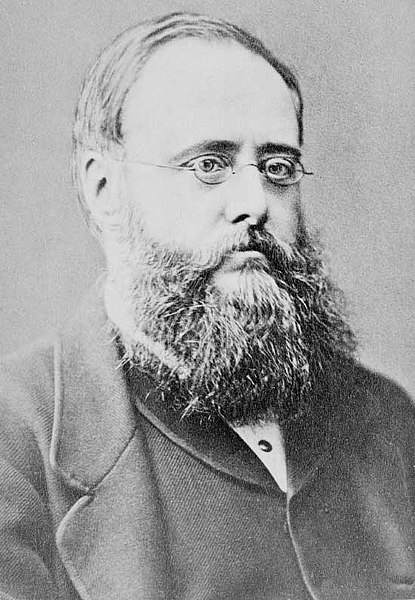
A friend, horrifed by Wilkie Collins's beard, said, "What a beard!" and suggested I do a piece on beards of literary men. So I've done a little investigation and posted photos of: (1) Wilkie Collins (top left); (2) Charles Dickens (below Collins); (3) Anthony Trollope (below) and (4) Henry James (below Trollope). Not all Victorian writers had beards as I learned after INTENSIVELY searching the internet (meaning 10 minutes). George Gissing and Edmund Gosse, for example, sported tasteful moustaches (which one hopes may have boosted sales despite their radicalism). There's something rather grotesque about two of the beards (who were their stylists?), though I like Dickens's. Which of these is your favorite beard? A, B, C, or D?

Sunday, June 08, 2008

Dames

It's a rainy day, so you rifle through your bookshelves.... Dames by Elizabeth North is randomly chosen, the kind of boarding school novel you might read as a girl (i.e., by Enid Blyton, a writer alluded to by North in the clash between the faculty's snobbery and the girls' tastes), except the characters are sophisticated and it chronologically jumps back and forth over a 25-year-year period. It's a bit like a subdued English version of Mary McCarthy's The Group, except it begins at a boarding school instead of a Seven Sisters college. At Dames School, the teachers dislike the group called the Ambers. These five girls scorn anyone “public-spirited, hearty and conscientious...” They nonchalantly mock their English teacher, pretend they’re menstruating in gym class, and skip chapel.

The rebellious Erica becomes a hip but worried mother of children who follow a guru in California. Mousie, the most overlooked member of the group, is at the center of the novel and becomes the least conventional. A woman in her 30s, Mousie has fallen in love with a married man and travels to Ethiopia to take over a mission connected with Dames.

The headmistress of Dames, Miss Bedford, is also unconventional. Disillusioned, she believes the school is outdated. She is defeated by the Ambers, the new kind of girl admitted by the school. Half of her doesn’t care about their skipping chapel; half of her realizes she must punish them, though the punishment will have no impact. An older Mousie, Miss Bedford is half in love with her late best friend’s widowed husband and meets him in Ethiopia when she spends her holiday at the Dames mission house.

So one single woman is in love with a married man; the other with a widower.

There is a coolness and cleverness to the subtle, witty style, which is so minimalist it stays in the background. There is an odd connection between the privileged Dames school and the patronage of the mission in Ethiopia. Sadly, this seems to be a forgotten book.

Friday, June 06, 2008

Wilkie Collins and Eliot Bliss


Wilkie Collins's Blind Love is a luxurious pleasure after hard work. It doesn’t take itself too seriously--it absorbs one's whole attention--and somehow it is believable while one reads. The intriguing characters include a harum-scarum young lord who romantically becomes a double agent in an assassins' group; Iris, a brilliant, faithful woman who saves him three times (once in men’s clothes); Hugh Mountjoy, a steady friend who fiercely loves Iris and negotiates her safety several times by bribing a confidence man to stay away; a con-man doctor; a former actress; and a half-mad maid.

Serialized in the Illustrated London News in 1889, Blind Love was completed by Walter Besant and posthumously published. , Collins on his deathbed left Besant copious notes on the development of the plot and even lines of dialouge. This neglected novel is worth looking up--but only do so after reading No Name, Armadale, The Moonstone, or some of his more famous works. The Dover paperback gives no background on Besant, just his short preface explaining the circumstances.

Now, back to Viragos. For every essay celebrating Virago’s 30th anniversary (the latest on Sunday June 4 by Justine Picardie), I have read at least five Viragos. Actually I read 8 last month. I can wholeheartedly recommend many: the witty Molly Keane (whose early books are published under the name M. J. Farrell), Nina Bawden’s Circles of Deceit (I’m a sucker for books about artists), Vera Brittain’s earnest Honourable Estate (which concentrates on the suffrage movement and socialism before and after WWI), and anything by Rose Macaulay (best known for Towers of Trepizand, but The World My Wildnerness and Told by an Idiod are also good and published by Virago).

I've most recently read Eliot Bliss's Saraband. What’s wrong with it? Why didn’t I like it? My enjoyment of this novel has been tepid at best. Saraband is the sometimes-poetic story of a dreamy Catholic girl, Louie, whose years at a Catholic boarding school never seem quite real to her (though she has one mischievous friend and mourns the pretty music teacher who leaves the nunnery ). Her idyllic home with her grandmother, Lulu, her mother, and uncles grounds her with an imagination that inspires some of the most vivid imagery and memories.

The first paragraph illustrates Louie's dreaminess: “All along the road from the river the frost made patterns on the ground, and how beautifully the air smelt...The sharp air hung over one’s head like the blade of a knife, she imagined it saying, ‘Behold, you shall be cold, you shall be cold...’ Winter had a most exciting smell, it made one think of people whom one knew and yet had never met, places where at some time or other one felt sure one must have lived and yet could not remember. The frost hung on the trees, it made them look as if they had gone white during the night from fear, it gave them a very queer stark look.”

Beautiful writing. this is great stuff, but why all the run-on sentences? As though she had turned stanzas of a poem into prose. Of course that's the point. Louie writes poetry and says she doesn't know how to write prose.

I also like this passage about leaving the business school where she learns stenography and typing.

“She was leaving the draughty, noisy place, the singing of the machines and the crowds on the stairs. Now they were all new people in the crowds, one hardly ever recognized a face anywhere. it was astonishing how quickly they changed. Very few people took the whole course. Most of them came to learn quickly, and they learnt quickly and went. And yet there were the same kind of people on the stairs. The same kind of conversation went on all around them....”

The pileup of adjectives and the unique phrase “singing” of the machines are brilliant. Then dreary short sentence follows short sentence. This particular Catholic feminist novel Isn’t in the same class as Antonia White’s Catholic novels. But Bliss does seem to be following in the footsteps of May Sinclair and Dorothy Richardson.

Dorothy Richardson, a friend of Bliss, may have influenced her style. Richardson, of course, is more innovative, but the more I write about Bliss the more I see this influence may be important.

Wednesday, June 04, 2008

Naked Lunch and Ice

I once listened to a record of William Burroughs reading from Naked Lunch. “I'm looking for a fix in Pleasantville, Iowa," he rasped. Much laughter all around. My eyes widened. Marijuana: okay. Heroin: no. I never forgot the time a friend on LSD forgot how to read and we took care of her until she was sane enough to return home. Insanity was only postponed: a few years later she ended up in a mental hospital. Did the LSD do it? And unfortunately those were the days when psychiatric treatment consisted of a regimen of drugs that resulted in personality change. She seemed so somehow slow and thickened when she came out. And so I have never read William Burroughs. Get real, I always think. But perhaps this is the year I overcome my prejudices and read these "drug" classics.


Some drug literature, however, fascinates me. Who can be consistent? [LEFT: detail of self-portrait of ANNA KAVAN] Anna Kavan, an English writer whose heroin addiction shaped her fiction, is known as a “cult” novelist (a phrase I recently applied it to Winifred Holtby’s socialist novels, just showing you can apply it to anything). Her most famous novel, ice, is sometimes considered science fiction, other times a surreal allegory. “Reality had always been something of an unknown quantity to me,” says the narrator of Ice. This allegorical world is on the brink of an icy nuclear war and the narrator is searching for a mysterious, fragile girl who has eluded both him and her husband (who thinks she is in need of psychiatric treatmen). It's fairly obvious that Kavan is the fragile girl (who charmed men but rejected them in favor of heroin). A few years ago I considered writing a paper on Kavan, but my notes led me nowhere. I should have concentrated on one book (Julia and the Bazooka, a book of short stories, is my favorite), but I wrote notes on all of them. Too much material for a single paper.

There is a biography of Kavan. And Rhys Davies, a Welsh writer and friend of Kavan, wrote a novel based on her life. He wrote that she once threw a chicken at him during a dinner party, but she also worked as an interior decorator and could be charming.

It would have to be inconvenient to be a friend of an addict. I mean how good a friend could they be? Chickens thrown at us at dinner? But I love Kavan’s writing: she is as good as (or better than) Jean Rhys, only completely unknown in this country.

Saturday, May 31, 2008

The Cult of Winifred Holtby


It's middlebrow novel time--beach reading, even if there is no beach--and the dusty novels of the '20s and '30s fit nicely into a totebag. After reading three of Winifred Holtby's absorbing if uneven and unsubtly political novels, I am suddenly a Holtby "cult" fan. SOUTH RIDING, ANDERBY WOLD, & THE CROWDED STREET speak across time and are emotionally and intellectually true. Her naturalistic portraits of women on farms, in villages, and cities are unglamourous but somehow touch one and often strike home: women have more choices now, but these books illustrate a period when not being selected to marry was shameful and spinsterhood was the "S" word. Women's and socialist politics, important to Holtby, have not, surprisingly, changed much.

Muriel, the unsympathetic protagonist of THE CROWDED STREET, was beginning to bore me when it became clear that this is Holtby's plan. Muriel's dullness and indecisiveness are caused by her very conventional, determined mother's indoctrination, which slowly withers Muriel's personality. After a meeting of a church society, "(Muriel) thought: 'What on earth shall I do when I get home? Read? All books are the same--about beautiful girls who get married or married women who fall in love with their husbands. In books things always happen to people. Why doesn't someone write a book about someone to whom nothing ever happens--like me?'"

Like a princess in a fairy tale, Muriel requires salvation, though that's not quite how it turns out. And perhaps the process is somewhat unrealistic. Never mind. Holtby completely carries us away.

This is not quite a classic--but almost. Library books of a lost world. And Persephone Books has just reissued this.

P.S. And talk about coincidence--there is an enthusaiastic REVIEW of this in the Sunday June 1 Spectator. The link is below:

http://www.spectator.co.uk/the-magazine/books/658421/not-the-marrying-type.thtml

Wednesday, May 21, 2008

Winifred Holtby


Another Virago in the house? All right. It's Winifred Holtby's SOUTH RIDING. I didn’t like this one so much as her best friend Vera Brittain's masterpiece, HONOURABLE ESTATE..

Holtby, the subject of Vera Brittain's memoir, TESTAMENT OF FRIENDSHIP, simply did not write as fluidly and well as Brittain. Holtby’s sprawling, intelligent, political, if somewhat turgid, novel, is compelling, yet awkward, the labored story of a town. SOUTH RIDING fascinatingly spirals out from actions of the city council of South Riding to highlight the characters of all classes from shack dwellers to headmistresses to construction workers on the dole to once wealthy farmers. Perhaps that is its appeal: Holtby cares so much about her characters and contrasts the innocence of socialists and do-gooders to the corruption of sleazy council members who hope to make real estate deals by preying on the poor. The traditional narrative is never preachy, and she gives all the characters their due. Published posthumously in 1936, the Winner of the James Tait Black Award, it doesn’t measure up to the best of ‘30s liberal writers like Storm jameson. Nevertheless, it is a very good traditional novel, logically constructed, if not exquisitely written.

In her preface Holtby wrote to her alderman mother: “What fascinated me was the discovery that apparently academic and impersonal resolutions passed in a city council were daily revolutionizing the lives of those men and women whom they affected. The complex tangle of motives prompting public decisions, the unforeseen consequences of their enactment on private lives appeared to me as part of the unseen pattern of the English landscape.”

Anyway...this one is readily available, though I’m not sure about Holtby’s others.

Tuesday, May 20, 2008

Revolutionary Road


Richard Yates (1926-1992), the author of Revolutionary Road, knows the hopeless emptiness of suburban life. He knows the commuters who hate their 9-5 jobs and the claustrophobic housewives whose pregnancies cut them off radically from past achievements and friends. Revolutionary Road, a cult classic, is passed on by word of mouth, or, according to Richard Ford in his introduction to the 2000 Vintage edition, taught by maverick professors who specialize in Kesey, Kerouac, and Paula Fox (the latter’s work is especially pertinent).

The protagonists, a couple named Frank and April Wheeler, never intended to live average lives. They enjoyed their slight rebelliousness in Greenwich Village until April became pregnant, the contingency on which their lives hinge. Frank talks her out of an abortion (which was a perilous and horrifying prospect, since she intended to perform it on herself with a syringe), but the pregnancy in fact ruins both their lives. April has no life outside the suburb; Frank, who prides himself on doing nothing at his job and not even knowing what it is, rebels at work, hilariously shuffling files from his in-box to his desk drawers to the secretary’s files and back to his own in-box, writing brochures and letters as seldom as possible. April, however, stuck at home, has lost confidence. She encourages him to quit his job and move to France, where she can support the family.

it is a, ironically, a madman who understands their philosophy. John, a schizophrenic mathematic, articulates their loathing of suburbia:

“You want to play house, you got to have a nice job. You want to play very NICE house, very SWEET house, then you got to have a job you don’t like. Great. This is the way ninety-eight-point-nine percent of the people work things out, so believe me buddy you’ve got nothing to apologize for. Anybody comes along and says “Whaddya do it for?’ you can be pretty sure he’s on a four-hour pass from the State funny farm...”

It takes a madman to speak the truth. And possibly a housewife (April has less to lose than Frank). But the reader also sympathizes with Frank’s point of view. He may be unlikable and arrogant, but is believable as a guy in a gray flannel suit who is tempted by success at a job he doesn’t respect.

Saturday, May 17, 2008

Honourable Estate


Readers of Virago Modern Classics have been hustling their green-backed paperbacks (and new chick-lit-lookialikes) out of their bookcases lately. You’ll see women in urban landscapes on the buses reading Elizabeth Taylor's A View of the Harbor, and sweaty women swigging water and munching power bars beside a dusty trail, reading Vera Brittain’s Honourable Estate (1936; Virago 2000).

The 30th anniversary of the founding of Virago is the occasion of gossipy reminiscences in blogs and the Guardian (including an article by founder Carmen Callil). Bloggers will ask what your favorite Virago is and are there any copies of The Brontes Went to Woolworth's for less than $34 (the answer is no). I've been reading some extraordinary Viragos myself. I LOVED the Tortoise and the Hare by Elizabeth Jenkins, which I learned about in Carmen Callil's article. And I mention Vera Brittain’s Honourable Estate because I was denied it so long by its obscure status, and because Brittain’s novels have been sneered at by critics and more often overlooked.

Carolyn Heilbrun, a literary critic who wrote the introduction to Brittain’s Testament of experience, declared: “Brittain was not a great novelist....She discovered her form to be the documentary.” Because of such dismissive statements, I assumed that Brittain’s autobiographies were her best work and never looked for the novels. I am stunned by this low estimation of her fiction. Honourable Estate is a swift-moving 587-page novel of ideas, from which I could barely tear myself away for work or for sleep.

In Honourable Estate, Brittain analyzes the impact of World War I on two generations of men and women. Janet, a pre-war suffragist, loathes housework and motherhood and escapes from her fanatical vicar husband to political meetings. In the next generation, Ruth, the feminist daughter of an indulgent manufacturer, graduates from Oxford, despite her family’s belief that marriage should be her “estate." A nurse during World War I, disillusioned by many losses, she believes that the war continues after the armistice as refugees pour into camps in Russia and Poland. All characters are psychologically damaged, but make a difference in society. The novel is not plot-oriented, but Brittain's ideas and the emotional political involvement of her characters are exquisitely expressed and explained in her fluid style.

Thursday, December 20, 2007

The Media

Media distortion is hardly a surprise. Jonathan Alter's editorial in the Dec. 24 issue of Newsweek claims, "In a carefully prepared sound bite at last week's Des Moines Register Democratic debate, Hillary Clinton thought she had found a line to jump-start her flagging campaign: 'Some believe you get change by demanding it. Some believe you get change by hoping for it. I believe you get it by working hard for change."

Some of the ACTUAL quotes were more vigorous--less dumbed-down. Edwards said (in response to another candidate) that it would be unrealistic to promise he could do everything in one year. Hillary responded to Edwards, "Well, I'm going to be busy." And she also mentioned "hard work."

Whether you prefer Edwards' realism, Obama's idealism, or Clinton's aggressiveness, their words were more intricate, snappier "sound-bytes" than Alter's quotations.

Alter analyzes Edwards style as "confrontational," Obama's as "conciliatory." and Clinton's as based on "perspiration." He didn't mention the other candidates. The voting records don't match their stump speeches--what a surprise--and he should have given us stats (they're out there). Essentially he says that Clinton should work on children's issues. "Her best bet is to reconnect with the real Hillary, the one who spoke out passionately for children." All of them must do more than that to get the nomination.

Most of the editorial reads as though it were written before the televised debate (in fact all except the first paragraph). And the quotes are tedious--inconsistent with Alter's style. Perhaps an intern took the notes.

And, if I may say so, his attitude towards Hillary Clinton is sexist. Get her back in the mommy-dom, is what he suggests

.

Thursday, December 13, 2007

Pre-election

I love Edward Gorey cards--but this year have a much more amusing card. It’s an Edwards card! On the cover is a photo of the family. Inside there's a message, which if you can read you're brilliant. The handwriting is terrible. It looks like: “Fur deliberately sacrifice...and, closs all...in cless times...”

Brilliant PR! And I'm not mocking. I put the card on my mantel.

Right now--I'd far rather stay home and do embroidery than go to any caucus or primary. I feel grumpy about it. I have to decide so soon. Why can't we have one big primary on the same day? Don't they do something like this in France?

I have to do my research at the Congressional Record, though I'd rather go by the PR.

So far I support Hillary Clinton to an extent it’s because she’s a woman, but I also believe she might win. She has worked with Republicans closely in the Senate and is very pragmatic and middle-of-the-road, which many progressives complain of. I still remember her health care reform committee as a First Lady during the ‘90s. Defeated, but a good effort. Frankly, I don’t think they can do a damned thing about health care--the drug companies are too strong. Of course, I don’t know who owns America... Hillary is tough: God knows she’s had experience. All those “scandals” during the Clinton administration.

I might change my mind. I do love Edwards's PR.

Thursday, March 22, 2007

Powell and Lethem

If you haven't read Jonathan Lethem's The Fortress of Solitude, you should. It's a classic (she says who doesn't get to decide these things), a brilliant novel, an often jeering riff or graffiti "tag" on Powell's A Dance to the Music of Time. The first allusion to A Dance to the Music of Time comes on p. 50:

"One day she thrilled, almost drunkenly to scratch with a ballpoint pen in the pages of Anthony Powell's Casanova's Chinese Restaurant_, breaking a taboo of seventy-eight years: she heard her father's voice then, a shred of memory, commanding her reverence for the leather-lined vault of his library. There might be nothing worse than defacing a book, but now she felt the urge to drop them, half read, from her deck into her overgrown garden. She would only need to turn her wrist, let her grip slip once more. She knew she'd quit, one way or another, drop the book or simply die, before finishing the twelve volumes of Powell's novel, his Dance to the Goddamn Music of Time. Powell had written too much, taken too much of her time already, and she punished him by scribbling in his book, a wavering row of lines, like some hieroglyphic tide."

This is so brilliant: I almost can't express how brilliant it is. Because in this gentrified Brooklyn neighborhood of the '70, hieroglyphics, graffiti, comic books, Star Wars, funk, and science fiction take the place of Powell's cycle (traditional literature), classical music, and Andy Warhol's art. Scrawling is somehow necessary: art is for everyone. There is no prep school or Oxford: it's public school, Stuyvesant, maybe City College. Lethem outlines class as: the upper-class woman who wants to gentrify the neighborhood, a woman who can't read Power after observing middle-class whites and blacks in the brownstones (artists, singer), middle-class blacks in the projects, Purerto Ricans, and Italians. Abraham, a single father and artist, has given up painting since moving to Brooklyn and has now documents his life painting on film and designing paperback covers. A black singer and divorced father has given up his lurcrative career to move to Brooklyn (he does drugs and watches football) but compromises by going back to work as a singer in a bad funk band (he's the only one who doesn't dress like a pimp). Dylan is the main observer, the artist's son who has to figure out how to be a reader, a writer of "tags," white, and not get beaten up every day by the blacks. (He's one of three whites in his public school.) The types are surprisingly similar to Powell's in many ways, sans prep school: Mingus is one of the most important characters, likable and able to move easily between black and white; Widmerpool is a fawning bootlicker, a boy named Arthur, a chess-playing nerd who fakes asthma attacks to escape violence and who has figured out how to latch onto Dylan and Mingus for protection.

It's fascinating: it's a scribble on the pages of Powell. It's "okay, Powell, this is you, privileged, in England, and this is us." Something like that.

It's the class distinctions that have always gotten on my nerves in Powell. They're much easier to understand in Lethem: there's more going back and forth.

Anyway, some of you might be interested in this book. I'm...FASCINATED. How could anyone be so brilliant?

Wednesday, February 21, 2007

The Bastard of Istanbul


Here is an entertaining quote from Elif Shafak's The Bastard of Istanbul, a novel about a Turkish family and an Armenian family and their intertwined pasts. Amanoush, the Armenian-American beauty with no friends, meditates on the subversive power of novel-reading and can't stop talking about books on dates. (Novels do seem to be disapproved of by people who read only history, science or biography--they're considered light-weight--and perhaps that's why so few novels get reviewed in The New York Times Book Review. And perhaps that's why Shafak includes a long chapter about Amanoush's reading ):

"Though books were potentially harmful, novels were all the more dangerous. The path of fiction could easily mislead you into the cosmos of stories where everything was fluid, quixotic, and as open to surprises as a moonless night in the desert. Before you knew it you could be so carried away that you could lose touch with reality--that stringent and solid truth from which no minority should ever veer too far from in order not to end up unguarded when the winds shifted and bad times arrived. It didn't help to be so naive to think things wouldn't get bad, as they always did. Imagination was a dangerously captivating magic for those compelled to be realistic in life, and words could be poisonous for those destined always to be silenced. If as a child of survivors you still wanted to read and ruminate, you should do so quietly, apprehensively, and introspectively, never turning youself into a vociferous reader. If you couldn't help harboring higher aspirations in life, you should at least harbor only simple desires, reduced in passion and ambition, as if you had been de-energized and now had only enough strength to be average. With a fate and family like this, Armanoush had to learn to downplay her talents and do her best not to glimmer too brightly...."

And later Amanoush tells her aunt:
"'You see, unlike in the movies, there is no THE END sign flashing at the end of books. When I've read a book, I don't feel like I've finished anything. So I start a new one.'"

Friday, February 16, 2007

American Masterpieces, Not Read in Loserville


Maureen Howard’s Novels of the Seasons are contemporary American masterpieces, little read. Think of Anthony Powell’s A Dance to the Music of Time as written by an American Virginia Woolf. Yet who reads them? Very few seem to have heard of her. There are so few Catholic writers I really like. She lacks the masochistic streak of Mary Gordon. She is no Flannery O'Connor, but writes about the sweep of geography, history, art, and perhaps the end of Catholicism in America. (The end of civilization? No, I'm joking.)

Howard fuses the stories of several Catholic families, immigrants, refugees, Catholic commune workers, priests, stockbrokers, farmers, artists, computer guys, professors, Audobon's wife, and even an autobiographical sketch of Howard. Personally, I find these novels more eloquent and less sentimental than Alice McDermott's Catholic novels. Why do critics love McDermott rather than Howard? Because the critics can understand McDermott? (I don't mean to put down McDermott, who is very good in her way.) Yet Howard’s pyrotechnics of language and prodigious leaps back and forth in time are much more gorgeous and layered. Give this woman a National Book Award or Pulitzer.

A Lover’s Almanac is perhaps the simplest novel in the cycle: Louise Moffat and Artie Freeman, a young couple without a history at the millennium, learn their personal histories and invent their own life-style, rebelling against parents and grandparents who concentrated on American rather than personal history. Louise and Artie see themselves as more sophisticated and ironic, but these Generation X-and-a-halfers have not lived through wars or sacrificed for family or country and only partially, through photographs and letters, come to understand their family relationships (yet self-centeredly and without much knowledge of their country’s history). The second and third novels give us their 20th century families' viewpoints, as well as Audobon and his wife’s. The refugee family from Austria in World War II is Catholic, not Jewish: fascinating in itself, since the Catholics who died in concentration camps are largely forgotten. The novels are told in sream of consciousness, straightforward narrative, illustrations, almanac pages, and histories of Franklin, Edison, and other Americans.

Perhaps religion is missing from Louise and Artie's lives.

These novels are showy and magnificent, the story of America. Too flamboyant? I don’t think so. The fourth novel--Autumn-- is yet to come.

Where are the Modern Library editions?

Thursday, February 08, 2007

Willa Cather, The Rolling Stones, and U2


Willa Cather’s fictional “lost lady” has something in common with The Rolling Stones and U2: all three bank with “shelters that pay handsomely.” Marion Forrester chooses to invest with Ivy Peters during “changing times” in the west, much to her old-fashoned friends' disapproval. And according to The New York Times (business, Section 3, p. 1, Feb. 4), the Stones and U-2 bank in the Netherlands. Bono and U-2 switched last year after Ireland did away with tax breaks for musicians, but the Stones have done it for 30 years.

Here’s why I like the Stones: they say “Hello, Detroit,” play, and collect their paycheck. They don’t suck up. They're businessmen. They don't pretend otherwise. After Captain Forrester’s death, Marion is a stony stone, stonier than the Stones. She doesn't care what anyone thinks. She needs money. It’s “Hello, Sweet Water” and then she’s out of there.

I'm prim about investments and tax shelters myself (not that I have any) but don't want taxes to support the war in Iraq. Give it to health care, etc. Marion, of course, was completely selfish. She had to get out of Nebraska. And that she did so by Ivy Peters's investments pulls her down in the readers' eyes.

A lot of people are criticizing U2 for banking in the Netherlands, trying to find hypocrisy in their actions. Bono has certainly done a lot of good for the world and I don't know where his taxes would have gone in Ireland.

Anyway, why was this in the New York Times? It's certainly "business lite."

If anyone wants to write about Cather’s women and banking...feel free.

Wednesday, January 31, 2007

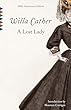
A Lost Lady


One of the saddest American novels I've read is Willa Cather's A Lost Lady. No one in the twentieth century writes more tragically and exquisitely than Cather, though she’s often designated a regional writer and craftsman rather than a tragedian and artist. She influenced F. Scott Fitzgerald, a midwestern writer who did not write about the midwest, and surpasses him because she realistically documented life on the prairie after she moved east, unlike Fitzgerald, who preferred to write about New York and France. Yet she is often despised for her "sentimental" novels about the pioneer era and its decline. Her work is passionate more often than sentimental, but many critics cannot see that and dislike her nearly perfect, simple style, believing it is less significant than that of her successors, Fitzgerald and Hemingway.

A cup of tea and Cather’s descriptions of winter in A Lost Lady are grand: they make one feel the cold of the terrible Nebraskan winters. The structure of A Lost Lady is complex. We see Captain Forrester and his wife, Marion Forrester, through the eyes of Niel, a small-town boy who grows up to admire the Forresters. Niel's uncle, Judge Pommeroy, is one of their few social equals. Marion Forrester is a vivacious woman who flirts with men and boys, allows the boys to fish on her property, and feeds them fresh cookies. Her husband, one of the richest men in town, is 25 years older, but she seems devoted to him. Questions are raised about this as the novel continues, yet we understand her duality. As long as the Forresters can spend the winter in Denver with friends, Marion can endure life in Sweet Water, Nebraska. But after Captain Forrester gives away his money to protect the working-class men who have lost everything in a failed Denver bank, Marion begins to drink and no longer cares if people know about her affair with a man in Colorado. Her morals are worse than the Captain’s and her ideals non-existent: Niel and Judge Pommeroy are disappointed and shun her. After the captain's death, Marion allows Ivy Peters, a base, cruel lawyer, to control her investments and business affairs. She doesn’t care that he cheats Indians and the poor.

“Money is a very important thing,” she tells Niel. Later, she explains to him why she has given her business to the working-class, scornful Ivy Peters. “[Your uncle] wouldn’t attempt to sell [the house] for more than twelve. That’s why I had to put it into other hands. Times have changed, but he doesn’t realize it. Mr. Forrester himself told me it wouldn’t be worth that. Ivy says he can get me twenty thousand, or if not, he will take it off my hands as soon as his investments begin to bring in returns.

Hermione Lee writes a chapter on "Lost Ladies" in her amazing critical study, Willa Cather: Double Lives. She writes:"There is a crucial change, now, from the early pioneering novels. The foucs has shifted from the immigrants to the American 'aristocracy'; and from female heroism to femininity. These heroines are 'ladies,' socially adept, self-conscious, sophisticated, decorative. They have no children, they are separated from their family roots, they have no independent occupations, and they define themselves in terms of their relation to men. They are confined and thwarted, not expansive and self-fulfilling. Their energies are poured, not intos something impersonal and bigger than themselves--the shaping of the land, the making of an art--but into personal feelings and self-expression. They are much more elusive and less reliable than the pioneering women-heroes."

No one respects Marion Forrester after a time. Yet Niel retains an affection for her. He learns the end of her story: she has finally gotten away. So was she lost? Was she right to change her business in changing times? Niel has the old values. So do we. Yet we think she might have straightened out near the end, after leaving Sweet Water, which was a kind of death to her.

Sunday, January 28, 2007

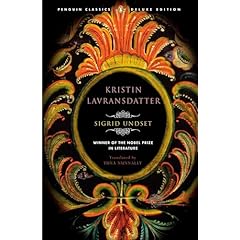
Kristin Lavansdatter


An Amazon book club plog is discussing Kristin Lavransdatter, a book I loved so much the first time that I tried to teach myself Norwegian.

Because I needed a respite from genre fiction, I turned first to Gissing and Trollope. Now I’m rereading Kristin Lavransdatter, the remarkable, luminous twentieth century trilogy about Kristin’s girlhood, marriage, and religious life in medieval Norway.

Penguin has a new translation of KL, which is supposed to be very good. I have the 1929 Nobel Prize Edition, translated by Charles Archer, which was fine when I first read it and is still fine now. One cannot be plugged into an iPod and read this; perhaps the Penguin edition is easier. In the first 35 pages Kristin runs away from an elf-maiden and a monk asks her to contemplate becoming a nun.

“’We have no child but me,’ answered Kristin. ‘So ‘tis like that I must marry. And I trow mother has chests and lockers with my bridal gear standing ready even now.’

“’Aye, aye,’ said Brother Edwin, and stroked her forehead. ‘tis thus that folk deal with their children now. To God they give the daughters who are lame or purblind or ugly or blemished, or they let Him have back the children when they deem Him to have given them more than they need. And then they wonder that all who dwell in the cloisters are not holy men and maids--’”

Having read this once before, I understand that Kristin would have been better off as a nun than married to an alcoholic (if I remember correctly he is an alcoholic: I haven't gotten that far).

I don’t think Undset is read much these days, even though she won the Nobel Prize. Perhaps the Penguin translation will introduce Kristin to a new generation. There is also a movie available at Amazon.

You may wonder why I can't stick to my reading plans. 2007 was supposed to be the year of the genre book. But can anybody read nothing but SF/fantasy and mysteries? I’ve read about medieval falconers and hawkmistresses (I love _Hawkmistress!_), psychics, women with vampire boyfriends, and crimes solved by detectives in ancient Rome and Egypt. Then I said one should read nothing but Gissing.

Next week...what?

Tuesday, January 23, 2007

Gissing, Vampires (Ugh), and Trollope

I mentioned that you might as well read nothing but Gissing.

One could make Gissing one’s life work. I loved The Nether World, which is one of his best novels about class. There is no escape for most of his lower-class characters, but a few of the slum dwellers who sacrifice themselves to help others are educated, virtuous, and philanthropic. They don't exactly find their rewards, though. If you can’t find Gissing's books at the library (and I can’t), most of his novels are at Project Gutenberg so you can read them on your computer or PDA or Sony Reader.

At Amazon I discovered, with a lot of work, that Gissing’s books are in print. Typing in George Gissing wasn’t enough. I then had to click on George Gissing after clicking on a title to get all of his books to come up. Something has happened to the Amazon database since they “improved” it a few years ago. Jeff Bezos’s book database was the best in the world until it was improved. It's still good, but one has to be very creative. I had to think like an idiot to find a boxed set of Leonard Woolf's autobiographies (finally found it: God knows how).

Instead of reading more Gissing this weekend, I decided to read one of those science fiction mystery series about women with vampire boyfriends. Who on earh would want a vampire boyfriend? Good vampire boyfriends, but a little of that goes a long way. Like 100 pages. There aren’t enough hours to read about women with vampire boyfriends.

After 100 pages I threw down the vampire book in disgust. I needed a classic. Finally I picked up Ralph the Heir. Reading Trollope is like going back to an old boyfriend who writes sensibly about money, marriage, class, and politics. Ralph the Heir, a playboy, doesn't pay his bills for clothes and boots, relying on his great expectations of a legacy. Since his uncle shows no sign of dying, he may have to marry the breeches-maker's daughter, Polly. It's so entertaining. Some people read nothing but Trollope, and though he's not as good as Gissing, he's great in a different way.

Friday, January 19, 2007

George Gissing


Why read anything but George Gissing? One can’t read genre fiction all the time. If one isn’t reading a mystery or a science fiction novel, one might as well read Gissing. Not a likable writer. Too gloomy, too depressive. But one can’t put his books down. Unlike Dickens, he shows unrelenting poverty and the daily grubbing for money. New Grub Street is a masterpiece about writing junk for money. The Odd Women and In the Year of Jubilee portray women who must work for their living or starve. Marriage doesn’t prevent starvation. Men drink and are estranged from their wives, who struggle to raise children and sometimes also drink. These three novels are underrated like many notable realistic novels of the nineteenth century. Realism wasn’t quite the thing. Dickens was comic. Gissing has no sense of humor. The British weren’t happy about Zola, one of Gissing’s cherished writers. What novel did I read in which a Zola novel is taken away from a young woman? Something by Colette, perhaps My Mother's House. And Gissing reminds me so much of Zola.

Having spent the day in Gissing’s thrall, reading The Nether World, a novel about working-class London, I am pondering the editor Stephen Gill’s suggestion that the novel is based on Great Expectations. it seems so much more complicated. The characters include slum dwellers, orphans, alcoholics, factory workers, barmaids, actresses, and one wealthy old man who hopes to use his money to help the lower classes. No one can fight his or her way out of the Nether World. I am not reminded in any way of Dickens. There are no caricatures. Dickens could be dark, but not like this. Dickens was an entertainer. Gissing wants to educate.

Gissing began The Nether World after being called to see his estranged wife, who had died of alcoholism in a bare room. In his diary her wrote: “Henceforth I never cease to bear testimony against the accursed social order that brings about things of this kind.”

In the twenty-first century most American novels seem to be about the upper classes. Some American writers assume there is no class. One exception is Richard Powers’s The Echo Maker, largely set in Nebraska, about a working-class man who suffers from a rare neurological disease after a car accident. But Powers doesn’t quite capture the tone of working-class men in dialogue. The dialogue about sports and women could take place among any men. He can’t do class.

It’s very hard to do.

That’s why we might as well read Gissing.

Check out George Gissing Website

Thursday, January 18, 2007

Genre Fiction

Snobs hate genre fiction. It's never been clear to me why. The best mysteries and science fiction novels are seldom if ever included in the canon, though some are certainly classics.

For years I had to conceal a taste for mysteries because only Dorothy Sayers and P. D. James were acceptable in my circle. Oh, no, nobody read mysteries, until I met a plucky woman who told me she read nothing but mysteries and showed me a whole room devoted to them.

Then suddenly Agatha Christie was back in vogue with the new BBC Jane Marple series. Elizabeth George’s Inspector Lynley series was also helped along by the BBC.

Interestingly, mysteries are often adapted for TV, but never science fiction or fantasy novels.

Genre people are extreme fans. That makes me not quite a genre person. Some genre enthusiasts read nothing but police procedural mysteries, others nothing but cozies about English villages, the crimes often solved by old ladies, others nothing but P.I. novels, others hard science fiction, and still others fantasy.

Historical mysteries are often excellent. I recently discovered Lauren Haney’s first-rate Lieutenant Bak mysteries, set in ancient Egypt. Haney is a former technical writer, with a plain flawless style. She doesn’t attempt to win the reader too quickly but contrives her plots thoughtfully and analytically . She includes historical details about Queen Hatshepsut and police and the military in ancient Egypt. At first her protagonist seems to have little character, but Lieutenant Bak of the Egyptian Medway police is a quiet, tough, and tenacious character who speaks wittily when he speaks, and who interrogates everyone associated with a crime and keeps going when others have long given up.

In Haney’s A Curse of Silence , Lieutenant Bak investigates the murder of a popular local prince. The murder was committed in the house of an inspector who has been sent by Queen Hatshupset to evaluate the worth of army fortresses and storehouses from the city of Buhen to the southern frontier. The people of Buhen and the provinces are furious, believing the inspector’s men are responsible for the murder and that they will shut down fortresses and cause unemployment. Lieutenant Bak must solve the crime, advise the inspector, and also provide protection for the inspector and his party as they travel through the south.

Haney writes so well that I was a little disturbed to see the series seems to have stopped in 2003. I hope she’s still writing something.

Trixie Lore

Ellen Moody of Ellen and Jim Have a Blog, Too has often mentioned Bobbie Ann Mason’s study of Nancy Drew. Although I avidly read Nancy Drew as a girl, I preferred a rival series about the tomboyish Trixie Belden. Sixteen books in the series have been reissued by Random House and are worth a look by collectors and others. I reread several recently, considering writing a retrospective about the female role models of my youth, and though I found the Trixie Belden books uneven, they are enjoyable in a kitschy way. She is indeed a sympathetic heroine. Fourteen-year-old Trixie believes there's nothing she can't do. Although she simply has too many distractions to succeed in school, she is very bright: she spends her time sleuthing, horseback riding, raising money for UNICEF, elderly displaced women, the school art department, and other charities, and attending meetings of the club she belongs to.

Julie Campbell Tatham, the creator of Trixie Belden, conceived of the series as an alternative to Nancy Drew, which she thought badly written. She wanted Trixie to be a more realistic character than Nancy, so Trixie has faults, occasionally makes mistakes in her sleuthing, and often jumps to conclusions, though she always solves her crime in the end. The first novel was published under Tatham’s maiden name, Campbell, in 1948; after the sixth book she left to write Cherry Ames and a stewardess series (both created by another writer). Then Western Publishing Company, publisher of the Trixie Belden series, which had paid her a flat fee for her books, insisted that it owned the rights to continue the series with other writers. Tatham fought them in court and won royalties for the other books, which were written by several different ghostwriters under the name Kathyrn Kenny, In 1986, after the publishing company had been bought a couple of times, the series died. If I remember correctly, Mattel was the last owner of the company. They were probably too busy with Barbie to appreciate Trixie.

It’s fascinating to see how Trixie changes over time. So many writers were involved that no one is quite sure who wrote some of the books. Some have been identified, others not. My favorite ghostwriter wrote both The Mystery of Cobbett’s Island and The Mystery of Mead’s Mountain. This particular “Kathryn Kenny” is a better stylist than most. Trixie is considerably more worldly and mature in the 1980s than she was in the ‘50s and ‘60s, though even then she could knock guns out of gang members’ hands (The Mystery of Cobbett’s Island), solve a sheep theft case and survive one of the worst floods in Des Moines (The Happy Valley Mystery), and briefly pilot a plane (The Mystery of Mead’s Mountain).

Most of the plot is told in dialogue. The novels are a bit clumsy, but I thought them incredibly witty as a child and was mesmerized by Trixie and her best friend, Honey. My mother had to buy me these and the Nancy Drew books. She had an argument with the librarian, who did not pity my mother for having to buy me the two series. The librarian told her the books were too poorly written to be in a library. Well, that has changed over the years...

Friday, December 08, 2006

Middle Ground

Happy Christmas. Mmm, you grumble. You’re Hamlet. And you can’t decide what to do for the holidays. Commercialism. Merry Capitalism.

Do you support the economy and glibly go into debt? Or do you have a simple Christmas and give to charity?

Mad Housewife's recommendations are for a few simple gifts:

OBLOMOV by Ivan Goncharev (there’s a new edition, translated by Tat'iana Tolstoya). A funny and poignant satirical novel about a very sleepy man, the Russian class system, and intellectuals.

THE INHERITANCE OF LOSS by Kiran Desai. Not only did it win the Booker Prize, it is the best contemporary novel I read this year.

REEF by Romesh Gunesekera. A former Booker Prize finalist: a novel about Sri Lanka.

THE THIRTEENTH TALE by Diane Setterfield. The story of an antiquarian bookseller who is invited to write a biography of a famous writer. Mysterious and filled with allusions to 19th-century novels.

AMERICAN HUMOR: THE DEVELOPMENT OF THE NATIONAL CHARACTER b y Constance Rourke. You can’t go wrong.

NO NAME by Wilkie Collins. Even better than THE WOMAN IN WHITE.

THE BRAMBLES by Eliza Minot. A beautifully written novel of family, siblings, the suburbs, and New York.

TRIANGLE by Katharine Weber. A novel about the Triangle Shirtwaist Fire in New York, coming to terms with survival, and music

THE UNFINISHED NOVEL by Valerie Martin. Collection of short stories.

DREAM NUMBER NINE by David Mitchell. Set in Japan, weird and amusing.

THE BEST AMERICAN POLITICAL WRITING 2006 edited by Royce Flippin. Everything you didn’t want to know about your country.

Gift certificates are also nice.