World War II novels fill me with dread, I’ve read so many in recent years: Jane Gardam, Ian McEwan, Sarah Waters. The list goes on and on and on and on.
It was not my intention to read Men at Arms. I had been considering rereading Brideshead Revisited and suddenly recalled that Waugh’s Sword of Honour trilogy was in the house. Unlike Waugh’s raucous satires, Men at Arms is an often touching, realistic novel, an account of the Roman Catholic, sweetly sardonic, Guy Crouchback’s war. Guy (guy?!) returns to England from italy, intent on fighting the Nazis, only to find that he is already superannuated in his mid-thirties. Finally, he meets a friend of his father's, a jovial major with Dickensian bluffness, who pulls some strings--and Guy becomes a member of a very peculiar brigade. We see the Halberdiers through Guy’s gently satiric eyes. And what a strange bunch they are.
Althorpe, the only other middle-aged officer in training, is a fool, a stickler for rules (and creator of other rules to boost his self-importance), entirely humorless, yet humorous in the extreme. He carries a collapsible chemical toilet, nicknamed the Thuderbox, and hides it in various sheds, where he can take care of “unfinished business.” The thunderbox finally explodes (this is the kind of incident that characterizes the first months of Guy’s war).
Many accidents happen: Guy is lamed for months after playing football with a wastepaper basket. Althorpe is similarly lamed by another absurd escapade. The Helberdiers believe the two are putting them on when they both walk into the dining room leaning on canes.
The wild brigadier, Colonel Ritchie-Hook, most famous for taking risks in battle, returns from a brief sortie in Algeria with a “Negro’s head,” (which he calls a coconut.) The jokes about his fondness for decapitation, which we hae heard at a dinner party. turn out to be real:
“’We mustn’t be late,’ said Mrs. Green. “Ben Ritchie-Hook is coming. He’s a terror if he’s kept waiting for his food.’...
“Is it the man you were telling me about?’ asked Mrs. Leonard, whose way of showing her disapproval of the expedition was to speak only to her husband, ‘the man who cuts off people’s heads?’”
There is also, of course, much sadness. Terrible things are happening all around them. The military world, oddly, from the point of view of the training camp, seems entirely protected. And of course it's not.
This is the most winning war novel I’ve read since Catch-22.
Tuesday, June 10, 2008

Monday, June 09, 2008
Beards in Literature
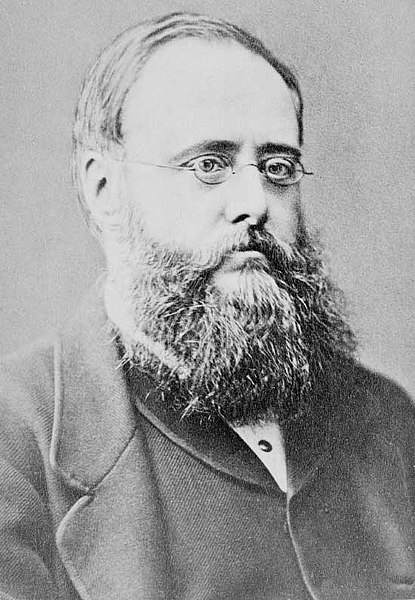

A friend, horrifed by Wilkie Collins's beard, said, "What a beard!" and suggested I do a piece on beards of literary men. So I've done a little investigation and posted photos of: (1) Wilkie Collins (top left); (2) Charles Dickens (below Collins); (3) Anthony Trollope (below) and (4) Henry James (below Trollope). Not all Victorian writers had beards as I learned after INTENSIVELY searching the internet (meaning 10 minutes). George Gissing and Edmund Gosse, for example, sported tasteful moustaches (which one hopes may have boosted sales despite their radicalism). There's something rather grotesque about two of the beards (who were their stylists?), though I like Dickens's. Which of these is your favorite beard? A, B, C, or D?


Sunday, June 08, 2008
Dames
It's a rainy day, so you rifle through your bookshelves.... Dames by Elizabeth North is randomly chosen, the kind of boarding school novel you might read as a girl (i.e., by Enid Blyton, a writer alluded to by North in the clash between the faculty's snobbery and the girls' tastes), except the characters are sophisticated and it chronologically jumps back and forth over a 25-year-year period. It's a bit like a subdued English version of Mary McCarthy's The Group, except it begins at a boarding school instead of a Seven Sisters college. At Dames School, the teachers dislike the group called the Ambers. These five girls scorn anyone “public-spirited, hearty and conscientious...” They nonchalantly mock their English teacher, pretend they’re menstruating in gym class, and skip chapel.
The rebellious Erica becomes a hip but worried mother of children who follow a guru in California. Mousie, the most overlooked member of the group, is at the center of the novel and becomes the least conventional. A woman in her 30s, Mousie has fallen in love with a married man and travels to Ethiopia to take over a mission connected with Dames.
The headmistress of Dames, Miss Bedford, is also unconventional. Disillusioned, she believes the school is outdated. She is defeated by the Ambers, the new kind of girl admitted by the school. Half of her doesn’t care about their skipping chapel; half of her realizes she must punish them, though the punishment will have no impact. An older Mousie, Miss Bedford is half in love with her late best friend’s widowed husband and meets him in Ethiopia when she spends her holiday at the Dames mission house.
So one single woman is in love with a married man; the other with a widower.
There is a coolness and cleverness to the subtle, witty style, which is so minimalist it stays in the background. There is an odd connection between the privileged Dames school and the patronage of the mission in Ethiopia. Sadly, this seems to be a forgotten book.
Friday, June 06, 2008
Wilkie Collins and Eliot Bliss
Wilkie Collins's Blind Love is a luxurious pleasure after hard work. It doesn’t take itself too seriously--it absorbs one's whole attention--and somehow it is believable while one reads. The intriguing characters include a harum-scarum young lord who romantically becomes a double agent in an assassins' group; Iris, a brilliant, faithful woman who saves him three times (once in men’s clothes); Hugh Mountjoy, a steady friend who fiercely loves Iris and negotiates her safety several times by bribing a confidence man to stay away; a con-man doctor; a former actress; and a half-mad maid.
Serialized in the Illustrated London News in 1889, Blind Love was completed by Walter Besant and posthumously published. , Collins on his deathbed left Besant copious notes on the development of the plot and even lines of dialouge. This neglected novel is worth looking up--but only do so after reading No Name, Armadale, The Moonstone, or some of his more famous works. The Dover paperback gives no background on Besant, just his short preface explaining the circumstances.
Now, back to Viragos. For every essay celebrating Virago’s 30th anniversary (the latest on Sunday June 4 by Justine Picardie), I have read at least five Viragos. Actually I read 8 last month. I can wholeheartedly recommend many: the witty Molly Keane (whose early books are published under the name M. J. Farrell), Nina Bawden’s Circles of Deceit (I’m a sucker for books about artists), Vera Brittain’s earnest Honourable Estate (which concentrates on the suffrage movement and socialism before and after WWI), and anything by Rose Macaulay (best known for Towers of Trepizand, but The World My Wildnerness and Told by an Idiod are also good and published by Virago).
I've most recently read Eliot Bliss's Saraband. What’s wrong with it? Why didn’t I like it? My enjoyment of this novel has been tepid at best. Saraband is the sometimes-poetic story of a dreamy Catholic girl, Louie, whose years at a Catholic boarding school never seem quite real to her (though she has one mischievous friend and mourns the pretty music teacher who leaves the nunnery ). Her idyllic home with her grandmother, Lulu, her mother, and uncles grounds her with an imagination that inspires some of the most vivid imagery and memories.
The first paragraph illustrates Louie's dreaminess: “All along the road from the river the frost made patterns on the ground, and how beautifully the air smelt...The sharp air hung over one’s head like the blade of a knife, she imagined it saying, ‘Behold, you shall be cold, you shall be cold...’ Winter had a most exciting smell, it made one think of people whom one knew and yet had never met, places where at some time or other one felt sure one must have lived and yet could not remember. The frost hung on the trees, it made them look as if they had gone white during the night from fear, it gave them a very queer stark look.”
Beautiful writing. this is great stuff, but why all the run-on sentences? As though she had turned stanzas of a poem into prose. Of course that's the point. Louie writes poetry and says she doesn't know how to write prose.
I also like this passage about leaving the business school where she learns stenography and typing.
“She was leaving the draughty, noisy place, the singing of the machines and the crowds on the stairs. Now they were all new people in the crowds, one hardly ever recognized a face anywhere. it was astonishing how quickly they changed. Very few people took the whole course. Most of them came to learn quickly, and they learnt quickly and went. And yet there were the same kind of people on the stairs. The same kind of conversation went on all around them....”
The pileup of adjectives and the unique phrase “singing” of the machines are brilliant. Then dreary short sentence follows short sentence. This particular Catholic feminist novel Isn’t in the same class as Antonia White’s Catholic novels. But Bliss does seem to be following in the footsteps of May Sinclair and Dorothy Richardson.
Dorothy Richardson, a friend of Bliss, may have influenced her style. Richardson, of course, is more innovative, but the more I write about Bliss the more I see this influence may be important.
Wednesday, June 04, 2008
Naked Lunch and Ice
I once listened to a record of William Burroughs reading from Naked Lunch. “I'm looking for a fix in Pleasantville, Iowa," he rasped. Much laughter all around. My eyes widened. Marijuana: okay. Heroin: no. I never forgot the time a friend on LSD forgot how to read and we took care of her until she was sane enough to return home. Insanity was only postponed: a few years later she ended up in a mental hospital. Did the LSD do it? And unfortunately those were the days when psychiatric treatment consisted of a regimen of drugs that resulted in personality change. She seemed so somehow slow and thickened when she came out. And so I have never read William Burroughs. Get real, I always think. But perhaps this is the year I overcome my prejudices and read these "drug" classics.

Some drug literature, however, fascinates me. Who can be consistent? [LEFT: detail of self-portrait of ANNA KAVAN] Anna Kavan, an English writer whose heroin addiction shaped her fiction, is known as a “cult” novelist (a phrase I recently applied it to Winifred Holtby’s socialist novels, just showing you can apply it to anything). Her most famous novel, ice, is sometimes considered science fiction, other times a surreal allegory. “Reality had always been something of an unknown quantity to me,” says the narrator of Ice. This allegorical world is on the brink of an icy nuclear war and the narrator is searching for a mysterious, fragile girl who has eluded both him and her husband (who thinks she is in need of psychiatric treatmen). It's fairly obvious that Kavan is the fragile girl (who charmed men but rejected them in favor of heroin). A few years ago I considered writing a paper on Kavan, but my notes led me nowhere. I should have concentrated on one book (Julia and the Bazooka, a book of short stories, is my favorite), but I wrote notes on all of them. Too much material for a single paper.
There is a biography of Kavan. And Rhys Davies, a Welsh writer and friend of Kavan, wrote a novel based on her life. He wrote that she once threw a chicken at him during a dinner party, but she also worked as an interior decorator and could be charming.
It would have to be inconvenient to be a friend of an addict. I mean how good a friend could they be? Chickens thrown at us at dinner? But I love Kavan’s writing: she is as good as (or better than) Jean Rhys, only completely unknown in this country.
Saturday, May 31, 2008
The Cult of Winifred Holtby

It's middlebrow novel time--beach reading, even if there is no beach--and the dusty novels of the '20s and '30s fit nicely into a totebag. After reading three of Winifred Holtby's absorbing if uneven and unsubtly political novels, I am suddenly a Holtby "cult" fan. SOUTH RIDING, ANDERBY WOLD, & THE CROWDED STREET speak across time and are emotionally and intellectually true. Her naturalistic portraits of women on farms, in villages, and cities are unglamourous but somehow touch one and often strike home: women have more choices now, but these books illustrate a period when not being selected to marry was shameful and spinsterhood was the "S" word. Women's and socialist politics, important to Holtby, have not, surprisingly, changed much.
Muriel, the unsympathetic protagonist of THE CROWDED STREET, was beginning to bore me when it became clear that this is Holtby's plan. Muriel's dullness and indecisiveness are caused by her very conventional, determined mother's indoctrination, which slowly withers Muriel's personality. After a meeting of a church society, "(Muriel) thought: 'What on earth shall I do when I get home? Read? All books are the same--about beautiful girls who get married or married women who fall in love with their husbands. In books things always happen to people. Why doesn't someone write a book about someone to whom nothing ever happens--like me?'"
Like a princess in a fairy tale, Muriel requires salvation, though that's not quite how it turns out. And perhaps the process is somewhat unrealistic. Never mind. Holtby completely carries us away.
This is not quite a classic--but almost. Library books of a lost world. And Persephone Books has just reissued this.
P.S. And talk about coincidence--there is an enthusaiastic REVIEW of this in the Sunday June 1 Spectator. The link is below:
http://www.spectator.co.uk/the-magazine/books/658421/not-the-marrying-type.thtml
Wednesday, May 21, 2008
Winifred Holtby

Another Virago in the house? All right. It's Winifred Holtby's SOUTH RIDING. I didn’t like this one so much as her best friend Vera Brittain's masterpiece, HONOURABLE ESTATE..
Holtby, the subject of Vera Brittain's memoir, TESTAMENT OF FRIENDSHIP, simply did not write as fluidly and well as Brittain. Holtby’s sprawling, intelligent, political, if somewhat turgid, novel, is compelling, yet awkward, the labored story of a town. SOUTH RIDING fascinatingly spirals out from actions of the city council of South Riding to highlight the characters of all classes from shack dwellers to headmistresses to construction workers on the dole to once wealthy farmers. Perhaps that is its appeal: Holtby cares so much about her characters and contrasts the innocence of socialists and do-gooders to the corruption of sleazy council members who hope to make real estate deals by preying on the poor. The traditional narrative is never preachy, and she gives all the characters their due. Published posthumously in 1936, the Winner of the James Tait Black Award, it doesn’t measure up to the best of ‘30s liberal writers like Storm jameson. Nevertheless, it is a very good traditional novel, logically constructed, if not exquisitely written.
In her preface Holtby wrote to her alderman mother: “What fascinated me was the discovery that apparently academic and impersonal resolutions passed in a city council were daily revolutionizing the lives of those men and women whom they affected. The complex tangle of motives prompting public decisions, the unforeseen consequences of their enactment on private lives appeared to me as part of the unseen pattern of the English landscape.”
Anyway...this one is readily available, though I’m not sure about Holtby’s others.
Tuesday, May 20, 2008
Revolutionary Road

Richard Yates (1926-1992), the author of Revolutionary Road, knows the hopeless emptiness of suburban life. He knows the commuters who hate their 9-5 jobs and the claustrophobic housewives whose pregnancies cut them off radically from past achievements and friends. Revolutionary Road, a cult classic, is passed on by word of mouth, or, according to Richard Ford in his introduction to the 2000 Vintage edition, taught by maverick professors who specialize in Kesey, Kerouac, and Paula Fox (the latter’s work is especially pertinent).
The protagonists, a couple named Frank and April Wheeler, never intended to live average lives. They enjoyed their slight rebelliousness in Greenwich Village until April became pregnant, the contingency on which their lives hinge. Frank talks her out of an abortion (which was a perilous and horrifying prospect, since she intended to perform it on herself with a syringe), but the pregnancy in fact ruins both their lives. April has no life outside the suburb; Frank, who prides himself on doing nothing at his job and not even knowing what it is, rebels at work, hilariously shuffling files from his in-box to his desk drawers to the secretary’s files and back to his own in-box, writing brochures and letters as seldom as possible. April, however, stuck at home, has lost confidence. She encourages him to quit his job and move to France, where she can support the family.
it is a, ironically, a madman who understands their philosophy. John, a schizophrenic mathematic, articulates their loathing of suburbia:
“You want to play house, you got to have a nice job. You want to play very NICE house, very SWEET house, then you got to have a job you don’t like. Great. This is the way ninety-eight-point-nine percent of the people work things out, so believe me buddy you’ve got nothing to apologize for. Anybody comes along and says “Whaddya do it for?’ you can be pretty sure he’s on a four-hour pass from the State funny farm...”
It takes a madman to speak the truth. And possibly a housewife (April has less to lose than Frank). But the reader also sympathizes with Frank’s point of view. He may be unlikable and arrogant, but is believable as a guy in a gray flannel suit who is tempted by success at a job he doesn’t respect.
Saturday, May 17, 2008
Honourable Estate

Readers of Virago Modern Classics have been hustling their green-backed paperbacks (and new chick-lit-lookialikes) out of their bookcases lately. You’ll see women in urban landscapes on the buses reading Elizabeth Taylor's A View of the Harbor, and sweaty women swigging water and munching power bars beside a dusty trail, reading Vera Brittain’s Honourable Estate (1936; Virago 2000).
The 30th anniversary of the founding of Virago is the occasion of gossipy reminiscences in blogs and the Guardian (including an article by founder Carmen Callil). Bloggers will ask what your favorite Virago is and are there any copies of The Brontes Went to Woolworth's for less than $34 (the answer is no). I've been reading some extraordinary Viragos myself. I LOVED the Tortoise and the Hare by Elizabeth Jenkins, which I learned about in Carmen Callil's article. And I mention Vera Brittain’s Honourable Estate because I was denied it so long by its obscure status, and because Brittain’s novels have been sneered at by critics and more often overlooked.
Carolyn Heilbrun, a literary critic who wrote the introduction to Brittain’s Testament of experience, declared: “Brittain was not a great novelist....She discovered her form to be the documentary.” Because of such dismissive statements, I assumed that Brittain’s autobiographies were her best work and never looked for the novels. I am stunned by this low estimation of her fiction. Honourable Estate is a swift-moving 587-page novel of ideas, from which I could barely tear myself away for work or for sleep.
In Honourable Estate, Brittain analyzes the impact of World War I on two generations of men and women. Janet, a pre-war suffragist, loathes housework and motherhood and escapes from her fanatical vicar husband to political meetings. In the next generation, Ruth, the feminist daughter of an indulgent manufacturer, graduates from Oxford, despite her family’s belief that marriage should be her “estate." A nurse during World War I, disillusioned by many losses, she believes that the war continues after the armistice as refugees pour into camps in Russia and Poland. All characters are psychologically damaged, but make a difference in society. The novel is not plot-oriented, but Brittain's ideas and the emotional political involvement of her characters are exquisitely expressed and explained in her fluid style.
Thursday, December 20, 2007
The Media
Media distortion is hardly a surprise. Jonathan Alter's editorial in the Dec. 24 issue of Newsweek claims, "In a carefully prepared sound bite at last week's Des Moines Register Democratic debate, Hillary Clinton thought she had found a line to jump-start her flagging campaign: 'Some believe you get change by demanding it. Some believe you get change by hoping for it. I believe you get it by working hard for change."
Some of the ACTUAL quotes were more vigorous--less dumbed-down. Edwards said (in response to another candidate) that it would be unrealistic to promise he could do everything in one year. Hillary responded to Edwards, "Well, I'm going to be busy." And she also mentioned "hard work."
Whether you prefer Edwards' realism, Obama's idealism, or Clinton's aggressiveness, their words were more intricate, snappier "sound-bytes" than Alter's quotations.
Alter analyzes Edwards style as "confrontational," Obama's as "conciliatory." and Clinton's as based on "perspiration." He didn't mention the other candidates. The voting records don't match their stump speeches--what a surprise--and he should have given us stats (they're out there). Essentially he says that Clinton should work on children's issues. "Her best bet is to reconnect with the real Hillary, the one who spoke out passionately for children." All of them must do more than that to get the nomination.
Most of the editorial reads as though it were written before the televised debate (in fact all except the first paragraph). And the quotes are tedious--inconsistent with Alter's style. Perhaps an intern took the notes.
And, if I may say so, his attitude towards Hillary Clinton is sexist. Get her back in the mommy-dom, is what he suggests
.
Thursday, December 13, 2007
Pre-election
I love Edward Gorey cards--but this year have a much more amusing card. It’s an Edwards card! On the cover is a photo of the family. Inside there's a message, which if you can read you're brilliant. The handwriting is terrible. It looks like: “Fur deliberately sacrifice...and, closs all...in cless times...”
Brilliant PR! And I'm not mocking. I put the card on my mantel.
Right now--I'd far rather stay home and do embroidery than go to any caucus or primary. I feel grumpy about it. I have to decide so soon. Why can't we have one big primary on the same day? Don't they do something like this in France?
I have to do my research at the Congressional Record, though I'd rather go by the PR.
So far I support Hillary Clinton to an extent it’s because she’s a woman, but I also believe she might win. She has worked with Republicans closely in the Senate and is very pragmatic and middle-of-the-road, which many progressives complain of. I still remember her health care reform committee as a First Lady during the ‘90s. Defeated, but a good effort. Frankly, I don’t think they can do a damned thing about health care--the drug companies are too strong. Of course, I don’t know who owns America... Hillary is tough: God knows she’s had experience. All those “scandals” during the Clinton administration.
I might change my mind. I do love Edwards's PR.
Thursday, March 22, 2007
Powell and Lethem
If you haven't read Jonathan Lethem's The Fortress of Solitude, you should. It's a classic (she says who doesn't get to decide these things), a brilliant novel, an often jeering riff or graffiti "tag" on Powell's A Dance to the Music of Time. The first allusion to A Dance to the Music of Time comes on p. 50:
"One day she thrilled, almost drunkenly to scratch with a ballpoint pen in the pages of Anthony Powell's Casanova's Chinese Restaurant_, breaking a taboo of seventy-eight years: she heard her father's voice then, a shred of memory, commanding her reverence for the leather-lined vault of his library. There might be nothing worse than defacing a book, but now she felt the urge to drop them, half read, from her deck into her overgrown garden. She would only need to turn her wrist, let her grip slip once more. She knew she'd quit, one way or another, drop the book or simply die, before finishing the twelve volumes of Powell's novel, his Dance to the Goddamn Music of Time. Powell had written too much, taken too much of her time already, and she punished him by scribbling in his book, a wavering row of lines, like some hieroglyphic tide."
This is so brilliant: I almost can't express how brilliant it is. Because in this gentrified Brooklyn neighborhood of the '70, hieroglyphics, graffiti, comic books, Star Wars, funk, and science fiction take the place of Powell's cycle (traditional literature), classical music, and Andy Warhol's art. Scrawling is somehow necessary: art is for everyone. There is no prep school or Oxford: it's public school, Stuyvesant, maybe City College. Lethem outlines class as: the upper-class woman who wants to gentrify the neighborhood, a woman who can't read Power after observing middle-class whites and blacks in the brownstones (artists, singer), middle-class blacks in the projects, Purerto Ricans, and Italians. Abraham, a single father and artist, has given up painting since moving to Brooklyn and has now documents his life painting on film and designing paperback covers. A black singer and divorced father has given up his lurcrative career to move to Brooklyn (he does drugs and watches football) but compromises by going back to work as a singer in a bad funk band (he's the only one who doesn't dress like a pimp). Dylan is the main observer, the artist's son who has to figure out how to be a reader, a writer of "tags," white, and not get beaten up every day by the blacks. (He's one of three whites in his public school.) The types are surprisingly similar to Powell's in many ways, sans prep school: Mingus is one of the most important characters, likable and able to move easily between black and white; Widmerpool is a fawning bootlicker, a boy named Arthur, a chess-playing nerd who fakes asthma attacks to escape violence and who has figured out how to latch onto Dylan and Mingus for protection.
It's fascinating: it's a scribble on the pages of Powell. It's "okay, Powell, this is you, privileged, in England, and this is us." Something like that.
It's the class distinctions that have always gotten on my nerves in Powell. They're much easier to understand in Lethem: there's more going back and forth.
Anyway, some of you might be interested in this book. I'm...FASCINATED. How could anyone be so brilliant?
Wednesday, February 21, 2007
The Bastard of Istanbul
Here is an entertaining quote from Elif Shafak's The Bastard of Istanbul, a novel about a Turkish family and an Armenian family and their intertwined pasts. Amanoush, the Armenian-American beauty with no friends, meditates on the subversive power of novel-reading and can't stop talking about books on dates. (Novels do seem to be disapproved of by people who read only history, science or biography--they're considered light-weight--and perhaps that's why so few novels get reviewed in The New York Times Book Review. And perhaps that's why Shafak includes a long chapter about Amanoush's reading ):
"Though books were potentially harmful, novels were all the more dangerous. The path of fiction could easily mislead you into the cosmos of stories where everything was fluid, quixotic, and as open to surprises as a moonless night in the desert. Before you knew it you could be so carried away that you could lose touch with reality--that stringent and solid truth from which no minority should ever veer too far from in order not to end up unguarded when the winds shifted and bad times arrived. It didn't help to be so naive to think things wouldn't get bad, as they always did. Imagination was a dangerously captivating magic for those compelled to be realistic in life, and words could be poisonous for those destined always to be silenced. If as a child of survivors you still wanted to read and ruminate, you should do so quietly, apprehensively, and introspectively, never turning youself into a vociferous reader. If you couldn't help harboring higher aspirations in life, you should at least harbor only simple desires, reduced in passion and ambition, as if you had been de-energized and now had only enough strength to be average. With a fate and family like this, Armanoush had to learn to downplay her talents and do her best not to glimmer too brightly...."
And later Amanoush tells her aunt:
"'You see, unlike in the movies, there is no THE END sign flashing at the end of books. When I've read a book, I don't feel like I've finished anything. So I start a new one.'"
Friday, February 16, 2007
American Masterpieces, Not Read in Loserville

Maureen Howard’s Novels of the Seasons are contemporary American masterpieces, little read. Think of Anthony Powell’s A Dance to the Music of Time as written by an American Virginia Woolf. Yet who reads them? Very few seem to have heard of her. There are so few Catholic writers I really like. She lacks the masochistic streak of Mary Gordon. She is no Flannery O'Connor, but writes about the sweep of geography, history, art, and perhaps the end of Catholicism in America. (The end of civilization? No, I'm joking.)
Howard fuses the stories of several Catholic families, immigrants, refugees, Catholic commune workers, priests, stockbrokers, farmers, artists, computer guys, professors, Audobon's wife, and even an autobiographical sketch of Howard. Personally, I find these novels more eloquent and less sentimental than Alice McDermott's Catholic novels. Why do critics love McDermott rather than Howard? Because the critics can understand McDermott? (I don't mean to put down McDermott, who is very good in her way.) Yet Howard’s pyrotechnics of language and prodigious leaps back and forth in time are much more gorgeous and layered. Give this woman a National Book Award or Pulitzer.
A Lover’s Almanac is perhaps the simplest novel in the cycle: Louise Moffat and Artie Freeman, a young couple without a history at the millennium, learn their personal histories and invent their own life-style, rebelling against parents and grandparents who concentrated on American rather than personal history. Louise and Artie see themselves as more sophisticated and ironic, but these Generation X-and-a-halfers have not lived through wars or sacrificed for family or country and only partially, through photographs and letters, come to understand their family relationships (yet self-centeredly and without much knowledge of their country’s history). The second and third novels give us their 20th century families' viewpoints, as well as Audobon and his wife’s. The refugee family from Austria in World War II is Catholic, not Jewish: fascinating in itself, since the Catholics who died in concentration camps are largely forgotten. The novels are told in sream of consciousness, straightforward narrative, illustrations, almanac pages, and histories of Franklin, Edison, and other Americans.
Perhaps religion is missing from Louise and Artie's lives.
These novels are showy and magnificent, the story of America. Too flamboyant? I don’t think so. The fourth novel--Autumn-- is yet to come.
Where are the Modern Library editions?
Thursday, February 08, 2007
Willa Cather, The Rolling Stones, and U2

Willa Cather’s fictional “lost lady” has something in common with The Rolling Stones and U2: all three bank with “shelters that pay handsomely.” Marion Forrester chooses to invest with Ivy Peters during “changing times” in the west, much to her old-fashoned friends' disapproval. And according to The New York Times (business, Section 3, p. 1, Feb. 4), the Stones and U-2 bank in the Netherlands. Bono and U-2 switched last year after Ireland did away with tax breaks for musicians, but the Stones have done it for 30 years.
Here’s why I like the Stones: they say “Hello, Detroit,” play, and collect their paycheck. They don’t suck up. They're businessmen. They don't pretend otherwise. After Captain Forrester’s death, Marion is a stony stone, stonier than the Stones. She doesn't care what anyone thinks. She needs money. It’s “Hello, Sweet Water” and then she’s out of there.
I'm prim about investments and tax shelters myself (not that I have any) but don't want taxes to support the war in Iraq. Give it to health care, etc. Marion, of course, was completely selfish. She had to get out of Nebraska. And that she did so by Ivy Peters's investments pulls her down in the readers' eyes.
A lot of people are criticizing U2 for banking in the Netherlands, trying to find hypocrisy in their actions. Bono has certainly done a lot of good for the world and I don't know where his taxes would have gone in Ireland.
Anyway, why was this in the New York Times? It's certainly "business lite."
If anyone wants to write about Cather’s women and banking...feel free.
Wednesday, January 31, 2007
A Lost Lady
One of the saddest American novels I've read is Willa Cather's A Lost Lady. No one in the twentieth century writes more tragically and exquisitely than Cather, though she’s often designated a regional writer and craftsman rather than a tragedian and artist. She influenced F. Scott Fitzgerald, a midwestern writer who did not write about the midwest, and surpasses him because she realistically documented life on the prairie after she moved east, unlike Fitzgerald, who preferred to write about New York and France. Yet she is often despised for her "sentimental" novels about the pioneer era and its decline. Her work is passionate more often than sentimental, but many critics cannot see that and dislike her nearly perfect, simple style, believing it is less significant than that of her successors, Fitzgerald and Hemingway.
A cup of tea and Cather’s descriptions of winter in A Lost Lady are grand: they make one feel the cold of the terrible Nebraskan winters. The structure of A Lost Lady is complex. We see Captain Forrester and his wife, Marion Forrester, through the eyes of Niel, a small-town boy who grows up to admire the Forresters. Niel's uncle, Judge Pommeroy, is one of their few social equals. Marion Forrester is a vivacious woman who flirts with men and boys, allows the boys to fish on her property, and feeds them fresh cookies. Her husband, one of the richest men in town, is 25 years older, but she seems devoted to him. Questions are raised about this as the novel continues, yet we understand her duality. As long as the Forresters can spend the winter in Denver with friends, Marion can endure life in Sweet Water, Nebraska. But after Captain Forrester gives away his money to protect the working-class men who have lost everything in a failed Denver bank, Marion begins to drink and no longer cares if people know about her affair with a man in Colorado. Her morals are worse than the Captain’s and her ideals non-existent: Niel and Judge Pommeroy are disappointed and shun her. After the captain's death, Marion allows Ivy Peters, a base, cruel lawyer, to control her investments and business affairs. She doesn’t care that he cheats Indians and the poor.
“Money is a very important thing,” she tells Niel. Later, she explains to him why she has given her business to the working-class, scornful Ivy Peters. “[Your uncle] wouldn’t attempt to sell [the house] for more than twelve. That’s why I had to put it into other hands. Times have changed, but he doesn’t realize it. Mr. Forrester himself told me it wouldn’t be worth that. Ivy says he can get me twenty thousand, or if not, he will take it off my hands as soon as his investments begin to bring in returns.
Hermione Lee writes a chapter on "Lost Ladies" in her amazing critical study, Willa Cather: Double Lives. She writes:"There is a crucial change, now, from the early pioneering novels. The foucs has shifted from the immigrants to the American 'aristocracy'; and from female heroism to femininity. These heroines are 'ladies,' socially adept, self-conscious, sophisticated, decorative. They have no children, they are separated from their family roots, they have no independent occupations, and they define themselves in terms of their relation to men. They are confined and thwarted, not expansive and self-fulfilling. Their energies are poured, not intos something impersonal and bigger than themselves--the shaping of the land, the making of an art--but into personal feelings and self-expression. They are much more elusive and less reliable than the pioneering women-heroes."
No one respects Marion Forrester after a time. Yet Niel retains an affection for her. He learns the end of her story: she has finally gotten away. So was she lost? Was she right to change her business in changing times? Niel has the old values. So do we. Yet we think she might have straightened out near the end, after leaving Sweet Water, which was a kind of death to her.
Sunday, January 28, 2007
Kristin Lavansdatter
An Amazon book club plog is discussing Kristin Lavransdatter, a book I loved so much the first time that I tried to teach myself Norwegian.
Because I needed a respite from genre fiction, I turned first to Gissing and Trollope. Now I’m rereading Kristin Lavransdatter, the remarkable, luminous twentieth century trilogy about Kristin’s girlhood, marriage, and religious life in medieval Norway.
Penguin has a new translation of KL, which is supposed to be very good. I have the 1929 Nobel Prize Edition, translated by Charles Archer, which was fine when I first read it and is still fine now. One cannot be plugged into an iPod and read this; perhaps the Penguin edition is easier. In the first 35 pages Kristin runs away from an elf-maiden and a monk asks her to contemplate becoming a nun.
“’We have no child but me,’ answered Kristin. ‘So ‘tis like that I must marry. And I trow mother has chests and lockers with my bridal gear standing ready even now.’
“’Aye, aye,’ said Brother Edwin, and stroked her forehead. ‘tis thus that folk deal with their children now. To God they give the daughters who are lame or purblind or ugly or blemished, or they let Him have back the children when they deem Him to have given them more than they need. And then they wonder that all who dwell in the cloisters are not holy men and maids--’”
Having read this once before, I understand that Kristin would have been better off as a nun than married to an alcoholic (if I remember correctly he is an alcoholic: I haven't gotten that far).
I don’t think Undset is read much these days, even though she won the Nobel Prize. Perhaps the Penguin translation will introduce Kristin to a new generation. There is also a movie available at Amazon.
You may wonder why I can't stick to my reading plans. 2007 was supposed to be the year of the genre book. But can anybody read nothing but SF/fantasy and mysteries? I’ve read about medieval falconers and hawkmistresses (I love _Hawkmistress!_), psychics, women with vampire boyfriends, and crimes solved by detectives in ancient Rome and Egypt. Then I said one should read nothing but Gissing.
Next week...what?
Tuesday, January 23, 2007
Gissing, Vampires (Ugh), and Trollope
I mentioned that you might as well read nothing but Gissing.
One could make Gissing one’s life work. I loved The Nether World, which is one of his best novels about class. There is no escape for most of his lower-class characters, but a few of the slum dwellers who sacrifice themselves to help others are educated, virtuous, and philanthropic. They don't exactly find their rewards, though. If you can’t find Gissing's books at the library (and I can’t), most of his novels are at Project Gutenberg so you can read them on your computer or PDA or Sony Reader.
At Amazon I discovered, with a lot of work, that Gissing’s books are in print. Typing in George Gissing wasn’t enough. I then had to click on George Gissing after clicking on a title to get all of his books to come up. Something has happened to the Amazon database since they “improved” it a few years ago. Jeff Bezos’s book database was the best in the world until it was improved. It's still good, but one has to be very creative. I had to think like an idiot to find a boxed set of Leonard Woolf's autobiographies (finally found it: God knows how).
Instead of reading more Gissing this weekend, I decided to read one of those science fiction mystery series about women with vampire boyfriends. Who on earh would want a vampire boyfriend? Good vampire boyfriends, but a little of that goes a long way. Like 100 pages. There aren’t enough hours to read about women with vampire boyfriends.
After 100 pages I threw down the vampire book in disgust. I needed a classic. Finally I picked up Ralph the Heir. Reading Trollope is like going back to an old boyfriend who writes sensibly about money, marriage, class, and politics. Ralph the Heir, a playboy, doesn't pay his bills for clothes and boots, relying on his great expectations of a legacy. Since his uncle shows no sign of dying, he may have to marry the breeches-maker's daughter, Polly. It's so entertaining. Some people read nothing but Trollope, and though he's not as good as Gissing, he's great in a different way.
Friday, January 19, 2007
George Gissing

Why read anything but George Gissing? One can’t read genre fiction all the time. If one isn’t reading a mystery or a science fiction novel, one might as well read Gissing. Not a likable writer. Too gloomy, too depressive. But one can’t put his books down. Unlike Dickens, he shows unrelenting poverty and the daily grubbing for money. New Grub Street is a masterpiece about writing junk for money. The Odd Women and In the Year of Jubilee portray women who must work for their living or starve. Marriage doesn’t prevent starvation. Men drink and are estranged from their wives, who struggle to raise children and sometimes also drink. These three novels are underrated like many notable realistic novels of the nineteenth century. Realism wasn’t quite the thing. Dickens was comic. Gissing has no sense of humor. The British weren’t happy about Zola, one of Gissing’s cherished writers. What novel did I read in which a Zola novel is taken away from a young woman? Something by Colette, perhaps My Mother's House. And Gissing reminds me so much of Zola.
Having spent the day in Gissing’s thrall, reading The Nether World, a novel about working-class London, I am pondering the editor Stephen Gill’s suggestion that the novel is based on Great Expectations. it seems so much more complicated. The characters include slum dwellers, orphans, alcoholics, factory workers, barmaids, actresses, and one wealthy old man who hopes to use his money to help the lower classes. No one can fight his or her way out of the Nether World. I am not reminded in any way of Dickens. There are no caricatures. Dickens could be dark, but not like this. Dickens was an entertainer. Gissing wants to educate.
Gissing began The Nether World after being called to see his estranged wife, who had died of alcoholism in a bare room. In his diary her wrote: “Henceforth I never cease to bear testimony against the accursed social order that brings about things of this kind.”
In the twenty-first century most American novels seem to be about the upper classes. Some American writers assume there is no class. One exception is Richard Powers’s The Echo Maker, largely set in Nebraska, about a working-class man who suffers from a rare neurological disease after a car accident. But Powers doesn’t quite capture the tone of working-class men in dialogue. The dialogue about sports and women could take place among any men. He can’t do class.
It’s very hard to do.
That’s why we might as well read Gissing.
Check out George Gissing Website
Thursday, January 18, 2007
Genre Fiction
Snobs hate genre fiction. It's never been clear to me why. The best mysteries and science fiction novels are seldom if ever included in the canon, though some are certainly classics.
For years I had to conceal a taste for mysteries because only Dorothy Sayers and P. D. James were acceptable in my circle. Oh, no, nobody read mysteries, until I met a plucky woman who told me she read nothing but mysteries and showed me a whole room devoted to them.
Then suddenly Agatha Christie was back in vogue with the new BBC Jane Marple series. Elizabeth George’s Inspector Lynley series was also helped along by the BBC.
Interestingly, mysteries are often adapted for TV, but never science fiction or fantasy novels.
Genre people are extreme fans. That makes me not quite a genre person. Some genre enthusiasts read nothing but police procedural mysteries, others nothing but cozies about English villages, the crimes often solved by old ladies, others nothing but P.I. novels, others hard science fiction, and still others fantasy.
Historical mysteries are often excellent. I recently discovered Lauren Haney’s first-rate Lieutenant Bak mysteries, set in ancient Egypt. Haney is a former technical writer, with a plain flawless style. She doesn’t attempt to win the reader too quickly but contrives her plots thoughtfully and analytically . She includes historical details about Queen Hatshepsut and police and the military in ancient Egypt. At first her protagonist seems to have little character, but Lieutenant Bak of the Egyptian Medway police is a quiet, tough, and tenacious character who speaks wittily when he speaks, and who interrogates everyone associated with a crime and keeps going when others have long given up.
In Haney’s A Curse of Silence , Lieutenant Bak investigates the murder of a popular local prince. The murder was committed in the house of an inspector who has been sent by Queen Hatshupset to evaluate the worth of army fortresses and storehouses from the city of Buhen to the southern frontier. The people of Buhen and the provinces are furious, believing the inspector’s men are responsible for the murder and that they will shut down fortresses and cause unemployment. Lieutenant Bak must solve the crime, advise the inspector, and also provide protection for the inspector and his party as they travel through the south.
Haney writes so well that I was a little disturbed to see the series seems to have stopped in 2003. I hope she’s still writing something.
Trixie Lore
Ellen Moody of Ellen and Jim Have a Blog, Too has often mentioned Bobbie Ann Mason’s study of Nancy Drew. Although I avidly read Nancy Drew as a girl, I preferred a rival series about the tomboyish Trixie Belden. Sixteen books in the series have been reissued by Random House and are worth a look by collectors and others. I reread several recently, considering writing a retrospective about the female role models of my youth, and though I found the Trixie Belden books uneven, they are enjoyable in a kitschy way. She is indeed a sympathetic heroine. Fourteen-year-old Trixie believes there's nothing she can't do. Although she simply has too many distractions to succeed in school, she is very bright: she spends her time sleuthing, horseback riding, raising money for UNICEF, elderly displaced women, the school art department, and other charities, and attending meetings of the club she belongs to.
Julie Campbell Tatham, the creator of Trixie Belden, conceived of the series as an alternative to Nancy Drew, which she thought badly written. She wanted Trixie to be a more realistic character than Nancy, so Trixie has faults, occasionally makes mistakes in her sleuthing, and often jumps to conclusions, though she always solves her crime in the end. The first novel was published under Tatham’s maiden name, Campbell, in 1948; after the sixth book she left to write Cherry Ames and a stewardess series (both created by another writer). Then Western Publishing Company, publisher of the Trixie Belden series, which had paid her a flat fee for her books, insisted that it owned the rights to continue the series with other writers. Tatham fought them in court and won royalties for the other books, which were written by several different ghostwriters under the name Kathyrn Kenny, In 1986, after the publishing company had been bought a couple of times, the series died. If I remember correctly, Mattel was the last owner of the company. They were probably too busy with Barbie to appreciate Trixie.
It’s fascinating to see how Trixie changes over time. So many writers were involved that no one is quite sure who wrote some of the books. Some have been identified, others not. My favorite ghostwriter wrote both The Mystery of Cobbett’s Island and The Mystery of Mead’s Mountain. This particular “Kathryn Kenny” is a better stylist than most. Trixie is considerably more worldly and mature in the 1980s than she was in the ‘50s and ‘60s, though even then she could knock guns out of gang members’ hands (The Mystery of Cobbett’s Island), solve a sheep theft case and survive one of the worst floods in Des Moines (The Happy Valley Mystery), and briefly pilot a plane (The Mystery of Mead’s Mountain).
Most of the plot is told in dialogue. The novels are a bit clumsy, but I thought them incredibly witty as a child and was mesmerized by Trixie and her best friend, Honey. My mother had to buy me these and the Nancy Drew books. She had an argument with the librarian, who did not pity my mother for having to buy me the two series. The librarian told her the books were too poorly written to be in a library. Well, that has changed over the years...
Friday, December 08, 2006
Middle Ground
Happy Christmas. Mmm, you grumble. You’re Hamlet. And you can’t decide what to do for the holidays. Commercialism. Merry Capitalism.
Do you support the economy and glibly go into debt? Or do you have a simple Christmas and give to charity?
Mad Housewife's recommendations are for a few simple gifts:
OBLOMOV by Ivan Goncharev (there’s a new edition, translated by Tat'iana Tolstoya). A funny and poignant satirical novel about a very sleepy man, the Russian class system, and intellectuals.
THE INHERITANCE OF LOSS by Kiran Desai. Not only did it win the Booker Prize, it is the best contemporary novel I read this year.
REEF by Romesh Gunesekera. A former Booker Prize finalist: a novel about Sri Lanka.
THE THIRTEENTH TALE by Diane Setterfield. The story of an antiquarian bookseller who is invited to write a biography of a famous writer. Mysterious and filled with allusions to 19th-century novels.
AMERICAN HUMOR: THE DEVELOPMENT OF THE NATIONAL CHARACTER b y Constance Rourke. You can’t go wrong.
NO NAME by Wilkie Collins. Even better than THE WOMAN IN WHITE.
THE BRAMBLES by Eliza Minot. A beautifully written novel of family, siblings, the suburbs, and New York.
TRIANGLE by Katharine Weber. A novel about the Triangle Shirtwaist Fire in New York, coming to terms with survival, and music
THE UNFINISHED NOVEL by Valerie Martin. Collection of short stories.
DREAM NUMBER NINE by David Mitchell. Set in Japan, weird and amusing.
THE BEST AMERICAN POLITICAL WRITING 2006 edited by Royce Flippin. Everything you didn’t want to know about your country.
Gift certificates are also nice.
Saturday, October 21, 2006
Two on a Tower and Lady Chatterley's Lover

I'm not quite finished with the essay below, but have decided to blog what I have. I'll post the bibliography later.
Thomas Hardy’s Two on a Tower and D. H. Lawrence’s Lady Chatterley’s Lover Revisited
I didn’t plan to spend two months reading Thomas Hardy and D. H. Lawrence.
It wasn’t as though I hadn’t already read them. As a college senior, I enrolled in a Hardy and Lawrence class because I had read almost everything on the syllabus, a plus to a woman in my situation. I was getting a divorce, hardly sleeping, and trying to accumulate credits towards graduation. I relaxed by flopping down on my bed in my minuscule rented room, drinking tea boiled up in a “hot pot,” and rereading the novels and poems.
Years went by without reading Hardy or Lawrence. On a camping trip when I tried to reread The Return of the Native, I found it unbearably heavy-handed: I had grown accustomed to the simpler prose rhythms of contemporary fiction. I gave away a copy of Tess of the D’Urbervilles to my nieces, optimistic that one of them might read it. I gave away a copy of The Rainbow to a man I didn’t know during a fit of depression.
It was March 2006, time for a charity book sale. This biannual used book sale at the Fairgrounds seems to stretch for miles in one of those enormous agricultural buildings. For dedicated readerss, this sale is the event of the season: out-of-print novels, biographies, and travel books. But, disappointingly, I was unable to find many rare books this spring. The sale had gone mainstream, as though a clique of new volunteers, in a coup that would harm not just picky readers like myself but the whole community, had discarded titles that would appeal to the most sophisticated bibliophiles and collectors. Puzzled buyers, looking crestfallen, lined up with one or two books instead of the usual boxes and carts. As long as I was there, I was determined to find something. I came home with several novels of Hardy and Lawrence which I had first read 30 years ago.
And so it began: my reading of Two on A Tower, a forgotten, beautifully written, but uneven early novel of Hardy, which almost immediately reminded me of Lawrence’s Lady Chatterley’s Lover.
It is difficult to believe that reviewers of the nineteenth and early twentieth century accused Thomas Hardy and D. H. Lawrence of writing pornography. Their passionate protagonists are deeply moral, though society brands them as outcasts. Critics condemned Hardy’s and Lawrence’s characters as lewd and repulsive and denounced their challenging of sexual mores, marriage, and divorce. The culture of the post-Freudian twenty-first century is defined by sex and money. When I emerged periodically from the pastoral, poetic, complex worlds of these novels, I was startled to find myself in an urban and suburban America characterized by a 50 percent divorce rate.
Divorce was not an option for Hardy’s Lady Constantine, nor would Lawrence’s Clifford Chatterley grant Lady Chatterley a divorce. Today, you can get a divorce on the internet: many Americans are more scandalized by the Clintons’ decision to remain together than by a vituperative divorce. Hollywood and the media drug the masses with images of pre-marital and extramarital sex (between car ads), which lead many to believe that contemporary society has a healthy attitude towards sexuality.
I had a revelation while reading a popular novel for a book group. I realized in amusement that Sue Monk Kidd’s The Mermaid Chair would have been banned in Hardy’s and Lawrence’s England. In the first fifty pages, the narrator, who has fallen out of love with her spouse, emerges from sex in the shower tattooed with the faucet (perhaps a symbol of sex with a husband she no longer loves). Later, she returns to her village on an exotic island and has an affair with a widower-turned-monk who regrets not having sneaked into the TV room to see a special on the making of the Sports Illustrated swimsuit issue. Although this novel is a beach read, Hardy and Lawrence paved the way for its existence. They paid a high price for struggling to portray realistic relationships between men and women. Throughout his writing life, Hardy was censored by editors and sensitive to accusations of immorality. Legal actions were brought against Lawrence for “indecency.”
They were anything but casual about their art and social criticism. In Thomas Hardy’s “Candour in English Fiction,” published in the New Review in January 1890, he lamented the fact that popular libraries and magazines dictated his characters’ actions. He writes: “Life being a physiological fact, its honest portrayal must be largely concerned with, for one thing, the relations of the sexes, and the substitution for such catastrophes as favour the false colouring best expressed by the regulation finish that ‘they married and were happy ever after,’ of catastrophes based upon sexual relations as it is.” And Lawrence wrote in his essay, “A Propos of ‘Lady Chatterley’s Lover,’” “Today the full conscious realisation of sex is even more important than the act itself.” Yet he also scorns “young people [who] scoff at the importance of sex, take it like a cocktail, and flout their elders with it” and adds that “marriage, or something like it, is essential....”
When Hardy’s ninth novel, Two on a Tower, was published in 1882, it disturbed critics nearly as much asLawrence’s notorious last novel, Lady Chatterley’s Lover, did in 1928. The biographer Carl Weber reported that reviewers described Hardy’s novel as “’hazardous,’ ‘repulsive,’ ‘little short of revolting,’ [and] ‘a studied and gratuitous insult.’” Lawrence’s novel, considered too sexually explicit to be published in England until 1960, was printed privately in Florence in 1928 and sold by mail order. Lawrence was called “a bearded satyr,” “obsessed by sex,” and his book, seized on Oct. 14, 1928 by British Customs Authorities, was said to “reek...with obscenity and lewdness about sex.” Lawrence wrote in August 1928: “Amusing how people disliked Lady C. I’m afraid I’ve lost 9/10 of my few remaining friends.”
The reputation of Two on a Tower has fallen into obscurity in the twenty-first century. But the parallels between Two on a Tower and Lady Chatterley’s Lover must have been obvious in the late 1920s to readers who knew Hardy’s work in the revised Wessex editions of 1912. Lawrence, who received a complete set of Hardy’s novels as a wedding gift in 1914, consciously incorporated many of Hardy’s plots into his novels. Worthen wrote: “He tended to rewrite Hardy’s books so as to make them conform to the ideas he felt that Hardy had grasped but which his own novels could fully demonstrate.” Hardy, who did not read Lawrence’s novels and died the year Lady Chatterley’s Lover was published, categorized Two on a Tower as a “romance and fantasy.” Both plots center on clandestine love affairs between a sensitive lady and an intelligent lower-class man. Hardy’s heroine, Lady Constantine, finds herself pregnant after a technical legality, the date of her husband’s death, renders her secret marriage to an astronomer invalid. Lawrence’s Constance Chatterley has an affair with a gamekeeper.
Hardy wrote in a letter to Edmund Gosse on Dec. 10, 1882 (Purdy and Millgate 110): “I get most extraordinary criticisms of T. on a T. Eminent critics write & tell me in private that it is the most original thing I have done...while other eminent critics (I wonder if they are the same) print the most cutting rebukes you can conceive--show me (to my amazement) that I am quite an immoral person...”
Hardy’s radical criticism of marriage and class in his later novels, Tess of the D’Urbervilles (1891) and Jude the Obscure (1895), caused more uproar. Wearied and hurt by attacks on the accuracy of his dialect and constant accusations of immorality, Hardy gave up writing fiction and turned to poetry). He rationalized his decision by observing that the novel was “gradually losing artistic form, with a beginning, middle and end, and becoming a spasmodic inventory of items, which has nothing to do with art.”
Just as William Barnes’ forgotten poetry influenced Hardy’s narratives of rural life, Hardy’s poetry and novels influenced Lawrence). “The only serious writer I heard him speak of with respect was Hardy,” wrote Barbara Barr. Lawrence pays homage to Hardy repeatedly, sometimes in the half-mocking manner of an affectionate but rebellious son towards his father. An aristocratic character admired by the famous Brangwens in The Rainbow bears the name of Mrs. Hardy, doubtless as an ironic tribute to Hardy, a master mason’s son who smashed class barriers to become one of England’s best novelists. Readers will recognize in Tom in The Rainbow a kind of anti-Jude, a man uninterested in education but sensitive to upper-class manners and longing to transcend his class. Much has been written about Lawrence’s allusions to Jude the Obscure, The Return of the Native, and Tess of the D’Urbervilles. Yet Two on a Tower, an obscure novel about class seldom mentioned by Lawrence, most powerfully influenced the schema of Lady Chatterley’s Lover, the banned novel that outsold all his other titles.
Lawrence, an avid reader and critic of Hardy, was commissioned to write a short book about Hardy for the series “Writers of the Day” in 1914. Enraged by the senselessness of the outbreak of war, he could not confine himself to a literary study. He wrote in a letter to his agent on September 5, 1914: “What colossal idiocy this war. Out of sheer rage I’ve begun my book on Thomas Hardy. It will be about anything but Thomas Hardy I am afraid--queer stuff--but not bad.” Aware that the publisher would reject his furious book, Lawence did not submit it. This strange, influential essay, a kind of Nietzchean literary manifesto with occasional remarks about Hardy’s novels, was posthumously published in Phoenix .
Lawrence claimed perversely that Hardy’s condemnations of Alec d’Urberville in Tess and Arabella in Jude as coarse seducers were unconvincing and then elaborated his complex views on love and sex . Lawrence uses his analysis of Hardy’s pastoral and social criticism to comment on the destruction of the social order and delineate his own theories of class, gender, sexuality, and work. In the chapter on class, Lawrence briefly mentions Two on a Tower, citing the heroine, Lady Constantine, as one of Hardy’s aristocrats and her lover, Swithin St. Cleeve, as a “bourgeois or average hero.”
Although Lawrence makes few references in “Study of Thomas Hardy” to Two on a Tower , the inter-class romance--reflected in his own marriage to Frieda--clearly interested him. Lady Chatterley’s Lover, though a much more radical exploration of sexuality and class, is filled with subtle references to Hardy’s minor novel.
There are basic plot similarities. Hardy’s Lady Viviette Constantine and Lawrence’s Lady Constance Chatterley both have illicit affair. Lady Constantine, who is isolated and depressed after her husband disappears in Africa, falls in love with Swithin St. Cleeve, who is characterized by Lawrence as an “unsuccessful but not very much injured astronomer.” Similarly, Lady Chatterley, who inhabits a sexual limbo after her writer husband returns in a wheelchair from World War I, has an affair with Oliver Mellors, a gamekeeper on their estate.
Lawrence’s first allusion to Two on a Tower is in the variant forms of his protagonist’s name. And though the heroines’ names share a Latin root, the different forms reflect their antithetical characters. Constantine is derived from constantia, a noun meaning”firm standing,” “steadiness,” or “constancy” (Lewis and Short). Hardy undoubtedly intended to evoke Christian associations with the name Lady Constantine. An agnostic who as a young man considered a career as a clergyman, Hardy often used “his writings [to] dramatize aspects of the pernicious influence of religious doctrines,” according to Robert Schweik (Kramer 55-56). The name is clearly a reference to Constantine I (306-37 A.D.), the emperor who Christianized the Roman empire), a conversion that some historians speculate contributed to the end of the Roman world. Hardy characterizes Viviette Constantine as a devout Christian whose religion hampers her independence of thought and eventually results in sexual martyrdom.
Lawrence’s Lady Constance Chatterley is too tough to sacrifice herself for the sake of propriety or to die like the sexually active women of Victorian literature. Having survived the horror of World War I, she is a stronger character than her predecessor Lady Constantine. World War I has smashed “the old England, the curious blood-connection that held the classes together,” and Lawrence’s men have fallen apart, unable to integrate the life of the mind with the life of the body. Lawrence wishes to create a fictional world which allows his characters to experience an idealized Christian marriage, which he defines as “Man and wife, a king and queen with one or two subjects, and a few square yards of territory of their own: this, really, is marriage” (“A propos 321). But Constance is in many ways the sole survivor, healthier than her veteran husband and lover.
The name Constance is derived from constans, the present active participle of consto, which has a slightly different meaning from Constantine: standing with some person, remaining like one’s self, standing firm, or being intellectually or morally certain, faithful, or unchangeable (Lewis and Short). Lawrence’s Constance attempts to remain faithful o herself under difficult circumstances. Her husband, Clifford Chatterley, a disabled war veteran and writer of “clever, rather spiteful, and yet, in some mysterious way, meaningless” stories (Penguin `16), is named Chatterley because of his empty chatter. He and his intellectual friends criticize Bolshevism, capitalism, Socrates, and theoretically condone free sex, but words take the place of action. Constance remains attached to Clifford but has a discreet sexual affair with an Irish playwright. She “always had a foreboding of the hopelessness of her affair with Mick.....Yet other men seemed to mean nothing to her.” It is not until she has an affair with the gamekeeper that she experiences sexual passion.
On the other hand, Hardy’s Lady Constantine has qualms about infidelity. Near the opening of the novel, Viviette struggles to remain faithful to a husband who exacted an unreasonable promise before disappearing on a hunting expedition in Africa. He had demanded that she “consider what my position would be...; hoped that I should remember what was due to him,--that I would not so behave towards other men as to bring the name of Constantine into suspicion...” She asks the rector, Mr. Torkingham, whether she need continue to refuse social invitations and “live like a cloistered nun in his absence.” The kind but ineffectual Mr. Torkingham advises her to keep her word even after she confesses that her “life has become a burden,”.
“My conscience is quite bewildered with its responsibilities,” she continued with a sigh. “Yet it certainly does sometimes say to me that--that I ought to keep my word. Very well; I must go on as I am going, I suppose.”.
Her conformity and fear of scandal eventually prove her undoing after she secretly befriends Swithin St. Cleeve, a younger man, an astronomer. Completely absorbed by his astronomical studies, he does not view her as a sexual being or understand that she gives him gifts for his observatory because she loves him When she hears a rumor that Sir Blount has returned to London, she persuades Swithin to travel there on her behalf. After hearing the news of her husband’s death, he still does not understand that her interest in astronomy has an ulterior motive. Not until he overhears the villagers gossiping about her interest in him does he experience a sexual awakening.
The class-conscious Swithin and Viviette marry secretly mainly because of Viviette’s position, though he insists that in his “present position you could not possibly acknowledge me as husband publicly.” Swithin learns that his uncle has left him 600 pounds a year on the condition that he not marry twenty-five. He sacrifices the legacy for the marriage. Ironically, his determination to honor his commitment to Viviette results in the loss of Swithin’s reputation. The secret marriage proves a disadvantage. When the Bishop discerns that a woman is hidden in Swithin’s hut, he does not, of course, suspect Viviette. He lectures Swithin on his morals and implies that he should not have received the sacrament of Confirmation--which, ironically, Viviette had insisted on.
Swithin is as sensitive to the Bishop’s accusation of immorality as Hardy was to critics’ accusations that his art was immoral.
“...Swithin’s nature was so fresh and ingenuous, notwithstanding that recent affairs had somewhat denaturalized him, that for a man in the Bishop’s position to think him immoral was almost as overwhelming as if her had actually been so, and at moments he could scarcely bear existence under so gross a suspicion. What was his union with Lady Constantine worth to him when, by reason of it, he was thought a reprobate by almost the only man who had professed to take an interest in him?”
When he pleads with Viviette to tell the Bishop about their marriage, Viviette refuses because to reveal that she had hidden “would make me ridiculous in the county; and anything rather than that!” She also learns that Sir Blount did not die until after the date of her secret marriage to Swithin, so insists that he accept his uncle’s legacy and travel to do his research. After his departure from England she discovers her pregnancy and, unable to reach Swithin, marries the Bishop. In a hasty ending, Hardy kills the Bishop and Swithin returns to England. Resolved to do his duty though he no longer finds her attractive, he offers to marry her--and Viviette ecstatically shrieks and dies in his arms, paying a high price for passion.
In the postwar England of Lady Chatterley’s Lover, Constance is better prepared to stand up to society. She first meets Oliver Mellors, the gamekeeper, when Connie is walking and Clifford is riding in his motor-chair. He has just asked, “But you do agree with me, don’t you that the casual sex thing is nothing, compared to the long life lived together?” Then the gamekeeper, Oliver Mellors, appears, a handsome man with thick, fair hair, to whom she is immediately attracted. Clifford asks Mellors to turn the chair around. .
Their second meeting occurs when she hears finds Mellors in “a secret little clearing, and a secret little hut made of rustic poles,” hammering wood for coops for the young pheasants. And his name is obviously derived from the word mell, which means a heavy hammer, or to beat with a mallet.
Mellors is a collier’s son, a former lieutenant in World War I, who went to India and after an illness, he returned to England and became a gamekeeper. He lives alone because his spouse, a blowsy, tartish Arabella-like character, has left him. Like Swithin, is conflicted about class; he frequently reverts to Derbyshire dialect to show his scorn for the upper classes. Like Clifford, he is benumbed by war and the smash-up of society.
Mellors has a pessimistic post-war view of the mechanization of emotions and the industrialization of England. “Their spunk’s gone dead--motor-cars and cinemas and aeroplanes suck the last bite out of them. I tell you, every generation breeds a more rabbity generation, with indiarubber tubing for guts and tin legs and tin faces. Tin people! It’s all a steady sort of bolshevism--just killing off the human thing, and worshipping the mechanical thing. Money, money, money! All the modern lot get their real kick out of killing the old human feeling out of man, making mincemeat of the old Adam and the old Eve....”
Constance, like Lady Constantine, becomes pregnant. Constance and Mellors meet not in a phallic tower, but in a womb-like hut. Lawrence, who writes from the woman’s point of view, emphasizes Constance’s sexuality even in the symbolic meeting place of the hut.
Hardy’s phallic tower is a symbol unneccessary in Lawrence’s freer century. Lawrence writes erotic sex scenes, though the lovers’ naming of their genitals--John Thomas and Lady Jane--may seem absurd to twenty-first century readers. Lawrence replaces the tower with the hut and house--a symbol of marriage.
Lawrence ends the novel with a letter from Mellors, who is working on a farm while his divorce is pending. Constance is miserable because Clifford refuses to divorce her, but is so repulsed by his childish attitude that she cannot maintain a friendship with him Reviewers ignored the realistically drawn sequence of events, focusing on the “coarseness” of the women’s sexuality.
Mellors writes: “Never mind about Sir Clifford. If you don’t hear anything about him, never mind. He can’t really do anything to you. Wait, he will want to get rid of you at last, to cast you out. And if he doesn’t, we’ll manage to keep clear of him. But he will. In the end he will want to spew you as an abominable thing.”
Monday, October 16, 2006
Viragos and Persephones

After a long summer of reading 19th century novels and 20th century poetry, I’ve been reading women’s novels, especially Viragos and Persephones. I’m having a Viragofest. Or a Persephonefest. Maybe both.
Some of the Viragos are first-class literature, like Vita Sackville-West’s THE EDWARDIANS, Oliphant’s HESTER, Rose Macaulay's TOLD BY AN IDIOT, and Emily Holmes Coleman’s THE SHUTTER OF SNOW. The latter is a novel about the author’s hospitalization for bipolar disorder. This is her only novel, an account of Coleman's experience and a record of the attitudes of doctors and nurses toward mentally ill patients in the ‘20s. It’s out of print, but historically significant. Coleman is an exceptional writer, more interesting in some ways than Janet Frame, a surreal writer about mental hospitals to whom Coleman has been compared.
As for the Persephones, I discovered them quite by accident while browsing at Amazon. These popular novels and non-fiction books of the '20s, '30s, '40s, and '50s have been revived by an English publsher. I think of them as women's comfort reads, but some are superb books one could recommend to one's husband. Viragos tend to be feminist novels, but not all Persephones are feminist. Noel Streatfeild's SAPLINGS, for instance, is a World War II novel which gives a good idea of life during the war. Sarah Waters mentioned this novel in a Guardian article as one she read when researching her own very good novel, THE NIGHT WATCH, a Booker Prize finalist and Orange Prize finalist.
One of my favorite Persephones is Dorothy Whipple's SOMEONE AT A DISTANCE. The novel is beguiling, Whipple's style simple. It's an early example of chick-lit, much more complex and sophisticated, though, with parts having been stolen (perhaps) by Elizabeth Buchan for the much lighter, less interesting THE REVENGE OF THE MIDDLE-AGED WOMAN. The flawless family in SOMEONE AT A DISTANCE is almost too good, honorable and comfortable, but that makes it pleasing: a well-written escape. The characters are completely absorbing, people one wants to spent time with. The forty-two-year-old protagonist, Ellen, gardens and cooks, is always rumpled, and has no idea her husband is having an affair with the disdainful French woman who has come to stay. Their daughter Anne loves her horse and family, especially loves her father, but refuses to see him after she learns about the affair. Her parents' divorce fragments her personality and wrecks her happiness. But Ellen, also destroyed by the divorce, refuses alimony and finds a job. Work saves Ellen. Schoolwork saves Anne. Ellen saves her mother-in-law's ex-maid by finding her a job.
The characters who are not saved--but that would be telling.
This is a feminist novel.
Thursday, July 20, 2006
Stephen Spender
The latest war in the Middle East made me think of Stephen Spender's stunning, sad, cynical poem, "The War God."
Here's the poem:
Stephen Spender's "The War God"
Why cannot the one good
Benevolent feasible
Final dove, descend?
And the wheat be divide?
And the soldiers sent home?
And the barriers torn down?
And the enemies forgiven?
And there be no retribution?
Because the conqueror
Is victim of his own power
That hammers his heart
From fear of former fear--
When those he now vanquishes
Destroyed his hero-father
And surrounded his cradle
With fabled anguishes.
Today his day of victory
Weeps scalding lead anxiety
Lest children of these slain
Prove dragon teeth (sown
Now their sun goes down)
To rise up one morning
Stain the sky with blood
And avenge their fathers again.
The defeated, filled with lead,
On the helpless field,
May dream the pious reasons
Of mercy, but alas
They know what they did
In their own high seasons.
The world is the world
And not the slain
Nor the slayer, forgive.
There's no heaven above
To make passionate histories
End with endless love.
Yet under wild seas
Of chafing despairs
Love's need does not cease.
Wednesday, April 26, 2006
Silences
I haven’t blogged in a while. Why not?
It’s a strange thing about bloggers. Some are chatty and prolific, while others fall silent. Some of my favorite bloggers have been silent lately.
I remember Tillie Olsen’s SILENCES, a study of one-book writers and the effect of gender and class on the creation of literature. Critics stated that Olsen should have been writing fiction instead of writing a literary study. But her theories were revelatory and apply to many contemporary writers. Stephanie Vaughan, Elizabeth Tallent, John Thorndike, and Larry Woiwode seem to have vanished from the literary scene. They had a lot to say and I miss their writing. Perhaps publishers don’t bother much with middle-aged writers.
There are so many new writers out there. Sure, they deserve their shot. But shouldn’t there be a place for the talented writers of the ‘80s and ‘90s too?
Not much is happening here. Except for spring, of course.
Recently I’ve read Mervyn Peake’s TITUS GROAN, the first novel in his grotesque Gormenghast trilogy, Thomas Hardy’s pleasant, underrated third novel, A PAIR OF BLUE EYES, and Pamela Sargent’s CLONED LIVES, an out-of-print science fiction novel (the second novel I’ve read about clones, the first being Ishiguro’s NEVER LET ME GO, which was a finalist for the 2005 Booker Prize and one of the best novels I read last year).
Good night and--not good luck--but pleasant dreams.
Tuesday, March 21, 2006
Aging in Literature
There should be a campaign to bring Enid Bagnold’s novel, THE LOVED AND ENVIED, back into print. First published in 1951, it focuses on a group of friends who confront the difficulties of aging through work, art, outings to the theater, improbable marriages, and mutual support.
Ruby, who has retained her beauty into her fifties, is loved, criticized, and envied by her friends. At the debut of her friend Rudi’s play, she mourns the news that a 70-year-old friend has married his fiftysomething housekeeper. It leads her to consider male aging in general.
“Alberti’s news, the light on his lonely condition, had so shaken her that when she caught sight of Edouard in the stalls and saw him bend his head to talk to his crumpled companion she felt for him too a tender and speculative compassion. All her men friends were getting older. The whole band, like a wagonette of picnickers, was driving towards the edge of the world. It was not so much the extreme edge, however, that gave her apprehension, as the pity she felt for hearts inwardly taken aback by the arrival of age. Contrary to what was supposed, it was easier for women.”
Is the arrival of age easier for women? Not all characters in the novel agree. Bagnold describes their rage against the absence or loss of beauty and attributes some of Ruby’s generosity to her lucky appearance. Rose, Eduard’s mistress, mourns the loss of her hair: “Her turbans were to Rose what false teeth might be to another woman.” Cora, a gifted painter, tells Ruby bluntly: “It puts me in a rage to think you aren’t grateful to God! If I could have one day of beauty, if the dear God in his kindness would let me change for one day the impedimenta I’ve had to put up with for fifty conscious years!” A character who attempted suicide because of her deformed face ironically profits from running an exclusive beauty salon.
Yes, the men suffer. They seek female companionship in old age as they become lonely and regret lost opportunities to connect. On the other hand, some of the women grow more independent.
A fascinating, witty novel about upper-class friendship, aging, and gender.
Sunday, March 19, 2006
Amitav Ghosh
A political novelist reminiscent of V. S. Naipaul, Amitav Ghosh describes in THE HUNGRY TIDE the struggles of the people of the Sundarbans, a group of islands off the eastern coast of India. Nature is their biggest foe: tigers attack men in the mangrove forests; storms and tidal waves destroy villages; women expect to be widowed at a young age. But government policy has also been their enemy.
Ghosh interweaves the stories of Kanai Dutt, an interpreter, Piya, a marine biologist, Fokir, a poor fisherman, and Kanai’s uncle, illuminating the political policies that have conspired to destroy lives and the environment. Ghosh’s description of the massacre of Bengali refugees in Morichjhapi in the 1970s gives us a terrifying glimpse of an incident virtually unknown outside of India, according to Ghosh, who says the only published historical treatment in English is an article in the 1999 JOURNAL OF ASIAN STUDIES.
The following two passages are not about the massacre of the Bengali refugees, however. One is about passion for work, the other about ecology.
In the passage below, Kanai, an interpreter and businessman, makes a fascinating connection between marine biology and translation while observing Piya, a marine biologist, at work.
“...she was back in position with her binoculars fixed to her eyes, watching the water with a closeness of attention that reminded Kanai of a textual scholar poring over a yet undeciphered manuscript: it was as though she were puzzling over a codex that had been authored by the earth itself. He had almost forgotten what it meant to look at something so ardently--an immaterial thing, not a commodity nor a convenience nor an object of erotic interest. He remembered that he too had once concentrated his mind in this way; he too had peered into the unknown as if through an eyeglass--but the vistas he had been looking at lay deep in the interior of other languages. Those horizons had filled him with the desire to learn of the ways in which other realities were conjugated.”
The next passage describes the dwindling Orcaella (river dolphin) population in the Mekong, where Piya had worked before journeying to India.
“The Orcaella population of the Mekong was known to be declining rapidly and was expected soon to fall below sustainable levels. The Mekong Orcaella had shared Cambodia’s misfortunes: in the 1970s they had suffered the ravages of indiscriminate American carpet bombing. Later they too had been massacred by Khmer Rouge cadres, who had hit upon the idea of using dolphin oil to supplement their dwindling supplies of petroleum. The once abundant population of Orcaella in the Tonle Sap, Cambodia’s great fresh-water lake, had been reduced almost to extinction. These dolphins were hunted with rifles and explosives and their carcasses were hung up in the sun so their fat would drip into buckets. This oil was used to run boats and motorcycles.”
The horror of the massacre of the dolphins, in a spooky way, parallels the massacre of the Bengali. Ghosh also captures the commitment and frustration of the activists as they attempt to rescue people and the environment.
Wednesday, March 15, 2006
Envy
"And in my heart such envy used to burn,
If I’d caught some one looking pleased with life,
Thou wouldst have seen how livid I could turn."--Canto XIV, vv. 82-84, Dante’s PURGATORY, tr. by Dorothy Sayers, Penguin
The envious dwell in Purgatory. Oddly envy isn’t discussed anymore. (Sexual jealousy, yes. Sexual jealousy is a popular theme in films and novels. But other forms of envy seem to be considered acceptable in contemporary society.) Dante’s hard-edged description of this sin makes it evident why the envious spend time in Purgatory. Guido del Duca, a 13th-century political and legal administrator in Ravenna, speaks the words above to Dante. Although Guido repents, he admits the ugliness of his past emotions. One envisions envy surging up like bile inside him.
One can imagine envy leading to crime: political character assassination; the falsification of information that led to the war in Iraq. Of course, the sowers of scandal end up in Dante's hell. But doesn’t it begin with envy?
Perhaps I don't think about envy because I'm not a careerist. I opted out of the traditional workplace years ago. Envy flourishes when people jockey for position and power. People in competitive professions talk about “having to watch their backs.”
The poor envy the prosperous. That's expected. Yet I’d never thought about the unhappy envying the happy, which shows a failure of imagination on my part. Dante reveals the hideous nature of sin.
Reading PURGATORY is an astonishing experience. Dante is not only a brilliant poet but understands the gamut of human emotions.
The Nobel Prize-winning poet Eugenio Montale writes in his introduction to the Everyman edition of THE DIVINE COMEDY: “It seems to me that if Dante is a universal patrimony (beyond a certain level of necessary study)--and such he has become, even if he remarked more than once that he was speaking to few who were worthy of hearing him--then his voice can be heard today by everyone as it never was in other ages and as may never again be possible in the future, so that his message can reach the layman no less than the initiate, and in a way that is probably entirely new.”
Saturday, March 11, 2006
THE HUNGRY TIDE
The cover of THE HUNGRY TIDE reminds my spouse of LIFE OF PI. “Do you think they did it deliberately?”
I laughed at his acuity. “There are actual tigers in the book, though.”
Honestly, the two novels couldn’t be more different. I'm very much enjoying Amitav Ghosh’s THE HUNGRY TIDE, set in the Sundarbans, a group of islands off the eastern coast of India. Ghosh’s political novel is beautifully written. The complex narrative alternates the stories of Kanai, a translator from Delhi, with that of Piya, an American marine biologist of Indian descent who is studying dolphins. Kanai is on his way to a remote village to visit his aunt, the organizer of a women's union and a hospital. She wishes him to read the papers of his late uncle. At the railway station, Kanai spots an unusual young woman.
The novel opens: “Kanai spotted her the moment he stepped onto the crowded platform: he was deceived neither by her close-cropped black hair nor by her clothes, which were those of a teenage boy--loose cotton pants and an oversized ite shirt....
“Why would a foreigner, a young woman, be standing in a south Kolkata commuter station, waiting for the train to Canning? It was true, of course, that this line was the only rail connection to the Sundarbans. But so far as he knew it was never used by tourists...”
At the end of their casual meeting on the train, he invites Piya to visit him. And after she tussles with two thuggish men on a boat and is rescued by a poor fisherman, she is glad to have the name of his aunt’s village.
Ghosh gracefully interweaves an exposition of Indian history and politics with Kanai’s memories of his last visit to his aunt and uncle and Piya’s involvement with a fisherman and his son.
Tuesday, March 07, 2006
Remembrance or Search?
The following passage from Part Two of WITHIN A BUDDING GROVE is a typical Proustian meditation on memory,both poetic and philosophical. It also provides a strong argument for translating A LA RECHERCHÉ DU TEMPS PERDU as REMEMBRANCE OF THINGS PAST rather than IN SEARCH OF LOST TIME.
Proust writes: “That is why the better part of our memories exists outside us, in a blatter of rain, in the smell of an unaired room or of the first crackling brushwood fire in a cold grate: wherever, in short, we happen upon what our mind, having no use for it, had rejected, the last treasure that the past has in store, the richest, that which, when all our flow of tears seems to have dried at the source, can make us weep again. Outside us? Within us, rather, but hidden from our eyes in an oblivion more or less prolonged. It is thanks to this oblivion alone that we can from time to time recover the person that we were, place ourselves in relation to things as he was placed, suffer anew because we are no longer ourselves but he, and because he loved what now leaves us indifferent. In the broad daylight of our habitual memory the images of the past turn gradually pale and fade out of sight, nothing remains of them, we shall never recapture it. Or rather we should never recapture it had not a few words (such as this ‘head of the Ministry of Posts’) been carefully locked away in oblivion, just as an author deposits in the National Library a copy of a book which might otherwise become unobtainable.”
Reading Proust is by turns ecstatic, intellectual, humorous, philosophical, and boring. In the above exquisite passage he analyzes memory, its relationship to concrete imagery and abstract emotions. Then he returns to the story, to M.’s train journey from Paris, away from his habits and pain over Gilberte, to his stay in Balbec, where new scenery and characters distract him from his neuroses.
Sometimes I tire of M.’s stream-of-consciousness. I admit I’m occasionally as bored by M. as Gilberte must have been. At other times I’m immensely amused, as when he describes the snobbish clientele at the hotel and the deterioration of the service after maid Francoise makes friends with some of the hotel employees (she refuses to disturb them on behalf of her employers).
It’s a long, brilliant, beautiful novel by a neurotically attentive writer who can turn a piece of furniture or a train journey into poetic prose.
M is such a sexist, though. Only his grandmother and the women of her generation are portrayed as well-educated and sympathetic. M. sees most women only as sexual beings or, in the case of Odette, as a kind of ideal fashion plate.
Five and a half more volumes to go...
Thursday, March 02, 2006
Sayers or Mandelbaum?
Sayers or Mandelbaum? Their styles are so different that their translations read like different poems.
Here are their two versions of vv. 1-9 of Canto IV of PURGATORIO.
Sayers’s translation:
When some one faculty, by its apprehension
Of pain or pleasure, grows so clamorous
That it commands the soul’s entire attention,
Of all powers else the soul’s oblivious--
Which goes to show how false is the surmise
That soul is kindled above soul in us.
Thus, when such things engage our ears or eyes
As bend the soul towards them totally,
Time passes, and we mark not how it flies;
Mandelbaum’s version of the same lines:
When any of our faculties retains
a strong impression of delight or pain,
the soul will wholly concentrate on that,
neglecting any other power it has
(and this refutes the error that maintains
that--one above the other--several souls
can flame in us); and thus, when something seen
or heard secures the soul in stringent grip,
time moves and yet we do not notice it.
My old Bantam paperback of the INFERNO had the Italian text side-by-side with the translation. My newer editions of PURGATORIO and PARADISO have only the English. I suppose the publishers are saving money.
I’ll return to Mandelbaum for PARADISO, as Sayers died before she finished her translation. A friend of Sayers finished the PARADISO and I don’t know her work.
It’s very, very wearisome having to depend on translations of poetry. Maybe I could teach myself Italian.
Yeah. But will I?
Doubtful.
N.B. The line indentations of Sayers's and Mandelbaum's translations don't come out right on Blogger. Apologies. I can't fix it.
Wednesday, March 01, 2006
"Twilight of the Superheroes"
There are no dull moments in “Twilight of the Superheroes,” the title story of Deborah Eisenberg’s new story collection.
The italicized surreal prologue reads like science fiction. On New Year’s Eve in 1999, people all over the planet anticipate Y2K, the widely predicted computer breakdown that fails to happen. Nathaniel, the author of a comic strip, PASSIVITYMAN, tells his grandchildren about the millennium.
“It must be hard for you to imagine--it’s even hard for me to remember--but people hadn’t been using computers for very long. As far as I know, my mother (your great-grandmother) never even touched one! And no one had thought to inform the computers that one day the universe would pass from the years of the one thousands into the years of the two thousands. So the machines, as these experts suddenly realized, were not equipped to understand that at the conclusion of 1999 time would not start over from 1900, time would keep going.”
Nothing came of Y2K. No disaster happened. Nathaniel, who had spent the evening partying with friends, awoke with a hangover.
But in 2001 Nathaniel, his friends, and his uncle Lucien, an art gallery manager who had found him a loft apartment sublet, witnessed the collapse of the Twin Towers.
Lucien, mourning not only his dead wife but the death of history as he understood it, tries to analyze the meaning of events and to brace himself for the future.
“But the future actually ahead of them, it’s now obvious, had itself been implied by a past; and the terrible day that pointed them toward that future had been prepared for a long, long time, though it had been prepared behind a curtain.
“It was as if there had been a curtain, a curtain painted with the map of the earth, its oceans and continents, with Lucien’s delightful city. The planes struck, tearing through the curtain of that blue September morning, exposing the dark world that lay behind it, of populations ruthlessly exploited, inflamed with hatred, and tired of waiting for change to happen by.”
The curtain imagery is reminiscent of the Iron Curtain imagery that dominated the ‘50s and “60s. It seems appropriate.
While Lucien tries to make sense of current events, his nephew Nathaniel, a newcomer to New York City, becomes depressed and loses his sense of creativity. Instead of concentrating on his career, he dreams about Delphine, a cosmopolitan woman who had tolerated him and allowed him to sleep in her apartment while the debris from the Twin Towers was cleaned from his loft. He must also leave the loft that has been his home, because the owner is returning.
A sad, moving, brilliant story, characterized by arresting imagery and insights.
Subscribe to:
Posts (Atom)