Friday, April 08, 2011

Five Years of the New Des Moines Public Library

Des Moines's New Public Library
It's the Des Moines Public Library's fifth birthday.

A spring photo
Yes, really.  The new Central Library opened on April 8, 2006. Old library: a comely, if shabby, brick building, purchased by The World Food Prize Foundation.  New library: 110,000 square feet, two stories and three wings built of concrete with a skin of copper mesh between two sheets of glass. 

The look takes getting used to. The copper reflects and reflects.  It's very glittery.  Inside looking out, there's a copper mesh in the way.  Concrete floor in the lobby.  Ugly.  

Of course I'm used to it now.  As in: it's the ugliest building but there's a LOT of space for books.  Comfortable chairs.  Well, some are comfortable.  Some are, actually, the wrong shape for people.  And when the flowers bloom and the grass greens, the exterior looks better.  Eventually the trees will grow.

The old library.
Libraries across the country have received grants for new buildings.  San Francisco, Denver, and many other cities.  In Iowa, there are  new libraries in Altoona, Iowa City, West Des Moines, and Urbandale, to name a few. All the Des Moines branch libraries have been spruced up by renovations.  Cedar Rapids is building a new library:  the old one downtown was destroyed in the flood of 2008.

With budget cuts, the Des Moines Public Library faces problems, though.  The library reported in 2010 that it had lost $400,000 over two years and must cut an additional $535,000 in 2010-2011.  Of course the building funds are separate from the other funds.  But aren't librarians cursing the government for not finding similar funds for personnel, books, and other normal functions?  Did they need new buildings in the first place?

And there have been plenty of construction glitches in the new library.  According to the March 6 issue of the Des Moines Register, the new boilers have to be repaired or replaced for the second time in five years.  It could cost up to $400,000.  And in 2009, the city settled a lawsuit over defective windows that began to break shortly after the library opened.

City manager Rick Clark told the Register:

"The boilers are pretty much shot.  I don't think anybody could be more frustrated about this than me and our new library director. There's no reason on the face of the Earth this should have happened, but the fact of the matter is we have to do something about it, and we will."
 
Meanwhile, the World Food Prize Foundation is restoring the old library for $29.8 million.  It did smell of B.O.:  it was like the homeless people's annex, a mile or so away from the homeless encampment on the Des Moines River.  There's no place for the homeless to go.  They can't hang out at the World Food Prize Building.  And  security guards seem to be keeping them OUT of the new library.  I don't know where they're going now. 

Wednesday, April 06, 2011

What I'm Reading Now-Meg Wolitzer's The Uncoupling-& "Bits"

I'm reading Meg Wolitzer's The Uncoupling with a sense of, if not quite awe, happiness and relief.  It is very well-written.  It is amusing and smart.  I can't stop reading it. I sat down on the porch swing and told my husband to make dinner.  (He served me a casserole.)  Read, read, read.  I love Wolitzer's humor.

Wolitzer has a brilliant, distinctly American voice, slightly Nora Ephronish, with a twist of Dorothy Parker.  Her clever novel revolves around the sexual fallout from Aristophanes's Lysistrata.  Dory and Robby Lang, a happy couple in a suburb of New Jersey, are falling apart.  They're Best Teacher of the Year-type high school English teachers who joke about The Odyssey, but aren't obnoxious and don't take themselves too seriously, and have a nearly perfect life with their teenage daughter, Willa.  That is, until a cold breeze blows into the house and destroys Dory's sexual desire.  The other women in town fall under the same "spell" and lose desire.  They're the women in Lysistrata, turned around, not just depriving men of sex, but not wanting it.  And it is connected to a new drama teacher at the high school who decides to produce Aristophanes' Lysistrata. 

I took an Aristophanes class long ago, and though we did not read Lysistrata, we read two fascinating plays (actually more fascinating in Greek than in English, requiring too many footnotes in translation).  Perhaps the professor was worried about reactions to Lysistrata, though the other plays are ribald, too.

In The Uncoupling, there are many broken connections, especially internet clicking and links, though Dory and Robby struggle to be hip and unaffected by the changes in student thinking and short attention spans.
"You weren't supposed to think life was worse now; it was 'different,' everyone said.  But Dory privately thought that mostly it was worse.  The intimacy of reading had been traded in for the rapid absorption of information....  The world was different, not worse, her colleagues said to one another."

I'm not finished yet, but really love this.  It means I DON'T hate modern literature. 

 Bits.   Through Mark Athakis's round-up of essays on approaches to criticism at his blog, Mark Athakis's Fiction Notes, I ended up at a place called htmlgiant reading an essay by someone who wants to see "constructive" instead of "negative" online criticism.

"it strikes me as an incredible exercise in futility to waste energy writing negativity. Sure, I don’t think it’s a bad thing to be able to articulate why you don’t like something, but it seems to me much more progressive & useful to be able to article why you do like something."

Athakis also linked us to several essays which think you should tell the truth about books.  You know which kind I like...

Bookstores.  I went shopping this afternoon and realized that we must rely completely on B&N now.  Borders has closed its doors, and our independent bookstores are tiny cliquey affairs.  You have to drive to Iowa City to find a good independent bookstore.  So whom do I support?  I've never lived in a one-bookstore town and it's scary.  There's still a Borders 40 miles away, which, by the way, put out of business the only independent bookstore there.  So if that closes...

Tuesday, April 05, 2011

The Sea, The Sea by Iris Murdoch

Edgewater Park
Iris Murdoch's The Sea, The Sea won the Booker Prize in 1978.  I distinctly remember reading the paperback at Edgewater Park, overlooking the waves of the lake, surrounded by people chatting, drinking beer, and listening to boom boxes.  The park, where hundreds gathered on the weekend on the beach, or, more soothingly, under the cool trees on the upper level of the park, was within walking distance of our house. 

I am astonished that I was able to concentrate on this long, lyrical, philosophical, tragicomic novel at the beach.  I reread it this weekend.  It is not quite linear, the scenes broken up by the memories of the hero, querulous, mad Charles Arrowby, a retired actor and director who has left London to live by the sea. He is obsessed with solitude, with writing in his diary, and near the beginning of the novel he sees a sea monster.  This is not his only viewing of the monster, but it is a portent.

Many passages in his diary are poetic and philosophical (characteristic of Murdoch).  The descriptions of the sea, the tower, the swimming near a dangerous rocky area, his musings on theater and love.  Everything is obsessively detailed.  He does not want to see his theatrical London friends, but they pursue him, seeing a charm in him that we do not.  He is very tired of the theater life.
"The theater apes the profound truth that we are extended beings who yet can only exist in the present.  It is a factitious present because it lacks the free aura of personal reflections and contains its own secret limits and conclusions.  Thus life is comic, but though it may be terrible it is not tragic:  tragedy belongs to the cunning of the stage."

His friends arrive comically in droves, and he keeps trying to turn them away.  Somehow they won't go. His cousin James, a retired military man, is brilliant and gentle, the opposite of Charles's memories of him, and stays despite Charles's brusqueness.  Charles's former lovers, Lizzie, a plump, mediocre actress who now lives with a gay man, and Rosina, a beautiful, violent actress, keep showing up.  Lizzie's gay partner, Gilbert, also temporarily moves in.  He loves slavishly playing butler.  The characters have many sadomasochistic interactions, as is typical in Murdoch's novels, which always disconcerts me.


Charles becomes fully absorbed in the present when he meets Hartley, the love of his youth.  She is old and gray, and "a bearded lady," as Rosina says, but she and her husband have retired to this village.  She was engaged to Charles and ran away from him years ago, but he has remained "in love" with her, or so he thinks.  She is unhappily married:  her husband Ben is obsessively jealous of Charles. 


So Charles takes Hartley hostage.  This is truly shocking,  horrifying for Hartley. He is insane, passing for sane.  He thinks Hartley stays in her marriage because she has Stockholm syndrome.  He believes he can cure her if he keeps her long enough.   His friends keep arriving, and at first don't interfere too much with the situation.  He is mad, but they are mostly mad, too.  Rosina is entirely mad.  She tries to kill her ex-husband.  

It is only when Charles goes too, too far that they confront him.


Charles's diary, which evolves into a novel, recounts his madness. The theater is a part of it.  Love, or a kind of love, is the nucleus.  One of the best books I've read this year:  a very good Booker winner.

Monday, April 04, 2011

Desperately Needing Classics: The Lost Honor of Katharina Blum

You cannot read new books all the time.  Do your usual once-a-year "yes" to the Michael Dirda thing, and "maybe" to the recommendations of Carolyn Kellogg, Ron Charles, and Michiko Kakutani, and order some beguiling new books. Then you start to OD on new books, and it is necessary to intersperse some classics.  

So I turned to Nobel Prize winner Heinrich Böll's The Lost Honor of Katharina Blum. 

This short complicated novel is more dense than The Clown, his sad, comic novel about a professional clown, with its subtext of a critique of the hypocrisy of post-war Germany.  The author, or narrator, of The Lost Honor of Katharina Blum documents the crime of the beleaguered innocent heroine, and delineates the politics, police blunderings, and incendiary journalism that precipitate her violence. When Katharina was published in 1974, Böll was accused of advocating terrorism.  The News, which ruins Katharina's life, was based on Germany's sensationalist right-wing paper, Bild-Zeitung.  Böll tells us in a note:  "Should the description of certain journalistic practices result in a resemblance similar to the practices of the Bild-Zeitung, such resemblance is neither intentional nor fortuitous, but unavoidable."

Böll's voice is bemused and half-facetious, not really objective, nor does he try to be.  His is not the viewpoint of a sociologist or investigator. He mixes up bits and pieces of interrogation, interviews, and journalism out of chronological order and traces the increasing grotesqueness.  The police arrest Katharina, a business-like housekeeper,  after she meets a charming wanted criminal, Ludwig Götten, at a dance.  Katharina entertains him at her apartment.  The police  do not see him leave.  How did he get away?  They suspect Katharina collaborated with him.  And they do not believe she met him for the first time at the dance.


Böll explains his narrative stance:

"For the following account there are a few minor sources and three major ones; these will be named here and not referred to again.  Major sources are:  the transcripts of the police interrogation; Hubert Blorna (attorney); and Peter Hach (public prosecutor, also high school and university classmate of Hubert Blorna)."


These sources are unreliable, too, but nothing compared to the newspapers.   At length he quotes excerpts from the hysterical News stories of  Werner Tötges, whose exaggerations and lies--he twists the sayings of every person he interviews--drive Katharina to murder.  On page three of the novel, she confesses that she shot and killed Tötges, and "requests that she be arrested, she would like to be where her dear Ludwig is."   

Katharina, though not very likable, is chaste and ethical.  Her love affair with Ludwig is the only romantic incident in her life. 


Blorna, a lawyer, and his wife, an architect, her employers, are loyal to her.  But Blorna's words, too, are twisted by Tötges.  No one can survive this degree of calumny.  It has spread across the nation and everyone wants to read it. 

The subtitle of The Lost Honor of Katharina Blum is How Violence Develops and Where It Can Lead.  That certainly sums it up.


Beautifully written, this disturbing novel is not entertaining, but rather a criticism of  a period of political violence.

Saturday, April 02, 2011

Saturday & Saylorville Lake

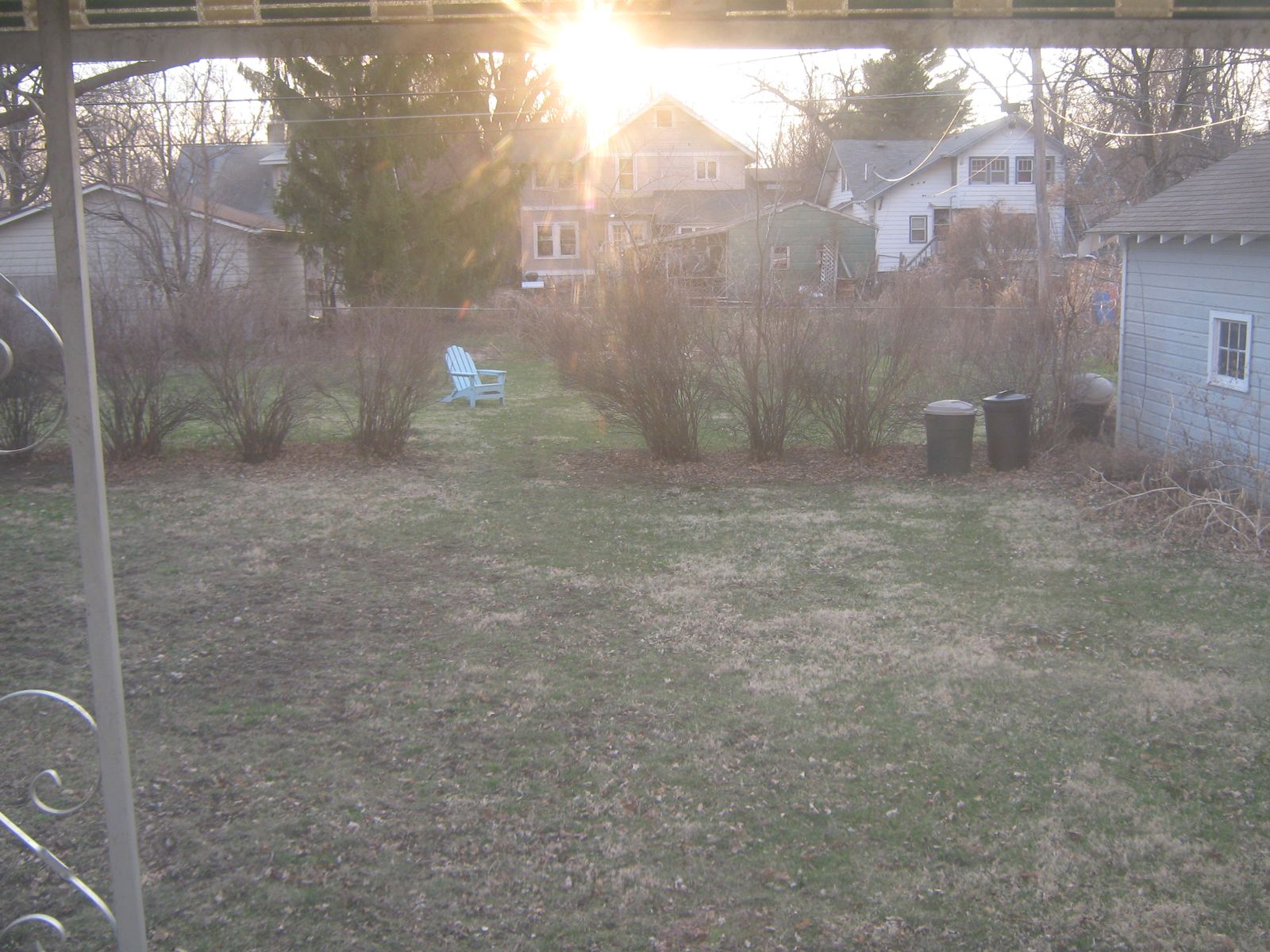
The end of the day in our back yard
Real Saturdays begin in spring.  Do you feel that way?  After a winter huddled inside, we are delighted to drink tea in the Adirondack chair in the back yard, look at the resurrection lilies, and wonder if we can plant lettuce soon.  Everything's still brown, but we bicycled past a garden center at the Hy-Vee. Too busy to stop, though.

For us Saturdays mean bicycling.  We loaded up on peanut butter cookies (recipe at allrecipesdotcom), stowed our books and jackets in the panniers, and bicycled on the Neal Smith trail to Saylorville Lake.  A warm breeze, and I cannot tell you how nice it is to be riding in a sweater and jeans again!  The Neal Smith trail, constructed in 1988, is 24 miles, ripples through woods and past the Des Moines River, and goes from downtown Des Moines to Saylorville Lake to Polk City to Big Creek State Park.  Last summer we never got farther than the butterfly garden.  Today we rode up and down hills--don't let anyone tell you the prairie is flat.  One of the hills is half a mile long.  

Finally we reached an appropriate bench.  Then I took a few pictures (which didn't come out very well).

Saylorville Lake, surrounded by woods & prairie grass

 This is how it will look soon:  
Gulls on Saylorville Lake
Here is the traditional bicycle rack picture.  Yes, every bike trip I take a picture of our parked bikes.  This bench comes with its own bike rack.

We took photos of each other and then dove into our books.  I'm reading Iris Murdoch's The Sea, The Sea (it seemed an appropriate title to bring to the lake).   I need to read the classics.  The new books I've read in the past few weeks, even when well-written, may not hold up.  Some are good, but most are transient, and they're instructive about the thinking of publishers and marketing departments.  This means this, and this records this, and this will keep them reading...  I'm beginning to like historical novels because the contemporary stuff (I'm thinking Niffenegger and Egan) is somehow high-strung. 

Anyway, home again, more reading, and I'll be back to book-blogging SOON.

Thursday, March 31, 2011

Jennifer Egan's A Visit from the Goon Squad

I collect rock fiction.  Marcelle Clements's Rock Me,  Sylvie Simmons's Too Weird for Ziggy, Francesca Lia's Dangerous Angels.  It's typical of me that I read about rock music without actually listening to it. There is no simultaneous reading and listening.

I did not read Jennifer Egan's A Visit from the Goon Squad until it won The National Book Critics Circle Award and made the long list for the Orange Prize. A double prize thing.  Why not before?  Because I had a bad experience with Egan's Look at Me.  I read it addictively, as though it were an unusually well-written trash novel, but I loathed the emptiness of the characters, and couldn't care about Charlotte, a fashion model whose face is destroyed in an accident. Mary Gaitskill recreated that same territory in Veronica, another novel about a fashion model, and one that worked better for me.

Egan's A Visit from the Goon Squad is what I now deem a typical Egan multi-layered novel.  A Visit is fast-paced, well-written, and easy to read. Her characters are sociopaths, narcissists, double-dealing, frantically falling, originally about music, but making concessions and wanting money, struggling in middle age, sometimes bought. Related to rock or bands or music in some way, they are still capitalists.  Anyone with a moral code is quickly out of the loop. 

"Time is a goon," says an aging rock star, Bosco, who wants to be filmed on a tour 20 years after his success, when he's sick, old, and unattractive.   Nobody believes in him.  But the time goon thing begins to work.  It is possible to get second chances as one gets older.  


The novel goes back and forth in time, a braid of punk rock-related stories, profiles, pseudo-journalistic pieces with footnotes a la David Foster Wallace, a power point presentation, and an SF futuristic marketing chapter in which everybody "ts" (even shorter messages than texts and twitters) and words like "story" are considered "constructs" because they have no meaning anymore.   Egan tries on a lot of styles and shows she can do them all.

One of the central characters is Bennie, a record producer and owner of his own label.  He rises from nothing and falls and rises again.  Perhaps because he's from nothing he's one of the more normal characters in the book. In middle age he is anxious, divorced, disillusioned with the music industry, and taking gold flake as a strange remedy for impotence.  But in high school in San Francisco Bennie played guitar in a band called the Flaming Dildos, and we get to know his old friends.  They're snorting coke and giving head and...  Bennie is the smart one, the one who can negotiate and deal.


Egan begins the novel with Bennie's assistant, Sasha, a sociopathic thief.  She is in the bathroom at a club and steals a wallet.  "It was easy for Sasha to realize, looking back, that the peeing woman's blind trust had provoked her."  Yes, that's Egan's book in a nutshell.  Normalcy provokes her. It turns out the woman is from out of town.   Sasha has no conscience, and though she gives the wallet back because her date, Alex, who plays a key part later in the book, is furious about New York dishonesty, no one ever knows she was the thief.  But to her therapist she talks about the wallet and admits she doesn't think about people, though he keeps trying to say she has compassion.  The word "steal" has no effect on her.  She knows the outcome of therapy will be that she gets well, so she goes along with whatever he says.  Later in the novel, when we see her from the outside, through other people's eyes, she seems rather nice and sympathetic.  I guess what Egan sees is that they're all creepy inside.

The characters do change over the years.  Sasha turns out to be a good mom.  Yes, I've said it.  Can you believe it?  But I think Egan is also showing us she can do that kind of writing.  She COULD write a realistic novel about nice people.  She just doesn't choose to.

In the last chapter, you realize the depth of Egan's pessimism.  Alex, so impassioned in the beginning, agrees to do some "blind team marketing" for Bennie, creating a buzz about a rock star he doesn't believe in, and enlisting other people to create a buzz online about an event.  For money.  His idealism is gone.  And his wife, who doesn't know he's done this, has heard all about the event and then enjoys it.  Her mind set has been assured ahead of time.  The event is sold:  she's a victim. Or was Bennie right to sell it first?  Or is all this "selling" right-wing?


So hours of addictive reading--I could never possibly read this satire again.  It seems to me there's nothing much here.  There is zero idealism, zero goodness, zero anything.  But some of the former punks do rebel.  And Bennie--but what's with that marketing event?  We don't have any individuality or privacy left.  All our information is on the internet. For corporations.  Egan says so.

I guess what bothers me is that Egan seems not to care.   It's a satire and yet...  She's very smart, but...


It's a bit like Gary Shteyngart's novel--at the end.  But his point of view is more critical.

A Visit from the Goon Squad is amoral.

I'd have to read it again to see how the braid of relationships work. But I really didn't like it, so I won't.

Tuesday, March 29, 2011

Audrey Niffenegger's Her Fearful Symmetry

Audrey Niffenegger's novel, Her Fearful Symmetry, is an entertaining page-turner of a pop-literary ghost story.  Think of Mrs. Henry Wood, author of East Lynne, with a dash of Wilkie Collins, Edith Wharton, and Henry James thrown in. Part junk, part good writing.  And although Her Fearful Symmetry is set in the 21st century, its Victorian ambiance quickly hooked me. Yet it's also eerily contemporary urban, a shadowy mix of Susanna Moore's shocking realism with Holly Black's SF grittiness.  It is set in Highgate Cemetery and its neighborhood in London.

I never read The Time Traveler's Wife.  A romance?  Not my kind of thing. Plus I suspected it was science fiction, and I prefer the science fiction that ends up in the science fiction section.

But well-done pop can be more rewarding than badly-done literary, and this isn't crap.  It's reasonably well-written, very well-plotted.  The story line explodes  the twisted stratagems of a sick mind, so I'll briefly synopsize  and get out of here.


The novel commences in Highgate Cemetery, a London cemetery famous for its Victoriana and Gothic tombs and mausoleums, where Karl Marx, Mrs. Henry Wood, George Eliot, John Galsworthy, and Stella Gibbons are buried.  Robert, one of the main characters, is a middle-aged, stuck-on-his-dissertation cemetery guide who is mourning his girlfriend Elspeth's death. The two of them had lived a rather dark bohemian life in separate apartments in a dark house on the edge of the cemetery.  Elspeth, an elaborate manipulator, bequeaths her apartment to twin nieces, Julia and Valentina, with a codicil that their parents can't set foot in the apartment.  And we learn that Elspeth herself was a twin, estranged from her twin sister Edie, the mother of the twins, in Chicago.

Confusing?  Yes, a bit.

When the twins move to London, there are problems.  Julia is the outgoing twin, Valentina the quiet, passive one.  Valentina wants her own life.  They are mirror-image twins, meaning that they have reverse symmetrical features.  Valentina and Robert begin to date, because she reminds him of a young Elspeth.  And the story develops from there.

Elspeth is now a ghost, stuck in her apartment.  She longs to know everything about the twins' life.  Eventually she engages Valentina in long hours of Ouija and automatic writing and seduces her from her real life into real danger. It's horrifying but nevertheless most of the characters have a strict moral code.  Otherwise I couldn't have continued.


All the characters are fascinating, and I very much enjoyed this.  A great, short weekend read.  Enjoy.

Monday, March 28, 2011

Wings: Leonora Rustamova

Teaching high school was the worst job I ever had.  There were highs and lows, but success is ALL about the middle of the road. 

Teach a feminist poem by Margaret Atwood to complement Ovid's Metamorphoses and you're likely to get complaints.  You can't go too high or low:  it's like Ovid's myth of Daedalus and Icarus. When the mythical inventor Daedalus manufactures wings, he has to prepare for the trip.  He instructs his son, Icarus, medio...ut limite curras, to fly in the middle of the path, not too near the sun or he'll get burnt.  In the case of Leonora Rustamova, she both invented wings and flew too high.   She invented a teaching method, and her own method melted the wax holding together the wings.


I read an article in the Observer about the fall of Leonora Rustamova, a successful teacher in the UK who lost her job after 11 years.  She wrote a 96-page novella, STOP DON'T READ THIS!, based on the lives of five of her 16-year-old students. The rebels in her class started reading.  She was promoted.

Then the book was accidentally published on the internet.  Rustamova was fired.


Leonora Rustamova
It's a long story, and I can't find the book, because it's been deleted, so I can't judge. According to The Observer, The Daily Mail, and other papers,  Rustamova's book named the school, the students, and described some of their issues:  drugs, truancy, stealing, students' crushes on her.  It also said a gay teenager resembled a Mr. Gay UK finalist, and described a boy's setting himself on fire.


Many of the boys and their parents, however, supported Rustamova and protested on her behalf.  All I can say is the UK must be much, much, much more liberal than the U.S..  The born-agains and tea-party conservatives  in the U.S. ban books and fire teachers all the time. The teachers are not necessarily teaching anything radical.  

Facebook is the root of all evil. A teacher in Georgia was fired in 2009 for posting a picture on Facebook of herself holding a wine glass and mug of beer.  A teacher in Massachusetts recently lost her job after trashing students and parents on Facebook (she thought the page was private).  A teacher in Iowa was fired after she wrote on Facebook she didn't believe in God. 

Oh, the internet.  So, in light of U.S. problems,  I have to be honest:  what was Rustamova thinking?  

And, in addition to Facebook, any sexual content in the curriculum can stir up problems. Parents rabidly complainabout books.  Sometimes students do, too.  A professor of mine retired ten years ago, worried about the possibility of sexual harassment complaints if he taught Aristophanes's Lysistrata. There's a whole life's work down the drain. I teach adults, but no longer feel free to talk about the phallic imagery in Catullus's poems. Some would regard it as normal and some would think I was the anti-Christ.  It was a different atmosphere when I was growing up.

So I'm not in the least surprised by Rustamova's losing her job.  She'd have been tarred and feathered in the U.S.

Sunday, March 27, 2011

Lark Rise to Candleford and Also Reading

Dorcas (Julia Sawalha) and Laura (Olivia Hallinan), Lark Rise to Candleford
Minnie (Ruby Bentall)
After crying over an episode of Lark Rise to Candleford, the BBC TV series which plays at 6 p.m. every Sunday, I decided to return to the second book of Flora Thompson's trilogy.  I recently enjoyed Lark Rise, the first book in the series, but put the trilogy aside because (a) I had read it long ago, and (b) I had too much going on this month.  Now the TV series has me hooked.  I love Dorcas Lane, the postmistress played by the actress Julia Sawalha. Her character is kind, canny, dashingly ladylike, and Machiavellian in a good way:  she mediates and manipulates for the good in times of crisis in Candleford.  She is also extremely generous.  She gives Minnie, the slothful, chirpy maid, many chances after housekeeping disasters because of Minnie's abusive stepfather.  Minnie dreams of marrying and having her own house, but is an incompetent and scatterbrained maid, and, in one sad scene, is left at home to do housework while Dorcas and Laura go to a party across the street.  Minnie dresses up, Cinderella-like, to dance by herself to the music.  She breaks Dorcas's trust, but Dorcas then begins to understand Minnie's needs.

I looked up the show IMBD.  I have to ask myself, Why?  In the old days, when I was really hooked on the BBC,  I would have watched the episode, had a cup of tea, and then read the book.  And doubtless I'd be finished by now.  Now I click on the title at IMBD, click on some of the actors, then discover I know some of them from other shows and movies:   Julia Sawalha as Sapphie on Absolutely Fabulous, Dawn French from The Vicar of Dibley, Ruby Bentall from Pride and Prejudice, and Peter Wight from Vera Drake.  I even found a long, very good article on Lark Rise to Candleford (the book and a bit about the TV series) at The Guardian (Dec. 13, 2008).  Which I skimmed.  Because I hardly need to read an article when I've read the book.

ALSO READING. The internet is a lot of clicking around, and I hate to tell you the exact number of pop books AND classics I have read reviews of on the internet  and which I am currently reading (of course many I've owned for years).   Audrey Niffenegger's Her Fearful Symmetry, The Diaries of Sofia Tolstoy, the second book of Kristin Lavransdatter,The Tin Drum, and Margaret Oliphant's A Country Gentleman and His Family (I may have to give that up). And that's not all.

And...

I added four books today today to my TBR in the Distant Future List. 


1.  A Man of Parts by David Lodge (not released here till September).  This historical novel about H. G. Wells will doubtless illuminate my fascination with his affairs with Rebecca West and Dorothy Richardson. Turn of the (last) century People Magazine AND literature?   I'm a Wells addict because of The History of Mr. Polly, Ann Veronica, and his other non-SF.


2.  Lucky Break by Esther Freud (available in April).  I've been a fan of Freud since Hideous Kinky; my favorite is Summer at Gaglow.    This new novel centers on a group of drama school friends and their subsequent 14 years.  


3.  Thomas Pletzinger's Funeral of a Dog.  A first novel by a German writer, compared in today's The New York Times Book Review to W. E. Sebald.  I love literature in translation and am eager to read something German: it's usually Spanish these days; have you noticed?


4. An Amazon Encore book.  If I understand this correctly, Amazon has picked up some self-published books and given them a kind of second chance.  One keeps showing up on my recommendations list:  Karen McQuestion's A Scattered Life, a novel about three women in Wisconsin, one of whom works in a bookstore.   Is it on my recommlendations list because I'm from the midwest, or because of the bookstore employee? I WILL  read anything with a bookstore in it... 

Saturday, March 26, 2011

Testing Lulu & Reading Other People's Self-Published Books

Thursday's New York Times & L.A. Times articles about Amanda Hocking, the Minnesota phenom who sold 900,000 copies of her self-published Y.A. series and stands to net $1 million from publishers of her new series, roused my curiosity about the world of internet self-publishing. Who is publishing at Lulu and Smashwords, free self-publishing sites?  Alternative writers seeking an outlet?  Creative writing teachers who write a little too well for mainstream publishing?   People who write for fun?

I read 60 pages of Keller's lyrical self-published novel.
Before I sampled some self-published e-books, I decided to test the capacities of Lulu.  Is it indeed three simple steps?  

It might help to write a book, but I breezily uploaded a blog entry.   "Create a keepsake just for yourself, full of favorite photos or your own stories. You'll end up with a professional-looking finished product that's a match for anything you'll find on the shelf at your local bookstore....No set-up fees. Ever. We make the book publishing process simple."

At first it wouldn't accept my iWorks document. I am all about the Mac and was annoyed.  I tried the program at Smashwords, and it was the same anti-Mac quandary.  Then my husband showed me how to save an iWorks document as Word.  Magic!   Lulu uploaded my "book."  Not actually a book, because I didn't bother to fine-tune the format, but I can certainly "Lulu" if I want to.


So, yes, run to Lulu and self-publish that novel.

READING self-published e-books is, of course, simpler. They're everywhere.  Self-publish on the internet and you're ready to sell or give away your e-book at Amazon, B&N, and other sites.  But after a recent backsliding into the world of REAL books (I ordered ten over spring break; the Nook is SOOOO over at our house), I can't justify buying a (possibly bad) self-published book. So I downloaded a few e-books from Obooko, a free site where authors can upload their work and we can download it for free. nough criticisms of  well-reviewed books from major publishers.


Here's the thing.  The self-published books are not actually bad.  Some of these people can write.  The problem is in the editing.

Take R. J. Keller's novel, Waiting for Spring. I read 60 pages. It seems at first like the kind of well-written issue novel Katrina Kittle writes. The narrator of Keller's novel, Tess Dyer, has just gotten divorced from Jason after eleven and a half years of marriage.  He didn't even bother to show up at the courthouse.  Sound Kittleish?  Yes.

It starts out strangely, with a prologue about a nun's retelling of the parable about the perils of sowing on hard ground on the path.  Then suddenly we're into Tess's divorce. 

Keller's writing about Maine winter is lyrical. The leafless trees.  The snow.   The stone steps of the courthouse were "solid, slick with ice in spots, crunchy with salt in others.  I focused on that sound, my books crushing the salt, because it was better than hearing the judge's gavel echoing in my brain."  

Then it gets weird.  Tess reads in the newspaper about the murder of a cleaning lady in a nearby town, and decides to move there and take over this woman's jobs because she needs a fresh start.  GOOD GOD.  She moves into a new apartment, is sexually aroused by the construction worker neighbor, has lunch with his friends, she drinks too much, and he comes onto her...and Keller needs to scratch some of these chapters and include a little drama because we're not going anywhere.  The plot is GONE after a couple of chapters.  And Tess honestly seems kind of trashy.

So Keller is a good writer in search of an editor. She can't seem to make anything HAPPEN in the novel.  We're always in Tess's head.   I can't finish the book because I keep itching to edit it.   

Then I looked at a couple of books that are unreadable.

And I just downloaded something (historical fantasy?  I'm not quite sure where I was on Obooko) called When Women Were Warriors.  It looks vaguely Marion Zimmer Bradley-ish.

I'm quite sure there are some good books up there.  But where to find them?  Not all of these writers are Amanda Hockings, though her books aren't my kind of thing at all...

Friday, March 25, 2011

Memini: The Underground Stream

Memini. The Latin word for "I remember.”  Me-mi-nee.  A lovely word.  It means to remember, to recollect, to be mindful, not to have forgotten, to bear in mind.  I particularly like that phrase, "not to have forgotten."  

The “m” sound is calming and dreamily repeats throughout the word, quietly murmuring and burbling like an underground stream.  Not a morose, dolorous word. Not a whingeing word.  Certain memories repeat often, often in my case the bad, but the beautiful memini word cancels that out. Remember the R.E.M. song, "Try Not to Breathe"?  

I will try not to worry you
I have seen things that you will never see
Leave it to memory me. I shudder to breathe

That is what I will try to do:  not to worry you.

Brooding memories are not the focus of my parents’ generation.  They have the gift of self-censorship.  You ask them what parts of their life were best.  They say, “All of it was good.”  You sit there wondering if they remember the screaming, the divorces, the illnesses, and when you read their memoirs, self-published in spirals at Kinko’s, which they give to the whole family, you are not surprised to see the past has been white-washed. Sometimes a private segment accidentally is published with the rest and they're flustered.  Oh, I didn’t mean to give you that. 

The use of memini is auspicious. My love of this word points me along the right path.   It precludes my writing a misery memoir. Not that that couldn’t be done. There are the usual things.  But it depends on your outlook.  Are you going to write about what interests you or what bores you?  Does anybody want to know about that...yes, they do.  But there's no reason to reveal the wretchedness.  I understand my parents' generation there.  I fall asleep as soon as I think about the unhappiness.  I'm more interested in what turned out well, whether you thought it would at the time or not.

Very schoolmarmy at one of my jobs.
Typical of me to use the Latin.  If you know me, if you've read my blog, you may not be surprised, nor think me stupid, for having embarked originally on A LATIN CAREER PATH.  CAREER PATH.  WHAT A JOKE. My friends were working in cafeterias, offices, and stores while I was in graduate school. I would show up at the library smoking room (a room open all night, off the entry of the library) at five in the morning and look up hundreds of words and translate.  Then I'd go to classes and take notes and translate, and then late in the day I'd teach (braless, as we all were, but at least in button-down shirts, as we were briefly too popular in leotards).  All the Latin is long ago, but it had an impact on me; it shaped the way my life would turn out.   Memini.  But I remember the men who were furious when I passed the Latin exam and got my master's.  Only two of us passed.  Professors were clasping my hands.  A friend who had dropped out of the program coldly said, "Oh, you're a master" and never spoke to me again.  It was the way things were.  Men were not happy for intelligent women.  

You may have heard me say at dinner parties that I teach Latin, and if I seem to exaggerate, it’s because if I don’t want people wondering. It is not acceptable not to work.  They hate it if you don't work.   The other option is to say I'm a housewife.  Men and women look incredulous.  Women actively blanch.

I am a housewife, and I teach as little as possible.  I teach a few classes a year for adults.  If you aren’t a happy teacher, and if you find it doesn't nurture you to give to others all day, it gets very boring.  At home you’re napping after work, and then you get up and read Buddenbrooks desperately because if you don’t, your whole life is preparing to teach and grading papers and being a nice lady with a group who gets to know very well, since you teach Latin I, II, III, and IV.  It was enjoyable sometimes but exhausting, and none of my friends taught Latin in high schools or colleges for longer than five years. One friend swatted unruly students with a magazine; another thought the students at a midwestern college were terrible; I was bored out of my mind.   I do have an adorable picture of me teaching in the ‘80s, with one of my students making rabbit ears behind my head.  It was a nice group.  

Antonia in I, Claudius
We drifted into other jobs that were more fulfilling and less tiring.  I reached a point when I decided to do something else.  I found my vocation later. I still teach a little adult education Latin in addition to other activities, because it's good to spread the word about this most powerful influence on English. 

And so perhaps it was Latin that shaped the Antonia in me, mixed with other Roman heroines, and a dash of Livia.  Certainly Livia may not have been as bad as everyone says.  You know those Romans...

Wednesday, March 23, 2011

The Self-Published World

Reporters at The New York Times and L.A. Times are agog about Amanda Hocking, a 26-year-old Minnesotan who sold more than 900,000 copies of her self-published young adult novels (mainly paranormal romances) in the last year.  She is now wheeling and dealing with major publishers, who have bid $1 million for her new series.  She is not the first self-published writer to become famous.  The 2,000s seems to be the self-published decade.  Lisa Genova, author of Still Alice, and Brunonia Barry, author of The Lace Reader, also made it big. 

Self-published books are nothing new.  In my family, we rush off to Kinko's and publish spirals of our latest memoirs. Everybody has written a memoir or autobiography, some are quite good, and most are illustrated with photos. It's touching to have "scrapbooks" of other people's lives. 

No, I wasn't there.
I'm waiting to write mine when I turn 60.  I've jotted down bits and pieces about my childhood and young adulthood, but I sound like a glib journalist, and can't meld the language of my late 20th-century history with the twitter of the current times.  I sound phony when I try to convey the naive philosophy and weird diction of the hippies, radicals, professors,  feminists, and cons who populated my world when I was young.  They were "into" things, smoked "dope" (never pot or grass), everything was "cool" or a "bummer," and I believe there were actual "dudes."  Some of it was so traumatic I've never gotten over it.  So do I want to write it down?


I'm happier free-lance.  I'm twice-again happier blogging.  It's fun to write short pieces.  And not to have to sort anything out. 

My family has not, as I mentioned, gone the electronic route. I am the only blogger.  Some of the younger family members are on Facebook.  Somebody scandalized everyone by writing about her life as a prostitute or something, but it's probably all made up.  Anyway, I don't have a Facebook account, so I haven't read it.


I think it would be fun to read self-published books for, say, a week.  I'm mostly down on receiving free books from "real" publishers, as my TBR pile is already endless, but if anyone wants to send me an excerpt from a "free" self-published e-book for possible review, I'm game.  The problem is I would say what I think. Writer, beware. E-mail me at frisbeebookjournal@gmail.com

Tuesday, March 22, 2011

Bibliobits: Not Buying Books & Carol Edgarian's Three Stages of Amazement

Our Public Library
I promised I would stop buying books. I promised my husband and a bunch of people I don't know online.  I promised the readers of my blog.  There was much drama and cutting up of a credit card.

For awhile I kept my vow.  I browsed in bookstores but didn't buy. I was very much the woman who borrowed books from the new library downtown. 

And then my husband visited his family for a week, and I was at home watching rom-coms and reading LIBRARY BOOKS, and I realized, "This has been SO MUCH DONE. More people DON'T buy books than DO." 

So anyway I allowed myself to buy a FEW books again.


Maud Newton at her blog briefly recommended Carol Edgarian's novel, Three Stages of Amazement.  She referred us to a review in The New York Times by Janet Maslin, who said Edgarian's novel "shares a surprising amount of common ground with last year’s most argued-about novel, Jonathan Franzen’s 'Freedom.'” 

Why I decided to read this is not clear, since I'm stuck in the first 100 pages of Freedom. But the combination of Newton's endorsement and Maslin's idea that this is Edgarian's take on the recession and the Obama administration interested me.  

I very much enjoyed it, though I have a few reservations.  It's very timely, but perhaps too timely.  It is well-written, sometimes even lyrical and inspired.  On the other hand, the theme is money, its use, power, and obstacles.  I dislike yuppies.  Sorry, they're probably not called yuppies anymore, but it's hard for me to care about Charlie Pepper, a surgeon and Silicon Valley surgery-robot-inventor, who stands to make millions of dollars through his business.  Charlie has personal problems with his down-to-earth, intense wife, Lena Rusch, whom he loves, in San Francisco. Fortunately the main character, Lena, is actually very sympathetic.  A former documentary maker, she is now at home with her five-year-old son, Theo, and her preemie baby, Willa, who constantly has pneumonia and other health problems.  Lena can't get her freelance script-writing done, but she can't give up. She is passionate about her family and burdened in this new city with trying to get Theo into the right school (all that yuppie stuff). She and Charlie are in debt.  But she has integrity.  When Charlie agrees to take money from Lena's uncle, Cal, a rich venture capitalist, Lena is furious and their marriage almost breaks up over this dirty money.   While Lena was growing up, Cal refused to give  money to his sister-in-law, Lena's impoverished mother, Beverly, after the death of Lena's father.  There are also various family secrets, such as  Lena's mother's affair with Cal.  Lena knows that the very rich, like Cal and his wife, Ivy, are dangerous.  They can help you or destroy you.  One day they're on your side; the next not.  They are Democrats, but not necessarily good guys; though Al and Tipper Gore go to their parties, Cal feeds off other people's ideas, Ivy has had one too many plastic surgeries and can by bitchy about the hoi polloi,  and what these two buy is what they are.

I had a hard time making the transition from Lena and Charlie, who are regular people, if high-maintenance, to Cal and Ivy, who are just not very interesting.  They have a ton of money but what have they contributed?  Ivy plans to give all her designer dresses to the Met:  so what?  Cal has been involved with Google or something:  so what?  They don't actually DO anything.  It's all done with money.

But Edgarian does manage to flesh out this repulsive elderly couple near the end--near their death.  Ivy has moments of generosity.  Cal also can be kind.  The best thing about them is their relationship to their dogs.  They are very, very kind tot heir dogs.

There are some very moving scenes about Ivy and Cal's illness, and their changing feelings are realistically described, and, though, like Lena, I shudder at them and believe they're dangerous rich people, I saw that they must once have been human, before all the money. You can't get anywhere if you can't have money.  That's a message here. And that we all know:  SOME money is necessary.  But too much can corrupt.  So Charlie has to find a new way.  And Lena's way to earn money at the end is so hypocritical by her standards  that I'm amazed she'd agree to nepotism.  She can take money, but Charlie shouldn't have?  She can't even find time to write scripts, so how does she qualify for this job?  

So the novel is about money and irony, with the Pepper-Rusches the family with the potential to transcend the problems. 


Some lovely scenes, some stymied by awkwardness.  Edgarian has a lot to say, and I hope it speaks to people.

Monday, March 21, 2011

Junichiro Tanizaki's Some Prefer Nettles

Junichiro Tanizaki's novel, The Makioka Sisters, is one of 100 novels critiqued at the end of Jane Smiley's accessible book about novels, 13 Ways of Looking at the Novel.   I underestimated Smiley's wonderful book at first because her style is so smooth and simple that it's easy to overlook how discerning her analysis is.  You think, oh, I already knew that, and perhaps you did, but it is an excellent resource for the critical history of the novel and recommendations of obscure classics.  I have gone back and dipped into it countless times. And I was very keen on reading the Japanese writer Tanizaki after I read her essay.  Tanizaki (1886 –1965), influenced by Tale of Genji, is, according to Wikipedia,  perhaps "the most popular Japanese novelist after Natsume Soseki."  

Many of Tanizaki's books are in print, but I decided to start with a short novel, Some Prefer Nettles.  I love this book:  it is a slim prose poem of a novel, reminiscent of the novels of Colette.   Set in Tokyo in the 1920s, it examines the mental processes and emotions of Kaname, an introspective man whose open marriage to Misako is causing anguish to both parties.  She is in love with another man, and meets with him openly.  Kaname and Misako talk casually about these meetings, and sometimes talk about divorce.  He is unhappy but  can't make up his mind about the divorce, because it will make their son, Hiroshi, unhappy.  


But this is an excuse:  Kaname isn't sure what he wants.  Is he a fool to throw away a traditional marriage to a compatible woman, even though he is not sexually attracted to her? Must marriage be sexual forever, or can it be an arrangement of convenience eventually?  What is the most modern outlook on marriage?  Is he cheating Misako by staying married?  What will divorce solve for Kaname, who doesn't want a wife or steady girlfriend?

His cousin, Takanatsu, urges him to get the divorce.  Kaname admires his cousin, a man of action, but has more subtle thoughts.

Kaname thinks:

"A separation is always sad.  Regardless of who is involved, there is a certain sadness in the mere fact of a separation, and Takanatsu was of course right that nothing would ever come of their waiting arm in arm for the perfect moment. There had been none of this hesitating when Takanatsu himself had left his wife.  After he made up his mind he simply called her into his room one morning and informed her, and spent the rest of the day explaining his reasons....  Kaname had come to Takanatsu with his problem because the latter had been through the experience and because Kaname had watched with some envy the firmness he had shown."


One of the most fascinating aspects of the book is Tanizaki's description of the classical puppet theater.  The elaborate plays with life-size puppets are usually about love and consequences.  Kaname's father-in-law, an old man, has a very young mistress, O-hisa, who is very like a puppet herself, and has been traditionally trained to please her lover in every way.  He  insists that they travel to see different puppet plays around Japan, and Kaname accompanies them.  Although Misako despises O-hisa, Kaname isn't sure:  maybe he would prefer a woman like this.  She is a doll or a puppet, unlike Misako, who has rejected the dolls her father has given her for the Festival of Dolls.  No demands.

This beautifully written novel is realistic and shocking.  I had to read the ending twice.  Fortunately, this is something the translator, Edward G. Seidensticker, addresses in his introduction.  Tankizaki is deliberately vague:  it is a style he favors.  You are not going insane.  


I loved this book and will certainly be reading more of this writer soon.

Sunday, March 20, 2011

Twin Souls: Anonymity and Obnoxiousness

Anonymity is a quirk of the web. It can be a problem; it can be an equalizer.  It depends on how you use it.  People hover pseudonymously around various websites, writing whatever inspired or peevish thought enters their heads, clicking the send button and running, not daring to write under their own names. They can pretend to be a man, woman, or cactus plant.   We don't know who they are.


Negative anonymous comments can be a problem.  The Washington Post, New York Times, and Slate receive so much anonymous hate mail that they have started blocking comments and changed their policies.  At Slate, commenters are now required to sign in under Facebook, Yahoo, Google, or Twitter, though, as Slate writer Farhad Manjou points out, anyone can set up a fake identity account at Google or Yahoo. 

I don't leave comments at newspapers, pseudonymous or otherwise, and I'm not really big on using my name online.  My name is not Frisbee--I guess you figured that out.   Am I who I say I am?  A reader and a bicyclist?  Yes, last time I checked.  I don't put my name out there because I don't have backup--I'm not writing for a corporation, nor am I writing for a particular audience. This is a journal. 

Nor do I expect other bloggers to use their own names.  We aren't publishing for profit in most cases; most of us just like to write. The comments are mostly by other bloggers.  The atmosphere has been pleasant.  We're under the radar here.

I never had problems with negative anonymous comments until February when I MADE A JOKE ABOUT PERSEPHONE BOOKS and offended a bunch of people.  I deleted the joke, but Anonymous hangs out here now. It's odd.  First I started moderating my comments.  Most were from Anonymous. Anonymous has little to do. Yesterday I had six or seven persistent Anonymous hate-comments about a blog entry I wrote on the Des Moines Sculpture Park.  Who even read that? Besides my seven friends in Des Moines and my family?  They all liked it. I made a joke there, too--but a nice joke.  Is it the jokes?   Well, it turns out the commenter is not even from the U.S.  It's  ONE ANONYMOUS PERSON writing from the UK!  I couldn't believe it, either.   Now this nut can't possibly know anything about Des Moines's sculpture park.  And I did delete all his/her comments because really he or she doesn't belong here.


Now the question is:  do I moderate all the comments forever?  Or simply block all of them?

It is possible to have a no-comment blog.  Do I want a no-comment blog?

I just clicked on the Registered User option and hope it will cut down on Anon.  You have to be a registered user now--God knows what that means.


Here is what Farhad Manjoo, a Slate writer, has to say about comments:

"I think Slate's commenting requirements—and those of many other sites—aren't stringent enough. Slate lets people log in with accounts from Google and Yahoo, which are essentially anonymous; if you want to be a jerk in Slate's comments, create a Google account and knock yourself out. If I ruled the Web, I'd change this. I'd make all commenters log in with Facebook or some equivalent third-party site, meaning they'd have to reveal their real names to say something in a public forum. Facebook has just revamped its third-party commenting "plug-in," making it easier for sites to outsource their commenting system to Facebook. Dozens of sites—including, most prominently, the blog TechCrunch—recently switched over to the Facebook system. Their results are encouraging: At TechCrunch, the movement to require real names has significantly reduced the number of trolls who tar the site with stupid comments."

Friday, March 18, 2011

The Middlebrow Prodigal Women by Nancy Hale and a Classic by Heinrich Böll

Spring Break:  My Idea of Hell
Spring break is traditionally a time to loll on the beach or golf, but I have never spent spring break at a beach or a golf resort.  Beachcombers and Golfers belong to Another Genus of Humankind.  Aside from my junket to Des Moines's Sculpture Park, I've been preparing for our Porch Madness Scrabble Tournament and reading a wide range of middlebrow novels and classics.  I've enjoyed the middlebrow doorstop of a novel, Nancy Hale's The Prodigal Women, and Nobel winner Heinrich Böll's masterpiece, The Clown.


First, let me say The Prodigal Women is a very good read, along the lines of Dreiser's An American Tragedy mixed with Jacquelyn Susann's Valley of the Dolls and Mary McCarthy's The Group. In other words, it is a fascinating mishmash, well-written, occasionally tawdy, and very dark.   Published in 1940, and reissued as a Plume American Women Writers book in 1988, it is a tripartite bildungsroman about three friends who grow up in the 1920s and '30s and live male-oriented, often tragic lives. Leda March is the intellectual daughter of a monied Boston family, who grows up victimized by the other girls at Country Day School in Hampton, a small town/suburb, and later at an exclusive girls' school in Boston. She is too serious, loves poetry, walks in the woods, and cannot make small talk.  But she desperately wants to be a debutante like her chief tormentor, a girl named Adele.  Then Betsy Jekyll, a Southerner, moves to Hampton and becomes Leda's bosom friend.  They talk about boys and do typical teenage things, like making up their faces and buying costume jewelry.  Leda finally fits in: she loves Betsy's arty family, her brilliant mother, Minnie May, and the beautiful older sister, Maizie.  


But things start to go wrong very soon.  Maizie falls in love with an artist who mistreats her.  She gets pregnant so he'll marry her, and, since he is unforgiving and sadistic on her honeymoon, she has an abortion while they are in South America.  She never recovers from the abortion.  She loses her looks and health, moves back in with her family, and runs back to the horrible Lambert whenever he calls.  Lambert admits to Leda he has ruined Maizie's life, that he wants to kick her like a dog when she is down, and he is like poison to her.
 
Nancy Hale
Worse, Leda has an affair with him.  Leda, who has grown up to be a beauty and a talented poet, has dumped Betsy and befriended a wealthy debutante, Nicola, who Does All the Right Things. When they meet Lambert through her chief tormentor, Adele, Leda has to have him.  Leda and Nicola think there's nothing wrong with Leda's crush, since Maizie has become a frump.   Leda and Lambert are both self-centered and cruel: they're two of a kind.  But Leda is very cold:  she does not want to have sex with him.


Leda cannot bear to be different, so when Adele accuses her of adultery she leaves Lambert and marries her kind cousin, James, a doctor, so she can be the conventional post-deb she wants to be.  Leda's coldness and sheer determination are horrifying.  She insists that they move to New York. 


Betsy, a warm, sweet girl, is not a deb, but is having a good time with Harvard men.  She has just met the love of her life, and I have a feeling it is going to go wrong.


I needed a break from all this tragedy, so I read Heinrich Böll's sad, comic novel, The Clown, one of the best books I've read this year.  


The brilliant Heinrich Böll won the Nobel Prize in 1972, and I read some of his novels when I was growing up.   Though most of his books are still in print in the U.S., I don't hear much about himanymore. German graduate departments are being cut across the nation, and fewer German novels seem to be translated.  Am I imagining that?


The Clown, published in 1963, is a comical, sad, post-war soliloquy and critique of Germany, both Catholic and anti-Catholic, and an analysis of the socioeconomic problems.  It is narrated by Hans Schneir, a down-and-out comedian-clown-pierrot, who returns to his apartment in Bonn, shattered because his girlfriend, Marie, a devout Catholic who has lived with him for many years, has left him to marry Zupfner, another Catholic. Hans is out of a job, with a hurt knee, and no money.  He telephones everyone he knows to ask for money.

Money is just one of the problems Hans faces.  Catholicism is another, or at least the face of the problem.  Hans, in his late 20s, is obsessed with social hypocrisy.  The Catholic group meetings Marie attended struck him as the essence of hypocrisy.  Hans attacks each of the vain, empty men in the group.  To Marie, they have been her life's blood.

Among the most horrifying men in Hans's past is a Nazi who brags about his history, pretends to be reformed, and enjoys a lot of attention from women. 


Hans does not marry Marie because it strikes him as the height of hypocrisy  to do paperwork for a civil as well as a Catholic ceremony and sign contracts about bringing up their children Catholic.  He believes the Catholic marriage will be less moral than their living together.  Marie is more complicated than the other Catholics, but she is torn and cannot agree with his point of view. 

Hans grew up in a rich, miserly Protestant household, where his mother starved her family, because she was always dieting.  His sister Henrietta tragically died during their childhood; his brother Leo converted to Catholicism to become a priest. His mother worked first against the Jews during the war, then for reconciliation after the war. His father saves two women from the Nazis, the only really good deed Hans thinks he has done. 

Now Hans is alone, desperate for money, and when his father comes to visit him, he will not give Hans money unless Hans agrees to take "clowning" lessons.  He does not understand that Hans has destroyed his career through drinking and missing Marie.


"What was it that made this kind man, my father, so hard and so strong, why did he talk on the TV screen about social obligations, about national consciousness, about Germany, about Christianity even, which he admitted he didn't believe in, and, what was more, in such a way that you were forced to believe him?  It could only be money, not the concrete kind you use to buy milk and take a taxi, keep a mistress and go to the movies--but money in the abstract.  I was afraid of him, and he was afraid of me:  we both knew we were not realists, and we both despised those who talked about "Realpolitik."  There was much more to it than those idiots would ever understand.  I read it in his eyes:  he couldn't give his money to a clown who would do only one thing with it...spend it, the very opposite of what you were supposed to do with money."
It's a fascinating novel, and I'd like to read it again, and read some history, to understand it fully.  It has been such a pleasure to read this wonderful, fast-paced, intellectual novel.