Sunday, November 29, 2009

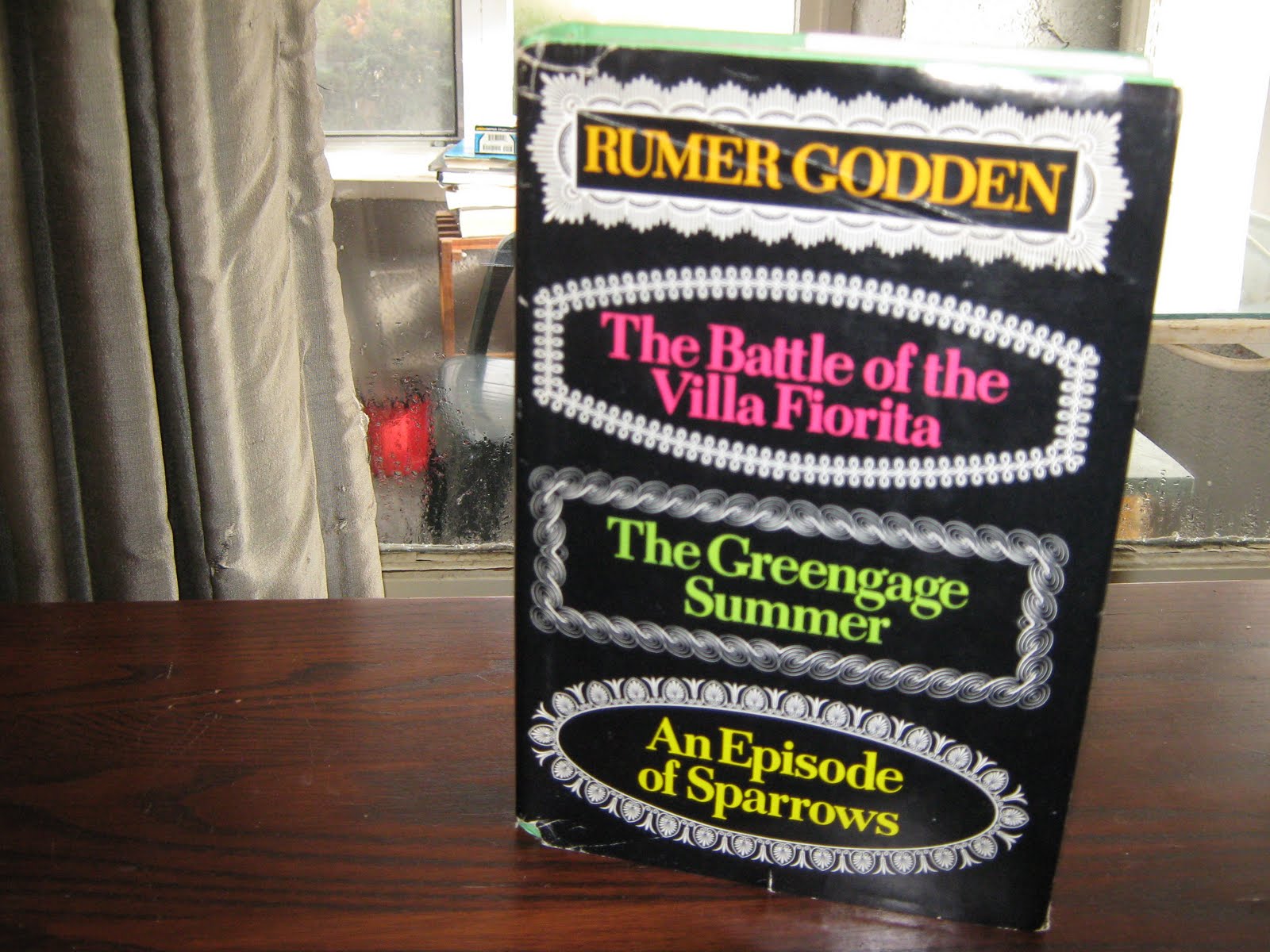
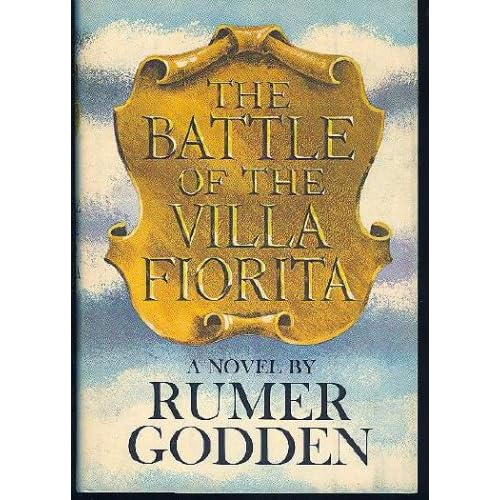
The Battle of the Villa Fiorita


The Battle of the Villa Fiorita is one of three novels in the Rumer Godden omnibus I bought at the Fabulous Charity Sale for $1. It contains Godden's best novel, An Episode of Sparrows, a classic (marketed for children via NYBR, but originally published as an adult novel); The Greengage Summer, a perceptive study of an emotional trauma that hits a family of children living on their own in a French hotel while their mother is in a hospital; and the puzzling, uneven, but well-written novel, The Battle of the Villa Fiorita. The latter analyzes a battle between children and parents over a divorce. Do not look for a family story with a comfortable ending. Agonizing in parts, sad, moving, and occasionally comedic, written in Godden’s distinctive, poetic style, part narrative and part musing commentary, the novel unflinchingly examines the real horror that can be caused by children who don't understand adult relationships.

Godden writes lovely sentences, but she packs a fierce emotional wallop: she is not the mistress of the happy ending. Weirdly, this bitter, intelligent, realistic novel was dismissed as sentimental in Time magazine when it first came out in 1963. In a scathing attack, the reviewer wrote,

“There is evidence that the Book-of-the-Month Club could not exist with out Rumer Godden... This time Author Godden, 55, is addressing herself to the woman in early middle age who has had her children, has become bored with her husband and feels parched for romance.”


The reviewer apparently really disliked Godden. What does her being 55 have to do with it? The heroine, Fanny, is a complicated person - hardly looking for romance. And divorce is certainly not romantic: perhaps in '63, when divorce was less common, the reviewer didn't understand that.

The Battle of the Villa Fiorita is skillfully told, an interweaving of the points of view of the children and tthe adults. Caddie, the 11-year-old who plots with her brother, Hugh, to run away to Italy and break up their mother’s relationship with her lover, is very simple, naive, and direct. She is the ordinary child who values honesty and family tradition, and she desperately wants her mother back. Hugh is the sensitive, sickly, intelligent older brother who has been devastated by the loss of his mother but is too angry to show it. Godden has a gift for portraying children as they are, not from an idealized point of view. And we can see them turn into wily beasts, shattered by their mother’s leaving, willing to do anything, however unethical, to get her back.

But the most interesting part of the novel is told from the point of view of Fanny, a wife and mother who, after years of acting as a housekeeper-chauffeur-caretaker-wife-of-an-absentee-military husband, leaves her family, torn away by her first real sexual love for Rob, a film director. (By the way, Godden does not introduce this career for the sake of glamour, as Time magazine implies: Godden herself was acquainted with filmmakers of the ilk of Renoir, who filmed her beautiful novel, The River.) Fanny is lonely, left alone by her military husband who travels for his job, always the odd woman out at dinner parties (and she meets Rob at a dinner party). Fanny and Rob occupy a beautiful temporary nest in a borrowed Italian villa, but Fanny is also recovering from the loss of her children, won by her husband in a punitive custody battle. She sleeps all the time.

“Rob, Celestina, and Giulietta were united in worrying in case she was uncomfortable, cold, depressed. Here Fanny was first and for years she had always been last; the last to be served -’Because I did the serving’--the last to go to bed, unless Darrell were at home, but first to get up in the morning, she thought wryly. She was last on every list and automatically the one to give up everything, to stay behind, to go without. ‘Well, mothers are like that,’ she would have said. ‘Some mothers,’ said Rob.”


Although this is not Godden's best book, it is considerably better than much of what I read today! (Sorry, contemporary writers, but she was an original.) Considered middlebrow these days, she is still popular and her novels are available widely at used bookstores and stores online.

Saturday, November 28, 2009

War for the Oaks


It is curious when a city produces a group of phenomenally talented writers of one genre, because in the normal annals of publishing not all of them would get published. But sometimes networking or talent defeats the laws of probability. I’ve been methodically reading some good fantasy novels by former members of a Minneapolis writers’ group, The Scribblies, among them Patricia Wrede (my favorite) and Pamela Dean, who I understand were more or less discovered by Terri Windling. Wrede's uniquely quirky characters, knack for witty dialogue, and the swift momentum of the plots of her Lyra books never fail to amuse me (read about her here). By the way - off the subject - if you're looking for exceptional literary fantasy, the surreal novels of the American writer Jonathan Carroll - who lives in Vienna and was never, alas, a Minneapolis Scribblie - are exotic and fascinating (reviewed here). (Lightning doesn't strike twice?)

I’m now reading Emma Bull, a brilliant former member of the Scribblies, whose novel War for the Oaks (1987), though it has a bit of a Y.A.-ish feel, is a groundbreaking work of “urban fantasy.” Set in Minneapolis, it mixes the worlds of rock and roll with the dangerous Seelie Court of faerie. Bull’s style is appropriately hip, tough, and honest, as is the voice of the androgynous heroine, Eddi McCandry, a guitarist who has quit her job in a loser rock and roll band and wonders gloomily if she can forge an identity outside of the world of music (will she become a temp?). As she walks home from the bar early in the morning through the deserted streets of Minneapolis, she is stalked and hijacked by a phouka, a member of the alternative Minnesota faerie land who can appear as a dog or a man, a creature who has selected Eddi as the mortal they will need to win a war against the underworld faeries.

Needless to say, Eddi is not keen on this. She and her friend Carla try to escape. But the phouka, who calls himself Robin Goode, proves curiously useful and gradually becomes a friend. He suggest that Eddi, who is very talented, form her own rock band with Carla. And serendipitously they attract some other excellent, if very odd, musicians. They’re on track to appear at an art school gig, but Eddi has to take time out to go with the phouka to fight a war.

Okay, that’s as far as I’ve gotten. But I think the edgy writing would appear to quite a range of readers, including collectors of rock and roll fiction.

Here’s the first paragraph:

"By day, the Nicollet Mall winds through Minneapolis like a paved canal. People flow between its banks, eddying at the doors of office buildings and department stores. The big red-and-white city buses roar at every corner. On the many-globed lampposts, banners advertising a museum exhibit flap in the wind that the tallest buildings snatch out of the sky. The skyway system vaults the mall with its covered bridges of steel and glass, and they, too are full of people, color, motion."


Pretty good, no? She's an obvious influence on Holly Black, a writer I discovered through Amazon after reading the Twilight books! War for the Oaks is not quite my kind of thing - somehow the characters don't seem as well-developed as the characters of the more flagrantly fantastic Patricia Wrede. Eddi is so hard - and seems kind of emotionally numb. Are all musicians like this? Perhaps. They certainly are in the tabloids!

Thursday, November 26, 2009

The Greengage Summer and the '60s


It’s a slow Thanksgiving, as it’s meant to be. There is no traffic on the street, a pumpkin pie was won at the Turkey Trot (not by me), the aroma of slowly roasting turkey permeates the house (baste every 15 minutes till the thermometer reads POULTRY) , and I am devoting the day to ‘60s literature.

The ‘60s literature puts me in the ‘60s holiday housewife spirit, which is my camouflage for the season. Actually I’m reading a 1963 omnibus of Rumer Godden’s novels, a book club edition bought at the Fabulous Charity Book Sale. Godden is one of my favorite writers - I especially love Kingfishers Catch Fire (reviewed here), her autobiographical masterpiece about a kind of pre-hippie widow who moves with her two children to an obscure village in India and almost gets killed because she doesn’t understand the culture.

Why does this make me feel like a ‘60s housewife?

Well, the pre-feminist ’60s is what my mother experienced. It was "before everything changed - before The Graduate,” as she recalls. She admired the Kennedys, read book club books, went to all the movies, used Green Stamps, made daily trips to the grocery store and the “locker” to get meat (our grandfather was a farmer), stayed home and took care of the children without complaint. The '60s was not for her primarily a period of social change, though she opposed the Vietnam war. Now that has not been my life, but I find it helpful to replicate the quiet atmosphere of Thanksgiving here. Nobody was depressed or suicidal over our holidays!

So there is a lot of reading going on - and there would have been a lot of smoking, too, if this had been that era. There is a little classical music in the background, but earlier we listened to Eric Clapton on “Bellbottom Blues” (1970, but close enough). And I finished The Greengage Summer - and am now blogging, a 21st-century activity, so I'm out of period.

The Greengage Summer is not Godden’s best novel, but it is a revelation: another autobiographical novel (I’ve read her autobiography), about a family of children who end up living alone at a hotel in France one summer while their mother is hospitalized for blood poisoning.

The story is divulged retrospectively through the perceptions of the narrator, Cecil, a 13-year-old girl who is beginning to understand the “grown-up” world as the action happens. Shadows waver and solidify and become human as Cecil analyzes her family’s fascination with Eliot, a kind, handsome Englishman who befriends them. Eliot comes and goes and is having a desultory affair with the owner of the hotel, the rather scatterbrained Zizi, but when Joss, Cecil’s beautiful older sister, recovers from a stomach illness and comes down from her room, Eliot is entranced and begins spending all his time with them.

The children love him, but Eliot’s girlfriend, Zizi, begins to humiliate Joss, upset by what is going on. And though Eliot and Joss don’t have an affair, Joss becomes competitive with Zizi in payback for the humilation. And as other men begin to pay attention to Joss, a tragedy unfolds.

The tone is fairly light - Cecil does not understand everything that happens as it happens - none of them understand what Eliot is up to. But the strange ambiguous ending does show him in a heroic, if rather warped, light.

I really enjoyed this. If you want to read more about Rumer Godden, go here.

Off to play Clue!

Tuesday, November 24, 2009

Catullus Censored: Not for Texting


Get out your Catullus. Latin professors all over the world will be translating Poem 16 with their students.

Or not.

Classicists will be chagrined to learn that the English multimillionaire financier, Mark Lowe, accused of attempting to hire a hitman to kill a female employee, Jordan Wimmer, also harassed her by texting a line from Catullus’s poem 16, "Pedicabo ego vos et irrumabo.”

“Only in England would someone practice sexual harassment with Catullus,” I said, frantically flipping through my Merrill edition for Poem 61.

“Can you imagine what kind of country that is?” my husband asked.

“They don’t know who Catullus is here,” I said - and am I sad or merry?

The Guardian blogger, Charlotte Higgins, is gleeful over the BBC's reticence about translation. (They take the Fifth or something.)

The word pedico isn’t even translated in my dictionary.

Lewis & Short, the scholarly 1879 lexicon, says it means "to practice unnatural vice."

Honestly, what a weird line to select. Not Catullus's best poem - and why Lowe would send his employee a line from an invective against Furuius and Aureli, two writers “who judge Catullus from his verses to be as bad as themselves” (Merrill) is beyond me. It is madly out of context.

The line, in my best 19th century English, means:

“I will practice unnatural vice on you and I will 'give suck.'"

Catullus goes on to call Aurelius "one who submits to unnatural lust" and Furius the one who "practices it." He tells them they're wrong to assume he's homosexual because they are. Just because he writes about "milia multa basiorum" (many thousands of kisses) doesn't mean he's "badly masculine."

Here's a translation by Peter Whigman - and notice the first and last line, which are the same, are not translated, because the Latin says it all.

Pedicabo et irrumabo
Furius & Aurelius
twin sodomites,
you have dared deduce me from my poems
which are lascivious
which lack pudicity....
The devoted poet remains in his own fashion chaste
his poems not necessarily so:
they may well be
lascious
lacking in pudicity
stimulants (indeed) to prurience
and not solely in boys
but those whose hirsute genitals are not easily moved.

You read of those thousand kisses
You deduced an effeminancy there.
You were wrong, Sodomites. Furius & Aurelius.
Pedicabo et irrumabo vos.

Monday, November 23, 2009

Cycling, Cars Gone Wild, & Consumerism


The Christmas insanity is beginning. Why am I not surprised? Go out on your bicycle and you can feel it on the roads. The cars will be lining up at the malls Friday morning (or do they do that at midnight?).

My policy is to buy whatever I want whenever I want during the year (mostly books), but suddenly I realize it’s time to buy for others. What? Will they also like books? If only, if only this ceaseless consumerism would end. But it won’t. Please, I beg of you, don’t buy anything for me! If I buy only one present for each person, each will give me five. I know how this works. So it’s time to buy everyone unimaginative gifts, things gleaned from a New York Times gift list or purchased in a moment of fake prescience of what someone likes. I’ve already spent $70 on The Collected Stories of William Trevor in a new two-volume set from the UK for a Trevor fan. Yes, there was much reading of William Trevor at our house this autumn, but I fear it’s been falling off lately. By Christmas it will be the wrong gift. Trevor, however, will be read eventually. On a bicycle trip some years ago I took a much thinner volume of Trevor’s short stories and it lasted me eleven days.

Because the road rage escalates this time of year and idiots are yelling out the car windows at bicyclists to get off the roads, I stick to trails whenever possible. Yet today I was at a busy intersection on a trail and the driver blocked the crossing, not even turning his head to see if anyone were on his right, preventing my crossing until he turned a minute later. According to the highly-recommended famous video, The Rights and Duties of Cyclists, we’re supposed to be out there on the streets controlling our lanes, calming the traffic, and forcing cars to acknowledge us. If you watch this video, you’ll definitely want to be out there making a statement by bicycling in traffic. But unfortunately I’m not as fast as these guys, and there have been some hit-and-run incidents in our area, so I’m more of a curb hugger - and even so I almost get killed.

So I'm thinking of gifts for bicyclists (a bullet-proof vest?). A great gift and a must-read for hard-core bicyclists (that would be everybody in our house) is Jeff Mapes’ Pedaling Revolution: How Bicyclists Are Changing American Cities. We loved it, loved it, loved it . He details the history of bicycling in our country: did you know that the roads were originally built for bicycles and then cars took over? He also writes about urban planning policies that are making bicycling easier in Amsterdam, Paris, and New York: sometimes outlawing cars or making drivers pay in downtown areas (if I remember correctly, and it’s been awhile since we’ve read this). Mapes, a political reporter for The Oregonian, is also himself a cyclist and bicycle commuter.

Bicycle lights are always a welcome present. You can also give a gift certificate from a bicycle store. Invest heavily in your bicycle store this Christmas.

David Byrne’s Bicycle Diaries might be a good gift, though it's more for the art lover, says The Prime Bicyclist in the Family. Byrne is very pro-urban bicycling and takes a fold-up bicycle all over the world, exploring cities on his bike.

Heavy, heavy irony: on my way home on my bike, after considering all those bicycling books, I had to ride on a tree-lined, quiet street through what I bluntly call “The Rich People’s Neighborhood,” and many, many signs were seen for a city council candidate who opposes bike trails. Good God! They don’t even have sidewalks on this street. But at least it’s SAFE for bicyclists, because there’s no traffic.

I have spent ZERO money on books for myself since Saturday. Yay, team! Every penny I don't spend goes for a gift probably nobody likes (except the bicyclists!).

Sunday, November 22, 2009

My Literary Agenda


I don’t usually read contemporary books anymore, but am determined to binge on a few more 2009 novels this year, having serendipitously read three of five finalists for the National Book Award, all of which were good, including the winner, Colum McCann’s Let the Great World Spin, not to mention Jonathan Lethem's superb novel, Chronic City, and having a few on my shelf which I HAD to have, thinking I would read them immediately, but then put aside (like C. E. Morgan's All the Living and Richard Flanagan’s Wanting). Perhaps 2009 IS a good year for literature.

Why don’t I read the newest books? Well, I have my own agenda. Usually it’s simply to read good writing in a variety of genres and time periods. I even got stuck reading Greek and Roman inscriptions for a while. Now I am making my way through Jonathan Carroll’s exquisite surreal novels, as well as finishing up Little Dorritt, gadding about with Margaret Oliphant’s Harry Joscelyn (a good book to pull out of your bicycle pannier at coffee shops), skimming Mary Beard's The Fires of Vesuvius (great information, but a bit awkward), and reading some very good fantasy novels at night. (I AM busy, so it will probably take a few months to finish these. They all get finished eventually.)

I finished Valerie Martin’s The Confessions of Edward Day. Although I admire most of her books, and very much enjoyed The Unfinished Novel and Other Stories, I regret to say The Confessions of Edward Day is well-written but disappointing, not one of Martin's stellar performances. Both Blythe Danner AND Ben Gazarra have blurbs on the back, which fascinated me, because I don’t believe I’ve ever seen actors endorsing books before.

This very readable but sketchy novel of the theater is a kind of compulsive read - what will happen next? - but ultimately I didn't respect it. Martin's style is usually concise but poetic and sometimes weird, but here it’s just concise and serviceable. Perhaps a theater person would get a kick out of it, in much the same way that I, a sometime teacher, like novels about teaching. But Edward Day just seems too ordinary to me - is that the point about acting?

The premise is that Edward is writing a memoir of the ‘70s and early ‘80s. Somehow he never comes to life, though he tells us in some detail of the years when he began to make his way as an actor in New York and formed a bond with his girlfriend, Madeleine Delavergne, an actress with whom he had an intense intellectual and explosive emotional relationship, and Guy Margate, a kind of doppelganger/aspiring actor who not only looks like Edward, buts saves him from drowning and ends up stealing Madeleine.

I never learn enough about the characters, except perhaps Edward, to care about them. Most of them are just incredibly dull: the only interesting thing about his nice friend Teddy’s life, for instance, is that his exploitive artist lover, Wayne, is Chinese (much is made of this, but why?).

Martin has done a lot of research and talked to many people in theater - perhaps too many - in the acknowledgements she lists names for two pages - but perhaps she should also have read Entertainment Weekly! Telling me a character studied at Yale or at Blah Blah Drama School, or that two people had sex, or that somebody worked as a waiter, doesn’t tell me much. It’s just not much of a story. Her research on theater gives me some basic information and I’m not saying it’s not interesting, but who are these people? We understand that both Madeleine and Guy are unreliable and neurotic, and it’s hard to say which is the bigger fantasist, but the scenes don’t add up to much. Surely actors are more interesting than this! Edward’s link to them shapes his career. But it’s one of those - and I hate to use this cliche! - tell-don’t-show books that makes it an unimportant volume in Martin’s oeuvre.

I do recommend ALL of her other books, though.

Honestly, I’d rather be reading Booth Tarkington on my Sony reader. And doesn’t that say it all?

Friday, November 20, 2009

Jonathan Carroll and Margaret Oliphant: Cranky Romances


There’s something appealing about alternating Victorian literature with fantasy - it’s nice to have a literary novel and a genre book going at the same time - and right now I'm reading Margaret Oliphant and Jonathan Carroll. Yet it may be a mistake to classify Jonathan Carroll as fantasy: White Apples is much better written than the usual literary novel, let alone SF, and yet more "mainstream" than Marcel Theroux's Far North, a worthy SF finalist for the National Book Award (it would have been nice if a science fiction book had won the award, but of course they called it speculative fiction instead of SF). Carroll was recently recommended to me by a bookstore owner who admitted he didn't know whether to classify him as literary fiction or science fiction. (I suggested he try both!)

White Apples is a surreal Kafkaesque romance, which I bought because of the title, thinking that it might be related to the golden apples of fairy tales and myth. That's not the case, but the writing is great: his novels have been compared to Philip K. Dick’s (and actually I think he’s better). White Apples is published by Tor, a publisher of fantasy and SF, yet the novel is billed cagily as a tale of “a genial philanderer, (who) discovers he has died and come back to life, but he has no idea why, or what the experience was like,” rather than locked into the fantasy genre. One of Carroll's early books, Sleeping in Flame, was classified as literary fiction and published as a “yuppieback,” one of those well-designed Vintage Contemporaries like Jay McInerney’s Bright Lights, Big City. How to market him? Publishers just don't know, though I gather he has a big following.

Carroll's character Vincent Ettrich is dead and doesn’t know what to do about it. He has two girlfriends: an on-again, off-again relationship with Isabelle, the love of his life, a model-beautiful Viennese woman who loves food and sex, and brings Victor back from the dead when their unborn child insists on it; there's also Coco, a pseudo-lingerie saleswoman who is really a supernatural agent assigned to guard him. The book is funny, beautifully written, and philosophical. Carroll is very poetic.

Mrs. Oliphant is, of course, completely different: a very brisk, prosy, competent Victorain storyteller, who wrote 120 books so there are plenty more to read. Having finished her novella, Two Strangers, , I am starting on Harry Joscelyn, a novel recommended in some bio or intro in a Virago book; I hunted it down at Amazon in an Elibron edition. It costs the earth - it’s in two volumes - but is definitely nicer than an interlibrary loan edition. Some of the interlibrary books crumble in my hands. This was first published in 1881, and it’s my guess that that’s the very edition that would arrive at our library long after I’d forgotten about it. Whereas at Amazon - what can I say? - they fly through the mail!

This novel reminds me so much of Anthony Trollope’s novels. Harry seems to have been a popular Victorian name, certainly the name of many a character in many of Trollope’s novels, and often, if I remember correctly, of a son who has gone slightly on the skids. Oliphant’s Harry is a recalcitrant younger son, a prodigy of his uncle, working now as a clerk, who wants to borrow his “mother’s money,” about 1,000 pounds, to invest in the business. Mr. Joscelyn, the abusive, nasty and fatuous father, refuses to hand over the money. Then, after Harry storms out of the house to a bar, Mr. Joscelyn locks the house and shuts his wife into her room so she cannot help Harry. Harry’s sister, Joan, an older, very competent, unmarried sister, has no fear of their father. But when she goes out of the house by a back way to let him in, the door locks behind her. Harry is so furious that he takes off and is not seen again by his family (at least not in Vol. I, though we follow his adventures in Italy under an assumed name).

The novel is not just the story of Harry, but a story of the family. His sister, Joan, is an especially colorful character. She does not respect their mother, who has been squashed into a trembling submissive ghost by her father. Yet when Joan's suiter, an older man, Sidney, comes calling, he manages to draw out Mrs. Joscelyn on subjects like literature (her mother is quite well-educated) and Joan is impressed. Joan dimples around Sidney, amazed that he would want to marry her at age 30, an age when she herself had given up on marriage, but she is ambivalent. For one thing, her parents’ marriage has not provided her with a good model. And she becomes cross when he tries to find Harry and his trail goes cold.

I’m very intrigued by this cranky romance!

Thursday, November 19, 2009

Patricia A. McKillip


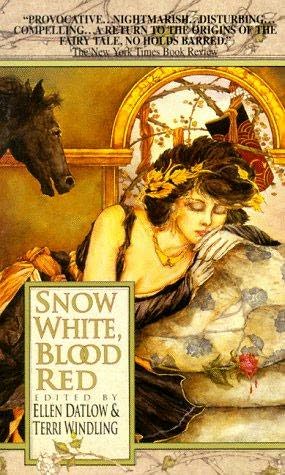
Mckillip's story "The Snow Queen" is the star turn of this excellent anthology.

Patricia A. McKillip is a writer of the same class as the well-reviewed Alice Hoffman, another writer of complex literary fairy tales, yet McKillip’s novels are ghettoized as fantasy. This is not the kiss of death, as many intelligent readers love fantasy, but it probably curtails her sales. In 2008 McKillip won the World Fantasy Award for Lifetime Achievement - an award every bit as important as the National Book Award - and she has won and been nominated for countless other SF/fantasy prizes. Her prose style is rich and lyrical, her sensibility poetic, and her tales as lush and beutifully composed as the magic realists'.

My recent discovery of “The Snow Queen,” her retelling of Andersen’s fairy tale, reminded me of how extraordinary she is: her writing eclipses the other adult fairy tales in Snow White, Blood Red, an anthology edited by Terri Windling and Ellen Datlow, which features superb stories by such famous SF writers as Charles de Lint, Neil Gaiman, and Nancy Kress.

Set in a glittering urban setting of sophisticated partygoers, "The Snow Queen" opens with Kay and Gerda observing a snowfall together.

“They stood together without touching, watching the snow fall. The sudden storm prolonging winter surprised the city; little moved in the streets below them. Ancient filigreed lamps left from another century threw patterned wheels of light into the darkness, illuming the deep white silence crusting the world. Gerda, not hearing the silence, spoke.”


Gerda is the warm one; her cold boyfriend Kay glitters like a knife. He is trying to solve a crossword clue: the first word schoolboys conjugate. “Most likely Latin,” he says. But no emotional words come to mind: his imagination is cold, unlike that of Gerda, who immediately guesses "love."

And of course at Selene’s party Gerda loses Kay to another woman (Kay is the one who loves parties): “Half the city was crushed into it, despite the snow.”

It's the best short story I’ve read this year.

I started reading McKillip a few years ago when I discovered the first volume of The Riddle-Master trilogy in a converted-garage- bookstore where everything was chilly and damp. Miraculously it had survived the mildew. Perhaps it hadn’t been there long. But I fell into it immediately and had to rush out to another used bookstore to find the last two books.


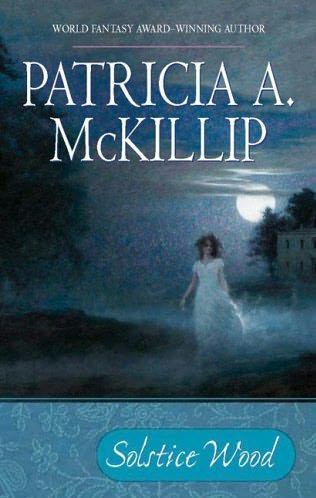
So yesterday I found my copy of McKillip's Solstice Wood, winner of the 2007 Mythopoia Award, a novel I bought intrigued by the fact that the main character is a bookstore owner. That really has nothing to do with the story, though the heroine, Sylvia Lynn, is a literary person. She returns home to Lynn Hall from self-imposed exile after her grandfather dies. There is magic at Lynn Hall; a fairy wood surrounds it; and Sylvia’s secret is that she is half faerie (she has exiled herself because of it). But she joins her grandmother and a group of women at a sewing cirlce whose stitches prevent the troublesome faeries from entering their world. Sylvia becomes more conflicted than ever, but can’t escape back to her west coast when people start to disappear and even her uncle can see with the naked eye people made of sticks and bark.

It starts out a little slowly, but soon the beautiful story clutches you.

I look forward to reading the rest of her books.

Tuesday, November 17, 2009

Corporate vs. Independent Bookstores: A Comfortable Chair


Loafers at Barnes & Noble

Stuart Walton, a blogger for the Guardian, has launched an attack on corporate bookstores on account of the INTERIOR DECORATION. He reviles the comfortable chairs at Borders and Waterstones and disdains the non-book-buying clientele who squat in them. Book buyers like himself never get the comfortable chairs, he says. And as if this argument weren’t strange enough, he claims that the coffee smells bad and splashes the books.

Though he prefers independent bookstores, he doesn’t defend hand-selling of small-press books or other traditional practices of the independents. No, that's not why he likes them. He claims he misses the cold independent bookstore clerks who don't look up from their books when you come in.

So that has me thinking.

Oh dear.

The comfortable chair is not an issue for me. It is true that many students and be-black-clothed types with laptops claim those cozy chairs or occupy the tables at the coffeehouse. It adds to the ambiance, I would have thought if I thought about it at all, because it gives you a feeling that readers are everywhere (even the laptop users SEEM to be reading). And if the employee who thought I was a homeless person is right, people hang out there all day. “You can sit here as long as you want.” The non-consumer inhabitants don't bother the clerks. They like to get people in there and then let the books work their magic.

Now this is not the case at the independent bookstores. At one cranky lady's bookstore, I have been followed suspiciously as if I were about to commit grand larceny. Yes, one employee seemed to expect me to load the entire small M-Z fiction shelves into my bag; why I cannot tell you. I blame it on my shabby denim bicycling outfit and helmet. (Oh, and the sweat.) The last time I was there I voluntarily left my bag behind the desk so I could comfortably peruse the books. This is enabling them: I should have hung onto my bag.

AS FOR THE COFFEE THING: Coffee is a '90s innovation, both for bookstores and libraries. I never go to a Barnes & Noble, Borders, or public library without buying coffee. Who can resist? I even tend to drink coffee when I’m buying at AMAZON or ABE’S BOOKS. But because the coffee cups in public stores have LIDS, I am unaware of ever having splashed a book. On the other hand, I am not one to lounge in comfortable chairs and spill my coffee. I browse standing up, occasionally sipping from my cup, and figure out what I need to buy.

The interior decoration is never great. B&N has a kind of green and wood thing going for it. The green bags match the decor. Perhaps Borders is more reddish. The comfortable chairs are a little TOO plush for reading. They swallow you up.

I love independent USED bookstores, but if STUART WALTON had to put up with my independent NEW store - and he does sound like the kind of book-obsessed character they foil - he'd never leave the house.

Monday, November 16, 2009

The Green Hat


Michael Arlen’s The Green Hat is a perfect get-well present or hangover present, a novel so absorbing that the ache of time or body simply goes away. Yes, when you’re sniffling in bed in the infectious diseases ward surrounded by attendants in face masks, or come home from a celebratory evening and can’t sleep, The Green Hat is a spellbinding innitiation into the shimmering amoral world of the 1920s - a society in this case dominated by the mysterious Iris Storm, a glamorous flapper who carries an air of doom about her, as she brings one man after another to his knees.

Kirsty Gunn, the writer of the introduction to the Capuchin edition, compares this to The Great Gatsby, and certainly I know what she means. I kept thinking of Aldous Huxley’s Point Counter Point, or perhaps something by Somerset Maugham - but I couldn’t quite put my finger on it. In many ways this is a young person’s novel - a kind of exploration/documentation of what it meant to live in a glittering postwar society of witty conversations and sparkling parties. Some, like the heroine, have abandoned traditional morality, living for themselves and the moment, while others struggle to live “honorably,” enjoying their parties while continuing to uphold the institutions of marriage and the family. Of course it’s not just the 1920s, a decade we associate with decadence: any person in his/her twenties may imagine he/she lives in such a society.

The narrator of the novel, who refers to himself as the Author, remains in the background, but it is through his sensibility that we observe the machinations of Iris Storm. Iris, a sylph in a green hat, enters the narrator's life when she stops by in “a long, low, yellow car which shone like a battle-chariot” to visit her brother. Under her green hat, she is beautiful and mysterious, a woman who says little but tells the truth, and she has not seen her twin in ten years. Our narrator, who is getting ready to move out of the downstairs apartment and has just come home from a party, takes her upstairs to see her brother, Gerald, a drunkard novelist who is passed out for the evening. Then the narrator has an all-night conversation with her. But after the night she writes to tell him she doesn’t want to see him again. He is her friend, but must remain a friend. (Does she find him unattractive? As one gets older, one wonders such unspeakable things: one would not even think it when younger, and I doubt that Arlen did.)

And chaos follows Iris wherever she goes. The Author likes her, despite Iris' supposed frankness about immorality (she tells him one husband committed suicide "for purity" because she had affairs; the other, however, left her and died after she said another man's name in her sleep). When she becomes ill after a miscarriage, she almost dies in a nursing home in Paris.

It is by chance that the narrator finds her there.

It is Arlen’s haunting prose, that reveals the sad story in flashes:

"At this time I hadn't the remotest idea as to where Iris was or how she did. I had not seen her since the night of her brother's death; and had been permitted to gather from Hilary that he knew as little as I did of her whereaouts. Secret she had always been in her absences, Hilary said, or, rather careless, but now she seemed positively in hiding."


When he visits her, we see her as a sad, wasted woman who has almost given up. But Napier, a man with whom she had an affair shortly before his wedding, shows up and she wants to live.

One of her oldest friends, Guy, attempts to interfere when she is having an affair with Napier. It is then we see Iris as she really is, a person who makes her own rules and defies societal conventions. She is the kind of siren-hussy figure that men, rather than women, seem to love to write about, and she is in many ways a stereotype, but in some ways she does exist: who hasn’t met great beauties who feel they can have anything they want whenever they want it? She is a force of nature - and somehow a bit androgynous, which is a good thing here: she has more character than the average mindless beauty, and faces men on their own ground. She has courage. And the narrator, who likes her so much at the beginning, changes his mind again and again - as do we.

This is really a very enjoyable, exquisite, oddly written novel - a period piece, very popular in its day.

Wednesday, November 11, 2009

Far North


Marcel Theroux's Far North is a science fiction classic. It is one of the best books of 2009, period. It is not catalogued as science fiction, and because it is sold as literary fiction, it has an edge over the average literary SF, which isn’t fair, but thus it goes. It is a finalist for the National Book Award in fiction, which brought it into the stratosphere for me, as it probably did for others. So far it is the best of the three NBA finalists I have read, the others being Jane Anne Phillips’ Lark & Termite and Colum McCann’s Let the Great World Spin. There are five finalists altogether, and the winner will be announced 11/18/09.

Theroux’s novel is set in a bleak post-apocalyptic future, but it is not the cliched world of Mad Max , The Road, or Riddley Walker. I would put this novel in the same class as The Day of the Triffids, though the plot is different. Far North is narrated by a sheriff, Makepeace, the last citizen of a ghost city settled by the previous generation - a group mainly consisting of idealistic Quakers, including Makepeace’s parents - who were fleeing the upheaval of climate change, violence, and materialism.

Makepeace is a woman. We do not find out her sex until Chapter 3, and it's a startling revelation. Big, broad, and scarred in the face from a terrible rape by men trying to pay her father back for nonviolence, she passes as a man to the marauders and rioters and carries a gun. Her father killed himself after her rape. Ironically, she did not share his nonviolent philosophy, as refugees from floods and plague invaded the city, robbed, looted, killed, and died.

"The years have taught me not to wonder too much at the dark things men do. Strange how men never act crueler than when they're fighting for the sake of an ideal....You drive yourself mad if you take it all personal."


Yet, though she must carry a gun,

"Killing always sits heavy with me.

"Whether that’s because of my being a woman, or because my disposition is naturally softhearted for another reason, I don’t know.

"I’ve had to fight the womanish things in my nature for almost as long as I can remember. These are not softhearted, womanish times.”

For a brief time she has a companion, Ping, a Chinese slave on the run, whom Makepeace wounded when she saw Ping taking books to make a fire. Makepeace believed in preserving culture, though she wasn’t a reader herself; she knew someone else would want books in the future. Ping recovers from the wound - it turns out she, with a shaved head, is a woman, too, pregnant from a rape, and in the summer she dies in childbirth. Makepeace goes half crazy. She hits the road after she sees an airplane. Someone must be out there, somewhere. She dreams of civilization.

This is a grim novel, but Makepeace’s stoicism and original observations make it worth reading. And Theroux's style is beautiful, simple but poetic. He is a new writer to me, the winner of the Somerset Maugham award for The Confessions of Mycroft Holmes: A Paper Chase.

Marcel Theroux is Paul Theroux’s son, but lives in London and was educated in England: perhaps he has dual citizenship. Colum McCann, the Irish author of Let the Great World Spin, also presumably has dual citizenship.

Theroux gets my vote for winner.

Sunday, November 08, 2009

The Princess on the Glass Hill


Having read some novelistic fairy tales lately (Tam Lin by Pamela Dean and Snow White and Red Rose by Patricia Wrede), I've been rereading some of my own favorites. One I come back to again and again is the strange tale, The Princess on the Glass Hill. In my old Blue Fairy Book, it's attributed to the Norwegians. The imagery of the glass hill always fascinated me. The story seems to be divided, in very Greek or Latinate fashion, into elements of three. But it is the story of the princess, a lone figure, that especially interests me: she is not a member of a trio.

There is a threat to the three brothers: a monster devours their father's meadow of grass year after year on St. John’s Eve, the festival of John the Baptist's birth, distinguished by prayers for God's blessing on the crops. The farmer has little hay and cannot afford to lose more grass. So the oldest son goes to guard the meadow on St. John’s Eve. In the middle of the night, however, the terror of an earthquake, apparently caused by a monster, scares the oldest son away.

The next year the same thing happens. The second son goes to guard the field. He also runs away in terror of the earthquake.

Then we learn the story of the greatly underestimated third son. Everyone laughs at Cinderlad when he says he'll watch (he is not a stepchild like Cinderella, we learn few details about him, and we do not know what his name means).

“Well, you are just the right one to watch the hay, you who have never learned anything but how to sit among the ashes and bake yourself!” (Lang’s The Blue Fairy Book). Cinderlad comfortably retires to the barn. He is fearless, but in the middle of the night he is aroused by the rumbling of the first earthquake. Then there's a second earthquake. Then a third very violent one. When the earthquakes stopped, he hears what sounds like a horse eating grass. And indeed it is. He goes outside and sees a giant horse: “...a saddle and bridle lay upon it, and a complete set of armour fit for a knight, and eerything was of copper...” He rides the horse away to a place no one knows and then rides homes again. And they have hay for the year.
.
The next year, he guards the field of grass again. A horse bearing silver armour appears. And they have hay. And the next year, ibid: a horse bearing golden armor appears.

Then the third and most interesting part of the story: A king, for whatever reason, commands his docile daughter to sit on a glass hill (and where does the glass hill come from?). Suitors must ride up the glass hill and take the three golden apples she holds.

Day 1: only Cinderlad (disgused in his copper armor) rides 1/3 of the way up the hill. The princess throws a golden apple which rolls into his shoe (how? Is it extremely small?).

Day 2: Cinderlad (disguised in his silver armor) rides two-thirds of the way up the glass hill. Another golden apple is thrown at him.

Day 3: he wears his gold armor and wins the princess.

Poor princess. We know little about her. How did it feel to sit on the glass hill? Foolish? She throws the golden apples, so isn't shy, but how can she know that the man in the most expensive armor is for her? (Suddenly I don't like her.)

Motifs: The youngest son takes the trick (succeeds). Tthis is definitely a folk tale motif. It occurs in The Frog Princess, Hop o’ My Thumb, The Golden Bird, The Singing Bone, The Grateful Beasts, The Crystal Ball, Prince Ivan and the Grey Wolf, and many other fairy tales. What does it mean? A tale of the weak (the last) overcoming strength (the first)? Encouraging people with low expectations? Appearance and position don't mean success?

Then there are the golden apples, particularly common in myth. Atalanta loses the race when Hippomenes distracts her with three golden apples. Hercules must steal golden apples from Hera’s orchard. In The Judgment of Paris, Eris (Discord), throws a golden apple at the wedding of Peleus and Thesis, inscribed with “for the most beautiful.” Paris must decide between Juno, Venus, and Diana.

Golden apples are irresistible, but not to Cinderlad, who waits till the third day to claim his prize.

And then on the glass mountain. Why on earth are they connected with marriage here?

Friday, November 06, 2009

And/Or Margaret Oliphant


After one has either read and/or absorbed through osmosis much canonical literature, one often turns for literary sustenance to the second tier, which forms something of a “secondary canon” among the cognoscenti. You find yourself delightedly reading George Gissing, Charlotte M. Yonge, Dorothy Baker, Pamela Hansford Johnson, and others who are not household names.

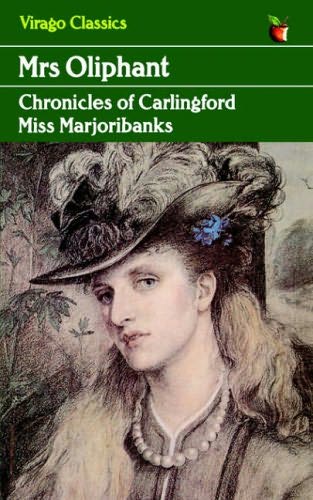
I went through an intensive Margaret Oliphant stage a few years ago. It began with a shriek of “Oh, I love Mrs. Oliphant!” at a used bookstore when I discovered Virago editions of The Chronicles of Carlingford on the $2 sales shelves. Actually, I had read none of Oliphant at that time: I meant that I hoped to love Mrs. Oliphant. She wrote something like 120 books, and I don’t know about you, but 120 books can keep me occupied for a long time. I very much enjoyed The Chronicles of Carlingford

(Miss Marjoribanks is my favorite), so I began to collect Mrs. Oliphant in Kessinger and Elibron Classics -very expensive, no-frills reprints. Yet if you want to read The Ladies Lindores, Kirsteen, The Duke’s Daughter, or many of the others, you turn to these.


I finally got around to Margaret Oliphant’s spellbinding novella, Two Strangers (Elibron), only 195 pages of huge print. The writing is very plain and unadorned--this is not her best style - but I’m stunned by the subtle presentation of the situation and very modern ending. Published in 1894, one of her later works, Two Strangers centers on the Wradisley family. Ralph, the adventurous younger son, returns home for the first time in years, bringing with him a friend, Bertram, who has written some journalistic pieces and aspires to write more (the writing terrifies the conventional family until they find he wrote "only about Africa" and does not intend to write about them). But Bertram is not the only stranger in their life: a beautiful, fascinating widow, Mrs. Nugent, has moved in nearby with her five-year-old daughter, Tiny. Lucy, the Wradisley daughter,is enraptured by her new friend and wishes her brother to meet Mrs. Nugent right away. He, however, prefers to smoke cigars with Bertram.

The other members of the Wradisley family, however, are fascinated by Mrs. Nugent: the oldest son, Reginald, wants to marry her, and his mother, Mrs. Wradisley, loves her dearly. Then Mrs. Nugent's daughter, Tiny, forms a bond with the stranger, Bertram, who does not meet her mother till near the end. And the meeting of Bertram and Mrs. Nugent catalzyes - well, one expects a romance.

I was very surprised by the ending.

Tuesday, November 03, 2009

Tam Lin


I tried to read Tina Nunnally's gorgeous translation of Andersen's Fairy Tales (Penguin Deluxe, the edition as beautiful as the writing), but discovered that I am no longer an Andersen person. Perhaps I would do better with Grimm. Definitely with contemporary retellings of fairy tales for adults.

The latter is an altogether unusual category that borders on fantasy and, occasionally, polemics. There has been a glut of these retellings of fairy tales since the Second Wave of feminism in the '70s. Angela Carter’s The Bloody Chamber and Other Stories, published in 1979, is a dark, original, exquisitely written collection of reimagined fairy tales, the title story a rendering of "Bluebeard." Robin McKinley’s poetic novel, Deerskin (1993), based on Charles Perrault's horrifying tale of incestuous rape, "Donkeyskin," delineates the courage, survival, and transcendence of the fugitive princess-heroine. Terri Windling’s Fairy Tale series, created for Tor Books, published from 1988 to 2002, also features some intriguing titles, among them Tanith Lee’s fantasy, White as Snow (2000), a retelling of Snow White laced with elements of the myth of Demeter and Persephone.

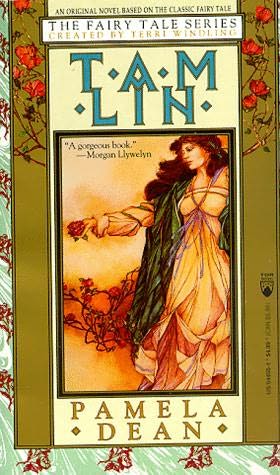
Pamela Dean's Tam Lin (1991), one of Terri Windling's series, is one of the most charming novels I've read this year. Based not on a fairy tale but on the Scottish ballad, “Tam Lin,” Dean’s novel is set in the 1970s at a small midwestern college where classics majors are rumored to be crazy, a mysterious student is selected by the administration to play bagpipes late at night, and the ghost of a classics major repeatedly throws Chase and Philips, an elementary Greek text, and the Liddell and Scott dictionary out the window of a dorm.

The love of books - the haunting, intense inner life of a reader - is the real theme of this novel (I've read half). The heroine, Janet, a freshman English major, lives through books, and not a page goes by when we don't see her world recreated by new books. Books shape her humor, the richness of her changing world view, her relationships, and her philosophy. She and her friends lovingly, unapologetically discuss literature: The Wind in the Willows, Till We Have Faces, The Children of Llyr, Daughter of Time, Lysistrata, Paradise Lost, A Wrinkle in Time, Aristophanes, Keats, Hamlet, Chaucer, and T. S. Eliot. The list goes on and on.

Here's an excerpt of dialogue about books between two of her friends:

"Are you on terms of such familiarity with all your favorite poets?" said Molly.

Robin provided her with an open and delighted grin, and said, "No, indeed. I'd never speak of Miss Austen so, nor Dr. Johnson, nor even Master Coleridge, though he thought better of himself than he ought to have. But our Will, you see, wrote those Sonnets, and after reading of them, it's hard to be formal with him."

"I suppose it's no ruder than calling them by their last names, like the critics do," said Molly. "As if they were suspects in a murder case."


Thus far the discussions of books ARE the book - and I couldn't be better pleased.

Saturday, October 31, 2009

The Wrong Venue


“It wasn't a good idea,” you say.

You were drinking tea in the supine position. After teaching your adult ed class, you lie down in a daze listening to R.E.M. on the headphones. You can’t be bothered to sit up , and since your head is propped on a pillow, you simply lift your tea cup and swig. Cheers. Warm. Your hands are so cold. Could you have some brandy? Just joking. You cannot have brandy. Your doctor gives you pills. Alcohol doesn’t mix with pills. Remember the time you sipped some cooking wine? My God, it was salty. You thought you might pass out.

“What wasn't a good idea?” he asks.

“Teaching adult ed.”

“But I thought you enjoyed it.”

“No.”

“But I hear you in the hall. You sound so relaxed and confident.”

“They don’t respect me. It’s hard to take.”

“They stay after class and talk to you!”

“Yes, but...”

He can’t possibly know. This adult ed class is a real headache. Some are good students, but some don't do the work. Some comprehend one week, but forget everything the next. Then there’s one hostile guy (the first hostile student you've ever encountered, but then you haven't taught in many years) who is always looking for a chance to denigrate you. He likes to interrupt you frequently to deliver mini-lectures on the Roman games (and that is relevant how?). Yes, you have heard it all: the Colosseum, the gladiators, the simulated naval fights on the flooded fields. Smile, smile. Some of the women encourage him. “He’s so smart,” one cooed. He, however, takes off right away after class so none of the women can talk to him. (Gay?)

And then you’re back to grammar, derivatives, and reading simple Latin stories - and the necessary six to seven worksheets you’ve made up painstakingly each week to make sure they get enough practice.

Just when you think they’re progressing - they all were enlightened about the concept of gender, number, and case and excelling on the derivative analysis - all is wiped out of their memories the next week. It’s inexplicable. Can this really be happening? Are they really spending time on it? They’re so sweet. They have their flashcards and they shuffle through them before class. They laugh about learning and relearning their vocabulary. You assure them this is a natural part of the process, but you can see that they reinforce each other in the belief that it’s unnatural to memorize. You emphasize that if they have to “prioritize” (a word you thought you’d never use), learning the vocabulary is the most important thing. But you can never make them close their books during drills because the administrator has made it clear that you must amuse them at all costs and not tax them. And you do mean costs and taxes (ha ha!). After the second week a woman who wanted a full refund after the drop-course “expiration” date complained that your were teaching grammar (and got a refund)! And how else is one to teach Latin? You were truly astonished that you were reprimanded for this. You assured the administrator that you were also teaching English derivatives (many dreary worksheets on identifying verb stems and prefixes) and bringing in culture (many poems translated by me, bits of graffiti, and some Roman culture). But why did you have to assure her of that? What is wrong with grammar? Latin teachers teach grammar. It's essential.

You have never taught a non-credit class. You are not an entertainer. This consumer-oriented approach seems foolish. It's all about making money (not for me - for the program). You're in a state of anxiety - about what? Why not just teach the language the way it should be taught?

Two have said the homework - half to one chapter a week - takes too much time - would you have had the gall to say that to a teacher? - and you try to sympathize but can you really slow down more? You planned to teach 16 chapters. You have compromised insanely. The class meets only once a week for two hours, but they are getting ample practice, as much in two hours as othe students get in their three-times-a-week classes.

Your husband says, "I feel guilty. It was my idea.”

Yes.” It was his idea. Although you both knew it was the wrong venue, there is no other venue.

The university in town has eliminated its language departments.

“It’s kind of a nightmare," you say as you drink your tea by the pound (OK, that's an exaggeration).

“Welcome to my world.”

Some have learned. Some are surprisingly good and could go much faster. (But I only hear from the ones who want to slow down.) Some have been very kind and stayed after class to say how much they have learned - that they got more out of it than they thought. “I thought I would go away with a list of English words,” one said. “It’s much more than that.”

So it is.

Some have told you their stories.

So are you exaggerating the feeling of dissatisfaction? If the majority are pleasant and learning a little - isn't that an accomplishment?

But it's such a small majority.

You should earn more money to make this worthwhile. You're not in it for the money, but you don't want to sweat over something so trivial.

Thursday, October 29, 2009

A Citizen of the Land of Genre Fiction


I’ve been a citizen of the land of genre fiction lately, dipping into two marvelous historical novels, Robert Harris’s absorbing novel about Cicero, Lustrum, which is just as well-crafted as all the reviewers claim, and Rosemary Sutcliff’s lyrical 1963 novel about King Arthur, Sword at Sunset. Sutcliff is probably going to end up at the charity sale; Lustrum, on the other hand, belongs in my cherished Roman kitsch collection. It’s not that Harris’s very well-written and well-researched book is junk, but it belongs on the shelves with everything from Gore Vidal’s classic, Julian, to a truly ridiculous novel called Clodia (which I plan to read in the next dozen years or so).

But much as I admire genre fiction, I prefer historical romances such as Sigrid Undset’s The Master of Hestviken or Anya Seton’s Katherine. Am I saying I prefer women’s fiction? Perhaps. In the beginnings of these novels (novel sequences in Undset’s case), Undset’s and Seton’s heroines’ lives revolve around love, but that shortly changes as work takes them over, they realize love is another difficult relationship, and husbands are far from perfect. These are books that reflect women's experience - love sweeps us away and makes us starry-eyed as young women - but one grows up fast with responsibilities.


Harris’s and Sutcliff’s books, on the other hand, are “men’s” books. Cicero’s and Arthur’s lives both revolve around politics and civil war. Harris's novel is narrated by Tiro, Cicero's secretary, an endearing, nervous character, who is loyal to Cicero, but longing to retire. Sutcliff's novel is told by Arthur, and we feel his dark moods and determination to conquer the invading Saxons, yet Sword at Sunset is primarily an action novel. Both are fascinating, but the emotions just aren’t there for me to glob onto - and I'm in one of those "glob" moods.


Anyway, I’ve moved on to another genre: when all else palls, turn to SF/fantasy. So last night I tried to read John Wyndham’s The Chrysalids - republished by NYRB - and struck out. The Day of the Triffids is a classic, and the second book I blogged about at Frisbee. The Chrysalids, however, is really a children's book - not an all-ages book either. Very disappointing and I'm glad I got it at the library.


So I walked among my genre books. I’ve considered making this a reading-only-books-on-my-shelves year, but this is unrealistic in terms of my life as a one-woman supporter of the book industry (new and used). But, searching my shelves, I pounced on an omnibus of Patricia C. Wrede’s first three Lyra books, Shadows over Lyra. These novels are delightful, well-written, well-imagined, and the characters are charming and likable. Wrede also has an excellent sense of humor. I began reading The Harp of Imach Thyssel - a novel of the road adventures in Lyra of a minstrel, Emerick, and his rich sidekick, Flindaron, a duke’s son, who, bored by weeks with a trader's caravan, is playing truant disguised as a minstrel. Almost right away they stumble upon danger and dark magic, after a kind of fairy-tale night at an inn, where, strangely, they don't want the minstrels to sing. The novel is suspenseful - the kind of plot you disappear into. It's very good for one of these long, dark nights.

Yes, I'm already complaining about the autumn weather. Daylight savings time ends Sunday. Then you know I'll have all the lights on in my house all the time: it's too dark out there.

Monday, October 26, 2009

The Flirt


Booth Tarkington, a novelist now lost in the annals of regional literature, won the Pulitzer twice in the early 20th century, in 1919 for The Magnificent Ambersons and again in 1922 for Alice Adams. His entertaining novels are too uneven to win a place in the canon, most readers would agree, yet they are engaging, comical, and strangely moving. He shares Sinclair Lewis’s gift for satire, but is more genial. He is as good a storyteller as Edna Ferber but is less smooth. Upton Sinclair, another of his contemporaries, operates on an altogether political plane. Tarkington is a joshing upper-middle-class raconteur, a judge's son, born in Indianapolis, educated at Exeter, Purdue, and Princeton, a sophisticated humorist who documented family life in slow-paced midwestern towns and cities. If you're new to Tarkington, The Magnificent Ambersons is your best bet, but I found myself lately lost in his 1913 novel, The Flirt,a public domain novel which I downloaded onto my Sony. (It has been downloaded 238 times.)

First serialized in The Saturday Evening Post, The Flirt is a fast-paced, colloquial, not particularly well-written novel, but its characters are always alive. Tarkington is especially adept at describing dysfunctional midwestern families. At the heart of The Flirt is the Madison family, all of whom revolve hectically around the demanding middle daughter, Cora, a beautiful, selfish, cruel, charming flirt who keeps her gentle, good-hearted, financially unsuccessful parents in a state of constant apprehension, her lovely, sensitive older sister, Laura, in constant attendance, and her mischievous younger brother, Hedrick, in a constant fury to expose her fickleness and lies.

There is another flirt in the novel: a huckster, Valentine Corliss, who returns to his midwestern hometown, Capitol City, and befriends the Madisons, the tenants of the house he has inherited and intends to sell. Corliss is a charming, intelligent, flirtatious, sexy, likable liar, and he soon begins to practice his con, persuading people to invest in nonexistent Italian oil mines. Cora falls for Corliss and soon puts herself to work furthering his scheme - though she doesn’t understand it’s a scam.

The action revolves around the shallow Cora and Corliss. Everyone in the novel is affected by the cheating of Cora and Corliss: Cora even persuades her sensible former boyfriend, Richard Lindley, to invest in Corliss's scheme, though Laura, who is in love with him, begs her not to; another of Cora's boyfriends, Ray Vilas, a drunken lawyer who doesn't practice law, sees through Cora but will do anything to please her; and Cora's father has a stroke trying to please her.

Cora hurts everyone: her victims are legion. But Corliss is, of course, even worse: there is a line drawn by Tarkington, but it's a very fine line. It's interesting how he takes the concept of flirtation and analyzes its manifestation in men (business relationships) and women (the business of love).

Not the best book I've read this year, but very interesting.

Saturday, October 24, 2009

Touch Not the Cat and Other Light Reading


On Monday, Oct. 19, in the Guardian Books Blog, I enjoyed Alison Flood's laudation of Mary Stewart's Touch Not the Cat, a 1976 Gothic which is out-of-print in England (in-print in the U.S., though). She was responding to 10 famous British writers' recommendations of “forgotten treasures of the literary world,” recently unveiled on Radio 4’s Open Book show. Flood had spent a recent afternoon rereading a second-hand copy of Stewart's novel and declared it lost treasure.

Well, I couldn't have been more thrilled. Kindred spirits? I adore Mary Stewart, my favorite 20th-century Gothic novelist, and am ecstatic to see her mentioned in a world that has gone Daphne du Maurier-mad (the Ph.D.s have rediscovered du Maurier, but are strangely silent on the subject of Stewart--surely a mistake). Touch Not the Cat is a book I haven’t reread, possibly because I’m uneasy about the narrator’s telepathy (a very weird element, not characteristic of Stewart’s fiction). But I started reading it last night and simply fell into it. The years fall away - suddenly I’m Bryony’s age - and I’m absolutely terrified that she’ll make a poor decision about love based on the fact that she doesn’t know who her telepathic friend is. (One of her cousins? Which one?) Her father has just died, she’s returned from a job in Madeira to live in the cottage on their estate (there’s an entail and the cottage is all she'll have), and her father, the victim of a hit-and-run accident, had ranted about danger in last words recorded in shorthand by a police secretary.

About the neglected books: Susan Hill's enthusiasm for F. M. Mayor’s The Rector’s Daughter, which I read and loved last year, has sent it to an Amazon best-sellers list. This seems to be the kind of thing that happens in the English book world all the time, but it's hard for me to imagine American radio having the same effect. Could NPR (surely our Radio 4 equivalent) send an old novel to the bestseller list? Would everybody suddenly start reading Susan Glaspell's Fidelity or Edna Ferber's So Big? (No. Not even Oprah could inspire Americans to read "old" books. Americans like the contemporary.)


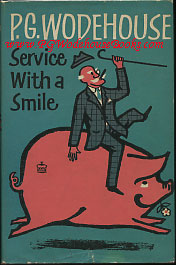
Since finishing my post-modern contemporaries, or post-contemporary moderns, I’m in a light reading phase. I just finished P. G. Wodehouse’s Service with a Smile, which I’ve been dragging around in my bicycle pannier for a couple of months. It’s one of those later, rather absent-minded books in which Wodehouse starts to repeat himself: yet again there is a plot to steal Lord Emsworth’s pig, The Empress of Blandings. And I can’t believe that Lady Constance is really gettting married and written out of the books, but perhaps P. G. was sick of her.

Wednesday, October 21, 2009

Sword at Sunset & The Last Days of Pompeii


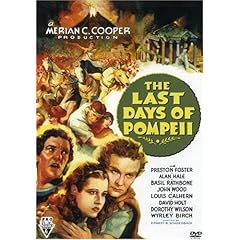
I’ve been so modern lately that I have had to ease into historical novels out of a need to escape. My immersion in the hip WEIRD worlds of Jonathan Lethem’s poetic marijuana-inspired alternate Manhattan (Chronic City, best novel of the year) and Lydia Millet’s offbeat stories about celebrities identified by relationships with animals, Love in Infant Monkeys, has been exhausting. I prefer HISTORICAL historical novels when I take the leap into the literature of escape: older books like Rosemary Sutcliff’s Sword at Sunset (1963) or Bulwer-Lytton’s appallingly badly-written The Last Days of Pompeii (1834), which appeals to me for its kitschy drama and careful attention to details from William Gell’s Pompeiana (Bulwer-Lytton dedicates the novel to him).

And so I’m reading both of them, Sword at Sunset in an attractive edition reprinted by the Chicago Review Press and The Last Days of Pompeii in a free manybooks.net edition on my Sony Reader.

Sword of Sunset is a thoughtful, beautifully written classic novel about King Arthur, based less on the legend than on a historical reconstruction of 5th century Britain and Arthur's struggle against the Saxons. The novel begins with the narrator, Artos the Bear (Arthur), wounded and examining his life, musing on his years of leading the Britons against Saxon invaders to defend Celtic-Roman civilization, and reviewing his mistakes, great love, and friendship-enmeties. I remember reading this book shortly after obtaining my first adult library card: I wandered dazely around the library looking for nothing in particular, pulling out books and deciding rather haphazardly what to bring home. My memory of the golden autumn light in which I read this - propped on my elbows in front of the screen door - was sparked by the opening paragraph of Sutcliff's poetic prose:

“Now that the moon is near to full, the branch of an apple tree casts its nighttime shadow in through the high window across the wall near my bed. This place is full of apple trees, and half of them are no more than crabs in the daylight; but the shadows on the wall beside my bed. This place is full of apple trees, and half of them are no more than crabs in the daylight; but the shadow on my wall, that blurs and shivers when the night wind passes and then grows clear again, is the shadow of that Branch the harpers sing of, the chiming of whose nine silver apples can make clear the way into the Land of the Living.”


This is fascinating, if rather slow. I love the character Artos. I'm not a great reader of war books, but I'm completely absorbed in Sutcliff's breathtaking, suspenseful, realistic scenes. Sutcliff is best known for children's books, but this is an adult novel. She has a grand stately vision of Arthur's England.


The Last Days of Pompeii is so overwritten that it puts me to sleep - therefore I am proceeding at the pace of three pages a night. Will I finish it? Well, I’m not sure. But I do want to get to the destruction of Pompeii. I may have to skip ahead. That does seem the best way to get through this.

Saturday, October 17, 2009

Chronic City


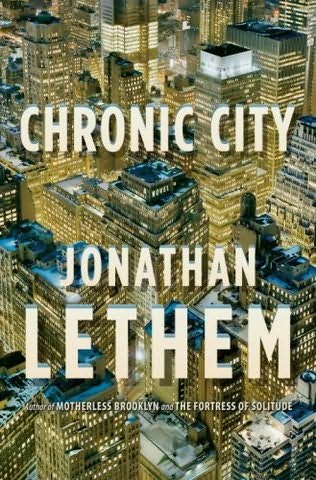
I’ve been waiting for Jonathan Lethem's Chronic City since I read an excerpt in The New Yorker last spring. It's finally out. I swooped on it at B&N. Lethem is probably the best American writer working today; his idiosyncratic characters, original plots, and witty, lyrical style never fail to amaze me. He's in control of his writing, which soars, dips, loops, and somehow remains smooth. At 45 he has already written two masterpieces, The Fortress of Solitude and Motherless Brooklyn (which won the National Book Critics Circle Award), and some people never forgive him for that. Though most critics love Chronic City, some are surprised that each book is wildly different from the last. Lethem doesn’t write the same book twice, and Chronic City has little except rock music in common with his last two novels, You Don't Love Me Yet, a short novel about a rock band, and The Fortress of Solitude, a bildungsroman about Brooklyn, growing up, race, music, and gentrification.

In a weird kind of way, the narrative voice of Chronic City reminds me of that in The Great Gatsby, which in turn is related to Petronius’ Satyricon (Trimalchio’s dinner party). The plot isn't really similar - at least as far as I’ve read - and perhaps I'm making a Perkus Tooth connection (Perkus, one of the main characters in Chronic, sometimes makes haphazard connections).

The novel is narrated by Chase Insteadman, a wealthy former child star whose casual voice is soothing and tolerant (we meet him when he’s doing a voiceover at a DVD studio). He doesn’t work much, he’s a charming ornament at people’s dinner tables, his astronaut girlfriend is literally lost in space (their romance is famous), and he lives off residuals from his ‘80s sitcom. He spends most of his time with some remarkable characters, who live in a kind of alternative parallel city and quickly overshadow his own star. Perkus Tooth, a former pop culture critic for Rolling Stone, takes a shine to Chase when they meet at the Criterion Collection. It seems a strange friendship: Perkus seldom leaves his apartment and spends most of his time smoking dope (a kind called Chronic is his favorite), watching old films, listening to little-known CDs, and making paranoid connections between disparate aspects of the culture. Chase, a rather quiet socialite, is fascinated by him.

Perkus is such a '60s throwback that Chase's hilarious observations about his discovery of eBay as the result of an acupuncture session are typically over the top (Perkus has an epiphany about beauty as he gazes at a vase in a photo on the acupuncturist's wall and decides to buy one for himself):

“If anything epitomized Perkus’s curious disadvantages, his failure to find traction in the effective world, it was the state of his computing. Perkus was the type to be Web-delving on some sleekly effective Mac, I’d have thought. Instead his lumpy Dell looked ten years old, Cro-Magnon in computer years. He connected by his phone line, which he transferred by hand from his living-room Slimline, and which bumped him offline if anyone rang, but also, it seemed, intermittently and at random. Watching that Dell painstakingly assemble a page view, images smoothed pixel by pixel, was agony. Perkus was enchanted - he’d just discovered eBay, by way of the chaldron hunt.”


One of the year’s best. I'm saving some of it for tomorrow.

MORE ON TEACHING: It was much better. Everybody did the homework. Now I don’t have to theorize gloomily that the society has gone to hell and no one wants to learn anymore, minds boiled by TV. But I slowed down anyway and did an intensive nominative-accusative review and mildly suggested that learning the vocabulary was the most important thing. They agreed.

READING ON THE SONY: I love Booth Tarkington’s The Magnificent Ambersons and Alice Adams and decided at random to download The Flirt. So far it’s surprisingly good.