Tuesday, February 24, 2009

Bleak House at the Home Cafe


My reading of the epic Drood has inspired me to return to Dickens. I was afraid this would happen. I decided halfway through to jump over to Bleak House, though it would have made more sense to try The Mystery of Edwin Drood, since I could at least have pretended a scholarly motive.

So I’m reading Bleak House and Drood both at once, more or less, if that’s possible.

I sat outdoors this afternoon and couldn’t believe how gorgeous it was. Sun on steaming thawing mud: the mud is cold but the light was beautiful and warm and it was a preview of spring. I balanced my book, tea and sandwich on the soiled plastic table, which needs a shot or two of Windex: I pretend the table and chairs under the tree are our "Home Cafe." Coffee, tea, water: we have it all al fresco. Squirrels and dogs were running about the yard, birds were singing gently, and there was a fair amount of city traffic noise. The dog next door alertly watched me and occasionally barked to make sure I didn’t jump the fence into his back yard. That is his nightmare.

So...I'm loving reading about Lady Dedlock. Usually it’s Esther Summerson whom I find cleverest; she is sweet and witty...and I don’t understand people who consider her cloying, as does the character Wilkie Collins in Drood. But this time I’m fascinated by Lady Dedlock’s frozen bitterness and ennui, and it occurs to me that she’s more than the stick figure I dismissed her as before. That’s what is so great about Dickens. Every time you read him you find more.

I had expected a break from laudanum and opium scenes in Bleak House. But no. I was startled by the minor character Nemo’s death from an opium overdose, havingI completely forgotten this detail: Nemo, a figure from Lady Dedlock’s past, has fallen in the world, been reduced to earning his living a law writer (a copyist of legal papers), and dies an opium addict.

Why did I turn to Bleak House instead of the brilliant Our Mutual Friend? Bleak House is more likable. My busy mind told me the reading was overdue, because it’s as necessary to Dickensians to reread Bleak House constantly as it is to Austenites to read Pride and Prejudice. By the way, it strikes me as strange that there are so many sequels to Jane Austen books but so few to Dickens's.

Monday, February 23, 2009

Cheap Date in the Wild West

Although there have been beautiful days this February, we’re all longing for the end of winter. There’s no snow, but there’s a bone-chilling, tree-shaking wind which stupefies, induces headache, and creates the creaky impression of a haunted house. Duvets, shawls, scarves, and afghans drape every piece of furniture. Time to bring out the cocoa...

But the important thing is to KEEP WALKING. Gotta conquer the outdoors! We boldly walked the trail yesterday clutching our independent coffeehouse paper cups, huddled in puffy coats with hoods, battling the wind (“It’s at our backs on the way home.”).. Only the intrepid walked the trail: a few gloomy dog-walkers, a rosy-faced bicyclist in a face mask riding 100 miles an hour to keep warm, and one crazy runner in shorts and a t-shirt.


Fortunately the frosty walk ended at a used bookstore. We hadn’t been here in quite a while and were happy to see the stock had changed. There was lots of Updike on the sales rack, as well as Daphne du Maurier. I longed for a Pocket Book copy of The Glassblowers , but it was falling apart. "Why do you want that?" my other half asked. I found a copy of Wyndham Lewis’s The Vulgar Streak (completely unknown to me, but in one of those beautiful Black Sparrow Press editions) and Delderfield’s To Serve Them All My Days, a long novel about a World War One vet who has to adjust to teaching in a remote English boys' school - lots of class issues. Inspired by a Masterpiece Theater production, I read this years ago. And even if I don’t read either of these books, it was fun to browse and was basically a cheap date.

If only there were more used bookstores in town...but we have to drive 200 miles to the next one...

Sunday, February 22, 2009

Drood


I had to buy Drood.

Friends and acquaintances won’t be surprised. I was the goofy young woman who used to read Dickens on the roof of the office building . My co-workers and I would sit up there during breaks, illicitly soaking up the sun, even in the dead of winter, sometimes chatting, other times reading (most of us reading because we were bored to death with each other), and some of us smoking - something (not opium like Drood; mostly cigarettes and cigars). We wore old air force parkas with the fur flapping in fringes around the hoods: you get the picture. The Roofs on the Plains Are Freezing-Windswept. Occasionally someone would read something witty aloud from the Village Voice or even, very occasionally, from Dickens.

People started naming their cats Nat Hentoff and Drood.

I was browsing at Borders the other day with a 40%-off coupon. It turned out to be inapplicable towards buying Dan Simmons’s new 30%-off bestseller Drood, which I snapped up. I've heard about Simmons for years because everyone insisted that I needed to read his science fiction account of the Iliad, Ilium - though Achilles seemed a sufficiently sci-fi-ish hero already in the epic. But a historical novel narrated by Wilkie Collins and centered on Dickens and his research for The Mystery of Edwin Drood was necessary to my life immediately.

The Mystery of Edwin Drood isn’t my favorite, but that’s all right - because Drood is as much about Wilkie Collins as it is about Dickens’ unfinished last novel. Cleverly presented as Wilkie Collins’s account of the last five years of Dickens’s life, it focuses on his bitter jealousy of Dickens (particularly of his most perfect book Our Mutual Friend), Collins’ growing addiction to laudanum, and his night walks with Dickens through London’s ghostly underworld in search of Drood, an opium addict/angel of death, whom Dickens claimed to have met during a traumatic train crash he survived in 1865 (along with his girlfriend, the actress Ellen Tiernan and her mother).

It’s an eerie novel. Well-written, well-researched, and historically accurate except for the Drood fantasy, it also cleverly takes the form of a sort of gigantic Wilkie Collins melodrama. There is the borderline hysteria of the novel of sensation: Dickens is a nervous wreck after the train wreck, and his motivation for pursuing Drood, who may or may not exist, baffles Collins as he is dragged by Dickens through crypts and tunnels, occasionally guided by Detective Hatchery, and later persecuted by Hatchery’s boss Inspector Field, a blackmailer who, though this doesn’t make much sense, needs Wilkie to tell him everything Dickens says about Drood (since his employee is guiding Dickens to Drood, this plot device seems thin, but it’s best not to think. It combines the character of Bucket in Bleak House with the detective in The Moonstone).

Anyway I’m enjoying this enormously (771 pages: I’d better). Collins's voice is easier to imitate than Dickens's, and though Simmons doesn't exactly claim he is doing that, it seems to work.

Thursday, February 19, 2009

Night and Silence Who Is Here?

This winter I have read Pamela Hansford Johnson’s Dorothy Merlin trilogy twice, and it would be fibbing to say I’m not going to read it again. Her three riotous satires on the writing life, The Unspeakable Skipton (still in print and considered a classic), Night and Silence Who Is Here?, and Cork Street, Next to the Hatter’s, have saved me from the February doldrums. These suberb comedies are loosely connected by the character of Dorothy Merlin, an obnoxious poet/playwright who extols maternity in her deliciously terrible, pretentious verses (cleverly and merrily ghosted by Johnson). In The Unspeakable Skipton, she is only a minor character, a tourist in Belgium despised and exploited by the impoverished expatriate novelist Skipton, who ekes out a living brokering fake antiques, arranging seedy sexual shows and other shady deals.


The second book, Night and Silence Who Is Here?, though not quite as perfect as the first and third, is very, very funny, a kind of Lucky Jim-ish comedy about Dorothy’s friend, Matthew, an aristocratic playboy who is lionized by an American college after Dorothy bullies him into writing articles about her. “Since he mildly liked her work, he saw no reason why not to; and as her total oeuvre consisted of twenty shortish poems and four slim verse-dramas, the labor was not demanding. He had all the luck of those who find themselves, by accident, first in the field. He was immediately accepted as the world authority on Dorothy Merlin, because he was literally the only one.”

Matthew looks forward to his term as a Visiting Fellow. But college life in a freezing New Hampshire village without shops or pubs comes as a shock since he can neither cook nor drive and must cadge meals or drink them when the union restaurant is closed (as it constantly is). He spends most of his time foraging for food and huddling in misery with the other fellows (two of whom are also English non-drivers) and thus writes little about Dorothy except for the book's title: ‘Dorothy Merlin: Tentative Steps Towards a Synthesis of Imagery” (which he steals from Cobb College's Emily Dickinson Fellow), The Fellows are both absurd and likable. Ruddick is writing about Emily Dickinson's drinking and forever cornering Matthew to listen to the latest "drinking" quotes from her poems. "Partake as doth the Bee/Abstemiously." Etc. Ruddick is really hysterical and somehow sympathetic: he's crazy but is, well, sweet.

But in Matthew's subversive protests against the inadequate arrangements for the Fellows, he begins to politick for the job as Director...

It's a very silly book, but so much fun.

Monday, February 16, 2009

Poppy Shakespeare


Sometimes it may seem that I read no contemporary books. Certainly I rarely write about them. Once upon a time I was a freelance book reviewer (for real journals, not my book journal); but I eventually lost interest and found that I’d rather read classics, or the “ quirky" tomes published by Overlook Press, Virago, Persephone, or Capuchin Classics, than sit down at my computer and write about mediocre new books. Did my snarkiness help the book industry? No.

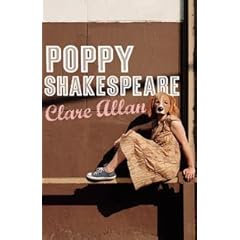
So what a thrill when I come across a contemporary book like Clare Allan’s Poppy Shakespeare, a madly satiric, poignant, and witty novel about madness which I found so addictive I could barely tear myself away to watch Battlestar Galactica (date night at our house). That says it all.

N, the narrator, has been mad all her life. She is an out-patient at a day program at a mental hospital, where she sits around the common room smoking cigarettes and exchanging jibes with Astrid Arse-Wipe and Middle-Class Michael, occasionally attending “life goals” groups where she learns to make lists of pros and cons (heavily weighted by her desired result, of course). She has spent her life shuttled around from one home or hospital to another. The day program has been as good as it gets. She calculates like a canny stockbroker to earn straight 6es on her yearly mental health assessment, because she needs her “mad money” and it’s hard work to remain an out-patient.

But life changes for N when she is assigned as a guide to Poppy Shakespeare, the new patient.

Poppy doesn’t want to be mad. She has been rounded up and dragged into the day program, a fiasco that resulted from a multiple-choice personality test she takes on the first day of a New Careers program. And she can’t persuade anyone she’s not mad. The “mental health” lawyers won’t work for her unless she’s on the “mad money” register.

It is N's original, vulerable, but pitch-perfect comic voice that makes this novel perfect. ("You know what I'm saying" is included in every insecure but incisive paragraph.)

“‘So you neurotic, psychotic, or what?’ I said, like just making conversation. Ask most dribblers what’s wrong, they’re that fucking grateful, they’ll talk till their throats is raw, but Poppy just stopped where she was, head down, not moving so much as a muscle and she didn’t say nothing for maybe a minute then, I can’t describe it like anything else, she turned to me and gave me this look like I’d pissed on her mother’s grave. ‘Let’s just get one thing straight,’ she said. “I Am Not a Nutter. There is Nothing Whatever Wrong with My Head. Alright?’”

To N Poppy's wish to escape the mad community is madness. But the story of N's and Poppy's friendship and Poppy's desperate attempt to escape the day program are touching and absorbing. It is ironic that Poppy is a compulsory patient just as the new Minister of Madness is threatening to privatize the health system and pressuring hospitals to “cure” patients and release them into the community.

A great book.

Friday, February 13, 2009

Green Dolphin Country

Some books hold up; others don’t.

You can still find worn-out, well-read books by Elizabeth Goudge at the library, but her old-fashioned novels appeal to a narrower constituency these days.

Elizabeth Goudge was one of my favorite authors when I was growing up: I segued eagerly from her children’s books - The Little White Horse won the Carnegie Award - to adult novels like The Dean’s Watch and Green Dolphin Country (published as Green Dolphin Street in America). I read her books again and again. And I remember being puzzled: why weren’t these classics?

Who could not adore her beautifully embellished descriptions and eccentric Dickensian characters?

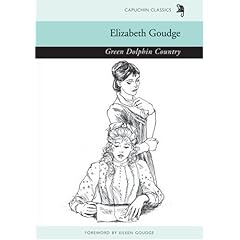
Okay, these are weird, weird books. I’m rereading Green Dolphin Country in a new Capuchin Classics edition, which makes it look respectable because the design looks like a Penguin, so I don’t have to read it secretly. This is so enjoyable: it transports me into Goudge’s magical world, and her whimsical style, her liberal use of adjectives and sweeping descriptive paragraphs, really turn this into a a fantasy; it wouldn’t suit every reader. This romantic novel is set in the Channel Islands and New Zealand in the 19th century; the heroines are two sisters, the demanding, ambitious Marianne and her peaceful, lovely younger sister Marguerite. William, the generous “boy next-door” who often “screws up,” as Obama would say, is loved by both. And in their late twenties they’re still unmarried, both waiting for William, though they haven’t heard from him since he left the island. William, ever impulsive and blundering, has inadvertently deserted from the English navy in China after an encounter with a conwoman prostitute. His ship sails without him; he eventually settles in New Zealan. After ten years in the lumber business, he writes a letter proposing marriage, naming Marianne as the bride instead of Marguerite by a drunken slip of the pen. And the rest of the novel revolves around the slip of the pen and its consequences.

Such a lovely book: so passionate, absorbing, and fun.

Yet I could not recommend this to everybody. It’s not that I don’t love it; I do. I simply couldn’t guarantee that everyone would like this flowery style. It’s for a special kind of reader, someone who doesn’t mind long stylized unwindings of ideas - the first 200 pages are devoted to growing up in the Channel Islands. William doesn’t arrive in New Zealand till page 231. The novel is out of date, written for a different time. In 1944 it won the Literary Guild Award and the MGM Literary Award, but no one writes books like this anymore.

It begins: “Sophie Le Patourel was reading aloud to her two daughters from the Book of Ruth, as they lay prostrate upon their backboards, digesting their dinners and improving their deportment. This spending of the after-dinner hour upon their backboards instead of in the parlour was as a matter of fact a punishment for insubordination during the morning, but their Papa being from home Sophie was softening the punishment by reading aloud. She was an indulgent mother, adoring her children, anxious to keep them with her as long as possible, afraid of what might be done to them by the great world outside the schoolroom window, the great world that in this mid-nineteen-century horrified her with its bustle and vulgarity and noise, George Stephenson’s terrible steam engine hurtling people to destruction at twenty-five miles an hour, its dreadful balloons in which man in his profanity was daring the heavens in which it was never the intention of his Creator that he should disport himself, its restless young people with thoughts for ever straining towards new countries and new ways, and its insubordinate children like her daughter Marianne.”

There are Goudge enthusiasts out there. Check out the Elizabeth Goudge Society at:

www.elizabethgoudge.org

Wednesday, February 11, 2009

A Time to Dance, No Time to Weep

Last year I became a Virago addict: I read so many Viragos that I began to recognize the types of heroines: curious spinsters who question the status quo, mischievous curate’s wives, ambitious working women, courageous political activists, trapped women, and mothers who learn to "think outside the box." Much as I loved these books, I needed to branch out.   Gradually I began to remember the cherished women’s literature of my own childhood and youth.  So this is the winter of establishing my personal “Virago-Persephone” list, meaning that, though I’m not a publisher, these out-of-print books have merit and should be shared.  


It's been a Rumer Godden marathon around here.  On Monday I stayed up most of the night reading her compelling and beautiful memoir, A Time to Dance, No Time to Weep, which spans her first 38 years. Godden, raised partly in India, partly in England, had an idyllic childhood before being banished by well-meaning parents to a succession of horrifying English boarding schools.  "I still cannot fathom why, as it had been decided that Fa would go back to India alone and Mam would stay with us four in a rented house, we could not have been day girls which would have been more merciful; perhaps Fa and Mam had decided Jon was out of hand and, of course, where Jon went I went too."

At a convent boarding school, which obviously inspired her best-seller, Black Narcissus, a group of brutal, narrow-minded nuns resolved to crush Rumer and her older sister Jon's obstreperous spirits.  Rumer was branded a "liar" for telling exaggerated stories about India; and when Jon had malaria she was accused of "rubbing the thermometer on her blanket - a school trick we poor innocents had never heard of - and she was told to get up, dress and go back to her class at once."  Eventually they were yanked out of this school:  Mam realizing something was wrong when they ceased to write letters:  Jon refused to write because of the nuns' censorship.

Five years later, when Mam and her four daughters returned to India, Rumer and Jon were debutantes, and Rumer, who had never had a beau, was so flattered that she almost married at 18.  She regained her senses in time, broke the engagement, and returned to England to study dance education. (Fa said it would have been cheaper to keep her at home).  She ran a dancing school in Calcutta for several years and, between classes, wrote her first novel; then, during World War II, as a wife and mother of two children, having written her first "big" book, Black Narcissus, Godden retreated to Kashmir as “an abandoned wife” (her irresponsible, Mr. Micawber-type husband joins the army and takes up with another woman).  She renovated a bungalow, taught the children, gardened so they could live off their own vegetables, and with a sculptor neighbor traded their  children  back and forth:  it was the only way she could have uninterrupted work time.  Eventually a shocking episode with the servants cut short the idyll.  This fascinating memoir uncovers the roots of her more autobiographical novels, and in the cases of The Greengage Summer and Kingfishers Catch Fire, she quotes excerpts. A fascinating life is obviously needed

Godden captures the atmosphere of India with beauty and wit and lightly conveys the advantages of living in such a multicultural society. She also elucidates the joys and problems of a writer’s life. The book ends with her return to England. Her second memoir, A House with Four Rooms, describes her years in England.

Godden grew up inseparable from her older sister Jon, a talented writer whose bouts of mental illness impeded her stamina and prevented her achieving the same stature as Rumer.
I haven't read her, but I certainly would be interested.

Thursday, February 05, 2009

More Rumer Godden

This winter I’ve begun to read Rumer Godden again.

I rejected her many years ago, in my late teens, after I began to concentrate on the classics. Godden wasn’t good enought. Reading in bed after a day of work was too good to waste on pop fiction when I could be reading Dickens or Austen. (I’d Rather Be Reading Dickens: the T-shirt.)

I obviously hadn’t read Godden’s India novels.


Breakfast with the Nikolides and Kingfishers Catch Fire are both minor classics. Kingfishers is a little better than minor.

Kingfishers Catch Fire, an autobiographical novel based on Godden’s experiences as an impoverished mother of two children who moves to Kashmir to “live simply,” is a beautiful, moving, and symmetrically perfect gem, a poetic, sometimes comic narrative in which Godden contrasts the relative meanings of poverty to an English family and Indian villagers. Painted against a gorgeous landscape, described in colorful, piercing detail of sights and sounds, the novel delineates the misunderstandings and resentment catalyzed when the rebellious, hip mother intrudes on village life and transgresses social barriers without understanding the traditions and hierarchy dictated by pride and poverty.

In Breakfast with the Nikolides, the action revolves around the death of a dog.

When Louise Pool and two daughters return to India after eight years in France, Charles, still at odds with Louise, tries to get to know his children. He gives a dog to Emily. The dog comes down with rabies, and as Louise recognizes the symptoms, she hysterically demands that they put down the dog; she screams until she gets her way, though Charles and the young veterinarian, Dr. Das, are more conservative about the diagnosis.

The family is shattered by Louise’s actions. The children have been away at breakfast with the Nikolides. The dog’s death is a trauma, and Emily will not forgive the mother. The dog’s death also has ramifications for a widening circle, including Dr. Das, who has struggled into the middle class, and his friend, Anil, a Brahmin.

Of course it is Godden's elegant style that makes the books. But the elaborate structure underlying the style is worth studying, too.

I can remember how dismayed and dumbfounded I was when a teacher friend told me Rumer Godden was her favorite writer.

Now I respect her for standing up for this undervalued writer.

Tuesday, February 03, 2009

The Unspeakable Skipton


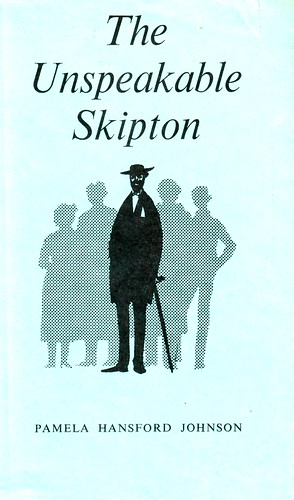
Pamela Hansford Johnson's The Unspeakable Skipton is an "underclassic," an unknown, under-read, potentially cult-status humor novel - if anyone knew about it. The good news: it's still in print. The bad news: it's not readily available in the U.S. (Just ask your bookseller.) But it is well-worth reading; in fact I intend to start all over and read it again tonight.

The droll Skipton inhabits the same portrait-of-a-writer universe as Anthony Burgess's hilarious Enderby and Updike's Bech: A Book.
Skipton is a horrific character, but Johnson's short, witty book about his horribleness is perfect: she reveals his insecurities as well as his exasperating self-centeredness. Her style mimics the somewhat anemic prissiness of Skipton, who is the most finicky, narcissictic, self-deluded of writers: he lives in a garret in Bruges ("in one of "the last of the patrician houses," as he fussily reminds himself); wears socks with individually knitted toes because he thinks it's faintly obscene to have toes touching; writes 250 often libellous words a day, which preclude his neverending new epic from being published; and also repulsively cons his fond publisher and a relative, whom he refers to as Flabby Anne, out of money, hassling them via insane invectives. Without conscience, he acts as a hustler/procurer of fake antiques and voyeuristic private parties at which mildly obscene skits of Leda and the Swan are performed. The misanthropic Skipton's shady business depradations are completely, fascinatingly detached from his writing.

Skipton always needs money. He is the greatest artist of his time, so he believes, but he must sneak out of his patrician house to evade his landlady. Her daughter thinks he's so hilarious that she smuggles up food he hasn't paid for. But the tricklings of cash are not enough - he occasionally must pay his landlady - and he honestly is incapable of making a living. Yet he is so unprincipled that he believes that everyone is fair prey, and has no morals where conning the rich is concerned. At the center of the book is his chance meeting with a group of literary tourists and his attempts to dub them out of money: Dorothy Merlin, a playwright, her husband, Cosmo, a bookseller, Duncan, a photographer kind of playboy, and Matthew, a mysterious aristocrat. He's equally matched here, however, and underrates his opponents, particularly the prima donna Dorothy Merlin's husband.

Ruth Rendell writes the enthusiastic introduction to the Prion Humour Classics edition.

Anyway, it's a coincidence that I read this and Bech in the same week.

Sunday, February 01, 2009

Bech: A Book


I've been attempting to read Bech: A Book, in memoriam of Updike. The buzz is that Henry Bech is "Updike's irreverent alter ego," so naturally I was curious to have a go at this lighter Updike. But these linked stories about the witty, patronizing, and often spiteful Bech utterly dismay me. Bech, on a literary tour of Russia and eastern Europe, teases and ridicules his well-meaning guides. In "Rich in Russian," he enjoys skewering the English of his guide, the translator Kate. After she earnestly shares her feelings about their tour of Tolstoy's house, rambling on about where he wrote his books, he rudely apes her English syntax, "I also like the way Upton Sinclair was in his bookcase." At one point, he reduces her to tears, and then guiltily tries to make it up to her by a surreal shopping trip In Moscow. (Kate doesn't enjoy the understocked Russian shops.)

In the next chapter, "Bech in Rumania," he gently mocks Petrescu, the polite, helpful guide and translator of Melville : Petrescu is "a fool for books." While Petrescu eagerly quizzes him about American literature, Bech, bored and rude, mimics him. Petrescu: "Is it possible to you that Pierre is a yet greater work than The White Whale?" Bech: "No, I think it is yet not so great, possibly." Petrescu: "You are ironical about my English." Yes, this is humorous --but Bech, oblivious, doesn't seem to care that people catch on to his barbs. Of course Updike portrays Bech's insensitivity, as well as his humor. Everyone is fodder for Bech's satire, and for Updike's too. Updike obviously enjoys himself, giving payback for the indignities of writer tours and other demands on his public persona. And it's all a literary joke: it opens with the fictional character Bech's letter to Updike, flippantly giving his blessing to Updike's "indecency of writing about a writer. Thus the metafictional Updike plays Boswell to Bech's Johnson.

"Until your short yet still not unlongish collection, no revolutionary has concerned himself with our oppression, with the silky mechanism whereby America reduces her writers to imbecility and cozenage....We veer between the harlotry of the lecture platform and the torture of the writing desk, only to collapse, our five-and-dime Halloween priests' robes a-rustle with economy-class jet-set tickets and honorary certificates from the Book-of-the-Month Club, amid a standing corwd of rueful Lilliputian obituaries. Our language degenerating in the mouths of broadcasters and pop yellers," etc.

It's brilliant, and yet it palls very quickly. Obviously writers experience these difficulties on writers' tours. But a little of this satire goes a long way..

Saturday, January 31, 2009

Rumer Godden

Finally, a beautiful Saturday! We turned off the heat, threw the porch door open, and basked in the sunlight, reading our library books. The sun feels so good! If we’d been braver, we would have sat outside in our Adirondack chairs, though there are still seven or eight crunchy inches of snow to deter us. (If we'd been younger, we would have done it.)

This timidly slanting light reveals memories of past reading in other gasping thaws. I remember with delight long ice-crunching walks to the library at the age of 12, gambling with my first adult library card on Rumer Godden's An Episode of Sparrows, Angela Carter's The Magic Toyshop, and Lloyd C.(?) Douglas's The Robe. It took a haphazard divining to come up with these three choices, but they were not as weird as you might think. I knew Rumer Godden from The Doll’s House, probably the only one of hers children’s books I'd read; I picked out The Magic Toyshop for the cover (and became hooked on Angela Carter almost before anyone else did); and The Robe because I’d been thrilled by the movie. Obviously my taste was all over the map, but I read all three indiscriminately, with equal enjoyment.

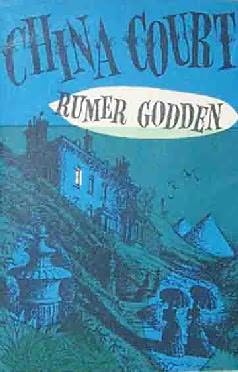
So...to go back in time, I've been reading some "real" library books, the old ones you find when you browse without preconceptions. I've rediscovered Rumer Godden's China Court, which was proudly displayed in the glass bookcases at my grandmother’s house. China Court was a Book- of-the-Month-Club book, as were most of my grandmother’s books. As a child I thought the novel had too many threads, portrayed too many generations, and was confusingly non-linear with parallel and intersecting back-and-forth-in time lines. Of course now I love it; it's exactly my kind of book. Five generations, the rise and fall of a Cornish house, the fourth generation abandoning the quarry and the obsolete china factory for more lucrative, less demanding careers. The novel begins with the death of Mrs. Quin, the third-generation dowager of the slightly dilapidated, once grand house, China Court.  Mrs. Quin, an unconventional woman who was originally rejected by Lady Patrick as an appropriate friend for her son, has, ironically, not only married into the family, but become the last matriarch and house historian.  Yet, through her wild garden, she has somehow renewed the house and even made the past more accessible.

One thing I love about Godden's style:  characters who are peripheral to the action, or even family members looking back at the past, comment, Greek-chorus-like, on events in the narrative.  We first learn about Mrs. Quin and life at China Court from her maids.

Godden writes:  "Neither Cecily nor Mrs. Abel whispered, nor did they speak of Mrs. Quin as if she were not there, but all the same, things were muted; there was no early firing of explosives from the quarry, which had stopped work when the news was heard and the men had been sent home as a mark of respect.  'But the news will be in the village before the men,' said Cecily.

"Of course, Dr. Taft's car would have been seen, then Mrs. Abel coming down, and Cecily knew the vicar would be here at any moment.  'No one goes in or out of China Court who isn't seen,' complained Cecily often, 'seen and talked about.'  The village was not kind: proudly inbred, it kept for strangers the spirit of its wrecker forebear, though where it respected it was staunch and for Mrs. Quin there would be genuine feeling.  'Mrs. Quin gone!'..."

Godden's best books deserve rereading:  most are out-of-print, at least in the U.S. We should lobby for  Persephone or Virago to "rediscover" them. T

Tuesday, January 27, 2009

John Updike


John Updike died of cancer today at the age of 76.

I wasn’t a natural fan of John Updike. He was not John Cheever, the reigning chronicler of the suburbs whom I idolized in my university days. Cheever’s stories were easier to read, more direct, less disturbing than Updike's.

It wasn’t until I read the Rabbit books that I understood Updike’s genius.

With humor, pathos, and a complete lack of sentimentality, Updike wrote about Rabbit's hollow confusion and stumbling attempts to break away from his class paradigm. Rabbit, Run, Rabbit Redux, Rabbit Is Rich, and Rabbit at Rest seemed to describe my life, or rather the contiguous lives of lower-middle-class male relatives who played pick-up basketball, yearningly watched sports, and broke their wives’ hearts by picking up women and sometimes leaving their families. The scenes are so familiar: Rabbit running away and his wife Janice drinking; Rabbit returning to Janice, and the two trapped by conventions and tragedy; Rabbit eventually managing his father-in-law's car dealership while Janice blooms; and their son Nelson’s cocaine addiction.

Isn't this the stuff of all our lives? Even as a metaphor?

The Rabbit books meant so much to me that I vigorously chose Rabbit Is Rich for my reluctant book group in 2000. Nobody wanted to read it, but they were stunned by the beautiful writing and the easy flow of the story. It was the third of the Rabbit quartet, and they loved it and immediately changed their minds about Updike’s reputation for inducing boredom.

Old interviews with Updike are all over the internet today. He was brilliant, calm, and patient with reporters who asked the same questions again and again. Was he too old to write well? Did he think he’d written better in his youth? Updike, who had liver spots on his hands and apparently was already suffering from cancer last fall, talked about Hemingway and Fitzgerald and the youth culture and America’s restless insistence on young talent.

His books were always there: something new to read in the teacher’s lounge at lunchtime. “Is that actually good?” someone asked, thinking I was posing as an intellectual when I read Memories of the Ford Administration. Oh please, give me a break.

“Of course.”

He won the Pulitzer, the National Book Award, and the National Critics Circle Award, so he certainly wasn't lacking in the awards department. But he should have won the Nobel for Rabbit if for nothing else

He was imminently readable.

Off to read Updike.

Saturday, January 24, 2009

A Favourite of the Gods

Sybille Bedford, a widely-touted novelist who died in 2006, was described in The Guardian as a writer who "did indeed look back to a multi-lingual society of salons and private trains, flawed by arrogance and complacency..." (Is there perhaps a hint of an apology in "indeed?")

She is so highly recommended (there seems to be a kind of mystique) that I did attempt to read A Favourite of the Gods.

Bedford wrote beautifully, with a luminous clarity which validates her reputation for intelligence and wit. The narrative of the novel perfectly orchestrates brilliant style with a loose plot centered on the complications of sexual fidelity. This Jamesian saga about three generations of women is vaguely reminiscent of Portrait of a Lady. James never wrote a saga, of course, but the characters on a superficial level fit into his paradigm of naive women and duplicitous men. Anna, an American ingenue (New England), marries an impoverished Italian prince, who makes her happy for many years. But when she learns of her husband’s long-term affair with a chic Italian woman he has known from childhood, she flees with her teenage daughter, Constanza, to England. And for a long time Constanza does not understand the reason for the separation. Since adultery seems so commonplace to her (she has already had affairs), she believes her father committed some crime, probably involving money.


In this case, unlike any of James’s novels, the prince is sweet, not a monster, but promiscuous. All three of the women, Anna, Constanza, and her daughter, Flavia, have different morals, all shaped by their birthplaces: America, Italy, and England.

The daughter of an IItalian prince and a German noblewoman, Bedford had some experience of growing up as the displaced daughter of a separated couple (she traveled between Rome and England, like her character, Constanza). And whe wrote of imcompatible marriage partners "that they at least shared a belief in the importance of society and the habit of being rich."

The characters seem shallow to me. I believe in Henry James, though how I don't know, yet these capricioush characters never come alive for me.

I know Bedford was a "good" humanist, though, who, as a legal journalist covered 100 complicated trials, among them the Lady Chatterley scandal and Jack Ruby's trial for the assassination of Lee Harvey Oswald.

And A Favourite of the Gods is a brilliant book on many levels. It just doesn't work for me.

Monday, January 19, 2009

Pamela Hansford Johnson

Yesterday we drove 40 miles to a university town, passing abandoned smashed cars cordoned off with yellow tape, wondering what had happened, since the ice has melted away (perhaps the tow trucks haven't come yet). We stopped at our favorite coffeehouse, Carpe Diem, rattled the paper, enjoyed the cappuccino-and-cinnamon smell, and then walked to one of the best libraries in the state. One of the perks of living here is that, with the flash of an ID, one is entitled to check out books statewide. I’ve browsed at small-town libraries (population 3,000) where I’ve discovered forgotten treasures by Cozzens and Cronin, and at bigger-city (well, population 100,000) libraries where I’ve perused the complete works of Sigrid Undset.

Tromping through the snow, a little more snow than we have in ____, we clumped and puffed up the staircase of the granite many-windowed building. It was a warmish day, thirtysomething, slushy, birds singing, a harbinger of spring, and people striding with parkas opened. We stopped at the computers to look up our lists: the computer is an IBM thing (I’m used to Macs) and I confess I couldn't turn it on without help. On my list: many of the books I wanted are in storage. I found Pamela Hansford Johnson, but not Pamela Frankau. In the stacks I serendipitously discovered a novel by Vera Brittain  and The Spare Room by Helen Garner (which I've read about online). The stacks are very narrow, so navigation among the bookshelves in a parka is slightly precarious: I pulled out my pile of books and sat cross-legged on the floor to examine them. My last collection included several disappointing books, among them Prozac Highway, which turned out to be a novel about lesbian performance artists with angst. (I had expected one of those fascinating madness books.) This collection looked better.  Then I smugly wandered over to a comfortable chair with a view of black-and-white trees through the church-like windows, as far from the buzzing fluorescent lights as possible.

I started reading Johnson’s An Impossible Marriage in the car and continued to read it till bedtime. Fascinating Virago-like material, the story of a thoughtful, strong-willed young woman who knows enough to dump a young man with whom she is sexually compatible but not otherwise;  but then makes the same mistake when she falls in love at first sight with a beautiful but arrogant man 14 years older than herself. That whole experience of falling in love at first sight: can that ever turn out well? The horror: it usually involves falling for someone believed to be superior to and more beautiful than oneself (and some groveling ). Johnson describes the affair with compassion and insight. She is a very good writer, whom I haven't read in years.

Wednesday, January 14, 2009

If not for Janet Malcolm...

When Janet Malcolm praised Gossip Girl in the "Critics at Large" column in The New Yorker (“Advanced Placement: The Wicked Joys of Gossip Girl,”3-10-2008), I made a mental note. I recently found a couple of Gossip Girl books and read like a zombie (at least I read one and a half before throwing them into the “give to charity” box). Although I admire Malcolm’s exuberance, her brisk, mordant style, and her penetrating journalism--The Freud Archives and The Silent Woman: Sylvia Plath and Ted Hughe are certainly American classics--why is she writing about Gossip Girl? A shock thing? This trashy series is about materialistic, shallow teenagers who casually drop brand names into every conversation, wear new designer clothes on each page (though I haven't heard of half the brands), drive Jaguars, fly private planes, check into posh hotels to meet boys, and attend exclusive private schools. In fact they have no real friends. These hollow girls and boys steal each other's lovers and spread rumors about each other on their phones when they're not in the dressing room at Barney's. The "Gossip Girl" column is a computer blog, on which the most scandalous gossip is spread. No one knows who Gossip Girl is (at least not in the first book).

Malcolm writes: "Von Ziegesar pulls off the tour de force of wickedly satirizing the young while amusing them. Her designated reader is an adolescent girl, but the reader she seems to have firmly in mind as she writes is a literate, even literary, adult."

Oh dear. What literate adult might that be? Malcolm actually refers to these books as "classics."

Some of the Gossip Girl columns are humorous, but the narrative is appalling. We need that loyal coterie of friends at the center, like the Sex and the City gals.

The Gossip Girl computer board could say: Rumor has it that Janet Malcolm is ghosting the series. That is totally so Gossip Girl! But of course, I made it up, so don't believe it for a minute. Janet Malcolm has nothing to do with these books ! Some of the books are "created by Cecily von Ziegesar," not written, so we can conclude she has some ghosts. (Not Janet Malcolm, though. I SO made that up!)

Saturday, January 10, 2009

My snowshoes are lost...(What would Trixie say?)


I planned to photograph the ice-rink lawns and post them here to invoke pity. Poor Mad Housewife! No wonder she's mad having to live in that ig -alow. Wait, isn't that Alaska? From all I hear, Alaska is melting and and it's trickling south so the Great Plains get whalloped with the ice and snow. The environmental drums are rolling. But if this is the New Alaska, where are the pubs, the small planes, the talk radio station? Maybe a couple of cute huskies and a sled? Is that Northern Exposure or Men in Trees?

The ice has melted, though, and we have a blanket of seven inches of snow. As you can imagine, every winter athlete has hit the, well, not the slopes, unless they wander down to Colorado, but the groomed trails. These obsessed x-country fanatics spend their LON-N-N-NNNNG lunches and breaks x-country skiing and sometimes make videos of themselves skiing . I have to pretend that I'm watching the ski film or I'll get hit over the head with a ski (gently). The boss doesn't rebuke them: he'd probably get whopped over the head with a ski, too.

"Do you want to ski or snowshoe?" they ask for the thousandth time. Their idea of teaching me was to stand me up on skis at the top of a trail and give me a little push. I slammed into a tree and was lucky I didn't fall into a deep ravine. Running into a tree sounds humorous, but it is painful. Since then I've glowered at the SHARE THE SKI ENTHUSIASTS. IT IS A WEAPON, NOT A TOBOGGAN. And why doesn't everybody remember that?

But they don't take a hint.

"How about the snowshoes?"

"What snowshoes?"

"I gave you snowshoes a couple of years ago."

"OH, THOSE SNOWSHOES. Well, they don't really fit, you know."

"Oh, come on. Wear the snowshoes. It'll be fun."

"If you want them so much, you wear them." Suck your cigarette in.  Bad, bad loss of temper. They love their sport so much they can't help proselytizing. And I can absolutely see this.line of thought. Snowshoes will be easy: then throw her onto skis...

"Well, get rid of that cigarette."

"Okay."

Have you ever read Trixie Belden and the Mystery at Mead Mountain? I can't find it, but I have read it. While staying in a ski lodge, Trixie and the Bob-Whites (her gang) soon stumble upon some suspicious goings-on. Oh, yeah, and there's skiing in this book. Cross-country AND downhill. I don't remember any snowshoes, though.

Thursday, January 08, 2009

The Elliptical and the Bike

Be careful on your walks this winter. Sometimes there's an incline at the intersection and you find yourself frantically grabbing at the traffic light pole so you don't fall into the street. It's melancholy and treacherous. Day after day of freezing rain and ice storms have transformed the world into a gigantic science-fictionl ice rink this winter. The yards are ice. Not icy snow, really ice. The world is stunning but unnavigable. I’ve never seen anything like it.

So everyone is stuck indoors. And mad as hell about it.

So we must go to the health club.

 At the health club treadmills are all taken and eveybody’s huffing and puffing on the elliptical. The elliptical is MY THING. You walk up and down on those pedals while you watch that movie, Elf, which has been playing on all the channels all the time since Thanksgiving. No, really you don’t want to watch Elf. It's only one step above Project Runway, which you also got stuck watching once here.

The solution during this cranky time is to switch to the bicycle. Like other bicyclists, I've discovered that it is possible to read a small paperback, WHICH YOU MUST PROVIDE, during exercise. At the health club, there's a pile of germy sweated-up Newsweeks, abandoned by my peers. (Recently every issue is about Obama. Obama lore! These will be collectibles someday!) So, like all desperately bored health club members, I've discovered some books that make perfect workout reading.


1. James Welch’s lyrical Winter in the Blood, a classic first published in 1974. In the new Penguin edition, it is only 137 pages, easily read in 20-minute increments on the bicycle. The narrator, an American Indian with a drinking problem and a bad knee, often gets stuck walking back from town to the ranch, where he lives with his mother, Theresa, and Lame Bull, whom she marries early on in the novel. His mother goes out with Lame Bull one day after many jokes about marriage, and comes back married, much to the
surprise of the narrator. Anyway...it's witty and sad, a novel about regrets, the past and the present.


2. I tried Michael Chabon's The Yiddish Policemen's Union. It is brilliant. It cannot, however, be read on a bicycle. The paperback is gorgeous, but I finally realized I'm not making a fashion statement. A fourth done, none of it at the health club. Well, it's a great book and I didn't really take it to the health club...

3. Any mystery will do.

Sunday, January 04, 2009

The Wicked Books

Gregory Maguire’s Wicked, the first book in his reimagined Oz series, reinvents the character of the Wicked Witch of the West as a “green” animal rights activists. Her nemesis, Dorothy, is a displaced, manipulative, politically savvy, two-faced bitch (sorry), who will do anything, even murder the witch, to escape the political intrigues of Oz and return to her dour aunt and uncle in Kansas. When Elphaba, the witch, idling in a tree, overhears the Yellow Brick Road quartet slander about her, she is stunned to hear that she is “psychologically warped,” “a despot,” or “born hermaphroditic, maybe entirely male.”

"The last thing she ever cared about was gossip. Yet she had been out of touch for so long that she was astonished at the vigorous opinions of these random nobodies."

We were all crazy about Elphaba when we read the novel for a book group 10 years ago. Yet I didn't keep up with the Wicked books. Perhaps the idea of the musical put me off (even though it confirmed my good taste).

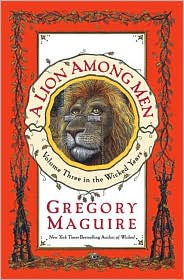
But for Christmas I received A Lion among Men, the third book in the Wicked series, an excellent novel for reading at night. Maguire has cleverly transformed Brr, the Cowardly Lion, into a displaced animal who earns a reputation for heroism when an act of cowardice is misinterpreted d during a political demonstration (dwarfs vs. humans).
Eventually we learn that he was probably concocted in a lab: he fits in nowhere and perhaps is the loneliest animal in the world. Talking animals have been driven out of the cities, and he has lived among humans too long. He is accepted neither by prides of lions nor by human beings during his adventures, and survives by working or, eventually, selling services for different political factions.

I enjoyed this novel, but it isn’t in the same class (a classic) as Wicked.

Son of a Witch, the second Wicked book, which I began today, is closer to Wicked in the complexity of the plot and smoothness of the writing.

Wednesday, December 31, 2008

Best of 2008

Seven hours till midnight: Hello, 2009. I sweat and chew my pen as I rustle through my notebook, my glasses on the end of my nose. It's the annual Mad Housewife's awards (I being MH) and so much depends on it. Yes, I have at least two readers, who are waiting to hear my judgment. I’ll mix and match a little of each.

Best contemporary novel: People of the Whale by Linda Hogan. I said: Hogan's elegant, concise, and subtle style is suited to recounting Indian legends about a fishing village's relation to the sacred whale... and to depicting the violence of damaged Vietnam vets, determined to break the poetry of the legend by hunting the whale, an endangered species, and committing crimes against the environment.

Second-best contemporary novel: Netherland by Joseph O’Neill. Not reviewed here.


Best fairy tales: Dangerous Angels by Francesca Lia Block. I said: A collection of Block’s “post-punk” Weetzie Bat books are delicate “post-punk” prose poems about a creative, unconventional group of drifting L.A. characters with names like Weetzie Bat, Dirk, Duck, Cherokee, Witch Baby, and Brandy-Lynn.

Best 20th-century women’s novel: Honourable Estate by Vera Brittain. I said: In Honourable Estate, Brittain analyzes the impact of World War I on two generations of men and women. Janet, a pre-war suffragist, loathes housework and motherhood and escapes from her fanatical vicar husband to political meetings. In the next generation, Ruth, the feminist daughter of an indulgent manufacturer, graduates from Oxford, despite her family’s belief that marriage should be her 'estate.'

Best 20th-century men’s novel: The Deep Sleep by Wright Morris. I said about his work in general: "Though Morris won the National Book Award twice, one must look to small presses for his books: Bison Books (University of Nebraska Press) publishes (most of them).

Best classic: A Hazard of New Fortunes by William Dean Howell. I said: A Hazard of New Fortunes is brilliantly written... , a luminous example of the “new realism” of the late 19th century....The focus of A Hazard of New Fortunes is the inception of a literary magazine: its many employees s comprise a complete society, who are transplanted to New York to pursue “new fortunes." They come from all classes and economic strata: poor artists and writers, intellectual editors and publishers, shrewd businessmen and backers, nouveau riche, middle class, and genteel poor.

Best Classic Western: The Curlew’s Cry by Mildred Walker. I said: Mildred Walker is a powerful writer. Set in Montana, where Walker lived from 1933 to 1955, The Curlew's Cry is the story of Pam Lacy, a passionate, independent young woman whose coquettish friend woos and steals her boyfriend... Confused and on the rebound, Pam makes a hasty marriage to the son of a wealthy businessman in Buffalo who is a director of the Rocky Mountain Cattle Company. (A fifth-generation Montanan, she returns to the West alone.)

Best memoir: An Orderly Man by Dirk Bogarde. I said: Tired of the hectic life of an actor, Bogarde buys a small run-down house in France (which is the frame and organizing concept of the memoir). The house needs extensive renovation. He hires an architect to redesign the house, which the architect explains has been neglected for 500 years. While Bogarde is away finishing a film (he retires only occasionally), the architect and contractors finish the house. Everything that can go wrong does. Humorous and sensitive.

Best non-fiction: The Letters of Jessica Mitford. Not reviewed here, but Mitford fans will like it.

Saturday, December 27, 2008

People of the Whale

People of the Whale, by the award-winning American Indian poet and novelist Linda Hogan, is perhaps the most stunning novel of the year. Certainly it tops my list for contemporary fiction of 2008. Hogan's elegant, concise, and subtle style can be effectively adapted to recounting Indian legends about a fishing village's relation to the sacried whale (who gave birth to humans), and to the violence of damaged Vietnam vets, determined to break the poetry of the legend by hunting the whale, an endangered species, and committing crimes against the environment.


Hogan interweaves the stories of a broken couple, Ruth, a strong-willed fisherwoman, and her drifter husband, Thomas, a Viietnam vet who disappears by choice after the war. These two stories are complete in themselves: they are subtly unbalanced by the tale of Thomas’s daughter in Vietnam, whose long life story seems to belong to a different novel. Hogan’s lovely, poetic prose compensates for the flaws, but it does detract from the novel. Yet Hogan’s world is one of contraditcions and conflicts:: the women lfeft behind in the U.S. and Vietnam, traditional cultures and the loss of belief by men who never recover psycholgically from the war and who turn on themselves.

The senseless, cruel killing of the whale and the women’s protests become a metaphor for the destruction of the old way of life and the fight of the conservationists. Hogan writes:

"On the day of the whale hunt, the gray day, only three women had the courage to stand at the shore facing the ocean fog as it lifted. Far out was the roar of the water, tlhe sound of a storm beginning in the lead-colored sky. Their eyes closed, the women sent their hearts across the ocean, willing the whales not to come near land....

"The three women told the whales not to come. But the whales no longer heard their voices or thoughts. Perthaps because the hunt had become a spectacle and not a holy thing. Their voices were drowned out by the sound of speedboats and a helicopter...This was not the way it had ever been done in the past. This was the first whale hunt since the 1920s."