Wednesday, December 31, 2008

Best of 2008

Seven hours till midnight: Hello, 2009. I sweat and chew my pen as I rustle through my notebook, my glasses on the end of my nose. It's the annual Mad Housewife's awards (I being MH) and so much depends on it. Yes, I have at least two readers, who are waiting to hear my judgment. I’ll mix and match a little of each.

Best contemporary novel: People of the Whale by Linda Hogan. I said: Hogan's elegant, concise, and subtle style is suited to recounting Indian legends about a fishing village's relation to the sacred whale... and to depicting the violence of damaged Vietnam vets, determined to break the poetry of the legend by hunting the whale, an endangered species, and committing crimes against the environment.

Second-best contemporary novel: Netherland by Joseph O’Neill. Not reviewed here.


Best fairy tales: Dangerous Angels by Francesca Lia Block. I said: A collection of Block’s “post-punk” Weetzie Bat books are delicate “post-punk” prose poems about a creative, unconventional group of drifting L.A. characters with names like Weetzie Bat, Dirk, Duck, Cherokee, Witch Baby, and Brandy-Lynn.

Best 20th-century women’s novel: Honourable Estate by Vera Brittain. I said: In Honourable Estate, Brittain analyzes the impact of World War I on two generations of men and women. Janet, a pre-war suffragist, loathes housework and motherhood and escapes from her fanatical vicar husband to political meetings. In the next generation, Ruth, the feminist daughter of an indulgent manufacturer, graduates from Oxford, despite her family’s belief that marriage should be her 'estate.'

Best 20th-century men’s novel: The Deep Sleep by Wright Morris. I said about his work in general: "Though Morris won the National Book Award twice, one must look to small presses for his books: Bison Books (University of Nebraska Press) publishes (most of them).

Best classic: A Hazard of New Fortunes by William Dean Howell. I said: A Hazard of New Fortunes is brilliantly written... , a luminous example of the “new realism” of the late 19th century....The focus of A Hazard of New Fortunes is the inception of a literary magazine: its many employees s comprise a complete society, who are transplanted to New York to pursue “new fortunes." They come from all classes and economic strata: poor artists and writers, intellectual editors and publishers, shrewd businessmen and backers, nouveau riche, middle class, and genteel poor.

Best Classic Western: The Curlew’s Cry by Mildred Walker. I said: Mildred Walker is a powerful writer. Set in Montana, where Walker lived from 1933 to 1955, The Curlew's Cry is the story of Pam Lacy, a passionate, independent young woman whose coquettish friend woos and steals her boyfriend... Confused and on the rebound, Pam makes a hasty marriage to the son of a wealthy businessman in Buffalo who is a director of the Rocky Mountain Cattle Company. (A fifth-generation Montanan, she returns to the West alone.)

Best memoir: An Orderly Man by Dirk Bogarde. I said: Tired of the hectic life of an actor, Bogarde buys a small run-down house in France (which is the frame and organizing concept of the memoir). The house needs extensive renovation. He hires an architect to redesign the house, which the architect explains has been neglected for 500 years. While Bogarde is away finishing a film (he retires only occasionally), the architect and contractors finish the house. Everything that can go wrong does. Humorous and sensitive.

Best non-fiction: The Letters of Jessica Mitford. Not reviewed here, but Mitford fans will like it.

Saturday, December 27, 2008

People of the Whale

People of the Whale, by the award-winning American Indian poet and novelist Linda Hogan, is perhaps the most stunning novel of the year. Certainly it tops my list for contemporary fiction of 2008. Hogan's elegant, concise, and subtle style can be effectively adapted to recounting Indian legends about a fishing village's relation to the sacried whale (who gave birth to humans), and to the violence of damaged Vietnam vets, determined to break the poetry of the legend by hunting the whale, an endangered species, and committing crimes against the environment.


Hogan interweaves the stories of a broken couple, Ruth, a strong-willed fisherwoman, and her drifter husband, Thomas, a Viietnam vet who disappears by choice after the war. These two stories are complete in themselves: they are subtly unbalanced by the tale of Thomas’s daughter in Vietnam, whose long life story seems to belong to a different novel. Hogan’s lovely, poetic prose compensates for the flaws, but it does detract from the novel. Yet Hogan’s world is one of contraditcions and conflicts:: the women lfeft behind in the U.S. and Vietnam, traditional cultures and the loss of belief by men who never recover psycholgically from the war and who turn on themselves.

The senseless, cruel killing of the whale and the women’s protests become a metaphor for the destruction of the old way of life and the fight of the conservationists. Hogan writes:

"On the day of the whale hunt, the gray day, only three women had the courage to stand at the shore facing the ocean fog as it lifted. Far out was the roar of the water, tlhe sound of a storm beginning in the lead-colored sky. Their eyes closed, the women sent their hearts across the ocean, willing the whales not to come near land....

"The three women told the whales not to come. But the whales no longer heard their voices or thoughts. Perthaps because the hunt had become a spectacle and not a holy thing. Their voices were drowned out by the sound of speedboats and a helicopter...This was not the way it had ever been done in the past. This was the first whale hunt since the 1920s."

Wednesday, December 24, 2008

Journey into Christmas

Dickens' A Christmas Carol doesn't blunt the edginess of the season. Is your family having a fit of major sulks while you entertain a ragtag group of friends who have appeared out of nowhere because their own families have rejected them? Is your perfectionist sister on the edge of nervous collapse because she burned the turkey? ("And, no, you can't start over again with a new turkey," you all have to insist). Is it possible that your husband and cousin are really going to spend all day playing foosball in the basement? ("IWe're not hungry," they say casually.)

Dickens particularly depresses me. I have two copies of his Christmas books, purchased at sales, in case I am suddenly infused with the Dickensian Christmas spirit, but I honestly believe these slapdash novels are sub-standard and setimental. The longer the better for Dickens: lest you think I am a philistine, I am very fond of Our Mutual Friend, Bleak House, and Dombey and Son)

This year, I have, however been delighted to find excellent Christmas stories in Bess Streeter Aldrich's collection, A Journey into Christmas and Other Stories. The title story is especially good and can be read at:

A Journey into Christmas

Sunday, December 21, 2008

Solstice


It's the winter solstice.

Is this a festival, I wonder? It’s -2 degrees. Lord, what could be gloomier? And in just four days...four days...it will be Christmas.

David Lodge's Deaf Sentence has some hilarious Christmas scenes, told in the form of a diary. It will cheer you up as much as a hot toddy (especially if you take meds, and are by necessity a teetotaller.)

So, anyway, I'm drinking herbal tea and trying to think cheerfully about Xmas. Here are some innocuous Christmas memories over the decades, showing that Christmas isn't ALL bad. (Though really, don't you hate those Dickens books?)

1964: there is a photograph of me, twinkling through my cat-shaped glasses, wearing an olive-green dress with fishnet stockings, so I obviously didn't mind getting dressed up on Christmas Eve. If I got the dress from Sears I'd begged for, I wore It. I also wore the impractical fishnet stockings, even in winter (think -2 degrees): Care about the cold? No, be cool. we wanted to look like Twiggy, or the Revlon girl, or someone.


The unwrapped gifts were kept in my mother’s closet, so it was impossible not to know what we were getting. Was this the year of the Barbie dream house? Or the Tammy house? This was the year of Tammy, a kind of alternative to Barbie (here is a photo of Tammy and her sister Pepper: I also had the Tammy house, cardboard with folding cardboard furniture, and Pepper's treehouse made of plastic.) Relieved, our mothers practically embraced Tammy, who, unlike Barbie, seemed like a nice, NORMAL girl.

There were also books: A Wrinkle in Time, E. Nesbit's books, etc.

1975: rabbit stew and no gifts. Friends and guests indulged in a drunken debauchery, so I got stuck cooking. Only immense irritation could have gotten me through that Julia Child recipe. I had to channel Julia Child, which is not easy when one is a non-cook. After dinner a Russian sang and accompanied himself on a guitar-like thing, which I should have appreciated. Instead, I wandered off into another room., leaving the drunks to drink and sing. The sober ones followed me. My excuse: exhaustion.

1982: we traveled; no gift exchange; doughnuts for breakfast and dinner at a steak house, the only restaurant open in town. I did receive a copy of Keats.

1990s and 2000s: we did the whole Christmas thing, complete with expensive presents. I suppose this shows we are finally adults.

Monday, December 15, 2008

Anti-War Classics

During a lull at a peace rally you might want to rejuvenate yourself with:

Joseph Heller's Catch-22

Aristophanes' Lysistrata

Virgil's Aeneid

Vera Brittain's Testament of Youth

Sophocles's Antigone

Kurt Vonnegut's Slaughterhouse Five

Cicely Hamilton's William - An Englishman

Vera Brittain's Honourable Estate

Noel Stretatfeild's Saplings

Elsa Morante's History: A Novel

Saturday, December 13, 2008

Miss Bishop


Miss Bishop was so popular when it was published in 1933 that it was made into a movie, Cheers for Miss Bishop. it was Bess Streeter Aldrich's homage to teaching, which was her own itinerant profession for 11 years (six in her hometown of Cedar Falls, one in Boone, IA, another in Salt Lake City, and three years in Marshalltown, Iowa, where she met her husband in a boarding house). The heroine, Ella, whom we first meet as an extroverted college freshman, cannot find a job teaching country school, but is then recruited to teach grammar at her college. A dedicated teacher, she cannot do "half-measures," and she manages to be vigorous and inspiring even about participles and subordinate clauses (her students love her) . She supports her frail mother, who worries that her schoolma'arm career may end in spinster-dom. But Ella says,, "Don’t you worry. I won’t be an old maid.... I have too many dreams for that, Mother. I think sometimes it is as though I am weaving at a loom with a spindle of hopes and dreams. And no matter, Mother, how lovely the pattern--no matter how many gorgeous colors I use,--always the center of it is...you know..., just a little house in the country in a garden and red firelight and...the man I love...and children...and happiness. For me, Mother, that’s the end of all dreaming.”

Although this novel was a best-seller in 1933, it has not stood the test of time: Aldrich’s language is dated, the style too blunt, and the change of point-of-view sometimes disconcerting. Yet her portrait of Ella, the workaholic teacher, is entirely convincing. Have we not all known someone like this? The novel is lighter and less affecting than A Lantern in Her Hand, Miss Bishop, the novel, not the character, is almost cloying at times. The imaginative reader must transport herself to another place and time to appreciate this, imagining herself in her “own little house in the country in a garden.” Ella, of course, does not realize all her dreams. To state one’s dream is to jinx it. Ella wants to marry: she is jilted in a scene that reminds me very much of the jilting in The Curlew’s Cry.

Read A Lantern in Her Hand instead.

Wednesday, December 10, 2008

A Lantern in Her Hand


Bess Streeter Aldrich knew exactly what she was doing when she wrote A Lantern in Her Hand (first published in 1928). Before she wrote the novel, she interviewed early settlers in Nebraska and studied historical documents and letters. Her heroine, Abbie Mackenzie Deal, follows her husband, Will, a Civil War veteran, to Nebraska, where he struggles to farm on the unforgiving prairie. Droughts and onslaughts of grasshoppers raze the fields year after year. One year the prices fall so low that the farmers burn corncobs rather than trade for coal at a loss. We often grieve for Abbie, who suffers the agony of the displaced yet struggles to emphasize small dertermined joys for the sake of her husband and five children. The landscape is barren and desolate, the endless wave of grasses get on her nerves, and she must constantly work in the sod house, saving every string and button and piece of brown paper (she eventually writes on the brown paper). She educates her children, giving them opportunities she didn't have. She cannot pursue the talents she once had (particularly singing), and is both proud and envious of her successful children.

Aldrich's understated prose in this engrossing novel matches the numbness necessary for dignity in Abbie's often dramatic life: She cannot show her feelings;

"The grasshoppers swarmed over the young waist-high corn and the pasture and the garden. By evening the long rows of sweet corn had been eaten to the plowed ground. The tender vines of the tomatoes were stripped down to the stalk. The buds of the fruit trees were gone. Part of the garden was a memory. The chickens had feasted themselves to bursting point. Gus Reinmueller, driving up to the door, could hardly control his raring houses, so irritated were they by the bouncing, thumping pests. The farm was a squirming, greenish-gray mass of them."

Aldrich, a conscientious graduate of Iowa Teachers College who had the "writing bug" (according to her son in an intro to an older versison of this book), won a writing prize from Ladies' Home Journal in 1911 and became popular in 1918 after American Magazine bought "Mother's Dash for Liberty." .Adrich moved to Nebraska with her doctor-husband in 1909 and raised her family there.

This is not a classic, perhaps, but it is a book to be cherished (it was recently reissued by University of Nebraska press). She seems a little uncertain at the beginning, but after three chapters you race through the book--and I did cry over one page.)

Monday, December 08, 2008

Bookworm Alert


"No more books." That's the Grinch speaking. But our shelves swell pregnant lywith books, so I have not succumbed to Borders 30%-off coupons for TWO WEEKS.

It's like a twelve-step program.

One Christmas Eve I hysterically bought most of Nabokov for an intellectual friend because I didn't have the faintest idea what to give.

"Going to have a dark Christmas?" the bookseller inquired.

Probably, though that wasn't my goal. I plunge into shopping on Christmas Eve out of a pathetic anti-Christmasy gloom to gossip with people who have even worse Christmases than I do (I hope this doesn't get on their nerves). Few clerks have families like Bob Cratchitt's They sit around; they read Advance Reader Copies; they have mood disorders and they lounge under those special lights to fight SAD.

I'm reading bookworm lit this year to prepare for giving gifts to bookworms. Here's a list:

George Orwell's Keep the Aphrodistia Flying (about a gloomy intellectual who works in a used bookshop)

Penelope Fitzgerald's The Bookshop

Nick Hornby's The Polysyallbic Spree (essays)

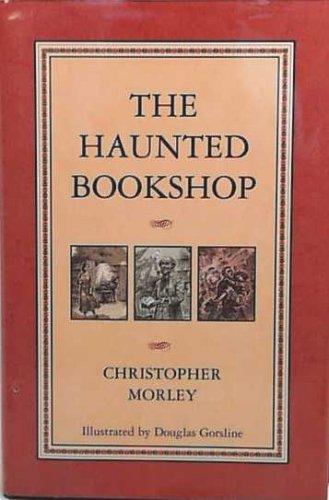
Christopher Morley's The Haunted Bookshop

Christopher Morley's Parnassus on Wheels

Christopher Morley's Pipefuls (essays and newspaper columns)

Christopher Morley's Shandygaff (essays and newspaper columns)

D. E. Stevenson's Miss Buncle's Book (published by Persephone)

The Western Canon by Harold Bloom

Alex Beam's A Great Idea at the Time: The Rise, Fall, and Curious Afterlife of the Great Books (I can't vouch for this one: it's a history of the Great Books program)

Nabokov's Lectures on Literature

Coetzee's Inner Workings: Literary Essays 2000-2005

Lynne Tillman's Bookstore: The Life and Times of Jeannette Watson and Books & Co.

Helene Hanff's 84 Charing Cross

Helene Hanff's Q's Legacy

On Reading by Andre Kertesz (photographs)

Hallie Ephron's 1001 Books for Every Mood

(And I'm sure there are many more, so let me know, and I'll add them)

Saturday, December 06, 2008

The Curlew's Cry

I wouldn't have read Mildred Walker's The Curlew's Cry if I hadn't gone to Omaha. (Like Chekhov's Three Sisters, we're always chanting, "If only we could get to Omaha.") It was a curiosity I spotted in a bookstore, and because I'm a sucker for university presses (Bison Press: www.nebraskapress.uni.edu) I decided to take a chance.


I have such a passion for this book that I don't know if I can convey it.

Mildred Walker is a powerful writer. Set in Montana, where she lived from 1933 to 1955, The Curlew's Cry is the story of Pam Lacy, a passionate, independent young woman whose coquettish friend woos her boyfriend away and almost spoils her life. Confused and on the rebound, Pam makes a hasty marriage to the son of a wealthy businessman in Buffalo who is a director of the Rocky Mountain Cattle Company. (The company ruined her father, a rancher, when it refused to back up his loan from a bank which changed hands). And in a sense the company also ruined Pam through her marriage to the unimaginative Alan. The marriage is mechanical and disastrous from the start. All Pam's loyalties are to her father and the landscape of the West, but when she speaks of her beloved Montana, the Easterners disparage it. She returns to Montana and divorces her husband (who cannot understand it) and builds an astonishing, unconventional career.

But the book is more than its characterization of Pamela. Walker writes this with such unobtrusive and consistence brilliance that we see and feel the beauty of the West.

I suppose she's considered a craftsman, not an artist. How boring that gets. But for readers of Susan Glaspell 's Fidelity,which I have also posted about, this novel is as remarkable or more so.

Sunday, November 30, 2008

William Dean Howells


William Dean Howells is one of those American writers of whom I’ve only been peripherally aware. His paperbacks have been floating around our house forever, though they have remained largely unread, because I understood that he was “second-rate.” Second-class novels are resigned to abysmal fates: they lie inert and dusty forever unless someone takes them idly off the shelf. Our grandmothers may have read them, but we have considered ourselves too modish and posh for such unfashionable literature. After bingeing on Sinclair Lewis’s satires, however, Howells, famous for his realistic “domestic” novels and skewering of capitalism, seemed the next logical step..

“Where’s Howells?” I asked. I looked over my glasses.

“Which?”

“Which do you recommend?”

Vaguely: “I’ll bring you a pile.”

“Just one.”

The pile grew. I considered his science fiction novel, A Traveler from Arturia, but decided to start with a more conventional, characteristic work. I chose A Hazard of New Fortunes (a classic reminiscent of Henry James, and why it took me so long to get around to it I’ll never know).

A Hazard of New Fortunes is brilliantly written and structurally convoluted , a luminous example of the “new realism” of the late 19th century. Howells controls the threads of his New York unobtrusively and the detailed, reflective, almost businesslike story unfolds in a subtly organized manner. The focus of A Hazard of New Fortunes is the inception of a literary magazine: its many employees s comprise a complete society, who are transplanted to New York to pursue “new fortunes." They come from all classes and economic strata: poor artists and writers, intellectual editors and publishers, shrewd businessmen and backers, nouveau riche, middle class, and genteel poor. All are connected to the new literary magazine. There are many, many protagonists: in Part One the March family reluctantly leave Boston for New York after March loses his insurance job. Fulkerson, the founder of the new magazine, has recruited him through sheer bluster to take a chance on being the editor. In Part Two we meet Beaton, a moody artist, and Alma Leighton, an illustrator, whom he has dropped after luring her and her mother to New York. The publisher, the son of a nouveau riche farmer who has made a fortune in real estate after being forced off the family farm, has no interest in the literary business, particularly as regards making money, and his sisters miserably live alone in a great house, unable to make friends in New York, having hoped to break into "society." (Their religious mother and their shrewd monied father care nothing about it.)

Howell, the son of an itinerant newspaperman and printer,worked as a journalist in his youth and eventually became editor-in-chief of The Atlantic Monthly. He wrote 13 novels and three works of criticism. Among his friends were Henry James and Mark Twain.

He is one of the best writers I’ve discovered this year.

Thursday, November 27, 2008

Babbitt


Oh, Sinclair Lewis! As I read Babbitt, I'm beginning to mix Sinclair Lewis up with Upton Sinclair. Such good ideas, such insightful sociology, such clumsy sentences. What is (was) America of the '20s and '30s? These two documented it unflinchingly.

Sinclair Lewis's Main Street is a beautifully written classic--Carol Kennicott gives us the middle-class, liberal arts-educated perspective on the horrifyingly closed-minded materialism of prairie towns . Upton Sinclair's Lanny Budd novels operate on a broader canvas--Lanny Budd, over a period of 20 years, analyzes international politics, often living in Europe and dealing with politicians (as did Sinclair in his lifetime).

But Lewis's Babbitt has almost defeated me. This satire is so broad, and the style much more florid than in Main Street. The style itself condemns George Babbitt. Yet I feel so sorry for the babbling, boosterish Babbitt. Babbitt's Zenith is a super-sized Gopher Prairie, a city of 300,000 people characterized by dog-eat-dog businessmen, state-university-educated vs. Yale-educated clubs, desperate housewives in modern housing developments, aimless daughters (graduates of Bryn Mawr with nothing to do), and punk sons who want to drop out and take correpsondence classes. It's a sad society, but of course they don't feel sad. Babbitt, a realtor who lives to shop and chomp cigars, is immensely proud of his self-made man status but also empty and bewildered as he wishes inarticulately for something better.

Babbitt and his overly-sensitive friend Paul (of whom he is proud) go to Maine for a week without their wives. Babbitt finds himself gradually descending into enuui, breaking down, wanting silence, relieved to escape the "chumminess" of his everyday life.. He becomes more lethargic when his wife arrives. He doesn't feel well until the last day of vacation.

Some of the scenes are really hysterically funny--a seance scene at one of Babbitt's dinner parties (the guests are Vergil Gunch, Chum Frink, Eddie Swanson, Orville Jones, Howard Littlefield, and their wives): and the wives want to "talk to Dante."

Vergil Gunch says: "I suppose Dante showed a lot of speed for an old-timer--not that I've actually read him, of course--but to come right down to hard facts, he wouldn't stand one-two-three if he had to buckle down to practical literature and turn out a poem for the newspaper-syndicate every day, like Chum does.:

But Babbitt thinks privately--and this is why we love him--"We're all so flip and think we're so smart. There'd be--A fellow like Dante--I wish I'd read some of his pieces. I don't suppose I ever will, now."

Tuesday, November 25, 2008

Main Street


Sinclair Lewis, who refused the Pulitzer in 1925 (see below) and accepted the Nobel in 1930 (love that international yet anti-American chauvinist attitude), isn't much talked about anymore.

Main Street, Sinclair Lewis' classic satire of the midwest, is my favorite book--at least occasionally, when I reread it. It has a perennial place in women’s studies and American studies (a kind of thank-God-I-took-that-class novel, with a radical bent). Lewis, who grew up in Sauk Centre, Minnesota, mocks the sanctimony of small town America . His Gopher Prairie (brilliant name!) is a dull, smug town of 3,000 gossips, which dismays and almost defeats Carol Kennicott, the heroine. (If you've read Babbitt, you'll know that Gopher Prairie is the country cousin of Babbitt's Zenith City.)

Poor Carol Kennicott, the heroine and would-be lofty converter to the arts in Gopher Prairie, is horrified by the ugliness of the town. She is baffled by the dull citizens' emphasis on "comfiness" and "jolliness" and resistance to change. She dreams of art, writing, drama, anthropology, archaelogy, plays, parties, and concerts. Born in Mankato, a university town with hills and valleys, she is encouraged to dream and studyt. As a librarian in Saint Paul, she dreams and influences patrons and attends parties where people discuss the latest" ideas." Her marriage to the good-hearted Dr. Will Kennicott almost shatters her dreams. Gopher Prairie, Will's home, almost breaks her. Although she loves Will, Carol fights back.

She guides us through the small town as though she has a Baedker. It takes 31 minutes to walk around the town. She is aghast at fly-specked store windows, a grocery store with a cat sleeping on bananas and lettuce, Billy's Lunch (an odor of onions and hot lard), ugly one-and-a-half-story houses, no town square. This is not a pioneer town--it's a nightmare, she decides.

Lewis’s style is blunt, yet he knows exactly the bluff tone of the dialogue. “Maybe we’re kind of slow, but we are democratic,” “Bridge is half the fun of life,” “There’s a fine class of people,” and “Best people on earth here. Great hustlers, too. Course I’ve had lots of chances to go live in Minneapolis, but we like it here. “Real he-town. did you know Percy Bresnahan came from here?”

Carol alienates people by her attempts to inculcate culture. Even Vida Sherwin, the "liberal" schoolteacher, a friend, crushes her by passing on the biting gossip of "The Jolly Seventeen "about Carol. (A whole chapter describes Vida's hatred and envy of Carol).

The most interesting character in the novel after Carol is Miles Bjornstam, a socialist handyman who becomes a successful and farmer and tones down his ideas so his wife, Bea, Carol's former maid, will make friends. No one comes near her. Carol has more in common with these two than with anyone else and visits them often.. But she is afraid to declare it. She doesn't want to lose any more friends.

Carol, though she is also subtly satirized, is a strong character, a nonconformist who tries hard not to be provincial, who doesn’t want to give in to the men’s narrow jokiness and the women’s gossip. Completely realistic.

Excerpt from Lewis's reasons to decline the Pulitzer:

"I wish to acknowledge your choice of my novel Arrowsmith for the Pulitzer Prize. That prize I must refuse, and my refusal would be meaningless unless I explained the reasons.

"All prizes, like all titles, are dangerous. The seekers for prizes tend to labor not for inherent excellence but for alien rewards; they tend to write this, or timorously to avoid writing that, in order to tickle the prejudices of a haphazard committee. And the Pulitzer Prize for Novels is peculiarly objectionable because the terms of it have been constantly and grievously misrepresented.

"Those terms are that the prize shall be given "for the American novel published during the year which shall best present the wholesome atmosphere of American life, and the highest standard of American manners and manhood." This phrase, if it means anything whatsoever, would appear to mean that the appraisal of the novels shall be made not according to their actual literary merit but in obedience to whatever code of Good Form may chance to be popular at the moment. "

Friday, November 21, 2008

The Post-Wright Read

After Wright Morris’s The Works of Love, I had trouble settling down to another book. Clearly Morris made an impression on me. It's not that he’s a GREAT writer--he can be sentimental--yet there are flashes of brilliance. And his voice mimics perfectly the bleak rhythms of midwestern speech, its strange mix of gloom, lyricism, numbness and sentimentality. Do you think Midwesterners are articulate? Think again. And Morris shows this through dialogue.

Most midwestern writers satirize their home. Sinclair Lewis couldn't wait to get away: think of Main Street, my favorite book (and why am I not reading it now?): in which Carol, the librarian from the Twin Cities, marries and get stuck in a small town with no culture. Then of course there's Babbitt.


Perhaps Larry Woiwode's artistic, lyrical novels are closest to Morris's in style. His extraordinary classic, Beyond the Bedroom Wall, describes four generations of the Neumiller family in North Dakota. Woiwode wrote for The New Yorker for a while, then he disappeared and returned to North Dakota. He has a title there: laureate of North Dakota. Yet people seem to have forgotten his masterpieces, now that he is farming, now that he is writing less.

I prowled around the room and stared at my bookcase. After rejecting a few yuppiebacks from my collection, I dug out Miles Franklin’s saucy My Brilliant Career. Stella Maria Miles Franklin wrote this witty, autobiographical account of a pioneer girl’s rebellion in Australia at the turn of the century when she was 16. Her chatty, upbeat--resentful, but undefeatable--narrator, Sybilla, longs to escape the failing farm in the bush. She is passionate and ambitious: she wants desperately to read, write, sing, dance, anything artistic. But she is doomed to work dawn to dusk on her parents’ farm, until she is invited to her grandmother's. And that's not the end of course.

Wednesday, November 19, 2008

Wright Morris


Regional literature, often uninteresting to mainstream publishers, maps the fictional history and geography of the country between NY and California: the midwest, south, and west; of farms, small towns, and unknown cities. The work of regional writers Susan Glaspell and Dorothy Canfield Fisher has recently been revived: Glaspell perhaps by Updike's inclusion of her work in The Best American Short Stories of the 20th Century, and Canfield Fisher by small presses in the U.S. and England.

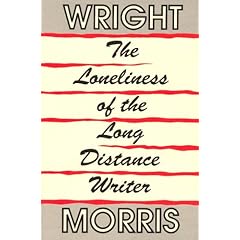
Wright Morris’s The Loneliness of the Long Distance Writer (2 novels) was reissued by Black Sparrow Press (before it was bought up by a mega-publisher). This exceptionally good writer is virtually unknown

The Works of Love, published in the '50s, is the terrifyingly sad story of Will Brady, a man with no connections, because of the geography that shapes him. Born on the empty plains of Nebraska in a dugout, Will grows up in the town of Indian Bow, where there is "a depot, a cattle loader, several square frame houses with clapboard privies; and later there were stores with pressed tin ceilings along the tracks." When he moves to the tiny town of Carbury (Will takes a train; trains and hotels are the connection in the novel for lonely ), working at the hotel seems the height of sophistication. But he wants and needs a wife. Where does he look for one? The town whorehouse, where he "connects" with the same woman every weekend. When he proposes, all the women laugh at him. A young prostitute with whom he has never had sex leaves her baby behind with his name on it: he raises the son as his own.

He is lonely and passive. He marries a rich woman who initiates the marriage but who is terrified of sex. Is this marriage normal? He doesn't know. Later he marries a young woman who is closer to his son's age than him: they hang out in the front room all day while he works.

Obviously influenced by Willa Cather, Morris is a good writer, yet there is something sentimental about his attempts at humor. His lonely protagonist has a bleak life, yet Morris tries sometimes to instill hope that isn’t there. But sometimes he gets it just right.

Though Morris won the National Book Award twice, one must look to small presses for his books: Bison Books publishes Plains Song (a Natl book award winner), a moving saga of three generations of Nebraska women; The Home Place, and Ceremony in Lone Tree. The University of Nebraska Press publishes Field Vision and The Works of Love.

Wright was also a photographer and a few of his books of photograpy are avialable (most out of print). Here is one of his quintessential Nebraskan photos:

Monday, November 17, 2008

Lost in Sandwich, or How to Take a Women's Road Trip

On a hot blue-skied day in Sandwich, I get lost.

Okay, not everybody could do this. I have three maps, dotted with “You are here” signs and decorated with arrows.

Well, I warned everybody: “I’m not very good at map-reading.” But I said goodbye to Mindy and Jan and walked briskly down the private drive from the condo.

It started with a wrong turn. It is my first day in Cape Cod. I turn instinctively toward the downtown area. The only problem is it’s not a left-hand turn, as Jan advised when I asked for directions to the beach. So what? Didn’t she mention the First Church of Christ? Yeah, It’s historic. Something like that. So why consult a map?

Founded in 1639, Sandwich has a Ye Olde New England look that tourists “ooh” and “ah” over. As the first village on the 70-mile peninsula of Cape Cod, it is a natural place to get out and stretch one’s legs. Personally I cared more about its beautiful white sand beaches than its Colonial architecture. In the middle of the village I passed a glass museum, a doll museum, and....all wasted on me. I refused to do anything educational.

Finally, unable to find the beach and aware that I was walking in circles, I sat on a bench on the village green and just sipped from my water bottle. I thought, What am I doing in Sandwich? On my first girl trip since 1981, I was already lost..

What’s a "girl's" road trip? It’s a trip taken with women friends, without husbands or boyfriends. It’s driving down the road at 75 miles an hour, praying a cop doesn’t ticket you, popping your gum while you swap life stories. It’s stopping at countless rest stops without some guy interrupting, “Do you have to go again?”

Perhaps women's road trips are a twentieth century phenomenon. Over the centuries most road travel books have been written by men, judging from a quick glance at the Oxford Book of Travel. Road trip literature since the 1960s has included the ultimate road novel, Jack Kerouac’s On the Road , Tom Wolfe’sThe Electric Kool-Aid Acid Trip , an account of the Merry Pranksters’ rock-and-roll, acid-laden cross-country bus trip, and William Heat Moon’s Blue Highways, a back roads look at America. Then there are the road trip movies: “Easy Rider,” “Get on the Bus,”“Harry and Tonto,” and “Stranger than Paradise.” And who was television’s premier chronicler of back roads? Charles Kurault.

When women in literature hit the road, they’re often on the lam or running away from husbands: there’s the mother/daughter road trip in Mona Simpson’s novel Anywhere But Here , and the cross-country adventures of Taylor Greer in Barbara Kingsolver’s best-selling The Bean Trees.. In movies we’ve seen the offbeat travels of women characters in “Manny and Lo,” “Thelma and Louise,” ”Boys on the Side,” “Trip to Bountiful,”and “Leaving Normal.”

An old woman in a church dress walked past. “Well, you found a nice shady spot.”

I smiled. “It is nice here, isn’t it? But could you tell me how to get to the beach?”

I had, of course, gone the wrong way entirely. I was all turned around. I had no clue what direction to go in. “Which beach? Oh, near Horizon House? Left, left, right, right, right,” she said. “That’s the easiest way, I think.”

So I started up the street around a left curve until I hit an intersection. And lo and behold, I was finally on the right road, Tupper Road, the road I started on, for God’s sake, the road I was supposed to turn left on instead of right. And I was approaching the intersection of Route 6A when Mindy pulled up in front of me in her Tracker.

“Want a ride?” she said.

“Please. “ And I climbed in, grateful to escape the heat .

So we went to the Bee Hive, a pub with a mural in the foyer and beehives hanging above the bar, and ate respectively a Greek salad (me) and clam chowder (Mindy). Then we went shopping. It was only hours later, when the sun was starting to set, that I realized, We never made it to the beach.

Not much of an adventure, you say? I think that’s the whole point.

In the evenings, we went in search of night life. We went to Hyannis! Oh, land of the Kennedys. Described by Jan’s husband as “tourist ticky-tacky,” it appeared to be a town of strip malls and tourists.

A used bookstore employee directed us to a coffee house called Prodigal Son. I cannot pretend that the ambiance was charming. It was a dingy hole-in-the-wall coffee bar, smelling of smoke and sweat. Mindy and I squeezed our bodies onto a faded burgundy couch in the back, banged down our decaf (Mindy) and latte (me) on a coffee table, and awkwardly opened books and laptop.

Then a guy stood up on a makeshift stage area in the front and announced that it was Poetry Slam night.

“It’s the Boston slam team vs. Hyannis,” announced the emcee. “And what’s our prize?” he asked as an afterthought

A ponytailed guy working the sound system quipped, “A date with me?”

Everybody groaned.

I typed notes about the slam on my laptop, though it was so dark I could only see by the light of the blue screen. A man with round glasses approached, nodded, and said, “Cool laptop.”

“Yeah.” I wondered, Hasn’t he ever seen a laptop?

Then Patricia Smith from Boston got up. I grabbed Mindy’s arm like a groupie.

“I can’t believe it. We get to see a famous slam poet. She’s a past winner of the National Poetry Slam,” I said.

Smith, a slim African-American woman, was younger than I expected. Funny, I felt about thirty on this vacation, but Patricia Smith probably is thirty, while I’m a forty-one-year-old pretender.

“Did I tell you that I’m the architect of rock and roll...Now I’ve never been sexy...But if I do say so myself..I do still turn some eyes,” she recited.

Oh yeah. I hear ya! I felt the same way, especially tonight. I typed frantic notes, and suddenly looked up to see one of the ponytailed guys turned around on his bar stool andsmiling.

What is this? Are these guys blind or desperate or what? By the time Mindy and I left, we were laughing.

“Hey, I really think we could have picked up some guys in there,” Mindy said.

“Oh, my husband would have loved that,” I said.

During the remainder of the girl trip I:

1. went to the beach, but did not go swimming.
2. went shopping in Provincetown, an artists’ colony on the tip.
3. read novels.
4. dyed my hair.
5. and did as little as possible.
And I returned from my girl trip refreshed and rested, horrifying my husband with my tales of DOING NOTHING on vacation.

RESOURCES FOR GIRL TRIPS (These may be old; I'll look them up)

Journeywoman,an online travel magazine for women:
http://www.journeywoman.com

The Women’s Travel Club, itineraries designed for married and single women who like to travel:
http://www.womenstravelclub.com/

women’s adventure travels, adventure travel service for women over 30:
http://www.adventurewomen.com/

Tuesday, November 11, 2008

Phillip Hensher


Books: I am reading Philip Hensher’s The Northern Clemency, finally released in the United States this month. This book in a way strikes me as the quintessential American novel (only English), similar to Jonathan Franzen’s The Corrections, the epic which failed as an Oprah book after Franzen made the mistake of saying on the radio something about not having written for Oprah fans. The Corrections (which I threw up on during an illness and then had to buy another copy of) focuses on two siblings from Kansas City, the brother a professor who is sued and fired after having an affair with a student (the girl calls her parents from a motel), and the sister a cook who, having escaped the midwest, turns lesbian. Hensher’s epic is a slower narrative and covers a much broader canvas, including minutiae about multiple characters from Sheffield, and focuses on two generations of families, straight, dull fathers, often discontented mothers, occasional drug dealers laundering money, and untraditional children who grow up to escape to London. (I’m only halfway through.) Both Franzen and Hensher shock with masturbation scenes: Franzen’s character masturbates on a couch (or perhaps it’s a leather jacket, I can’t remember), and one of Hensher’s characters actually DIES from masturbation. Please, no.

Hensher’s writing is lively and acerbic, his characters are realistic, and somehow we trust his analysis of the culture of the '70s and '80s: he has obviously observed and absorbed, understood and organized the confusing, jumbled elements of ordinary life. When the neurotic Katharine wants to have an affair, we understand why: her husband lives for re-creation's of the Civil War and gardening, while she dreams on a large scale and ends up outdoing him by working in a florist’s shop and even having sex with the florist (once).

It's a sociological novel: "All happy families are alike..,etc."

Sunday, November 09, 2008

E. Nesbit


At night, you want to read something that will put you to sleep. There is a pile next to my bed: Georgette Heyer, Poldark, and E. Nesbit. E. Nesbit has become a favorite lately, because after half a chapter of Story of the Treasure Seekers, the Wood-Be-Goods, or The New Treasure Seekers, I fall asleep. ZZZZZZZ. As a child, I loved her books. Every birthday I received her books in plain red editions, published, I believe in Great Britain, which were always on the same shelf of the bookstore, which my parents became very familiar with. My favorite was The Enchanted Castle , but I also loved The Phoenix and the Carpet ,The House of Arden, The Magic world, and other” magic adventures.” All had the original H. R. Millar illustrations.

Gore Vidal read and admired them. In the ‘60s, he wrote an essay n which he attacked the American teachers and librarians who,, according to Vidal, rejected turn-of-the-century fantasy classics by Nesbit and pushed badly-written realistic novels on children. He lamented the slow development of children’s imaginations, and gave many examples of Nesbit's influence on C. S. Lewis (and, my God, was she better. Those ghastly Narnia books!) As a matter of fact , he may have overstated the case. because many public libraries carried Nesbit (under her maiden name, Edith Bland, and perhaps he didn't look there) and certainly my parents good-humoredly purchased every one of them over a period of years.

So it has been a while since I read them. I read half of The Enchanted Castle a year ago, and though I remembered loving it, I eventually abandoned it. Perhaps it's less entertaining when you’ve read it 20 times. (It was the Harry Potter of its day. Only in those days they didn't need midnight book parties to read) Recently I began rereading the Story of the Treasure Seekers, one of my least favorites as a child. But The Story of the Treasure Seekers--one of the Bastable books-- is more readable because it is more realistic: the Bastable children wish to estore the family fortunes, only nothing quite works out: when they dig the hole for treasure the earth collapses when the sniveling Albert-Next-Door digs. Etc. Etc.

Nesbit was a socialist and feminist and a “free thinker” who had to write to support her family and found she could easily crank out children’s books. She had tried all kinds of writing, and though she didn’t particularly like children, she remembered exactly what it was to be a child. In fact, Vidal also loves her autobiography (which I have not been able to find).

.

Sunday, November 02, 2008

Everyman: Gogol's Tales


Who could not fall in love with the touching epigraph : “Everyman, I will go with thee and be thy guide, in the most need to go by thy side”? A good library SHOULD be a guide, and Everyman retains this idealistic principle. The new editions have jazzed-up covers, presumably to sell books to an over-stimulated generation (though I like the covers very much and admit that I bought this new edition of Gogol’s The Collected Tales partly because of the new translation but also partly because of the art , a reproduction of The Peasant). Founded in England in 1906 and relaunched in the U.S. in 1991, Everyman Books resembles Penguins and Oxford Classics in their lluminating introductions and notes.

This is a superb edition, translated by the award-winning Richard Pevear and Larissa Volokhonsky. Divided into "The Ukrainian Tales" and "The Petersburg Tales, " Gogol's voice is rollicking, irrespressible, and merry (one would like to meet Gogol at a party). The earlier Ukrainian Tales often adopt the voice of a flippant narrator who claims he cannot remember the tale or cannot even remember who has told the tale or, when he finds, that person, then HE cannot remember the tale, either. There is often a fairy-tale quality to these early tales: demons "call" souls of innocent daughters, old women turn into witches, warrior ghosts appear, friends feud almost to the death (the feud has the quality of a folk tale). These earlier stories, good in their own right, pave the way to his equally witty, more sophisticated later work.

One of the best stories in the Petersburg Tales is “The Portrait,”which begins in medias res when an artist acquires an unlucky painting. The painting falls into many hands: all are driven to crime or suicide. The tale leaps and bounds and finally combines both past and future.

Of course the best stories are also included: "The Nose," "Diary of a Madman," and "The Overcoat." In "The Nose," a man wakes up without a nose: then he meets his own nose riding in a coach around Petersburg. “He did not know what to think of such a strange incident. How was it possible, indeed, that the nose which just yesterday was on his face, unable to drive or walk--should be in a uniform!” In “Diary of a Madman” and "The Overcoat," civil servants are maddened by poverty and lack of status: in "Diary of a Madman," a schizophrenic expresses grandiose dreams of royalty; in t"The Overcoat," another civil servant attempts desperately to acquire a new overcoat.

Tuesday, October 28, 2008

Tess of the D'Urbervilles


My Mrs. Tim fandom does not preclude my reareading the gloomy Tess of the D'urbervilles. I am now on my fourth copy of Tess because I have given away three: two to charity sales and one to a friend who recommended it to her daughters, only to be informed they only read Harry Potter and Gossip Girls.

It is autumn; the first freeze has occurred; we ate the last of our green tomatoes (hard as rocks) in an onion sauce which usually softens them nicely. One cannot read Tess in the summer. Now the garden is gone; our freezer is full of bags of beans, peppers, and tomatoes. Often I turn to gloomy books this time of year.

Tess, though far from my favorite Hardy, shows Hardy at the height of his powers. His solemn style is effortlessly elegant, his descriptions of nature (the heath particularly) create or reflect moods, his outlook, though pessimistic, is leavened by occasional flashes of humor, and the structures architecturally symmetrical, resembling figures of speech, which fly, loop, rearrange themselves, and then fall to fate, and reflect Hardy’s training as an architect and classical reader.

Hardy sets up Tess's story as follows: A beautiful, intelligent girl, Tess is educated to be a schoolmistress, but the death of a horse when she falls asleep in a cart on the way to market stymies her ambition. (The death of the horse is needlessly graphic: pierced by a mail cart in the dark and buried by the family. Tess only drove the horse because her father was too drunk.) Believing she is responsible for her family's poverty, Tess goes to work on a farm for a branch of the D’urbervilles, to which her family apparently belonged at one time. (Durbeyfield is a corruption of D'urberville.)

Mrs. D'urberville is blind; Alec, the moustache-twirling son, seduces Tess. Pregnant, Tess goes home.

Hardy can be heavy-handed (particularly in his last two novels, Tess and Jude the Obscure, which shocked his readers).

Iinsecure about his working-class roots, he sometimes burdens his prose with odd references to Thomas Malthus, Praxitelean creation, and "Thermidorean." His dialect, however, is perfect: one of the best features of his books.

Pregnancy out of wedlock ("getting into trouble") was unacceptable even twenty years ago. In the 2000s we hardly bat an eye at it. (Sarah Palin's teenager is pregnant.) But the question was problematic to a Victorian audience: unmarried women with children were routinely ostracized or declassed. Elizabeth Gaskell, in her didactic novel, Ruth, a predecessor of Tess, defended such women. Hardy treats the same problem of the ostracization of unmarried pregnant women. Although sympathetic fellow writers, Mrs. Humphrey Ward, Edmund Gosse, and Walter Besant, considered Tess a masterpiece, Tess was trashed in the Saturday Review and The Spectator as “immoral.” (One critic concocted the witticism, “Tessamism.”) Hardy, always too sensitive to reviews, was prevented from confrontng the reviewers when friends told him it was undignified; finally he was buoyed by the realization that condemnations of Tess's “sensuality” and "immorality" boosted sales.Yet in the preface to the fifth edition Hardy could not resist the opportunity to rebut reviewers (which goes on for two pages).

Hardy stopped writing novels after Tess and Jude the Obscure. A pity.

Friday, October 24, 2008

D. E. Stevenson and Mrs. Tim


D. E. Stevenson wrote her Mrs. Tim Christie books, a quartet of interwar novels written in the form of witty diary entries , after a friend read her amusing diary and suggested she “pep it up” and publish it as a novel. The four resulting novels, Mrs. Tim Christie (originally Mrs. Tim of the Regiment), Mrs. Tim Carries On, Mrs. Tim Gets a Job, and Mrs. Tim Flies Home, resemble E. M. Delafield’s Provincial Lady series, though Stevenson's are less telegraphic (and Dodie Smith's I Capture the Castle is possibly influenced by both). The diary genre was popular in the ‘30s and ‘40s, and perhaps the short entries made the domestic comedy seem more appealing and realistic because they fit the staccato routines of daily life.

Mrs. Tim, though a British officer’s wife, is not in the least military: rather, she is a tactful, often secretly mirthful, popular figure among the soldiers and their wives: her husband, Tim, has a dry sense of humor, though, like all husbands, he is obtuse about fashion and wonders why she can't keep wearing the same dress; their Tom-Sawyer-like son is away at a prep school; and their rambunctious daughter asks embarrassing questions when the meddling colonel's wife drops in to tea.

The entries, subtly hilarious, consist of a vivid, first-person narrative (if only we could all write diaries like this!). For instance on April 12 in Mrs. Tim Christie (published in the 1930s):

“Sit down after dinner feeling very tired. Tim points out that I have done nothing all day to make me tired (which is true, in a way). He continues that I have no business to be tired. I have not got a crowd of half-boiled soldiers to plague my life out from morning to night. Am surprised at this statement (as Tim has been very keen on his territorilals up to now), but conclude that something must have occurred to upset him, and resign myslef to listen and sympathize instead of starting Sheila Kaye Smith’s latest novel, which I have just procured with vast trouble from the librfary.”

Compare this to an entry of Diary of a Provincial Lady Dec. 9 (published in 1931, a bit earlier than the Mrs. Tim books:

“Rose staying here two days before going on to London. Says All American houses are Always Warm, which annoys Robert. He says in return that All American houses are Grossly Overheated and Entirely Airless. Impossible not to feel taht this would carry more weight if Robert had ever been to America."

Stevenson and Delafield write gentle satires of family life, but I prefer D. E. Stevensons more expansive (and less snobbish) entries.

The Christie family adjusts to frequent moves, and much of the book is set in Scotland. Mrs. Tim and the Provincial Lady both have to cope with the servant problem, which few of us have had to contend with these days, but the British in novels have difficulties with governesses, cooks, etc. (And of course Monica Dickens, in One Pair of Hands, quits her cook job, because the employers are so unreasonable, so that's another way of looking at it) .

These are great winter books. Very addictive.